Library Books – December 2023

These are the books I have on loan from my local library:
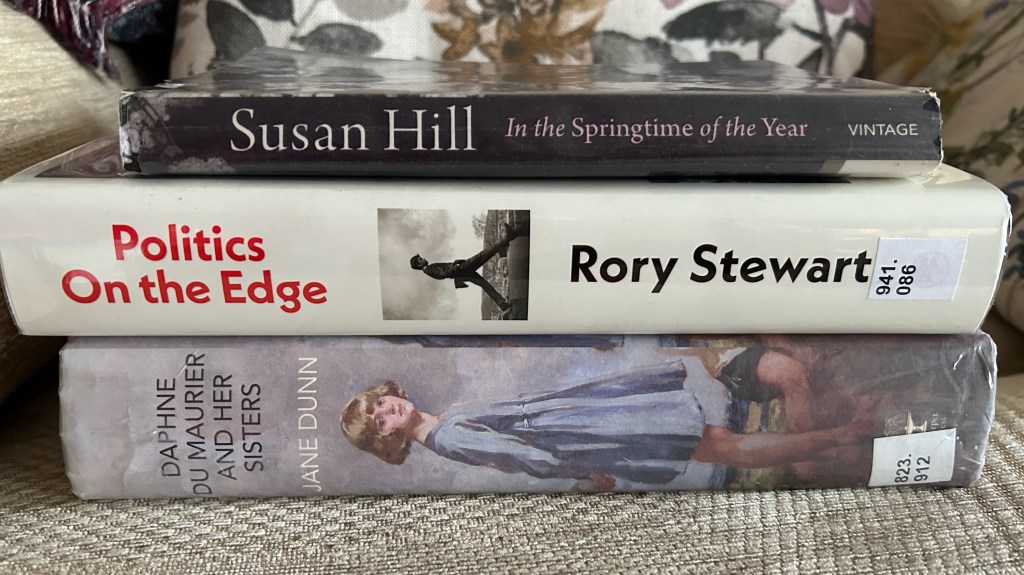
Daphne Du Maurier and her sisters : the hidden lives of Piffy, Bird and Bing by Jane Dunn.The Du Mauriers – three beautiful, successful and rebellious sisters, whose lives were bound in a family drama that inspired Angela and Daphne’s best novels. Much has been written about Daphne but here the hidden lives of the sisters are revealed in a riveting group biography. The sisters are considered side by side, as they were in life, three sisters who grew up during the 20th century in the glamorous hothouse of a theatrical family dominated by a charismatic and powerful father. This family dynamic reveals the hidden lives of Piffy, Bird & Bing, full of social non-conformity, love, rivalry and compulsive make-believe, their lives as psychologically complex as a Daphne du Maurier novel.

Politics on the edge : a memoir from within by Rory Stewart. Over the course of a decade from 2010, Rory Stewart went from being a political outsider to standing for prime minister – before being sacked from a Conservative Party that he had come to barely recognise. Tackling ministerial briefs on flood response and prison violence, engaging with conflict and poverty abroad as a foreign minister, and Brexit as a Cabinet minister, Stewart learned first-hand how profoundly hollow and inadequate our democracy and government had become. Cronyism, ignorance and sheer incompetence ran rampant. Around him, individual politicians laid the foundations for the political and economic chaos of today. Stewart emerged battered but with a profound affection for his constituency of Penrith and the Border, and a deep direct insight into the era of populism and global conflict. This book invites us into the mind of one of the most interesting actors on the British political stage.

In the Springtime of the Year by Susan Hill. After just a year of close, loving marriage, Ruth has been widowed. Her beloved husband, Ben, has been killed in a tragic accident and Ruth is left suddenly and totally bereft. Unable to share her sorrow and grief with Ben’s family, who are dealing with their pain in their own way, Ruth becomes increasingly isolated, hiding herself in her cottage in the countryside as the seasons change around her. Only Ben’s young brother is able to reach out beyond his own grief to offer Ruth the compassion which might reclaim her from her own devastating unhappiness.

I’d love to know if you’ve read any of these books and if so what did you think? If you haven’t, do any of them tempt you?
Books from the Mobile Library: June 2021

On Tuesday I borrowed three books from the mobile library, all by authors whose books I’ve read and enjoyed. I often can’t decide which books to borrow, but this week I picked these books off the shelves straight away and knew I wanted to read them:

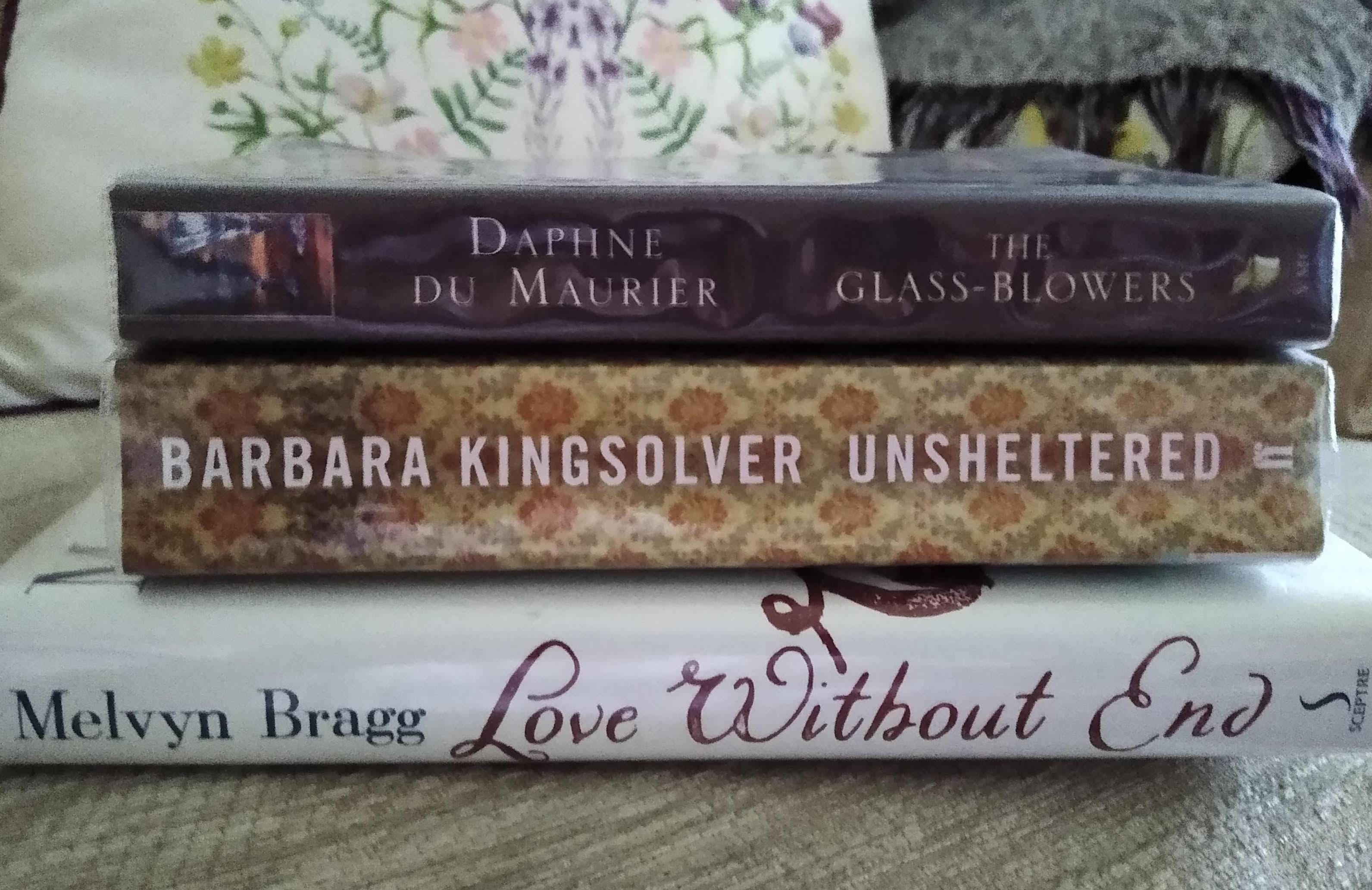
The Glass-Blowers by Daphne du Maurier, one of my favourite authors. The first book of Daphne du Maurier’s that I read was my mother’s copy of Rebecca, which I first read as a young teenager and I loved it. Since then I’ve read most of her books, but there are a few that I haven’t read including this one. It’s a fictionalised reworking of her own family history. She was a descendant of a French master craftsman who settled in England during the French Revolution.

Unsheltered by Barbara Kingsolver, who has been one of my favourite authors ever since I read The Poisonwood Bible. It’s a long book of over 500 pages, so I’m hoping I’ll be able to renew it as I doubt I’ll managed to read it by 13 July. Set in Vineland, New Jersey, this is a dual timeline novel, about two families living in the same house – one in the present century and the other in the nineteenth. Just reading the first two sentences made me to know more – ‘The simplest thing would be to tear it down,’ the man said. ‘The house is a shambles.’

Love Without End: A Story of Heloise and Abelard by Melvynn Bragg. It was reading his Soldier’s Return trilogy that first made me want to read more of his books. This is another novel with a dual timeline. It’s set in Paris in 1117 about the love affair of Heloise and Peter Abelard and nine centuries later about Arthur as he writes a novel about the couple, aiming to bring Heloise out of history’s shadows. I’ve never read the medieval story of Abelard and Heloise, so this will all be new to me.

Have you read any of these books? Are you tempted?

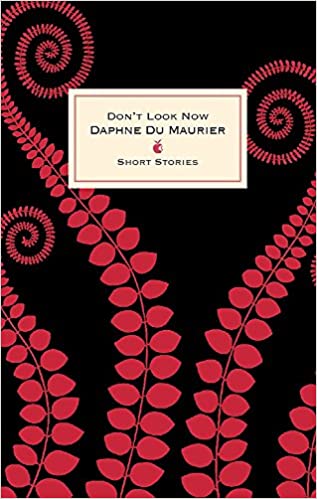
Don’t Look Now and other Short Stories by Daphne du Maurier

I love Du Maurier’s books and her short stories are much better than others I’ve read. My copy of Don’t Look Now and Other Short Stories by Daphne du Maurier is a Virago Modern Classic. The other short stories in this collection are Not After Midnight, A Border-Line Case, The Way of the Cross and The Breakthrough, making this a collection of stories of suspense, mystery and slow, creeping horror.

I read the first story Don’t Look Now (52 pages) a few years ago. It’s a supernatural tale about a couple, John and Laura who have come to Venice to recover after their young daughter’s death. They encounter two old women who claim to have second sight and find themselves caught up in a train of increasingly strange and violent events, involving hallucinations, mistaken identity and a murderer.

I read the other four stories this month. They explore deep fears and longings, secrets and desires. In Not After Midnight (48 pages) a lonely teacher, Timothy Grey, investigates a mysterious American couple, the Stolls, whilst on holiday on the Greek island of Crete. The couple invite him to visit their chalet, with the warning ‘not before midnight’. What he discovers involves a jar or rhyton, shaped into the form of a head resembling Stoll, with dancing satyrs. The story gradually became more and more ambiguous and mysterious – I wondered just what was real and what was imaginary.

In A Border-Line Case (65 pages) a young woman confronts her father’s past after he died. She wants to know more about his early life. He was ex-British Army and she goes to Ireland to search for the man who used to be his friend. When she finds him, she falls in love with him and then discovers something that shocks her completely. This is very intense story.

In The Way of the Cross ( 67 pages) there’s a party of pilgrims who meet disaster in Jerusalem. This is a strange story about seven people from a cruise ship as they follow the Via Dolorosa and each experience their own humiliation, each one meeting the fate they most dread.

The Breakthrough (43 pages) is the oddest and most menacing story of this collection. It is set on the windswept coast of rural Suffolk in an isolated laboratory. It’s about a scientist, experimenting with the idea that when people die there is an untapped source of energy, as their ‘soul’, for want of a better word, leaves their body. He attempts to harness the power of the mind to the most chilling effect, by releasing this energy from a young man, dying of leukaemia, into the mind of a child of ‘sub-standard intelligence’.

I enjoyed these stories – or are they novellas? The longer length means these stories have more depth, characterisation and substance than the shorter stories. I find them more satisfying – and the ambiguity and supernatural elements in these makes them especially thought-provoking. Some are better than others and the one I enjoyed the most is Not After Midnight.

First Chapter First Paragraph: Don’t Look Now by Daphne du Maurier

Every Tuesday First Chapter, First Paragraph/Intros is hosted by Vicky of I’d Rather Be at the Beach sharing the first paragraph or two of a book she’s reading or plans to read soon.

This week’s book is Don’t Look Now: Short Stories by Daphne du Maurier, a book I’m about to start reading.

Don't Look Now and Other Stories

‘Don’t look now,’ John said to his wife, ‘but there are a couple of old girls two tables away who are trying to hypnotise me.’

Laura, quick on cue, made an elaborate pretence of yawning, then tilted her head as though searching the skies for a non-existent aeroplane.

‘Right behind you,’ he added. ‘That’s why you can’t turn round at once – it would be much too obvious.’

Blurb (Amazon):

John and Laura have come to Venice to try and escape the pain of their young daughter’s death. But when they encounter two old women who claim to have second sight, they find that instead of laying their ghosts to rest they become caught up in a train of increasingly strange and violent events.

The four other haunting, evocative stories in this volume also explore deep fears and longings, secrets and desires: a lonely teacher who investigates a mysterious American couple, a young woman confronting her father’s past, a party of pilgrims who meet disaster in Jerusalem and a scientist who harnesses the power of the mind to chilling effect.

~~~

After I’ve read it I shall watch the film – Julie Christie and Donald Sutherland play the parts of Laura and John in the 1973 film.

Don't Look Now  (Digitally Restored) [DVD] [1973]

I wonder how well it follows the original story? And will it infuriate me if it doesn’t? I hope not.

Favourite Books: August 2007 – 2010

I’ve been really enjoying looking back at some of my favourite books and this month I’m  looking back at some I read in August in each of the years 2007 ‘“ 2010. Click on the titles to see my original reviews.

Looking back at these books makes me want to re-read each one. I was enthralled by them all:

2007

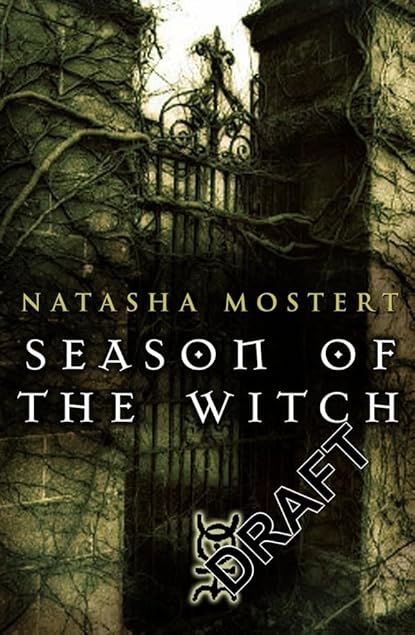
There is so much I loved in Season of the Witch by Natasha Mostert, a thrilling, spine tingling story of mystery, mysticism and magic, abounding with symbolism. It’s a modern day gothic epic, mixing computer technology with witchcraft, alchemy and the power of the human mind, in the search for enlightenment.

I raced through the book with that nervous tension anticipating danger that you feel watching a horror film build up, leaving me breathless as I read.

Gabriel Blackstone is a computer hacker by trade, and by inclination he is a remote viewer; someone whose unique gifts enable him to ‘˜slam rides’ through the thought processes of others. He is contacted by an ex-lover who begs him to use his gift to find Ronnie, her stepson, last seen months earlier in the company of two sisters, Minnaloushe and Morrighan Monk (wonderful names). The beautiful and mysterious sisters are descendants of Dr John Dee, a mathematical genius, alchemist and secret adviser to Queen Elizabeth I. Both of them bewitch Gabriel as he seeks to unravel the mystery behind Robbie’s disappearance.

2008

August 2008 found me reading a completely different genre – Pompeii by Robert Harris is historical fiction. The story begins in August AD 79 just two days before the eruption of Mount Vesuvius and builds up to a climax. Whilst most people are blissfully unaware of what is about to be unleashed upon them one man ‘“ the engineer Marius Attilius Primus realises the danger when the aqueduct Aqua Augusta fails to supply water to the people in the nine towns around the Bay of Naples. Then Vesuvius erupts destroying the town of Pompeii and killing its inhabitants as they tried to flee the pumice, ash and searing heat and flames.

The book brought history to life and I could feel the danger and fear as Vesuvius inevitably destroyed Pompeii. I particularly liked mixture of fictional and historical characters and the inclusion of Pliny, then the Admiral of the Fleet, as he watched and recorded the progress of the eruption and the account of his death.

2009

In August 2009 I read The Rebecca Notebook and Other Memories which gives a glimpse into the mind of Daphne Du Maurier. Rebecca has long been one of my favourite books, so I was fascinated to read the notes she made as she was writing the book. She began to write Rebecca in 1937 when she was thirty years old, living in Alexandria and feeling homesick for Cornwall. She jotted down chapter summaries in a notebook, setting the book in the mid 1920s ‘˜about a young wife and her slightly older husband, living in a beautiful house that had been in his family for generations.’

As she thought about it ideas sprang to her mind ‘“ a first wife ‘“ jealousy, something terrible would happen ‘“ a wreck at sea. She became immersed in the story, losing herself in the plot, as so many of us have done ever since.

I enjoyed the other short pieces in this book ‘“ her ‘˜memories’ of her family and her own life and beliefs. Some are about her family, some about her childhood and some about the house she loved, Menabilly.

2010

Finally in August 2010 I read Thirteen Hours by Deon Meyer, one of the best books I read that year. I was engrossed in it right from the start. It’s tense, taut and utterly enthralling. Moving at a fast pace the book follows the events during the thirteen hours from 05:36 when Rachel, a young American girl is running for her life up the steep slope of Lion’s Head in Capetown.

The body of another American girl is found outside the Lutheran church in Long Street and an hour or so later Alexandra Barnard, a former singing star and an alcoholic, wakes from a drunken stupor to find the dead body of her husband, a record producer, lying on the floor opposite her and his pistol lying next to her.

Meyer is a fantastic story teller and creates such wonderful characters. DI Benny Griessel is mentoring two inexperienced detectives who are investigating these crimes. I grew very fond of Benny, who is also an alcoholic and struggling to keep his marriage together.  The book also reflects the racial tension in the ‘˜new South Africa’ with its mix of white, coloured and black South Africans. There is a strong sense of location, not just from the cultural aspect but also geographical.

The Rendezvous and Other Stories by Daphne du Maurier

When I finished reading The Rendezvous and Other Stories I had absolutely no hesitation in giving it 5 stars – I loved it. This is most unusual for me as generally I’m not too keen on short stories because they often leave me feeling dissatisfied, thinking they are lacking in substance or characterisation. Not so with this book, even though some of the endings were predictable and some of the stories are very short I think they all worked well!

Daphne du Maurier wrote some of these stories before she wrote her first novel (The Loving Spirit, 1931), when she under 23, and the rest between 1937 and 1947, when she was a well established writer. The earlier stories are shorter than the later ones as they were written for magazines

There are 14 stories:

  • No Motive ~ this begins with the suicide of an apparently happy woman expecting her first child. Her husband desperate to discover what could have caused her to take her own life and that of their unborn child employs a private detective to investigate. What he discovers is just so sad and tragic.
  • Panic ~ This is one of the shorter stories about a casual love affair that ends in death and the panic that ensued.
  • The Supreme Artist ~ Another shorter story of an aging actor trying to fight off the years.
  • Adieu Sagesse ~ I loved this one about a hen-pecked husband who plans to escape his tedious life and have an adventure.
  • Fairy Tale ~ A gambler and his long-suffering wife face destitution – unless he wins the lottery!
  • The Rendezvous ~ Now this story really caught my imagination. It’s the story of an ageing writer, who meets a fan of his books whilst on a trip to Switzerland to lecture about his work. As in some of Du Maurier’s books this is about an unequal relationship and the exploitation of one of the partners. It is vividly written, the sense of disappointment, the misunderstandings and subsequent let down is brilliant.
  • La Sainte-Vierge ~ A very short and predictable story about a naive young wife.
  • Leading Lady ~ a beautiful actress manipulates the men around her.
  • Escort ~ Another of the really good stories, full of atmosphere set in set in World War II on board a merchant ship as it sails across the North Sea. Just what is the ship that offers to escort it as a submarine threatens  – and who is its captain?
  • The Lover ~ More sexual manipulation, this time by a young man.
  • The Closing Door ~ A young man is told of his terminal illness and the devastating effect it will have on his life.
  • Indiscretion ~ An amusing tale of what happens when you say something without knowing the consequences – a bit signalled but still enjoyable.
  • Angels and Archangels ~ A bitter and cynical look at religion and hypocrisy.
  • Split Second ~ A brilliant story to finish the book – about a woman who leaves her highly organised house for a walk and finds everything has changed when she returns.

This is one of a set of Du Maurier’s books that I bought at least seven years ago. It was well worth the wait! I still have one more of the set to read – I’ll Never Be Young Again, her second novel.  And there are more that I don’t own to enjoy in the future too.