The Classics Club Spin Result

The spin number in The Classics Club Spin is number …

3

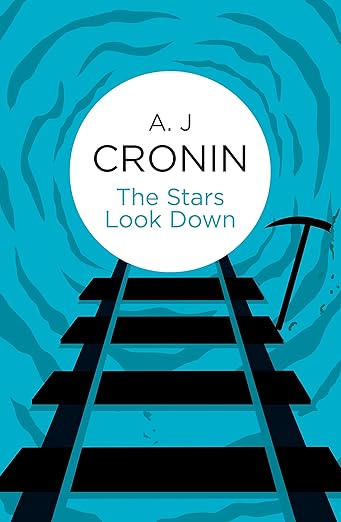
which for me is The Stars Look Down by A J Cronin. The rules of the Spin are that this is the book for me to read by 18th December, 2024. I added The Stars Look Down by A J Cronin because I enjoyed The Citadel many years ago. So, I’m looking forward to reading it but I hadn’t realised that it is 712 pages long!

Synopsis from Amazon

The Stars Look Down was A.J. Cronin’s fourth novel, published in 1935, and this tale of a North country mining family was a great favourite with his readers.

Robert Fenwick is a miner, and so are his three sons. His wife is proud that all her four men go down the mines. But David, the youngest, is determined that somehow he will educate himself and work to ameliorate the lives of his comrades who ruin their health to dig the nation’s coal. It is, perhaps, a typical tale of the era in which it was written – there were many novels about coal mining, but Cronin, a doctor turned author, had a gift for storytelling, and in his time wrote several very popular and successful novels

In the magnificent narrative tradition of The CitadelHatter’s Castle and Cronin’s other novels, The Stars Look Down is deservedly remembered as a classic of its age.

Did you take part in the Classics Spin? What will you be reading?

Classics Club Spin

It’s time for another Classics Club Spin.

Before next Sunday, 20 October 2024 create a post that lists twenty books of your choice that remain “to be read” on your Classics Club list. On that day the Classics Club will post a number from 1 through 20. The challenge is to read whatever book falls under that number on your Spin List by the 18th December, 2024.

Here’s my list:

  1. In Cold Blood by Truman Capote
  2. The Case of the Gilded Fly by Edmund Crispin
  3. The Stars Look Down by A J Cronin
  4. Bleak House by Charles Dickens
  5. Dombey and Son by Charles Dickens
  6. Nicholas Nickleby by Charles Dickens
  7. The Lost World by Arthur Conan Doyle
  8. Friends and Heroes by Olivia Manning
  9. The Birds and other short stories by Daphne du Maurier
  10. I’ll Never be Young Again by Daphne du Maurier
  11. North and South by Elizabeth Gaskell
  12. Brighton Rock by Graham Greene
  13. The Go Between by L P Hartley
  14. The Great Fire by Shirley Hazzard
  15. Brave New World by Aldous Huxley
  16. Daisy Miller by Henry James
  17. Go Set a Watchman by Harper Lee
  18. Friends and Heroes by Olivia Manning
  19. Down and Out in Paris and London by George Orwell
  20. Fire from Heaven by Mary Renault

I hope it’s one of the shorter books! Which one/s would you recommend?

The Classics Club Spin

Today is the day to finish reading the latest Classics Club Spin, which for me was How Green Was My Valley by Richard Llewellyn. I forgot about it until last week and so there wasn’t enough time for me to finish it by today. But I began reading it anyway. Sadly, I decided that it wasn’t a book for me. I just couldn’t get into it. Maybe I’ll try again some time.

The Classics Club Spin Result

The spin number in The Classics Club Spin is number …

17

which for me is How Green Was My Valley by Richard Llewellyn. The rules of the Spin are that this is the book for me to read by 22 September 2024.

Synopsis from Goodreads

A poignant coming-of-age novel set in a Welsh mining town, Richard Llewellyn’s How Green Was My Valley is a paean to a more innocent age, published in Penguin Modern Classics

Growing up in a mining community in rural South Wales, Huw Morgan is taught many harsh lessons – at the kitchen table, at Chapel and around the pit-head. Looking back on the hardships of his early life, where difficult days are faced with courage but the valleys swell with the sound of Welsh voices, it becomes clear that there is nowhere so green as the landscape of his own memory. An immediate bestseller on publication in 1939, How Green Was My Valley quickly became one of the best-loved novels of the twentieth century. Poetic and nostalgic, it is an elegy to a lost world.


This is good as How Green Was My Valley is also on my 20 Books of Summer list. I’m looking forward to reading it. It’s been on my To Be Read list for so long!

Did you take part in the Classics Spin? What will you be reading?

Classics Club Spin

It’s time for another Classics Club Spin.

Before next Sunday, 21July 2024 create a post that lists twenty books of your choice that remain “to be read” on your Classics Club list. On that day the Classics Club will post a number from 1 through 20. The challenge is to read whatever book falls under that number on your Spin List by 22nd September, 2024. March, 2024.

Here’s my list:

  1. Sense and Sensibility by Jane Austen
  2. In Cold Blood by Truman Capote
  3. The Case of the Gilded Fly by Edmund Crispin
  4. The Stars Look Down by A J Cronin
  5. Dombey and Son by Charles Dickens
  6. Nicholas Nickleby by Charles Dickens
  7. The Lost World by Arthur Conan Doyle
  8. The Birds and other short stories by Daphne du Maurier
  9. I’ll Never be Young Again by Daphne du Maurier
  10. North and South by Elizabeth Gaskell
  11. Brighton Rock by Graham Greene
  12. The Great Fire by Shirley Hazzard
  13. Strangers on a Train by Patricia Highsmith
  14. Brave New World by Aldous Huxley
  15. Daisy Miller by Henry James
  16. Go Set a Watchman by Harper Lee
  17. How Green Was My Valley by Richard Llewellyn
  18. Friends and Heroes by Olivia Manning
  19. Down and Out in Paris and London by George Orwell
  20. Fire from Heaven by Mary Renault

I hope it’s one of the shorter books! Which one/s would you recommend?

The Black Tulip by Alexandre Dumas

4*

The Black Tulip is historical fiction, a love story, mixing historical characters with fictional ones. It was first published in 1850. I loved The Count of Monte Cristo by Alexandre Dumas, so I was hoping to enjoy The Black Tulip too. I did, but not quite as much. I think it’s because I don’t know much about Dutch history and so I found the early chapters, about the brothers Cornelius and Johan de Witt, a bit difficult to follow. They were Dutch statesmen, accused of treason, who were brutally killed by a mob in the Hague in 1672, during a period of political upheaval, when they escaped from prison.

The story centres on Cornelius von Baerle, the fictional godson of Cornelius de Witt and his desire to grow a black tulip. He became involved in the de Witts’ affairs when Cornelius de Witt left a sealed parcel of his correspondence with the French war minister, with him for safekeeping. He didn’t open the parcel and didn’t know what it contained.

When the Tulip Society of Haarlem offered a prize of a hundred thousand guilders for the development of a tulip ‘without a spot of colour‘, this set the tulip growers into a frenzy of activity, including Van Baerle and his neighbour, Isaac Boxtel. Boxtel spied on Van Baerle’s experiments to grow a black tulip, which were having more success than his own efforts. Indeed Boxtel was obsessed with what Van Baerle was doing, neglecting his own tulips to wither and rot as he observed, through a telescope, what his neighbour was doing both in his garden and in his laboratory.

Whilst observing Van Baerle’s laboratory, Boxtel had seen the meeting between Cornelius de Witt and Van Baerle when he entrusted his papers to his godson. On hearing that the de Witt brothers had been arrested Boxtel realised he could inform against Van Baerle and get him arrested, thus giving himself the opportunity to steal the bulb Van Baerle had produced. And the hundred thousand guilder prize would be his.

And so Van Baerle was thrown into prison, wrongly convicted of treason and under sentence of death. However William of Orange, Stadtholder of Holland granted him his life but condemned him to imprisonment for life. He was sent to the fortress of Loewestein and there kept in solitary confinement. What follows is a dark and somewhat farcical tale, as aided by the jailer’s daughter Rosa he continues to cultivate his tulip bulbs. He and Rosa fall in love, despite all the difficulties that assault them.

It’s a great story, full of drama and emotion. It’s a love story, a story about passion, hatred, jealousy, obsession and injustice. After the difficulties I had with the first four or five chapters (I had to re-read them to work out how the rest of the story was connected) I found it difficult to put down, keen to find out what would happen next. I didn’t love it like I loved The Count of Monte Cristo, but I really liked it.