First Chapter First Paragraph Tuesday Intros

Every Tuesday Diane at Bibliophile By the Sea hosts First Chapter First Paragraph First chapterTuesday Intros, to share the first paragraph or (a few) of a book you are reading or thinking about reading soon.

The Cabinet Room, 10 Downing Street, London, 4.30pm, 9 May 1940

Churchill was last to arrive. He knocked once, sharply, and entered. Through the tall windows the warm spring day was fading, shadows lengthening on Horse Guards Parade. Margesson, the Conservative Chief Whip, sat with Prime Minister Chamberlain and Foreign Secretary Lord Halifax at the far end of the long, coffin-shaped table which dominated the Cabinet Room. As Churchill approached them Margesson, formally dressed as ever in immaculate black morning coat stood up.

‘Winston.’

Churchill nodded at the Chief Whip, looking him sternly in the eye. Margesson, who was Chamberlain’s creature, had made life difficult for him when he had stood out against party policy over India and Germany in the years before the war.He turned to Chamberlain and Halifax, the Prime Minister’s right-hand man in the government’s appeasement of Germany. ‘Neville. Edward.’ Both men looked back; no sign today of Chamberlain’s habitual half-sneer, nor of the snappy arrogance which had alienated the House of Commons during yesterday’s debate over the military defeat of Norway. Ninety Conservatives had voted with the Opposition or abstained; Chamberlain had left the chamber followed by shouts of ‘Go!’ The Prime Minister’s eyes were red from lack of sleep or perhaps even tears – though it was hard to image Neville Chamberlain weeping. Last night the word around a feverish House of Commons was that his leadership would not survive.
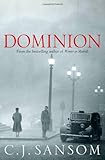
This is the opening of Dominion by C J Sansom, a novel about what might have happened, an alternative history, if Germany had been triumphant in the Second World War. All events that take place in this book after 5 p.m. on 9 May 1940 are imaginary.

I’ve read and enjoyed Sansom’s earlier books, the five Matthew Shardlake historical mysteries and Winter in Madrid, historical fiction set in Spain in 1940, but I wasn’t sure I wanted to read Dominion, his latest book, described on the book jacket as ‘a vivid, haunting re-imagining of 1950s Britain’ and ‘a gripping, humane spy thriller and a poignant love story.’

I like the opening paragraphs I’m still not sure because ‘re-imaginings’ don’t exactly appeal to me. I prefer historical fiction to be historical and fiction to be fiction, not  an alternative version of history. But when I saw a copy on the library shelves I was tempted to at least look at it and brought it home to see if it’s any good. After all it’s written by C J Sansom, so it can’t be bad, can it?

Crime Fiction on a Euro Pass

A new challenge: Crime Fiction on a Euro Pass

Kerrie at Mysteries in Paradise is hosting a new challenge taking us on a 12 stage European Journey in Eurail Pass style. As our travel agent she has chosen 12 destinations for our journey. It began last Monday with with a stop in England. Click HERE for additional details.

The challenge is simple really.

You have to connect us to a blog post on your site that relates to crime fiction in the country we are visiting. The meme will enable us to share our knowledge and perhaps point out new reading opportunities to each other.

You can choose one of the following (or something more imaginative)

  • a book review (create a new one or revive an old one)
  • an author profile
  • a reading syllabus for crime fiction either set in this country, or written by authors from this country.

I don’t think I’ll be taking part every week, but for this week I’m in Spain, featuring C J Sansom’s Winter in Madrid, which I thought was one of the best books I’ve read. I wrote about on this blog back in January 2008, describing it as a book that had me in tears as I was reading about the devastation, desolation and waste of war. I little thought that a few years later we would be witnessing the devastation that has been happening here in England with the terrible riots that have been taking place this week.

Back to the book. I already knew from reading his 16th century crime thrillers that C. J. Sansom is a master storyteller and this book exceeded my expectations. It is an action packed thrilling war/spy story and also a moving love story and historical drama all rolled into this tense and gripping novel.

Sansom vividly conveys the horror and fear of the realities of life in Spain during the Spanish Civil War and the first two years of the Second World War. The opening chapter dramatically sets the tone for the book with the brutality of the Battle of Jarama in 1937 then leaps straight into the bombing of London in 1940. Then Harry Brett, traumatised by his injuries at Dunkirk is sent to Spain to spy for the British Secret Service. He is plunged into the terrible living conditions in Madrid where people are starving, children are left homeless to fend for themselves and wild dogs roam the rubble of bombed houses.

He turned into a square. Two sides had been shelled into rubble, all the houses down, a chaos of broken walls rising from a sea of shattered bricks and sodden rags of bedding. Weeds had grown up between the stones, tall scabrous dark-green things. Square holes in the ground half filled with green scummy water marked where cellars had stood. The square was deserted and the houses that had been left standing looking derelict, their windows all broken.

Harry had never seen such destruction on such a scale; the bombsites in London were small by comparison. He stepped closer, looking over the devastation. The square must have been intensively shelled. Everyday there was news of more raids on London ‘“ did England look like this now?

This is a long and detailed book, but it moves along rapidly, with believable characters, including the bullying Ambassador, Sir Samuel Hoare, Alan Hillgarth, the chief of intelligence (both of whom are real historical figures), diplomats, Spanish Monarchists and Falangists and the ordinary Spanish people. Franco’s Madrid is shown as a place where fear, poverty and corruption stalk the streets; where hatred and suffering are paramount. It’s a chilling picture, but Harry finds love too when he meets Sofia and plans her escape with him to England after he has completed his mission.

The question is will Franco maintain Spain’s neutrality and enter the war in support of Hitler? Harry’s cover is as an interpreter, whilst his mission is to make contact with Sandy Forsyth, who he had known at public school in England, gain his confidence and discover the truth behind the rumour that gold deposits have been discovered in Spain, which would boost the economy making Spain less reliant on British support. Harry, a reluctant spy, soon finds himself in danger. He is plagued by memories of another school friend Bernie Piper, an ardent Communist who had enlisted in the International Brigades and had disappeared, reported killed at the Battle of Jarama. Barbara, an ex- Red Cross nurse, now Sandy’s girlfriend and Bernie’s former lover is convinced Bernie was not killed She appeals to Harry for help in finding Bernie, and so the story moves to its climax.

With its haunting themes of corruption, murder, the power of authority and heroism Winter In Madrid captivated my imagination. It’s a book I’d like to reread some time.

Heartstone by C J Sansom: Book Review

Mantle (Macmillan) 2010
Pages 640
ISBN 9781405092739
Dimensions 234mm x 153mm   Weight 0.95 kg

Publisher’s blurb:

Summer, 1545. England is at war. Henry VIII’s invasion of France has gone badly wrong, and a massive French fleet is preparing to sail across the Channel . . .

Meanwhile, Matthew Shardlake is given an intriguing legal case by an old servant of Queen Catherine Parr. Asked to investigate claims of ‘monstrous wrongs’ committed against his young ward, Hugh Curteys, by Sir Nicholas Hobbey, Shardlake and his assistant Barak journey to Portsmouth. There, Shardlake also intends to investigate the mysterious past of Ellen Fettiplace, a young woman incarcerated in the Bedlam.

Once in Portsmouth, Shardlake and Barak find themselves in a city preparing for war. The mysteries surrounding the Hobbey family and the events that destroyed Ellen’s family nineteen years before, involve Shardlake in reunions both with an old friend and an old enemy close to the throne. Soon events will converge on board one of the king’s great warships gathered in Portsmouth harbour, waiting to sail out and confront the approaching French fleet. . .

This is the fifth novel in the Matthew Shardlake series and to my mind although it’s good, I think it’s not quite as good as the others. Compared to the earlier books it’s a bit plodding as Shardlake goes on numerous journeys. But that aside it’s great on detail about life in Tudor times. There’s the war against the French, details about how the troops were recruited and trained, about the French attack on Portsmouth and the sinking of the Mary Rose. Actually I found that more interesting than the mystery surrounding Hugh Curteys, which I’d guessed quite early on, although it began well with Shardlake out of his usual area of expertise, going through the records at the Court of Wards.

The story about Ellen Fettiplace is more intriguing. Ellen had been an inmate in the Bedlam for 19 years and Shardlake discovered that there was no order of lunacy to authorise her imprisonment. His searches lead him to Rolfswood, the place where Ellen had lived. There he eventually discovers the terrible truth. Shardlake is dedicated to protecting the underdog, championing those unable to help themselves and above all to justice and truth, disregarding his own safety. But his dedication has become obsessive and there were times when I agreed with Barak that he should let go and return to London.

As usual, reading Sansom’s historical novels there is the echo of the past repeating itself. In this one I found myself thinking of the nature of war, the power that national leaders have in making decisions and the effects it has on ordinary people who get dragged into the battles willy-nilly. His research is excellent, his characters are well drawn and the atmosphere and sense of place are convincing. Whilst I was reading I was transported to Tudor England at a time of war.