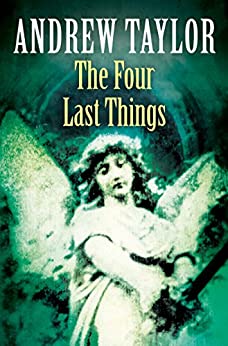
… The Four Last Things by Andrew Taylor.
This is the first in the Roth trilogy, a tense and scary opening book. So chilling that I nearly stopped reading it and only continued because I couldn’t get the story out of my head and I wanted to know how it ended.
The complete trilogy is about the linked histories of the Appleyards and the Byfields. The books work backwards in time, with this first book being the last chronologically, set in the 1990s, and each book works as a stand-alone, self-contained story. Andrew Taylor states they are designed to work together, but they can be read in any order. The second novel, The Judgement of Strangers, describes events that took place during the summer of 1970, with the third, The Office of the Dead, ten years earlier again. But, having read the first book and the second, I think it is best to read them in that order, because there are people and things that happen that have roots in the second (and I suspect because I haven’t read it yet) the last book and it would spoil the story to know these in advance.
The Four Last Things tells the story of Lucy Appleyard, aged four, who is snatched from her child minder’s one cold winter afternoon. Her parents, Sally, a deacon in the church of England and Michael, a police sergeant, are distraught. Their fears mount as grisly body parts are discovered first in a graveyard and then in a church. A sense of evil and menace permeates the book, told from varying viewpoints conveying Sally’s and Michael’s terror and powerlessness. The characterisation is strong, so much so that I feared for Lucy’s safety and even sympathised with one of the kidnappers.
It’s not just the characters and the mysteries that kept me captivated reading The Four Last Things, because the settings are so well described and so atmospheric, so vivid that I could easily see them in my mind – the dingy London streets and alleyways, the old churches and graveyards, and the overgrown back garden of 29 Rosington Road.
The reason I found this book is so compelling to read is that, although there are horrific elements to it (although not in gratuitous detail) and it’s about the kidnapping of a little girl (which always horrifies me), it’s also a puzzle, posing questions such as why and how these events came about. And the answers aren’t all in this first book. There are tantalising glimpses of the kidnappers’ backgrounds and their psychological make-up, which in themselves are so disturbing. There are questions too about the parents – Sally wonders if there is a religious motivation behind the kidnapping, particularly after the incident in church where she is cursed by an old woman. And what is so troubling in Michael’s background, why is he so reliant on his ‘Uncle David’, an Anglo-Catholic known as Father Byfield? Where do the Reverend Francis Youlgreave and the parish of Roth fit in ? What had happened there when David was the vicar? It was these questions that made me pick up the next book as soon as I’d finished the first. I have just finished it this morning and have some of the answers, but also more questions. I’ll be writing more in another post on The Judgement of Strangers some time soon.
The title is a reference to a painting of the Last Judgement showing the ‘four last things’ identified in a passage in the Apocrypha as ‘Death and Judgement and Heaven and Hell.’ Sally comes to realise that ‘where hell is, there is Lucy.’
I vaguely remembered watching a TV version of this with Emilia Fox and Charles Dance as two of the characters. Looking it up, I see that this was in 2007 under the title Fallen Angel. Fallen Angel is also the title of the HarperCollins paperback omnibus of the trilogy (formerly published as Requiem For an Angel). I think the books will stick in my mind longer than the TV version did. For me reading is almost always better than watching a film or TV drama.
A Crime Fiction Alphabet post for the letter T.
 This book also fits very nicely into the R.I.P. VII Challenge.
- Paperback: 368 pages
- Publisher: HarperCollins; (Reissue) edition (5 Feb 2001)
- Language: English
- ISBN-10: 0007105118
- ISBN-13: 978-0007105113
- Source: my own copy
- My rating: 4/5
- Author’s website: Andrew Taylor
 BooksPlease