Spell the Month in Books: June 2025

Spell the Month in Books is a linkup hosted by Jana on Reviews From the Stacks on the first Saturday of each month. The goal is to spell the current month with the first letter of book titles, excluding articles such as ‘the’ and ‘a’ as needed. That’s all there is to it! Some months there are optional theme challenges, such as “books with an orange cover” or books of a particular genre, but for the most part, any book you want to use is fair game!

This month’s Spell the Month in Books theme is Books that you found or currently see at the library. For this theme I’ve used books I’ve previously borrowed from the library for the letters J, U, and E and a book I’ve seen on the library’s website for the letter N.
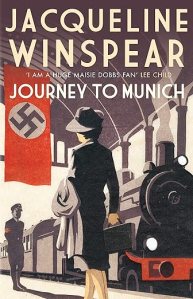
Journey to Munich by Jacqueline Winspear – Travelling into the heart of Nazi Germany, Maisie encounters unexpected dangers – and finds herself questioning whether it’s time to return to the work she loved. But the Secret Service may have other ideas!
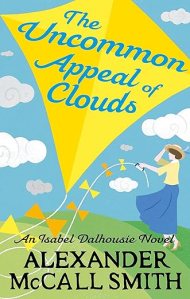
Uncommon Appeal of Clouds by Alexander McCall Smith – an Isabel Dalhousie book – An unexpected appeal for help from a collector who has been the victim of an art theft threatens to take Isabel Dalhousie far outside her comfort zone.
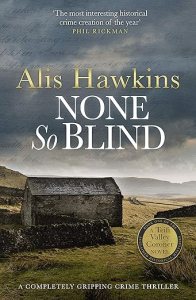
None So Blind by Alis Hawkins – West Wales, 1850. When an old tree root is dug up, the remains of a young woman are found. Harry Probert-Lloyd, a young barrister forced home from London by encroaching blindness, has been dreading this discovery. He knows exactly whose bones they are. Working with his clerk, John Davies, Harry is determined to expose the guilty. But the investigation turns up more questions than answers and raises long-buried secrets. The search for the truth will prove costly.

An Event in Autumn by Henning Mankell a Wallender thriller – Kurt Wallander’s life looks like it has taken a turn for the better when his offer on a new house is accepted, only for him to uncover something unexpected in the garden – the skeleton of a middle-aged woman. As police officers comb the property, Wallander attempts to get his new life back on course by finding the woman’s killer with the aid of his.

The next link up will be on July 5, 2025 when the optional theme will be: Set in a fantasy world or fictional place.

The Uncommon Appeal of Clouds: Book Beginnings & The Friday 56

Every Friday Book Beginnings on Friday is hosted by Gillion at Rose City Reader where you can share the first sentence (or so) of the book you are reading. You can also share from a book you want to highlight just because it caught your fancy.

I’m featuring The Uncommon Appeal of Clouds by Alexander McCall Smith, an Isabel Dalhousie book, that I’ve borrowed from my local lbrary.

Chapter One:

‘Mozart’ said, Isabel Dalhousie. And then she added, Stinivasa Ramamjan .

Also every Friday there is The Friday 56, hosted by Freda at Freda’s Voice, but she is taking a break and Anne at My Head is Full of Books has taken on hosting duties in her absence. You grab a book and turn to page 56 (or 56% of an eBook), find one or more interesting sentences (no spoilers), and post them.

But then, we can misjudge each other so easily, she thought; so easily.

Description from Amazon:

As a mother, wife, employer and editor of the Review of Applied Ethics, Isabel Dalhousie is aware that to be human is to be responsible. So when a neighbour brings her a new and potentially dangerous puzzle to solve, once again Isabel feels she has no option but to shoulder the burden.

A masterpiece painting has been stolen from Duncan Munrowe, old-fashioned philanthropist, father to two discontented children, and a very wealthy man. As Isabel enters into negotiations with the shadowy figures who are in search of a ransom, a case where heroes and villains should be clearly defined turns murky: the list of those who desire the painting – or the money – lengthens, and hasty judgement must be avoided at all cost. Morals, it turns out, are like Scottish clouds: complex, changeable and tricky to get a firm grip on; they require a sharp observational eye, a philosophical mindset, and the habit of kindness. Fortunately for those around her, Isabel Dalhousie is in possession of all three.

I’ve read some of his other Isabel Dalhousie books and enjoyed them. So I’m hoping to enjoy this one too. I really like the gentle pace of these books and what I find so fascinating is that whilst not a lot actually happens, a lot goes on in Isabel’s head.

What do you think, does this book appeal to you? What are you currently reading?

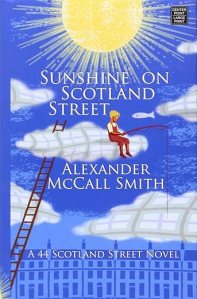
Sunshine on Scotland Street by Alexander McCall Smith

I’ve read a few of Alexander McCall Smith’s Isabel Dalhousie books, which I enjoyed – but not any of his 44 Scotland Street novels. So when I saw Sunshine on Scotland Street in the library, going off the blurb on the back cover, I thought it would be a change from the crime fiction and historical novels I’ve been reading recently.

From the back cover:

Scotland Street witnesses the wedding of the century of Angus Lordie to Domenica Macdonald, but as the newlyweds depart on honeymoon Edinburgh is in disarray. Recovering from the trauma of being best man, Matthew is taken up by a Dane called Bo, while Cyril eludes his dog-sitter and embarks on an odyssey involving fox-holes and the official residence of a cardinal. Narcissist Bruce meets his match in the form of a sinister doppelganger; Bertie, set up by his mother for fresh embarrassment at school, yearns for freedom; and Big Lou goes viral. But the residents of Scotland Street rally, and order – and Cyril – is restored by the combined effects of understanding, kindness, and, most of all, friendship.

My thoughts:

Even though I haven’t read the seven books before this one I had no difficulty in following the storylines, although it is obvious that the characters all have backstories and previous relationships that are hinted at in this book. In a way it’s very like the Isabel Dalhousie books as the action is interspersed with McCall Smith’s philosophical and ethical musings, his thoughts about human nature and relationships, which in general I liked more than the story.

It begins with an amusing account of the preparations for Angus and Domenica’s wedding, which Angus seems to think will just happen without much preparation by him – a hole in his kilt, his lack of a ring, and he has given no thought at all about where to go for thier honeymoon. But his bestman, Matthew helps him sort out the kilt and ring problem and Domenica has arranged both the reception and the honeymoon.

After that Angus and Domenica disappear from the book until the last chapter, leaving Cyril, Angus’s dog in the care of the Pollock family, the insufferable Irene, her long-suffering husband, Stuart, 6 year-old son Bertie and baby Ulysses. Cyril and Bertie are my favourite characters in the book and their ‘adventures’ caused me much concern, as Irene does not like Cyril and stifles both Bertie and Stuart. In fact I wasn’t too bothered about any of the other characters, apart from Bertie’s spindly-legged friend from cub scouts, Ranald Braveheart Macpherson and his mother who has no difficulty in putting Irene firmly in her place.

This is an easy read, meandering from one character to the next. It has a light, humorous tone that I enjoyed, along with thoughts about friendship, religion, spirituality and happiness. At the end as Angus looks round the group of people gathered for their homecoming party it strikes him that they are an ‘infinitely precious band of souls’:

And this realisation that he had was not specifically religious – although it could easily and appropriately be that. It was, rather, a spiritual notion – the idea that each of us, even the least of us, has a rich hinterland of value behind us: the lives we have led, the thoughts we have had, the love we have given and received – the little things of our lives that may not mean much to others unless and until they are granted the insight that brings love into the heart, sudden, exalting love. To see another as a soul was to acknowledge the magnifcent, epic course that life is for each of us, and to experience sympathy for the other in his or her negotiation of that course. It was quite different from seeing others simply as people. (pages 294 – 295)

Reading challenges: Read Scotland and What’s In a Name, in the category of a book with a country in the title.

  • Paperback: 304 pages
  • Publisher: Abacus (18 July 2013)
  • Language: English
  • ISBN-10: 0349139164
  • ISBN-13: 978-0349139166
  • Source: Library book

Book Notes

I’ve been reading more than writing recently and there are four books that I have yet to write about on this blog. One of my reasons for writing is to remember more details of what I’ve read and to crystallise my thoughts about the books. But as it has been some time now since I read these I’m just going to write short notes on two of them.

This book follows on from Achebe’s Things Fall Apart being the third book about the family of Okonkwo in Nigeria from the time of European colonisation up to the 1950s. No Longer at Ease is set in the 1950s. Obi Okonkwo has been educated in England and returns to Lagos where he works as a civil servant. He has a fiancée, Clara and a lot of expectations to live up to from his family and tribe who paid for him to study in England. He soon falls victim to the corruption in the city and upsets his family, who disapprove of Clara. This is the story of pressure from a changing world that Obi doesn’t understand and struggles to adjust to.  It’s a downward spiral and a sense of foreboding pervades the whole book.  I preferred Things Fall Apart which I’d read quite a while ago now.

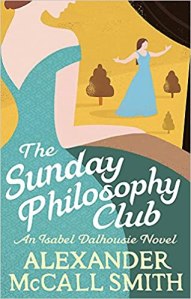
This is the first in the Isabel Dalhousie series. I’ve read a few of the later ones before getting to this one, which does fill in some of the gaps in my knowledge of Isabel’s background. It is really better to read these books in order.

Isabel is a philosopher and the editor of the Review of Applied Ethics and as you would expect from this the book is packed with Isabel’s thoughts on the events that take place. I really like the gentle pace of these books and reflecting on the points made. It actually begins dramatically with the death of a young man who falls from the upper circle of the Usher Hall where Isabel had been at a concert. She saw him fall and becomes convinced that he had been pushed.

I like the mix of Isabel’s reflections and her concern over her actions and their consequences. I like the characters – Grace, Isabel’s down to earth housekeeper, Cat her niece who seems to go from one unsuitable boyfriend to the next, and particularly Jamie, Cat’s ex-boyfriend. I noted a few questions raised by Isabel’s reflections – questions about the nature of lying, whether there are good lies and bad lies, the blurring of truth and falsehood, what moral obligations do we have to other people, forgiveness, and hypocrisy.  Isabel finds it

… intellectually exciting to become involved. She wanted to know why things happened. She wanted to know why people did the things they did. She was curious. And what she wondered was wrong with that? (page 78)

And that’s why I like this book and the other Isabel Dalhousie books so much.

The other books I’ve read and not yet written about are both by S J Bolton – Awakening  and Blood Harvest. They are both great books, which I’ll write about soon.

Friday Finds

Friday Finds is  hosted by Should Be Reading.

I have just one ‘find’ this week. I’ve only recently discovered how good Alexander McCall Smith’s Isabel Dalhousie novels are. There are seven in the series and I’ve read just two of them so far. The latest one in the series is due out in September. It is:

The Charming Quirks of Others

Description from the publishers Little, Brown Book Group:

Isabel Dalhousie, Edinburgh philosopher and curious observer of the behaviour of her fellow man, is approached by a friend at a local boarding school that is planning to appoint a new headmaster; an anonymous letter has arrived suggesting that one of the shortlisted candidates has a compromising past. But which one is it? Isabel is once again drawn into an investigation, and finds herself exploring dilemmas of human weakness and forgiveness. She turns to her fiancé Jamie for advice, but he too appears to have something to hide . . .

That gives me time to catch up reading the others in the series before this one is published (links to Alexander McCall Smith’s website):

  • The Sunday Philosophy Club
  • Friends, Lovers, Chocolate
  • The Right Attitude to Rain – read
  • The Careful Use of Compliments – read
  • The Comfort of Saturdays – waiting to be read
  • The Lost Art of Gratitude
  • Library Loot

    I’ve been reading lots of library books  recently and still have quite a pile left unread. Here are just some of the books I’ve borrowed that I haven’t started to read yet.

    From top to bottom:

    • Zennor in Darkness by Helen Dunmore. I haven’t read any of her books. The title of this drew my attention – Zennor is a village in Cornwall just north of Penzance, one of the places we used to go to years ago when Dave used to go rock climbing. But this book is different – it’s set in 1917 and U-boats are attacking ships on the Cornish coastline. D H Lawrence and his wife Frieda come into this novel, which won the McKitterick Prize in 1994.
    • Passenger to Frankfurt by Agatha Christie. I’m steadily reading Christie’s books, just in the order I find them. This is one of her later books and was written in 1970, published to mark her eightieth birthday. It’s a spy novel.
    • The Right Attitude to Rain by Alexander McCall Smith. I picked this one because I’d enjoyed The Careful Use of Compliments so much. This is the previous Isabel Dalhousie Novel in his Sunday Philosophy Club series and the third one in the series.  I’m looking forward to reading Isabel’s thoughts on moral and ethical dilemmas.
    • The Vicar of Sorrows by A N Wilson. I have a mixed reaction to Wilson’s books, some I like and some just turn me off. I liked A Jealous Ghost and Incline Our Hearts, but shied away from My Name is Legion. I also like his non-fiction – After the Victorians and some of his biographies. The Vicar of Sorrows is about a clergyman who does not believe in God and does not love his wife. It remains to be seen if I’ll like it.