Nonfiction November: Week 2 Book Pairings

Week 2: (November 8-12) – Book Pairing with Katie at Doing DeweyThis week, pair up a nonfiction book with a fiction title. It can be a “If you loved this book, read this!” or just two titles that you think would go well together. Maybe it’s a historical novel and you’d like to get the real history by reading a nonfiction version of the story. 

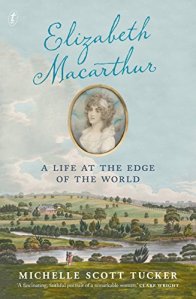
Earlier this year I read the novel A Room Made of Leaves by Kate Grenville and I’m pairing it with Elizabeth Macarthur: A Life at the Edge by Michelle Scott Tucker, which I haven’t read yet.
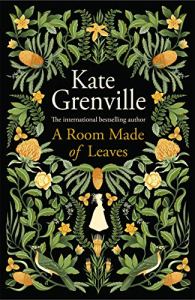
Kate Grenville is one of my favourite authors, so I was very keen to read A Room Made of Leaves. It’s historical fiction telling the story of the Macarthurs, Elizabeth and John Macarthur, who settled in Australia at the end of the eighteenth century. It’s based on the real lives of the Macarthurs using letters, journals and official documents of the early years of the New South Wales colony. Her writing suits me – historical fiction, with good descriptive writing setting the scenes vividly in their locations. I find her books difficult to put down and they stay in my mind long after I’ve finished reading. This one is no exception.

Whenever I read historical fiction I always want to know how much is fact and how much is fiction, how accurate it is. And so this novel intrigued me because Kate Grenville’s book begins with an editor’s note about ‘the ‘incredible discovery of Elizabeth Macarthur’s secret memoirs’ in a tin box containing old papers, revealing the real person behind the few letters she wrote home to her family and friends and a lot of ‘dull correspondence with her adult children’. Was this true, I wondered. So I turned to the back of the book to read Grenville’s Author’s Note and in that she clarifies that this is not history and, although the extracts from Elizabeth’s letters are from the letters of the real Elizabeth Macarthur, she has ‘taken some liberties in order to shape this work of fiction’. The old documents were Grenville’s ‘inspiration and guide’. In other words you have to bear in mind the epigraph, an actual quotation from one of Elizabeth’s letters: Believe not too quickly, a reminder that this is fiction.

It made me want to know more about the Macarthurs, and what was indeed their history, so I was delighted to find out that Kate Grenville references Michelle Scott Tucker’s biography: Elizabeth Macarthur: A Life at the Edge of the World as the standard biography in her Acknowledgements and I was even more delighted to see that it’s available as a ebook. So it is now in my Kindle and I’m keen to read it as soon as possible. I want to see what Michelle Scott Tucker has made of the same historical sources – history, after all, is an interpretation of the facts from the records, trying to explain what happened and why, dependent on available evidence. Fiction is more flexible and can fill in the gaps where the documentary evidence is lacking.
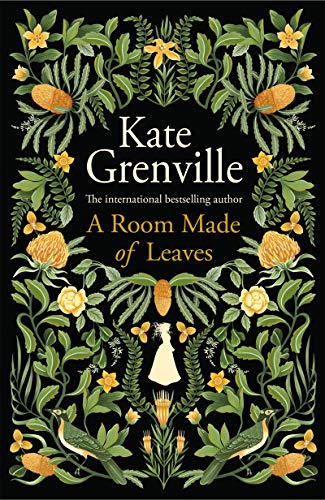
A Room Made of Leaves by Kate Grenville

Canongate| 6 August 2020| 325 pages| e-book| Review copy| 4*

I’m late getting round to reading A Room Made of Leaves, because I am behind with reviewing my NetGalley books. But it was well worth the wait. It’s historical fiction telling the story of the Macarthurs, Elizabeth and John Macarthur, who settled in Australia at the end of the eighteenth century. It’s based on the real lives of the Macarthurs using letters, journals and official documents of the early years of the New South Wales colony. But, although based on fact this is not history, it is fiction, as Kate Grenville makes clear in her Author’s Note at the end of the book (which I read after I read the opening paragraphs of the Editor’s Note at the start of the book).

Description

It is 1788. Twenty-one-year-old Elizabeth is hungry for life but, as the ward of a Devon clergyman, knows she has few prospects. When a soldier, John Macarthur promises her the earth one midsummer’s night, she believes him and with a baby on the way she marries him. Only then he tells her he is to take up a position as Lieutenant in a New South Wales penal colony and she has no choice but to go. Sailing for six months to the far side of the globe with a child growing inside her, she arrives to find Sydney Town a brutal, dusty, hungry place of makeshift shelters, failing crops, scheming and rumours.

All her life she has learned to be obliging, to fold herself up small. Now, in the vast landscapes of an unknown continent, Elizabeth has to discover a strength she never imagined, and passions she could never express. 

Inspired by the real life of a remarkable woman, this is an extraordinarily rich, beautifully wrought novel of resilience, courage and the mystery of human desire.

My thoughts:

I’ve enjoyed all of the books by Kate Grenville that I’ve read so far. Her writing suits me – historical fiction, straight-forward story-telling, with good descriptive writing setting the scenes vividly in their locations. I find her books difficult to put down and they stay in my mind long after I’ve finished reading. This one is no exception.

It begins in Devon where Elizabeth was born and grew up, first with her parents and then after her father died on her grandfather’s sheep farm and then with the local vicar’s family, whose daughter, Bridie is her friend. There she meets John Macarthur, an ensign. When she becomes pregnant they marry and then he tells her he has signed on as a lieutenant in the New South Wales Corps in the penal colony at Sydney Cove. But their married life is not a happy one. John was rash, impulsive, changeable, self-deceiving, and given to embarking on grandiose schemes. He was quick to take offence and was dangerously unbalanced. Over the course of their marriage he was forced to return to England twice, at first for four years and later for nine. During that time Elizabeth made the best of life, carrying on with their sheep farm at Parramatta, where she improved the flock, and helped to establish New South Wales as a reliable supplier of quality wool.

One of the outstanding parts of the book for me is her relationship with William Dawes, an astronomer with the Corps, who was mapping the night sky. He had an observatory near Elizabeth’s farm and it was there that she met some of the local inhabitants and learned a bit of their language and about their ways of life. And it is with William that Elizabeth learns to appreciate not just the night sky, but also the landscape and its flora and fauna and in particular the ‘room made of leaves’ – a private space enclosed on three sides by greenery, a place where you could simply be yourself.

This is a book that captivated me from the opening paragraphs, and there is so much more in it than I have mentioned in this post. It gave me much to think about, in particular bearing in mind the epigraph, an actual quotation from one of Elizabeth’s letters: Believe not too quickly, reminding me that this is a work of fiction. I enjoyed it immensely. And it makes me want to know more about the Macarthurs. I came across Michelle Scott Tucker’s biography: Elizabeth Macarthur: A Life at the Edge of the World and I was delighted to see that Kate Grenville references this book as the standard biography in her Acknowledgements. It is now on my wishlist!

Many thanks to the publishers and NetGalley for my review copy.