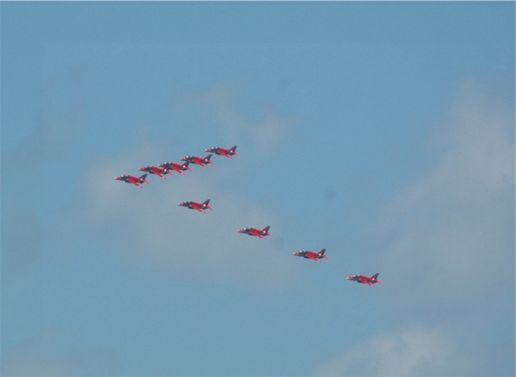
- Red Arrows flypast over our house – part of Halton Air Show

Teaser Tuesday is hosted by MizB at Should Be Reading.
Share a couple or more sentences from the book you’re currently reading. You also need to share the title of the book that you’re getting your ‘teaser’ from €¦ that way people can have some great book recommendations if they like the teaser you’ve given!
And please avoid spoilers!

Another teaser from Company of Liars by Karen Maitland:
It was not easy dancing in the graveyard. The dancers tripped over humps and banged into wooden crosses and stone markers, but by now everyone was so merry on the free ale, cider and mead that they roared with laughter each time someone fell over. (page 79)
 Today’s MUSING MONDAYS post is about library borrowing€¦
Do you restrict yourself on how many books you take out from the library at a time? Do you borrow books if you already have some out? Do you always reborrow books you don’t get to?
I don’t restrict my borrowing – the library does that for me! We’re allowed to borrow up to 15 items, but as my husband doesn’t use up his allocation I can have more using his ticket. But right now I’ve only got 14 books out. I’ve been trying to catch up reading from my own unread books, but the library is so convenient (ten minutes away by car) that I usually visit once a fortnight or so. I don’t wait until I’ve read all the books I have on loan but each time I go I take some books back and usually bring home more than I returned.
What is so good about borrowing books is that I can look at them in more detail that in a bookshop. Sometimes if I really like a book I’ll then buy a copy. If I haven’t read a book before it’s due back, sometimes that’s because I’ve decided not to read it and then I return it. Other times it’s because I haven’t got round to it, so I renew it. I can renew books on-line up to four times, provided no one else has reserved it, after that you have to take the book and have it re-issued. If someone has reserved it you can reserve it again without charge – pretty good really.
Since May, in an attempt to catch up with reading books I already own, I’ve been avoiding buying any more books. If you don’t count the secondhand copy of The Franchise Affair by Josephine Tey that I bought for 20p off the trolley at the hospital I stuck it out until last weekend when I gave in and bought three books.
Well, I went in Waterstones for a coffee and so I had to browse the books. It would be a sad day if I ever come away from a bookshop without even wanting to buy one book, but that just doesn’t happen. This time there were plenty I could have bought but I restricted myself to three. I didn’t pick them for their covers but when I realised they are practically the same colours I thought there’s obviously a theme here. They’re all historical mystery/crime fiction and two of them are books that have been on my wishlist for a while.
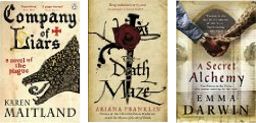
The first two books have been on my wishlist for ages.
I have started to read Company of Liars, which is set in 1348 at the time of the Plague. Nine strangers brought together on Midsummer’s Day (which is today!) travel together through England trying to escape the plague. The group includes Camelot, the relic- seller, a one-armed story teller, a strange, silent child and a painter and his pregnant wife. They each have a secret and it’s not just danger from the plague that threatens them.
The Death Maze (published in the USA as The Serpent’s Tale) is Ariana Franklin’s second book featuring the Italian doctor, Adelia Aguilar. Set in the 12th century Henry II is on the throne and when his mistress Rosamund Clifford dies a painful death by poisoning, his wife, Eleanor of Aquitaine, is the main suspect. Henry sends for Adelia to investigate.
The third book, A Secret Alchemy by Emma Darwin, attracted me because it’s about the Princes in the Tower, believed to have been killed by their uncle Richard III in 1483. I’m sure there are many books on this subject; I’ve read just two – a novel, The Daughter of Time by Josephine Tey and a non-fiction book The Princes in the Tower by Alison Weir – both of which are extremely good. I was also drawn to this book by the author’s name – Emma writes a blog which I’ve been reading recently – This Itch of Writing.
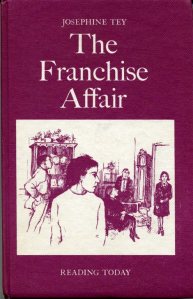
Tey’s The Daughter of Time is probably the best historical mystery novel I’ve read so I’m hoping The Franchise Affair will be just as compelling reading as The Daughter of Time. This one is crime fiction in which a lawyer defends two women accuse of kidnapping and is based on the real life 18th century case of Elizabeth Canning. Our local hospital has been a good source of secondhand books for me recently – there are trolleys of books for sale in all the waiting areas – and the waits have been long!
And to round off, my current Agatha Christie book is The Thirteen Problems, a satisfying collection of stories of unsolved mysteries, featuring Miss Marple. The first stories are told at Miss Marple’s house on Tuesday evenings after dinner and then the setting moves to Colonel and Mrs Bantry’s house (who feature in The Body in the Library) where a slightly different group of guests including Miss Marple, entertain each other with tales of mystery and murder.
Weekly Geeks asked participants to list books they have read but not reviewed and then invite others to ask questions about these books. The idea was to help us catch up on our reviews. I listed A Judgement in Stone by Ruth Rendell as one of those books and Sherrie who writes A View of My Life blog had a question for me. She asked as this is a modern mystery did it keep my attention through the whole book? Well, it did – once I’d started I just had to keep on reading.
Ruth Rendell, Baroness Rendell of Babergh also writes under the pseudonym Barbara Vine. She writes traditional detective stories, mainspring novels and crime fiction concentrating on one character.
I’ve known of Ruth Rendell’s books for years and watched the TV versions of her Inspector Wexford books and other books too. But I don’t think I’ve ever read any of them before. As well as A Judgement in Stone I’ve also recently read The Birthday Present (Rendell writing as Barbara Vine). Both are quite disturbing books.
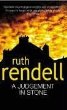 A Judgement In Stone portrays Eunice an illiterate woman and a psychopath who does anything to stop anyone from finding out that she can’t read or write. The opening sentences sets it out clearly:
Eunice Parchman killed the Coverdale family because she could not read or write. There was no real motive and no premeditation; no money was gained and no security.
Her ingenuity and resourcefulness is amazing. She blackmails people and killed her father. I found the whole premise of such a damaged person apparently functioning normally in society scary. She is employed by the Coverdales as their housekeeper and in the interests of having their house kept clean and tidy they tried to make her comfortable. But part of the problem was that they looked on her as little more than a machine, not as a person. They meant well, wanting to make other people happy, but they were interferers, they didn’t understand that
… selfishness is not living as one wishes to live, it is asking others to live as one wishes to live.
Things went from bad to worse when Eunice met Joan, who was completely unstable, in fact she was insane. Joan is a religious fanatic, a sinner who delights in telling people of her past sins and wanting them to seek God’s forgiveness. Their friendship ends in tragedy.
Illiteracy is essential to the novel. I felt helpless whilst reading this, desperately wanting the Coverdales to realise Eunice’s problems, but they were blind to the fact that Eunice was illiterate and although they tried to prevent her meeting Joan they were unaware of the danger they were in. This inflamed Eunice and pushed her into taking the actions she did.
Although Eunice’s crime is known right from the start, that does not detract from the suspense. It actually makes it worse – you know that the murder is going to happen and as the reasons why it happens become clear, the tension builds relentlessly.
 Note: this is the 19th library book I’ve read this year qualifying for the Support Your Local Library Reading Challenge.
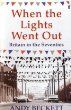
I saw When the Lights Went Out: Britain in the Seventies by Andy Beckett on LibraryThing’s Early Reviewer Programme and the publishers’ description made me think maybe it would be interesting:
Over five years in the making, this book is not an academic history but something for the general reader, written with the vividness of a novel or the best works of American New Journalism. No such treatment of the seventies has been previously attempted. Hopefully the book will bring the decade back to life in its all its drama and complexity.
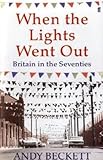 And it did bring that decade back to life. It’s a very detailed book, using original material such as diaries, letters, personal memoirs as well as books written about the period. I particularly liked the personal, face-to-face interviews with some of the key figures such as Ted Heath, and his assessments of politicians such as this one of Margaret Thatcher in 1975 when she was a contender for the leadership of the Conservative Party:
She was a fast learner, a holder of fierce convictions and a highly distinctive speaker and political presence. (page 261)
Margaret Thatcher was, essentially not easy to be around: ‘Thatcher was always tiresome,’ remembers the political journalist Michael White who spent a lot of time with her in the seventies. ‘There was no romance, no self-analysis, no self-consciously epic qaulity like you would have got with Churchill. (page 262)
When Beckett describes the strikes of the decade, and there were so many, the changes in the balance of power, the three-day week and the Winter of Discontent, I was back there living it all over again. My only criticism is a personal one – when he writes about the economic and financial situations with all the statistics he quotes I was a bit bored and have to admit that I skim read those sections. It was the personalities, the personal touches and the cultural and social scenes that I liked – for example during his interview with Denis Healey, who was Harold Wilson’s Chancellor of the Exchequer in the seventies Healey talked about Wilson’s lack of ambition:
‘In his second term he told many people that he planned only to stay a few months. He told me in the lavatory at No. 10 just before a Cabinet meeting.’ Healey giggled, characteristically delighting in the black comedy. Then, equally characteristically, he looked out of the window of his Sussex study and kicked Wilson’s reputation in the shins. ‘I thought, “About bloody time!” He was a terrible prime minister, actually.’ (page 162)
Andy Beckett is a journalist and this book is very readable. As well as the personalities I also liked his descriptions of places, comparing how they are today with how they were in the seventies and his comparisons of the crises that faced Britain then with those facing us today:
At the least, a very seventies dread has seeped back into how people in Britain and other rich countries see the world. Economic crises, floods, food shortages, terrorism, the destruction of the environment: these spectres, so looming in the seventies did not go away during the eighties and nineties; yet they faded – they were often quite easy to forget about. Now that they have returned to haunt newspaper front pages almost daily, it is possible to wonder how many of Britain’s seventies problems were ever really solved. (page 522)
 BooksPlease