The Bone Chests by Cat Jarman

A history of the making of England as a nation, told through six bone chests, stored for over a thousand years in Winchester Cathedral.

William Collins| 14 September 2023| 400 pages| Review copy| 4*

The front cover shows a section of the Great West Window of Winchester Cathedral, made up of mosaics created after 1660 from the glass that had been smashed during the Civil War in 1642. I think it is just beautiful.

Description:

In December 1642, during the Civil War, Parliamentarian troops stormed the magnificent cathedral, intent on destruction. Reaching the presbytery, its beating heart, the soldiers searched out ten beautifully decorated wooden chests resting high up on the stone screens.

Those chests contained some of England’s most venerated, ancient remains: the bones of eight kings, including William Rufus and Cnut the Great – the only Scandinavian king to rule England and a North Sea empire; three bishops ; and a formidable queen, Emma of Normandy. These remains belong to the very people who witnessed and orchestrated the creation of the kingdom of Wessex in the seventh century, who lived through the creation of England as a unified country in response to the Viking threat, and who were part and parcel of the Norman conquest.

On that day, the soldiers smashed several chests to the ground, using the bones as missiles to shatter the cathedral’s stained glass windows. Afterwards, the clergy scrambled to collect the scattered remains.

In 2012, the six remaining chests were reopened. Using the latest scientific methods, a team of forensic archaeologists attempted to identify the contents: they discovered an elaborate jumble of bones, including the remains of two forgotten princes. In The Bone Chests, Cat Jarman builds on this evidence to untangle the stories of the people within. It is an extraordinary and sometimes tragic tale, and one of transformation. Why these bones? Why there? Can we ever really identify them? In a palimpsest narrative that runs through more than a millennium of British history, it tells the story of both the seekers and the sought, of those who protected the bones and those who spurned them; and of the methods used to investigate.

My knowledge of the Anglo-Saxons from school history lessons is very basic – little more than Alfred the Great on the run from the Vikings and letting the cakes burn, and King Canute, sitting in his throne placed at the water’s edge and trying unsuccessfully to forbid the waves from advancing and wetting his feet.

So I was looking forward to learning more in The Bone Chests: Unlocking the Secrets of the Anglo-Saxons. In her Author’s Note Cat Jarman clarifies that her intention with this book is to tell the stories of the chests, and of the tumultuous times that they and the people interred in them, lived through. She has concentrated on the south and south-west of England to consider why Wessex and Winchester took on such significance in the history of England in the early medieval period. So, the main emphasis in this book is on the history, on the kings and politics of the period rather than on the forensic archaeology and the modern scientific techniques.

Having said that there is enough about the use of DNA and isotopic analysis of teeth to investigate the diet and origins of the owners of the bones for me as a non scientist to understand. I found it all fascinating even though in places I was left wondering what century I was in, having moved from the 11th to the 21st century (when Richard III’s remains were discovered under a Leicester car park), via various Viking raids and the 17th century. At times I had to keep reminding myself which chest was being described.

The mortuary, or bone chests, themselves, are most interesting and I would love to visit Winchester Cathedral to see them for myself. There are six chests, painted wooden caskets which are displayed high on stone screen walls on either side of the high altar area. The bones are the remains of many kings and bishops who were originally buried in the Anglo-Saxon cathedral known as Old Minster, north of the present cathedral.

Jarman describes the chests in, vaguely, chronological order and has relied on the Mortuary Chests Project, a research project led by archaeologists from Bristol University in collaboration with Winchester Cathedral that began in 2012. She is not involved in the Project but has incorporated details of the team’s partial results released in May 2019 in her book.

The book is very detailed and well researched and I learned so much, bringing the medieval period to life as I read. I had never heard of Queen Emma and the details about her life stand out for me. She was the daughter of Richard I, Duke of Normandy, wife of two Anglo- Saxon kings – Æthelred the Unready and Cnut (Canute) – and the mother of Edward the Confessor and Harthacnut of Denmark. She was given the name Ælfgifu and in 1017 she married Cnut. I was fascinated to read that the Project team has put together a set of bones that they confidently determine to be a female that could be the body of Emma. (See – details of an exhibition at Winchester Cathedral, Kings and Scribes: the birth of a nation. This includes a 3D model of the female skeleton thought to be Queen Emma).

The last section of the book is made up of Notes of the sources used, an extensive Bibliography, and an Index. There is also a List of Illustrations; the illustrations were not included in my review copy.

Many thanks to the publishers for a review copy via NetGalley.

Dr Cat Jarman is a bioarchaeologist and field archaeologist specialising in the Viking Age, Viking women, and Rapa Nui. She uses forensic techniques like isotope analysis, carbon dating, and DNA analysis on human remains to untangle the experiences of past people from broader historical narratives. Dr Jarman has contributed to numerous TV documentaries as both an on-screen expert and historical consultant, including programmes for the BBC, Channel 4, History, Discovery, and more.

Mini Reviews

I’ve been reading almost non-stop and not pausing long enough to write proper reviews, so it’s time for a brief look at some of the books I’ve read. These notes are not as detailed as I usually write, but when you read quickly this is the result!

Friend of the Devil by Peter Robinson, the 17th DCI Banks book 4*

Inspector Alan Banks and his team, the Western Area Major Crimes Squad, investigate the murder of 19-year-old Hayley Daniels who was found raped and strangled in the Maze, a tangle of narrow alleys behind Eastvale’s market square, after a drunken night on the town with a group of friends. There are plenty of suspects and it’s a matter of looking at who was where and when to find the murderer. It wasn’t who I thought it was.

DI Annie Cabbot, on loan to the Eastern area, is assigned to look into the murder of Karen Drew, a quadriplegic, who was found dead in her wheelchair on a seaside cliff. It’s only when Annie discovers the real identity of Karen Drew, that the question of why anyone would want to murder a quadriplegic, becomes clear. But who could have done it? Annie has to revisit an earlier case to find the culprit.

Although this can be read as a stand-alone novel, part of the enjoyment in reading the series in order is that you see the development of the main characters and their relationships over the years. The books are basically police procedurals but along the way there’s a lot about Alan and Annie as people rather than police officers. I have become fond of the regular characters in these books.

Watching the Dark by Peter Robinson, the 20th DCI Banks book 4.5*

This is the description on Goodreads: DCI Alan Banks reluctantly investigates DI Bill Quinn with Inspector Joanna Passero. Quinn, convalescing at St Peter’s Police Treatment Centre, was killed by a crossbow on the tranquil grounds, and left compromising photos. Quinn may be disreputable, linked to a vicious crime in Yorkshire and to a cold case – English Rachel Hewitt 19 vanished in Estonia six years ago.

Banks is not happy about this investigation, not only at the murder of one of their own officers, but because of the involvement of Joanna Passero who seems to him to be determined to prove that Quinn was a corrupt cop.

The team’s investigations lead them to a group smuggling illegal immigrants from Eastern Europe into the UK, taking Banks and Passero to Tallin in Estonia, whilst Annie heads the investigation in the UK. It’s remarkably complex. It’s also long, with many twists and turns, and it became too repetitive in the middle of the book, which is why I haven’t given it 5 stars. But I did enjoy it more than Friend of the Devil, especially the setting in Estonia. Robinson’s books are all definitely grounded in their settings, whether they’re in Yorkshire, Estonia, or elsewhere.

I have now read 20 of the 28 DCI Banks books.

I think the setting in Estonia means I can add Watching the Dark to the Wanderlust Bingo card in Central/Eastern Europe square.

Top Ten Tuesday: Books I Thought I’d Love but Didn’t

Top Ten Tuesday is a weekly meme created by The Broke and the Bookish and now hosted by Jana at That Artsy Reader Girl. For the rules see her blog.

The topic this week is The topic this week is Books That Defied My Expectations (books you thought you would didn’t like that you loved, books you thought you’d love but didn’t, books that were not the genres they seemed to be, or in any other way subverted your expectations!

I don’t like writing about a book I didn’t enjoy when I know so much work has gone into it and clearly other people have loved it. But these are just my opinions, for what they are worth. I had to dig back into my memory ( and my blog) to find these books – they don’t stick in my mind for long. And I think that these are books I shouldn’t have read anyway – I’m not the target audience for them.

The Man Who Died Twice by Richard Osman 1* – light, easy to read crime fiction, this is a follow up to The Thursday Murder Club. Many people have written glowing reviews of this book, but Richard Osmond’s style of humour differs from mine, so I didn’t find it very funny. I don’t like being so negative about a book but I think the characters are rather stereotypical and the plot is over complicated and unconvincing. In addition it’s written in the present tense which usually irritates me – and it did.

Six Tudor Queens:Katheryn the Tainted Queen by Alison Weir 2* I wanted to read this book because I knew very little about Henry VIII’s 5th wife, except that she was beheaded on the grounds that she had committed adultery and treason. It has glowing reviews on Amazon full of praise and it is based on extensive research. Clearly other people love this book, but I didn’t. For me it came across as a romance novel, primarily focused on Katheryn’s imagined thoughts, emotions, and sexual encounters. It is simply written, but with too many cliches and modernised text.

Before the Fall by Noah Hawley, which I didn’t enjoy. It won the 2017 Edgar Award for Best Novel and was selected by The Sunday Times as one of the top page-turners of summer 2017, so I’m in the minority because I thought it was boring and tedious. The plot is simple – a plane crashes into the sea after taking off from Martha’s Vineyard, just two people survive and the mystery is why did the plane crash and who was responsible. The main part of the book is made up of the long backstories of the people on the plane. It’s not gripping or thrilling and definitely not a page-turner. 1*

The Gathering by Anne Enright 1* It won the Man Booker Prize in 2007. The narrator is Veronica Hegarty and it is through her eyes that the Hegarty family story is told as they gather at her brother’s wake in Dublin. Liam, an alcoholic, had committed suicide by putting rocks into his pockets and walking into the sea at Brighton. The characterisation is fantastic and I had no difficulty seeing the people in my mind’s eye; the descriptions of their appearance and personalities are strong and detailed.

As the blurb says it is about ‘thwarted lust and limitless desire‘ and the focus is on the body, on death, on sex and sexual abuse, on alcoholism, on insanity and on secrets and betrayal, but not much about love. At times I found it depressing or boring.

I read The Close because I’ve read and previously enjoyed Jane Casey’s Maeve Kerrigan books. Maeve is a Detective Sergeant with the Metropolitan Police – in the first six books she was a detective constable. She and her boss Detective Inspector Josh Derwent are the two main characters. They have a confrontational working relationship and their spiky relationship is a recurring theme in the books.  They are all police procedurals, fast-paced novels, with intriguing and complex plots. I thought that the Maeve/Josh relationship took a significant turn in the 9th book and I wondered what would happen next!

But it was simply disappointing. Maeve and Josh went undercover, carrying out surveillance in Jellicoe Close, whilst posing as a couple. As the synopsis describes it there are some dark secrets behind the neat front doors, and hidden dangers that include a ruthless criminal who will stop at nothing. What I really did not expect was that this would result in their relationship becoming such an abusive one.

The Church of Dead Girls by Stephen Dobyns about the disappearance and murders of three young teenage girls. It’s far too detailed and drawn out. I had trouble with the narrator, wondering how he  could possibly know all the detail of what other characters were thinking and doing. Described on Amazon thus ‘One after another, three girls disappear from a small American town. As the sleepy town awakens to a horrific nightmare, no one is safe from the rising epidemic of suspicion. Dobyn’s chilling novel is superbly written portrait of a little place seemingly at home with itself. The suspense builds to a magnificent climax.’ I did not like it at all. But a friend loved it.

We Are Not in the World by Conor O’Callaghan 2* A strange, confusing and depressing book that I read as though I was in fog, never really getting to grips with the plot. It meanders and drifts through the characters, shifting between the past, the near past and the present, and from place to place, as Paddy drives the lorry from England down to the south of France. I was often not sure what was happening, when or where it was happening and to whom it was happening. It’s a stream of consciousness, as the various characters move in and out of focus.

There were times when I wondered why I was reading this, it was like a dream where the scenes move randomly through a number of sequences, and you wake up with that fearful feeling that something dreadful has been going on inside your head that was disturbing, and unsettling. There’s a sense of timelessness and of detachment from the day to day reality – they are not in the world. I didn’t enjoy the book, and found it difficult to follow. It is too vague, and as soon as I thought I’d begun to understand it, it drifted away into obscurity. and I was left floundering.

Landscapes: John Berger on Art edited by Tom Overton 2* is a collection of essays by art critic, novelist, poet, and artist John Berger written over the past 60 plus years. However both the title and the cover art – a painting of a landscape – led me to think it would discuss landscapes. But I should have taken more note of this sentence in the blurb-‘Landscapes offers a tour of the history of art, but not as you know it.‘ It is definitely not art as I know it but it is a “landscape” of Berger’s thoughts on his life, on people and ideas that have influenced him, artists and authors that he liked and disliked, with very little in it about landscapes. There are essays on his life, people, ideology, philosophy and on art history and theory about the nature and meaning of art.

Death Comes To Pemberley by P D James 2*. I thought it was OK I was disappointed. I love Jane Austen’s Pride and Prejudice and I like PD James’s books, so this book should have been just right for me. But maybe it was just the wrong book for me because I have yet to read a sequel/spin-off by a different author that I have enjoyed. They never live up to the original and if this had been written by anyone except P D James I probably wouldn’t even have looked at it. But plenty of others loved it!

The Ministry of Utmost Happiness by Arundhati Roy. I wanted to read Arundhati Roy’s second novel, The Ministry of Utmost Happiness because I’d loved her first novel, The God of Small Things when it won the Booker Prize in 1997. My initial reaction to it was one of disappointment. I struggled with it because there is so much description, so little plot and such a large cast of characters. At times I was on the verge of abandoning the book, but then one episode and then another, and another, held my imagination and I read on. By the end, though, I was glad I finished it as the ending is clearer and more understandable than the middle, where quite frankly I was for the most part bewildered. I’m sure that I didn’t pick up all the political and cultural references, but the issues surrounding caste, nationalism, gender and religious conflict are clear.

It’s a book about love and loss, death and survival, grief, pain and poverty. There are outcasts, the hijras – transgender individuals, rape victims, addicts and abandoned babies; and there is a lot of violence, massacres, beatings, tortures and rapes. It’s a heartbreaking book, which doesn’t spare the details. I was relieved to finish it.

Spell the Month in Books – September 2023

Spell the Month in Books is a linkup hosted by Jana on Reviews From the Stacks on the first Saturday of each month. The goal is to spell the current month with the first letter of book titles, excluding articles such as ‘the’ and ‘a’ as needed. That’s all there is to it! Some months there are optional theme challenges, such as “books with an orange cover” or books of a particular genre, but for the most part, any book you want to use is fair game!

The theme this month is From your TBR list.

The links in the titles of each book go to Amazon UK and the descriptions are from Amazon UK, Goodreads, or LibraryThing.

S is for Small Wars by Sadie Jones

Set on the colonial, war-torn island of Cyprus in 1956, Jones tells the story of a young solider, Hal Treherne, and the effects of this “small war” on him, his wife, Clara, and their family. Reminiscent of classic tales of love and war such as The English Patient and Atonement, Jones’s gripping novel also calls to mind the master works of Virginia Woolf and their portrayal of the quiet desperation of a marriage in crisis. Small Wars is at once a deeply emotional, meticulously researched work of historical fiction and a profound meditation on war-time atrocities committed both on and off the battlefield.

E is for End in Tears by Ruth Rendell,

The twentieth book to feature the classic crime-solving detective, Chief Inspector Wexford.

A lump of concrete dropped deliberately from a little stone bridge over a relatively unfrequented road kills the wrong person. The young woman in the car behind is spared. But only for a while…

A few weeks later, George Marshalson lives every father’s worst nightmare: he discovers the murdered body of his eighteen-year-old daughter on the side of the road.

P is for The Pursuit of Happiness by Douglas Kennedy

Manhattan, Thanksgiving Eve, 1945. The war was over, and Eric Smythe’s party was in full swing. All his clever Greenwich Village friends were there. So too was his sister Sara — an independent, canny young woman, starting to make her way in the big city. And then in walked a gatecrasher, Jack Malone — a U. S. Army journalist just back from a defeated Germany, and a man whose world-view did not tally with that of Eric and his friends. Set amidst the dynamic optimism of postwar New York and the subsequent nightmare of the McCarthy witch-hunts, The Pursuit of Happiness is a great tragic love story; a tale of divided loyalties, decisive moral choices, and the random workings of destiny.

T is for Thirteen by P D James, It’s the fifth book in the Eddie Flynn series of crime thrillers.

It’s the murder trial of the century. And Joshua Kane has killed to get the best seat in the house and to be sure the wrong man goes down for the crime. Because this time, the killer isn’t on trial. He’s on the jury.
But there’s someone on his tail. Former-conman-turned-criminal-defense-attorney Eddie Flynn doesn’t believe that his movie-star client killed two people. He suspects that the real killer is closer than they think, but who would guess just how close?

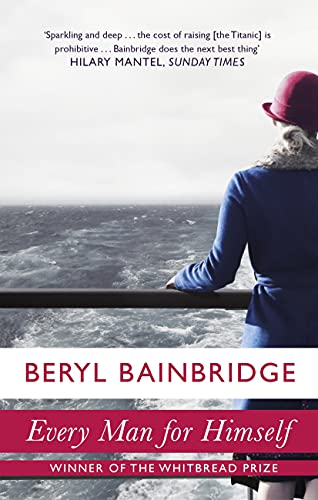
E is for Every Man For Himself by Beryl Bainbridge

For the four fraught, mysterious days of her doomed maiden voyage in 1912, the Titanic sails towards New York, glittering with luxury, freighted with millionaires and hopefuls. In her labyrinthine passageways the last, secret hours of a small group of passengers are played out, their fate sealed in prose of startling, sublime beauty, as Beryl Bainbridge’s haunting masterpiece moves inexorably to its known and terrible end.

M is for The Master Bedroom by Tessa Hadley

Kate Flynn has always been a clever girl, brought up to believe in herself as something special. Now Kate is forty-three and has given up her university career in London to come home and look after her mother at Firenze, their big house by a lake in Cardiff. When Kate meets David Roberts, a friend from the old days, she begins to obsess about him: she knows it’s because she’s bored and hasn’t got anything else to do, but she can’t stop.

Adapting to a new way of life, the connections Kate forges in her new home are to have painful consequences, as the past begins to cast its long shadow over the present…

B is for Broadchurch by Erin Kelly

It’s a hot July morning in the Dorset town of Broadchurch when Beth Latimer realises that her eleven-year-old son, Danny, is missing. As Beth searches desperately for her boy, her best friend, local police officer DS Ellie Miller, arrives at work to find that the promotion she was promised has been given to disreputable Scottish outsider DI Alec Hardy.

When Danny’s body is found on the beach Ellie must put her feelings aside as she works with DI Hardy to solve the mystery of Danny’s death. As the case becomes a murder investigation the news hits the national press, jolting sleepy Broadchurch into the national spotlight.

As the town’s secrets begin to unravel, members of this tight-knit community begin to consider those in their midst. Right now it’s impossible to know who to trust…

E is for The Earth Hums in B Flat by Mari Strachan

Gwenni Morgan is not like any other girl in this small Welsh town. Inquisitive, bookish and full of spirit, she can fly in her sleep and loves playing detective. So when a neighbour mysteriously vanishes, and no one seems to be asking the right questions, Gwenni decides to conduct her own investigation.

Mari Strachan’s unforgettable novel was one of the most acclaimed and successful debuts of 2009. It is a heart-breaking and hugely enjoyable story.

R is for Rowan’s Well by C J Carter

Who’s the one person you’d trust with your life? Your husband? Your best friend? Your father? Think again…
Mark Strachan has everything: good looks, doting wife, great job, loyal best friend… and a hidden flaw that goes to his very core. A deep secret he’ll wreck lives to protect.
At Rowan’s Well, a house full of secrets on North Yorkshire’s rugged cliffs, Mark will force his family, and best friend Will, to face the consequences of trusting a man like him.
Mark is about to change all their lives forever. He’s going to commit a crime so shocking there’ll be no going back.
Unless someone can stop him.

The next link up will be on October 7, 2023 when the theme will be: Title contains a number or color

20 Books of Summer 2023

Cathy’s 20 Books of Summer Challenge 2023 has ended. There were options to read 10 or 15 books instead of the full 20. And you could swap a book, or change the list half way through if you wanted. And you could drop your goal from 20 to 15 or 10 if you wanted to.

As I’ve not been well since last year I’ve not been reading as many books as I usually do, so I dropped my goal to 15 books and I did read all 15. But it is only a partial success as I only managed to review five of them.

These are the books I read, the first five are linked to my reviews.

  1. A Sea of Troubles by Donna Leon
  2. Loch Down Abbey by Beth Cowan-Erskine
  3. The Midnight Hour by Elly Griffiths
  4. Just Another Missing Person by Gillian McAllister
  5. Empire by Conn Iggulden
  6. Moon Tiger by Penelope Lively
  7. The Birthday Girl by Sarah Ward
  8. The Vanishing Tide by Hilary Taylor
  9. Death is Now My Neighbour by Colin Dexter
  10. The Last Remains by Elly Griffiths
  11. The Locked Room by Elly Griffiths
  12. Mister Pip by Lloyd Jones
  13. Lady’s Well by L J Ross
  14. The Cut by Christopher Brookmyre
  15. A Dirty Death by Rebecca Tope

Six Degrees of Separation from Wifedom to

2 Sept 2023

It’s time again for Six Degrees of Separation, a monthly link-up hosted by Kate at Books Are My Favourite and Best. Each month a book is chosen as a starting point and linked to six other books to form a chain. A book doesn’t need to be connected to all the other books on the list, only to the one next to it in the chain.

The starting book this month is Wifedom by Anna Funder, a novel about George Orwell’s wife, Eileen O’Shaughnessy.

My first link is an obvious one via Orwell:

to George Orwell’s novella Animal Farm an allegorical novella, of the Russian Revolution and the rise of the Soviet Union. It tells the story of a farm where the animals rebel against the farmer, Mr Jones, and throw him off the land. They hope to create a society where they are all equal, free and happy.

My second link is via Farming to:

James Rebank’s non fiction book, English Pastoral, about farming. His family farm in the Lake District hills was part of an ancient agricultural landscape: a patchwork of crops and meadows, of pastures grazed with livestock, and hedgerows teeming with wildlife. It is beautifully written. I enjoyed his account of his childhood and his nostalgia at looking back at how his grandfather farmed the land. And I was enlightened about current farming practices and the effects they have on the land, depleting the soil of nutrients.

My next link is via English to:

The English by Jeremy Paxman, more non fiction He writes about food, sport, football hooligans, language, individualism, education, religion, ‘John Bull’, cities and the countryside – the English idyllic village, class structure and social tone, attitudes to women, business and trade to name but a few topics. It’s well researched and very readable, with a bibliography listing all the books he mentions plus others that presumably he has used.

My next link is via Jeremy to

Another author called Jeremy, Books, Baguettes and Bedbugs: the Left Bank World of Shakespeare & Co. by Jeremy Mercer. A memoir of the author’s refuge at the Paris bookshop, Shakespeare & Co. on the banks of the River Seine opposite Notre Dame. Jeremy Mercer, a Canadian crime reporter, packed his bags and headed for Paris after receiving a death threat. He arrived during the last days of 1999 and shortly afterwards found his way to Shakespeare & Co, where he was amazed to find not only is it a bookshop but also a place providing beds for a number of writers. 

My fifth link is via Shakespeare to:

Shakespeare’s Restless World by Neil MacGregor, non fiction recreating Shakespeare’s world through examining twenty objects. It reveals so much about the people who lived then, who went to see Shakespeare’s plays in the 1590s and 1600s, and about their ideas and living conditions.

My final link is via a retelling of one of Shakespeare’s plays:

Macbeth by Jo Nesbo, a retelling of Shakespeare’s Macbeth. It sticks well to Shakespeare’s version (which itself wasn’t original!) – it has the same themes and plot lines. Inspector Macbeth, an ex-drug addict is the head of the SWAT team. All the characters are here, including Duncan, the new police Chief Commissioner, Malcolm his deputy, Banquo, Macbeth’s friend and his son, Fleance, Inspector Duff (Shakespeare’s Macduff, Thane of Fife), head of the Narcotics Unit, Caithness, the three witches, Lennox and so on. 

My chain is mainly non fiction. I’ve read all six books.

Next month (October 7, 2023), we’ll start with a classic – I Capture the Castle by Dodie Smith.