The Man Behind Narnia by A N Wilson

This week the theme for Novellas in November is nonfiction novellas and I read The Man behind Narnia by A N Wilson, about C S Lewis.

A N Wilson is the author of over forty books – 20 novels, biographies, a three-part history of the last 100 years, and stories for children.

I’ve read a few of his biographies, the latest one I read was about Queen Victoria. At 656 pages it took me 3 months to read and I learned so much and enjoyed it immensely. In 1990 he wrote a full length biography of C S Lewis (which I haven’t read) and in 2013 he made a BBC 4 documentary about Lewis and his work. I didn’t watch the programme, but that didn’t spoil my enjoyment of The Man Behind Narnia. In only 72 pages he writes briefly about Lewis’s life, his own reflections on Lewis’s works, and describes the making of the documentary.

Clive Staples Lewis (1898–1963) was a Fellow and Tutor in English Literature at Oxford University until 1954, when he was elected to the Chair of Medieval and Renaissance Literature at Cambridge University, a position he held until his retirement. He wrote more than thirty books, including Mere Christianity, Out of the Silent PlanetThe Great DivorceThe Screwtape Letters, and The Chronicles of Narnia books.

I first came across Lewis’s books when I was a teenager and a friend lent me The Screwtape Letters and then I read his autobiography, Surprised by Joy – in which he tells the story of his conversion to Christianity and about his childhood in Ireland, his school years and his adolescence – then his time at Oxford University and in 1917 he enlisted and was sent to the front line in France. Since then I’ve read quite a lot of his theological books, including Mere Christianity, as well as The Lion, the Witch and the Wardrobe (the first of his Narnia books) which I read about 15 years ago. I think I’d have enjoyed it more if I’d read it as a child.

I enjoyed Wilson’s book very much, but it really is as much about himself and the effects that Lewis’s writing has had on him as it it is about Lewis. He writes about the places where Lewis lived, Belfast where he was born, Dunluce Castle on the coast where he used to visit with his mother (the castle in the Narnia stories), the places he went to school in England, and Oxford University. I’ve realised in writing this post that Wilson’s book jumps around a lot from place to place whilst covering Lewis’s life at different periods of time, so that it might seem a disjointed book, but it isn’t. As I was reading it, it seemed to flow naturally.

He also writes about Lewis’s relationships with, amongst others his father, and Mrs Moore, his friend’s mother and later his lover (allegedly) and their life together at The Kilns in Headington. He only writes briefly about his marriage to Joy Davidman. Several years ago I remember being enthralled watching Anthony Hopkins, Debra Winger, and Julian Fellowes in Shadowlands (not a dry eye in the cinema). Shadowlands is  about Lewis’s meeting with Helen Joy Davidman and about the events that led to their marriage. And earlier this year I read Becoming Mrs Lewis, a novel by Patti Callahan about Joy Davidman and her meeting and subsequent marriage to Lewis, so I was interested to read what Wilson’s view of their relationship was. He too ‘dissolved into tears‘ whilst watching the film, ‘even though [he] knew the circumstances of Lewis’s marriage to Joy Davidman [bore] only the haziest relationship to the story of ‘Shadowlands’. Interesting, I wondered what he based this on. My impression of Joy from reading Becoming Mrs Lewis was that she was stalking Lewis and I couldn’t warm to her.

In Chapter three he writes about the Narnia stories. Like me Wilson didn’t read the Narnia stories as a child. He hadn’t wanted to spoil his admiration for Lewis’s academic books by dipping into Narnia and found Lewis ’embarrassing’ when he got onto the subject of religion. He finally read them when he was on holiday in the Hebrides with his family and as it was raining he read The Lion, the Witch and the Wardrobe aloud to his daughters. The children were enraptured but he found it disturbing and shocking, with the Atonement theology of the story. But even so he found the story absolutely absorbing.

There is so much packed into this novella that I could probably go on writing about it. But this post is too long already, so I’m going to stop. If you’re interested in knowing more I can recommend reading it. I was fascinated and it has made me want to read more of Lewis’s books. I have little pile of them and haven’t read all of them yet.

The only one I’ve written about on this blog is Letters to Malcolm, a book about prayer. I’m also wondering whether to read Wilson’s biography of Lewis, or maybe Alister McGrath’s more recent biography, written in honour of the 50th anniversary of C. S. Lewis’s death, C S Lewis: A Life: Eccentric Genius, Reluctant Prophet.

Nonfiction November: Week 2 Book Pairing

I’m taking part in Nonfiction November again this year. It runs from Nov2 to Nov 30. Each Monday a link-up for the week’s topic will be posted at the host’s blog for you to link your posts throughout the week. 28 to Nov 30.

Week 2: (November 9-13) – Book Pairing (Julie @ Julz Reads): This week, pair up a nonfiction book with a fiction title. It can be a “If you loved this book, read this!” or just two titles that you think would go well together. Maybe it’s a historical novel and you’d like to get the real history by reading a nonfiction version of the story.

I’ve recently read Hamnet by Maggie O’Farrell, historical fiction inspired by Hamnet, Shakespeare’s son. It is a story of the bond between him and his twin sister, Judith.  Shakespeare isn’t the main character and he is never named in this novel, which really focuses on Ann Hathaway and her children. Little is actually known about her and she comes across to me in this book as a rather wayward, wild young woman when Shakespeare first met her, flouting convention and set on getting her own way, manipulating the people around her.

So, I’d like to know more about Ann Hathaway. Germaine Greer’s book, Shakespeare’s Wife explores what is known but I haven’t read it, so I don’t know how much is supposition and padding. I think it sounds interesting from the description on Goodreads:

Until now, there has been no serious critical scholarship devoted to the life and career of the farmer’s daughter who married England’s greatest poet. Part biography, part history, Shakespeare’s Wife is a fascinating reconstruction of Ann’s life, and an illuminating look at the daily lives of Elizabethan women, from their working routines to the rituals of courtship and the minutiae of married life. In this thoroughly researched and controversial book, Greer steps off the well-trodden paths of orthodoxy, asks new questions, and begins to right the wrongs done to Ann Shakespeare.

If you have read Shakespeare’s Wife I’d love to know what you think about it.

Top Ten Tuesday: Book Titles that Would Make Great Song Titles

The topic this week is Book Titles that Would Make Great Song Titles. These are all books I’ve read, so the links take you to my reviews. I have no idea who would sing these fictional songs, but they are all rather mournful. In my head I can hear them as slow, soulful songs.

  1. Awakening by Sharon Bolton
  2. Don’t Let Go by Harlan Coben
  3. Dreamwalker: the Ballad of Sir Benfro by J D Oswald (James Oswald)
  4. Endless Night by Agatha Christie
  5. Like This, For Ever by Sharon Bolton
  6. Little Boy Lost by Marghanita Laski
  7. Losing You by Nicci French
  8. On Beulah Height by Reginald Hill
  9. Sometimes I Lie by Alice Feeney
  10. Watching You by Lisa Jewell

The Guest Cat by Takashi Hiraide: a Novella

This is my first novella review for Novellas in November hosted by Cathy and Rebecca

It was the cover of The Guest Cat by Takashi Hiraide, translated by Eric Selland, that first caught my eye. As a cat lover how could I resist this book? It is only short, 146 pages but it packs so much within those pages. And there was a lot that struck chords with me.

It is a story of how a cat made itself at home with a couple in their thirties who lived in a small rented house in a quiet part of Tokyo. The opening chapter describes the house and its position on a little alleyway the couple called ‘Lightning Alley’ because of its frequent sharp turns that one sees in drawings of lightning blots – or, I imagine, of the one on Harry Potter’s forehead. The alleyway followed a twisting path between the extensive grounds of an old estate and the place they were renting. It had originally been a guesthouse of the old estate, where their landlady lived. There was a rickety gate in a wooden fence, that was the landlady’s side entrance and the tenants’ front gate. And just beyond the gate was a knothole. I couldn’t quite visualise it but after reading it a few times I gave up trying to picture the scene and the optical illusion, like a camera obscura, the knothole projected on the small window in the corner of the kitchen.

I simply moved on to the story of the cat the narrator noticed in their garden. Their neighbours’ house to the east, which because of the twists and turns of Lightning Alley, was a distance away from them so that they rarely met face to face. But they could hear their neighbours’ little boy often playing where the alleyway turned sharply. One morning he announced his intention to keep a stray cat, Chibi, and they could hear the tinkling of the cat’s little bell. At first the cat was cautious and just peeked inside their little house but eventually Chibi spent a lot of time with the couple coming and going as she pleased.

Chibi was a jewel of a cat. Her pure white fur was mottled with several lampblack blotches containing just a bit of light brown. The sort of cat you might see just about anywhere in Japan, except she was especially slim and tiny.

These were her individual characteristics – slim and small, with ears that stood out, tapering off beautifully at the tips, and often twitching. She would approach silently and undetected to rub up against one’s legs. (page 11)

So, I wondered why the picture of the cat on the cover that caught my eye was different. I think the picture on the cover of the audio book is more like Chibi:

There’s not really much more to say about the story, except that is a collection of fragments – of events that gradually change the couple’s lives. Chibi becomes a source of joy to them both and they began to see the beauty around them. There are passages about Chibi’s activities – her agility, her unexpected ways and playfulness.

Having played to her heart’s content, Chibi would come inside and rest for a while. When she began to sleep on the sofa – like a talisman curled gently in the shape of a comma and dug up from the prehistoric archaeological site – a deep sense of happiness arrived as if the house itself had dreamed this scene. (page 14)

Hiraide’s description of nature is detailed – the garden of the large house in particular. And I was struck by his description of two dragonflies, copulating while flying, in formation like a bracelet ‘in the shape of a distorted heart.’

But then something happens that changes their lives again. Change over the passage of time is one of the main themes in this book. Others are about nature and the nature of belonging – who does Chibi belong to, were her visits to their home actually a homecoming or was her home really with the neighbours? This was one of the chords that resonated with me because my in-laws once had a little white cat, Mitzi, who went to live with one of their neighbours. The neighbours clearly thought she didn’t belong to them because although = they fed her and she lived with them they brought the vet bill to my in-laws for them to pay it.

And so the changes continued. The ending which gave me much pause (pun not intended) for thought, is ambiguous, a mystery left hanging for you to decide for yourself what had happened – inevitable, maybe.

I was curious about this book – is it fact or fiction? So, I looked online and I came across this article, about a book signing/discussion organised by the Japan Foundation at the International Anthony Burgess Foundation’s venue on Cambridge Street in Manchester. Takashi Hiraide explained that some of the novel including the location and living quarters for instance, are based on fact, although the novel is a mixture of reality and fiction.

He also explained that the novel is a Japanese ‘I’ novel and pointed out the problems in translating it into English. For example whereas in Japanese personal pronouns (such as ‘I’, ‘he and ‘she’) are not necessary in a sentence, in English they are. As a result the narrator, who in the novel is meant to be a detached observer, in the English translation sometimes becomes a character in the story, which explains the detached feeling I had whilst reading it. I was also interested to find out that Hiraide is influenced by modern art and that he regards book covers as an art form in themselves. So, the cover that first attracted me to the book was his choice (I guess).

I loved this novella – so different from other books I’ve read. It’s one of my To-Be-Read books that has been hiding in my Kindle for five years, until I looked to see if I had any novellas in e-book form.

Six Degrees of Separation – From The Dogs of Riga to The Mysterious Affair at Styles

It’s time again for Six Degrees of Separation, a monthly link-up hosted by Kate at Books Are My Favourite and Best. Each month a book is chosen as a starting point and linked to six other books to form a chain. A book doesn’t need to be connected to all the other books on the list, only to the one next to it in the chain.

The chain this month is a wild card – start with the book you’ve ended a previous chain with, and continue from there (for those playing for the first time, start with the last book you finished reading). So my chain begins with The Dogs of Riga by Henning Mankell, the book that ended my chain in May this year. It’s an Inspector Wallander book. A little raft is washed ashore on a beach in Sweden. It contains two men, shot dead. They’re identified as criminals, victims of a gangland hit. Wallander’s investigation takes him to Latvia.

The First Degree – a book I bought on the same day as The Dogs of Riga in August 2018 from Barter Books in Alnwick. It’s another murder mystery:

A Killing of Angels by Kate Rhodes – the second book in her Alice Quentin series. It’s a psychological thriller. At the height of a summer heatwave, a killer stalks the City of London.The avenging angel leaves behind a scattering of feathers with each body – but why these victims? What were their sins?

The Second Degree – another book with ‘angel in the title:

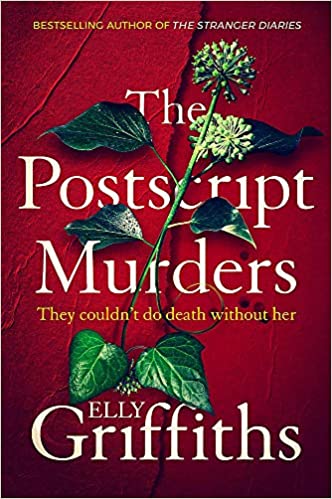
The Dark Angel by Elly Griffiths, a Dr Ruth Galloway Mystery. I like Ruth and enjoy these books, even though they are written in the present tense, which I can find irritating. This one is set in Italy. It’s the 10th Dr Ruth Galloway Mystery and the first one to be set in Italy. I like the mix of archaeology, mystery and crime fiction in Elly Griffiths’s books and also the continuing story of Ruth and the other regular characters.

The Third Degree – another Ruth Galloway mystery:

The first Ruth Galloway mystery I read is The Crossing Places. It’s an interesting mix of investigations into a cold case – the disappearance of Lucy, a five year old girl ten years earlier and a current case of another missing four year old girl. Are they connected and just how does the discovery of a child’s bones from the Iron Age fit in? It’s set in Norfolk  in winter with its immense skies and its remoteness, treacherous mud flats, marshlands and driving rain. Parts of the story involving quicksand reminded me of Wilkie Collins’s The Moonstone.

The Fourth Degree – quicksand:

In Wilkie Collins’s The Moonstone Rosanna Spearman drowns in quicksand on the marshes. It’s about the theft of a large diamond, originally stolen from a statue of an Indian God and said to be cursed. Collins uses several narrators to tell the story, one of whom is Sergeant Cluff, the detective who loves roses. He leaves the mystery unsolved, but a year later, the culprit is revealed. Years ago I watched a TV dramatisation and the images of the Indians, the jewel, the shifting sands and Sergeant Cuff have remained in my mind ever since.

The Fifth Degree – a book about a real detective who Wilkie Collins used as the model for Sergeant Cluff:

In The Suspicions of Mr Whicher Kate Summerscale describes how writers like Charles Dickens and Wilkie Collins used real life police detectives as models in their novels – for example Bleak HouseThe Moonstone, and The Woman in White. This is nonfiction about the brutal murder of Saville Kent, aged three, with all the suspects of a classic murder mystery – the original country house murder. 

The Sixth Degree – another country house murder mystery:

One of my favourite Agatha Christie novels The Mysterious Affair at Styles, her first novel. In it she created Hercule Poirot, the famous Belgian detective and introduced Captain Hastings and Inspector Japp. Old Mrs Inglethorp is found dying in her bedroom and although by the end of the book I guessed who had murdered her, I was completely bamboozled most of the way through the book by all the clues and false trails.

The links in my chain are all murder mysteries of one type or another, taking me from Sweden and Latvia to a country house somewhere in England.

Next month (December 5, 2020), we’ll begin with a book that is celebrating its 50th birthday this year – Are You There God? It’s Me Margaret by Judy Blume. I’ve not read this book, but the title, with my name in it, intrigues me. I may have to read it!

Throwback Thursday: 5 November 2020

One of the best books I’ve read is Crossing to Safety by Wallace Stegner. I read it in November 2007.

Here is an extract from my review:

In essence, the novel recounts the lives of two couples who first met during the Depression in 1930s America and the joys and difficulties they encounter throughout their lives. Larry Morgan is the narrator and the events are seen through his eyes. Both he and Sid Lang have jobs in the English Department at the University of Wisconsin and their lives are intertwined from the moment they meet, when both their wives are pregnant. At the start of the novel we are told that Charity, Sid’s wife is dying. Sally and Larry have travelled to Battell Pond in Vermont for a reunion with the Langs. Sally is in a wheelchair and from that point Larry looks back over their lives.

Click here to read the rest of this review