Recent Loans from the Library

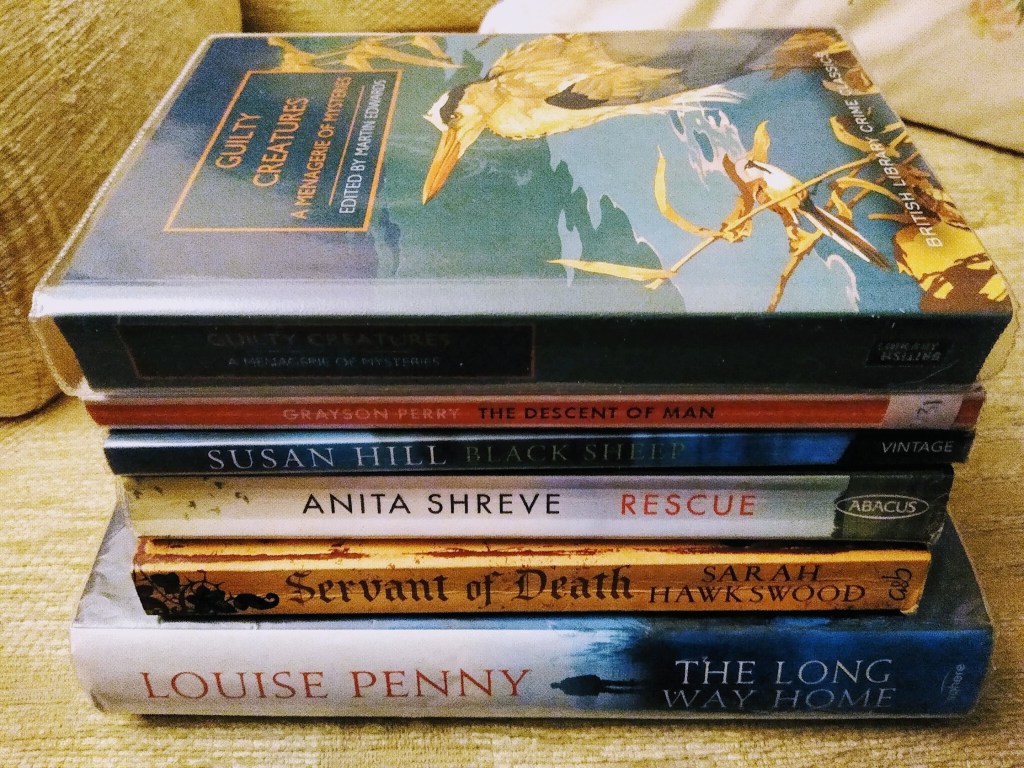
Guilty Creatures: A Menagerie of Mysteries edited and introduce by Martin Edwards. I like these anthologies as much, if not more, for Martin Edwards’ introductions than for the actual stories. I often find that they’re too short for my liking, but I’m hoping there will be some that will prove me wrong. This collection includes stories by Arthur Conan Doyle, G K Chesterton, Edgar Wallace, Josephine Bell and Christianna Brand, among others.

The Descent of Man by Grayson Perry. During the fist lockdown I loved watching Grayson’s Art Club, Channel 4’s documentary series hosted by him and his wife, psychotherapist Philippa Perry. In this book he is looking at masculinity, particularly examining how men dominate much of our world, how men dress and act, how men resort to crime and violence, and how men feel.

Black Sheep by Susan Hill, a novella about a brother an sister who grew up in a coal mining village and yearn to escape. Neither can break free and their decisions result in brutal consequences. It sounds a bit grim!

Rescue by Anita Shreve. The last few books by Anita Shreve I’ve read haven’t been as good as her earlier ones, so I’m hoping this one won’t be disappointing. It’s about a paramedic who rescues a troubled young woman from a car crash. They start a love affair and have a daughter. Eighteen years later he is raising the girl on his own,

Servant of Death by Sarah Hawkswood, historical murder mystery set in the 12th century, the first in the Bradcote and Catchpole mystery series. The Lord Bishop of Winchester’s clerk – is bludgeoned to death in Pershore Abbey and laid before the altar in the attitude of a penitent. Who hated him enough to murder him?

The Long Way Home by Louise Perry. I thought it looked familiar and when I got home and checked my blog I realised I’d borrowed this book before – in 2018! But I took it back unread, thinking I’d try to get the first one. It’s the 10th Chief Inspector Gamache novel – and I still haven’t read any of the previous books, so maybe I’ll read this one this time.

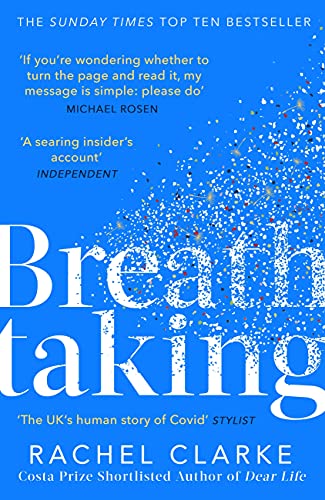
Short Nonfiction: Breathtaking by Rachel Clarke

Little, Brown Book Group| 26 January 2021| 154 pages| 4*

Novellas in November is hosted by Cathy and Rebecca. This week the focus is on short nonfiction.

I’ve watched TV programmes about Covid-19, seeing what it was like in a number of hospitals as the virus took hold in the UK, so a lot of the information in Rachel Clarke’s book, Breathtaking: Inside the NHS in a Time of Pandemic wasn’t new to me. But, I wanted to read this book to get an inside perspective on what it was like working in the NHS during the pandemic.

There have been so many fears that the NHS would be overwhelmed and reports criticising the way the government has dealt with the situation – and this is still the case now as winter approaches and the number of daily confirmed cases of coronavirus is still high, whilst hospital waiting lists for non-Covid-19 treatment remain high. Add to this there are now reports that doctors are saying that casualty departments are on the ‘edge of a precipice’, leading to dangerous levels of handover delays with patients forced to wait in ambulances for up to 11 hours outside hospitals. On TV I’ve seen the enormous queues of ambulances outside hospitals waiting to admit patients!

Rachel Clarke is a palliative care doctor and her book recounts her experiences during the first four months of 2020, when she worked on the Covid-19 wards in the Oxford University Hospitals system. Taken from her diary that she kept at the time it has an immediacy as she records her insomnia, her fears for her family and also the tremendous resilience, courage and empathy that she and the rest of the hospital staff had.

She tells the now familiar story about the PPE shortages, the lack of funding they experienced and criticises the government for their failure to act quickly enough – which I echo. Although it is a grim account, as I expected, it is also uplifting to know the care they took of their patients and the attentiveness to their patients’ needs despite the fact that many of the staff were not trained in intensive care and had never dealt with anything like this before.The way they had to prioritise patients is shocking, but I suppose inevitable given the lack of resources and staff.

She found that being a pandemic doctor was revelatory:

The crisis has undeniably revealed sweeping truths about social and economic inequalities, class divisions, global interconnectedness and the fact that our society’s most vital key workers were, and remain, among the lowest paid and the least empowered. Historians will dissect the issues for years to come. My revelations were about people. I learned from ward to ward, from bedside to bedside, paying meticulous attention to one human being and then another. I discovered how to distinguish what we absolutely cannot do without from what is really in the end, superfluous. (page 18)

This book is a snapshot, written at the time:

It depicts life and death, hope, fear, medicine at its most impotent and also at its finest, the courage of patients in enormous adversity, the stress of being torn between helping those patients and endangering your spouse and children, the long, fretful nights ruminating over whether the PPE you wear fits the science or the size of the government stockpile. I needed, I think, to take a stand with my pen and simply say: I was there. I have seen it, from the inside. I know what it was like. Here, with all its flaws and its inherent subjectivity, is my testimony. Make of it what you will. (pages 18-19)

Breathtaking records the compassion and kindness of numerous people, and pays tribute to both NHS staff and volunteers in dealing with such a distressing and immensely horrific situation.

Novellas in November: Short Nonfiction

Novellas in November is hosted by Cathy and Rebecca. This week the theme is short nonfiction and these are some I’ve read in previous years.
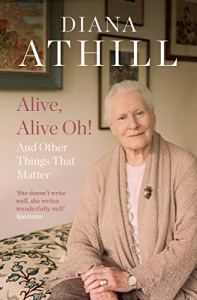
  1. Alive, Alive Oh and Other Things That Matter by Diana Athill (21 December 1917 – 23 January 2019). She was a British literary editor, novelist and memoirist who worked with some of the greatest writers of the 20th century at the London-based publishing company Andre Deutsch Ltd. This book contains her memories, thoughts and reflections on her life as she approached her 100th year, covering events from her childhood in the 1920s and 1930s, her post-war life, visits to Florence, and in the Club Mediterranee in Corfu in the 1950s, and the friends and lovers she has known upto 2009 when she moved into a home. The chapters follow on chronologically but are unconnected except for the fact that they demonstrate her love of life. And it is this love of life that is evident in her writing that makes it such a remarkable book. I loved it.
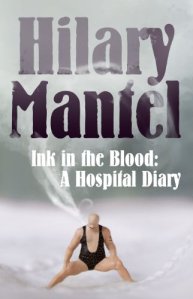
  2. Ink in the Blood: A Hospital Diary by Hilary Mantel, another short memoir. I read this in 2011 after Hilary Mantel’s talk at the Borders Book Festival at Melrose had been cancelled in the previous summer.  She had to cancel that because she wasn’t well – I didn’t know just how ill she was. Ink in the Blood reveals all – how she had surgery to remove an intestinal obstruction that ended up in a marathon operation, followed by intense pain, nightmares and hallucinations. Illness she found knocks down our defences, revealing things we should never see, needing moment by moment concentration on breathing, on not being sick and being dependent on others for your well-being. Writing was Hilary Mantel’s lifeline – it was the ink, as she wrote in her diary, that reassured her she was alive.
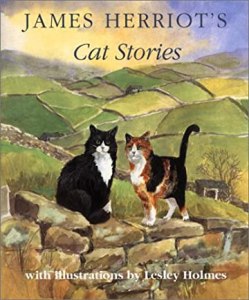
  3. James Herriot’s Cat Stories is a collection of ten stories clearly demonstrating his love of cats. In the introduction James writes that cats were one of the main reasons he chose a career as a vet. They have always played a large part in his life and and when he retired they were still there ‘lightening’ his days. This is a short book of 158 pages with illustrations by by Lesley Holmes.

I’ve recently read Breathtaking by Rachel Clarke and I’ll post a review later.

Nonfiction November: Week 2 Book Pairings

Week 2: (November 8-12) – Book Pairing with Katie at Doing DeweyThis week, pair up a nonfiction book with a fiction title. It can be a “If you loved this book, read this!” or just two titles that you think would go well together. Maybe it’s a historical novel and you’d like to get the real history by reading a nonfiction version of the story. 

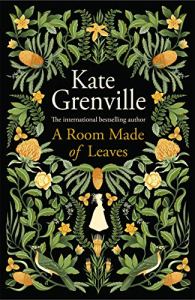
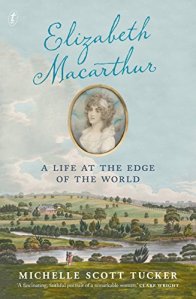
Earlier this year I read the novel A Room Made of Leaves by Kate Grenville and I’m pairing it with Elizabeth Macarthur: A Life at the Edge by Michelle Scott Tucker, which I haven’t read yet.

Kate Grenville is one of my favourite authors, so I was very keen to read A Room Made of Leaves. It’s historical fiction telling the story of the Macarthurs, Elizabeth and John Macarthur, who settled in Australia at the end of the eighteenth century. It’s based on the real lives of the Macarthurs using letters, journals and official documents of the early years of the New South Wales colony. Her writing suits me – historical fiction, with good descriptive writing setting the scenes vividly in their locations. I find her books difficult to put down and they stay in my mind long after I’ve finished reading. This one is no exception.

Whenever I read historical fiction I always want to know how much is fact and how much is fiction, how accurate it is. And so this novel intrigued me because Kate Grenville’s book begins with an editor’s note about ‘the ‘incredible discovery of Elizabeth Macarthur’s secret memoirs’ in a tin box containing old papers, revealing the real person behind the few letters she wrote home to her family and friends and a lot of ‘dull correspondence with her adult children’. Was this true, I wondered. So I turned to the back of the book to read Grenville’s Author’s Note and in that she clarifies that this is not history and, although the extracts from Elizabeth’s letters are from the letters of the real Elizabeth Macarthur, she has ‘taken some liberties in order to shape this work of fiction’. The old documents were Grenville’s ‘inspiration and guide’. In other words you have to bear in mind the epigraph, an actual quotation from one of Elizabeth’s letters: Believe not too quickly, a reminder that this is fiction.

It made me want to know more about the Macarthurs, and what was indeed their history, so I was delighted to find out that Kate Grenville references Michelle Scott Tucker’s biography: Elizabeth Macarthur: A Life at the Edge of the World as the standard biography in her Acknowledgements and I was even more delighted to see that it’s available as a ebook. So it is now in my Kindle and I’m keen to read it as soon as possible. I want to see what Michelle Scott Tucker has made of the same historical sources – history, after all, is an interpretation of the facts from the records, trying to explain what happened and why, dependent on available evidence. Fiction is more flexible and can fill in the gaps where the documentary evidence is lacking.

Six Degrees of Separation: from What Are You Going Through to The Man on a Donkey

It’s time again for Six Degrees of Separation, a monthly link-up hosted by Kate at Books Are My Favourite and Best. Each month a book is chosen as a starting point and linked to six other books to form a chain. A book doesn’t need to be connected to all the other books on the list, only to the one next to it in the chain.

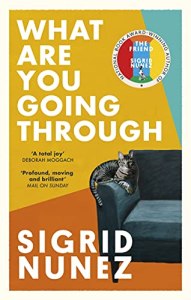
The chain this month begins with  What Are You Going Through by Sigrid Nunez, a book I’ve not read. Described as a luminous, heartbreaking and life-affirming novel about choosing to die, it is a novel about a woman with terminal cancer. She asks a friend to accompany her on a holiday where she will, without warning one day, take a lethal pill to end her life on her own terms.

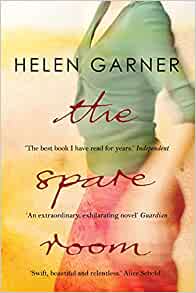
My first link: My first thought was to link my chain to books about cancer, beginning with The Spare Room by Helen Garner. Nicola, who is suffering from cancer goes to stay with her friend Helen whilst she undergoes alternative therapy. She refuses to accept that she is dying and Helen struggles to cope with the situation. It is a difficult book to read, not because of the style of writing, which is fluent, but because of the agonising descriptions of Nicola’s condition and the anguish and anger that hits Helen. But I’m glad I read it; it was nowhere nearly as bad as I imagined it would be.

So then I changed my mind and the rest of the chain just happened:

My second link is a bit tenuous and is via the author, Helen Garner, an Australian author, born in Geelong. In the 1959 film of Nevil Shute’s novel On the Beach the closing scenes were filmed near Barwon Heads, a suburb of Geelong. The novel is set after a world wide nuclear war has destroyed most of the globe, and the few remaining survivors in southern Australia await the radioactive cloud that is heading their way and bringing certain death to everyone in its path.

My third link is another novel with the word ‘beach’ in the title, On Chesil Beach by Ian McEwan. Edward and Florence married that morning are on honeymoon at a hotel on Chesil Beach, an 18-mile long shingle barrier beach on the Dorset coast. They are struggling to suppress their fears of their wedding night to come.

My fourth link: is the name ‘Florence’. In Deadheads by Reginald Hill old Mrs Florence Aldermann instructs her great nephew, eleven year old Patrick, how to deadhead roses and explains why it is necessary. When Patrick eventually inherits the splendid Rosemount House and gardens on the death of his aunt he is able to indulge his horticultural passions without restraint. But why do so many of his colleagues keep dropping dead?

My fifth link is to a novel with the word ‘rose’ in the title. It’s one of my favourite books, The Name of the Rose by Umberto Eco, historical fiction set in 1327. Benedictine monks in a wealthy Italian abbey are suspected of heresy, and Brother William of Baskerville arrives to investigate. He collects evidence, deciphers secret symbols and coded manuscripts, and digs into the eerie labyrinth of the abbey, where “the most interesting things happen at night.” When his delicate mission is suddenly overshadowed by seven bizarre deaths, Brother William turns detective.

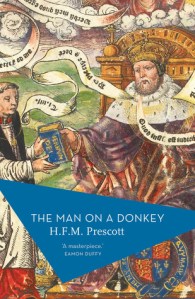
My sixth link: is to The Man on a Donkey by H F M Prescott, historical fiction that features Benedictines but in this book it’s Benedictine nuns, not monks. It is set in 1536 and is about The Pilgrimage of Grace, a protest against Henry VIII‘s break with the Roman Catholic Church, the Dissolution of the Monasteries, and the policies of the King’s chief minister, Thomas Cromwell.

Beginning with stories about terminal cancer my chain travels to one about Henry VIII’s dissolution of the monasteries, via tales about survivors of a nuclear war, a couple’s fears of their wedding night, a man who loves roses accused of murder, and murders in an Italian abbey.

Next month (December 4, 2021), we’ll start with the classic novella, Ethan Frome by Edith Wharton. For a change the chain begins with a book I have read!

Contemporary Novellas: Fludd by Hilary Mantel

A dark fable of lost faith and awakening love amidst the moors

5*

Novellas in November began this week, hosted by Cathy and Rebecca. Each week they will take it in turns to host a “buddy read” of a featured book they hope you will join in reading – see their blogs for details.

The definition of a novella is loose – it’s based on word count rather than number of pages – but they suggest aiming for 150 pages or under, with a firm upper limit of 200 pages. The prompt for this week is contemporary fiction, defined as post 1980 and hosted by Cathy,

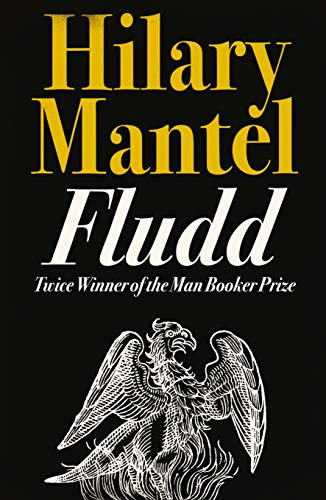
My choice this week is Fludd by Hilary Mantel, first published in 1989 by Viking. My copy, published in 2010 by Fourth Estate, has 181 pages followed by additional features at the end, including an About the Author section, and an interview with Hilary Mantel.

Description:

Fetherhoughton is a drab, dreary town somewhere in a magical, half-real 1950s north England, a preserve of ignorance and superstition protected against the advance of reason by its impenetrable moor-fogs. Father Angwin, the town’s cynical priest, has lost his faith, and wants nothing more than to be left alone. Sister Philomena strains against the monotony of convent life and the pettiness of her fellow nuns. The rest of the town goes about their lives in a haze, a never-ending procession of grim, grey days stretching ahead of them.

Yet all of that is about to change. A strange visitor appears one stormy night, bringing with him the hint, the taste of something entirely new, something unknown. But who is Fludd? An angel come to shake the Fetherhoughtonians from their stupor, to reawaken Father Angwin’s faith, to show Philomena the nature of love? Or is he the devil himself, a shadowy wanderer of the darkest places in the human heart?

Full of dry wit, compassionate characterisations and cutting insight, Fludd is a brilliant gem of a book, and one of Hilary Mantel’s most original works.

My thoughts:

It is 1956, set in the north of England in the fictional village of Fetherhoughton, which is loosely based on the village where Mantel grew up. She was brought up as a Catholic and the idea for the story came from a conversation with her mother about her childhood. When she was around four the Bishop decreed that all the statues in the church were to be removed which annoyed the parishioners and she heard the adults talking about what to do with the statues. One suggestion was to bury them. Her mother also told her about a young priest, who everyone liked, and who disappeared. It was assumed that there was a girl involved. The two events combined in her mind and came out as this novel.

Mantel clarifies in a Note before the story begins that the church in Fludd bears some resemblance, but not much to the Roman Catholic Church in the real world. Fludd was a real person (1574 – 1637), a physician, scholar and alchemist and she adds that

In alchemy, everything has a literal and factual description, and in addition a description that is symbolic and fantastical.

This sets the scene for what follows – there is a mystery that lies beyond the visible world, miraculous things appear to happen and very ordinary things appear miraculous. There is a hint of the supernatural.

The story centres on Fludd, a young priest who comes to the Church of St Thomas Aquinas to help Father Angwin, a cynical priest who has lost his faith. The Bishop, a modern man, is concerned about Father Angwin and wants to bring him and the Catholic community up to date – so the statues in the church have to go. This has a most disturbing effect on all concerned – not just the church and Father Angwin, but also the the nuns in the convent, and the school, both under the stern eye of Mother Perpetua.

Fludd, himself is something of a mystery. When he eats the food disappears, but he is not seen eating. When he pours out whisky for Father Anwin the bottle always remains full. Strange things happen, a wart disappears from one character’s face and finds its way to another’s, one character apparently spontaneously combusts, another disappears and there’s a tobacconist who may or may not be the devil. The real question is just who is Fludd?

I enjoyed it all immensely – partly about religion and superstition, but also a fantasy, a fairy tale, told with wit and humour with brilliant characterisation.