Weekly Geeks: Blurry Book Disorder

This week’s Weekly Geeks questions are:

  • how do we avoid BBD (Blurry Book Disorder): When one can no longer keep characters and storylines straight? Often brought on by reading multiple books from the same genre in a short period of time.
  • and secondly how we avoid reading ruts.

If I’m not careful I do suffer from BBD – if I read one book after another too quickly without pausing between them. This is one reason I write at least a few words about the books I’ve read, as it does fix them in my mind a bit longer, and I can check back what I thought about it. But unless it’s an outstanding book the details of plots and characters don’t stay with me for very long.

I also find sometimes that I’m not sure whether I’ve read a book or not. This can be because I know the story from seeing a TV adaptation or a film as in the case of some of Dickens’s novels, like Oliver Twist. As for Crime and Punishment, I think I read it years ago, but then again maybe not, maybe I just started it and never finished it. This is another reason for keeping a list of the books I’ve read. The difficulty is that I only started to do this about ten years ago and then only spasmodically.

Books can become blurry when I’m looking at them in the library or in bookshops. It’s not so bad borrowing books I’ve already read but buying duplicates is bad. I have duplicate copies of a few books because I think I’d like to read them, buy them and then discover they’re already in the to-be-read piles.

As I read from a wide range of genres I rarely find myself in a reading rut and if I do I try to read something completely different. That usually works.

Sunday Salon

I was looking through the Radio Times yesterday to see if there are any programmes of interest this week and discovered that the BBC have launched a year-long season celebrating books. Starting last night with Sebastian Faulks’s 4 programme series Faulks on Fiction on BBC2. I haven’t watched it yet – it’s still available on BBC iPlayer and on BT Vision. This first programme is about the Hero and Heroism; how ideas  have developed over the last three centuries from Daniel Defoe’s Robinson Crusoe to Martin Amis’s John Self in Money.

Tomorrow night on BBC4 at 8.30 pm there is The Beauty of Books, a new series of 4 programmes looking at the importance of books from early texts to the present day paperbacks. The first programme focuses on the oldest surviving Bible – the Codex Sianaticus.

That programme is followed at 9.00 pm by the Birth of the British Novel, examining the social and political history of 18th century Britain – another look at Robinson Crusoe and the literary innovations from Tristram Shandy to Evelina.

Robinson Crusoe was based on the real life adventures of Alexander Selkirk – see my other blog for a photo of his statue in Lower Largo, Fife where he was born.

Also starting this month is a BBC2 chat show with Anne Robinson talking to guests including P D James, Robert Harris, Clare Balding and Sister Wendy Beckett. On World Book Night on 5 March The Culture Show has a literary evening with Sue Perkins on Books We Really Read.

Later in the year Arena looks at Dickens on film, there’s a BBC4 adaptation of The Mystery of Edwin Drood, and a new version of Great Expectations on BBC1.

And that’s without looking at the radio programmes – today it’s Bookclub on Radio 4 at 4.00 pm with James Naughtie talking to Tim Butcher about his bestselling travel book Blood River, followed by Poetry Please at 4.30 pm.

There won’t be much time for actual reading!

ABC Wednesday – C is for …

Thumbnail for version as of 06:51, 12 November 2010… Susan Coolidge, the American author of some of my favourite books when I was a child.
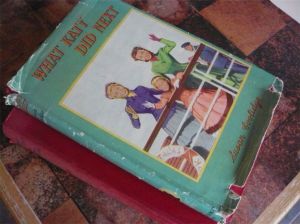
Susan Coolidge was her pen name – her real name was Sarah Chauncey Woolsey (1835 – 1905). She is best known for her classic children’s book – What Katy Did, featuring Katy Carr and her family. Along with Little Women this must be the book that I’ve the most number of times, together with What Katy Did at School and What Katy Did Next.

Looking at her entry in Wikipedia I realise now that she wrote many other books, short stories and poems, some of which are available from Project Gutenberg, including two more ‘Katy’ books, which I haven’t read – Clover and In the High Valley. There is a brief biography at the 19th-Century Girls’ Series.

I loved Katy. She was a tomboy, always getting into scrapes, playing rough games and getting into trouble. But there is another side to the story of Katy and her little brothers and sisters (based roughly on her own family) because Katy has an accident, falling off a swing and becomes bedridden, eventually with the help of Cousin Helen learning patience and cheerfulness. I haven’t read the book for years and I suspect I could find it a little too moralising now. I hope not I enjoyed it so much.

Katy’s hair was always untidy; her frocks were always catching on nails and ‘tearing themselves’; and in spite of her age and size, she was as heedless and innocent as a child of six. Katy was the longest girl that was ever seen. What she did to make herself grow so, nobody could tell; but there she was – up above papa’s ear and half a head taller than poor Aunt Izzie. …

She had fits of responsibility about the other children, and longed to set them a good example, but when the chance came, she generally forgot to do so. Katy’s days flew like the wind; for when she wasn’t studying lessons or sewing or darning with Aunt Izzie, which she hated extremely, there were always so many delightful schemes rioting in her brains, that all she wished for was ten pairs of hands to carry them out. These same active brains got her into perpetual scrapes.

These are my well-worn ‘Katy’ books:

Katy books

So far my entries for ABC Wednesday have had a literary connection and I hope to continue with them as long as possible. I also post non-literary entries on my other blog Margaret’s Miscellany – this week it’s C for Corfe Castle.

Sunday Salon

Reading today:

Eden’s Outcasts: the Story of Louisa May Alcott and Her Father by John Matteson. I’m making heavy weather of this book, mainly because I’m finding Bronson Alcott such a difficult person. I’m only reading a few pages each morning, which is about all I can put up with Bronson’s self-centred approach to life.

It will take me a while to finish this book as it’s over 400 pages long. So far, I’m up to page 118, and Bronson has tried and failed at almost everything he has undertaken in his search for perfection. His efforts at running a school have failed and he is about to embark on a new project – a self-sufficient commune, a ‘beacon of morality in a fallen world.’  This was to be ‘an earthly heaven‘, anything that came from the work of slaves was excluded, they would do away with money, shun the use of animal products and rely as little as possible on animals for work.

He asked Emerson to join him in his venture and also to back him financially. Emerson refused and wrote in his diary:

For a founder of a family or institution, I would as soon exert myself to collect money for a madman. (page 114)

I have to agree with Emerson.

There has been little yet in this book about Louisa but I’m hoping that will soon change as she is now 11 and beginning to rebel against her father, who baffles him with her stubbornness.

I’ve also started to read Perfume: the Story of a Murderer by Patrick Suskind. I’m not sure yet what I think of this novel. It begins well, grabbing my attention with a description of the birth of Jean-Baptiste Grenouille in Paris just before the French Revolution began. The description of the smells of Paris at that time is breath-taking in its awfulness:

The streets stank of manure, the courtyards of urine, the stairwells of mouldering wood and rat droppings, the kitchens of spoiled cabbage and mutton fat; the unaired parlours stank of stale dust, the bedrooms of greasy sheets, damp featherbeds, and the pungently sweet aroma of chamber-pots. The stench of sulphur rose from the chimneys, the stench of caustic lyes from the tanneries, and from the slaughterhouses came the stench of congealed blood. People stank of sweat and unwashed clothes; from their mouths came the stench of rotting teeth, from their bellies that of onions, and from their bodies, if they were no longer very young, came the stench of rancid cheese, and sour milk and tumorous disease.  (page 3)

Grenouille born in this stink, is not an attractive character either. Having no odour of his own but a highly developed sense of smell, he is a strange character to say the least. On the trail of an elusive but exquisite smell he tracks it down to a young girl and kills her to possess  her scent for himself.

Peter Ackroyd is quoted on the back cover:

A meditation on the nature of death, desire and decay.

I’m reserving judgement for the time being.

Teaser Tuesday

Teaser Tuesday is a weekly event hosted by MizB of Should be Reading.

My teaser today is from The Adventure of the Dancing Men in Favourite Sherlock Holmes Stories by Arthur Conan Doyle.

Holmes had been seated for some hours in silence, with his long thin back curved over a chemical vessel in which he was brewing a particularly malodorous product. His head was sunk upon his breast, and he looked from my point of view like a strange, lank bird, with grey dull plumage and a black top-knot.

‘So, Watson, said he, suddenly, ‘you do not propose to invest in South African securities?’ (page 57)

Favourite Sherlock Holmes Stories is a collection of twelve stories that Arthur Conan Doyle rated as his very best. It includes what Conan Doyle described as ‘the grim snake story’, The Speckled Band, and The Red-Headed League and The Dancing  Men on account of the originality of the plot of each.

It  also includes his first story – A Scandal in Bohemia; the story that deceived the public with the erroneous death of Holmes –  The Final Problem;  and the story that explained away the alleged death of Holmes – The Empty House.

Sunday Salon – P G Wodehouse

Years ago I was a Jeeves and Wooster fan and read as many of these books by P G Wodehouse that I could find in my local library. I also liked the excellent TV version with Stephen Fry and Hugh Laurie. So when my book group decided our next book would be any Wodehouse book  I was quite pleased. I’d read the first Blandings Castle book, Something Fresh a couple of years ago and enjoyed it. I don’t own any Wodehouse books so went to the library to see what was on the shelves. I came home with Summer Moonshine, first published in 1938, Jeeves in the Offing, published in 1960 and Stiff Upper Lip, Jeeves, first published in 1963.

So far I’ve read Stiff Upper Lip, Jeeves, which I finished this morning. Bertie Wooster goes to Totleigh Towers, the home of Sir Watkyn Bassett and his daughter Madeline, who is engaged to Gussie Fink-Nottle, but under the impression that Bertie is desperately in love with her – which he isn’t, of course. When Madeline insists that Gussie becomes a vegetarian he rebels and now no longer wants to marry her. Bertie is horrified as that will mean that Madeline will turn to him. He hot foots it to Totleigh Towers, despite her father’s intense dislike of him to bring about a reconciliation.

Thank goodness for Jeeves, who accompanies Bertie and helps him out of seemingly impossible situations. The events all conspire against Bertie who prides himself on his ‘stiff upper lip’:

It’s pretty generally recognised at the Drones Club and elsewhere that Bertram Wooster is a man who knows how to keep the chin up and the upper lip stiff, no matter how rough the going may be. Beneath the bludgeonings of Fate, his head is bloody and unbowed, as the fellow said. In a word, he can take it.

But I must admit that as I crouched in my haven of refuge I found myself chafing not a little. Life at Totleigh Towers, as I mentioned earlier, had got me down. There seemed no way of staying put in the darned house. One was either soaring like an eagle on to the top of chests or whizzing down behind sofas like a diving duck, and apart from the hustle and bustle of it all that sort of thing wounds the spirit and does no good to the trouser crease. And so, as I say, I chafed. (page 152)

It’s a very easy book to read, and the slang is interspersed with many literary and Biblical references, which I enjoyed, but I didn’t find it as riveting or as funny as I thought it would be – as the Jeeves books were in my memory. I suppose the farcical nature of it all eventually wormed its way into my subconscious and by the end of the book I found myself warming to it more than at the beginning and looking forward to reading the other two books.