Saturday Snapshot – Glen Etive

Here are some more photos from our recent holiday in Scotland. They are of Glen Etive in the Highlands. We drove down a little track alongside the River Etive:

River Etive P1000071until we got to Loch Etive:

Loch Etive P1000091Loch Etive is a sea loch and is part of the Rathad Mara Project to transport timber from the forests using a mobile floating pier, now derelict:

Floating Pier Loch Etive P1000090

An interpretation board by the loch side records that Glen Etive was the home of ‘Deirdre of the Sorrows‘, a first century Pictish princess who was betrothed to Conchobar, the High King of Ulster. According to Celtic tales she fled to Scotland to Glen Etive, with her lover Naoise and his two brothers, where she spent a most idyllic and peaceful time. But promised safe conduct and hospitality by Conchobar, they reluctantly leave Etive for Ireland. It ends in tragedy because Conchobar’s promise is broken, Naoise and his brothers are murdered and Deirdre according to one tale kills her self by falling from a chariot, dashing her head against a rock. In another version she simply dies of a broken heart.

Glen Etive Int Bd P1000075For more Saturday Snapshots see Melinda’s blog West Metro Mommy Reads.


Scottish Scenes from Our Holiday

Whilst we were on holiday this summer in and around Glencoe we visited Castle Stalker again. We first saw it nearly two years ago at the end of an afternoon as the light was fading. So this time we went in the morning and looked at it from both sides. We were staying at Kentallen near Glencoe – Castle Stalker is on the same road, the A828 between Kentallen and Oban and there is a view point behind the View Cafe. Just a short distance along the road there is another viewpoint via an old lane. This takes you down to the shore of Loch Linnhe:

Castle Stalker 1and here it is in close-up:

Castle Stalker 2When I say we ‘visited’ Castle Stalker it’s not strictly accurate as although it is open to visitors that’s only for five days a year  – and not during the time we were there.

From Castle Stalker we drove on to Oban, which as it was the holiday season was packed. But we walked up the hillside above Oban to McCaig’s Tower overlooking the town and it was much quieter there. It’s not actually a tower but a Roman style Colosseum built over a five year period from 1895 until his death in 1902 by John Stuart McCaig. It was unfinished at the time of his death. He intended it to have a roof and a central tower.

McCaig's Tower from below P1000051

Inside the tower is a garden with spectacular views over the town, the harbour and out to  the islands of KerreraLismore and Mull.

McCaig's Tower P1000034


Oban from McCaig's Tower P1000042

I have more photos to show another day of Glen Etive, a beautiful glen in the Central Highlands.

 Saturday Snapshot is a weekly event hosted by West Metro Mommy Reads.

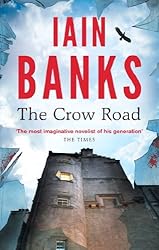
Book Beginnings: The Crow Road by Iain Banks

It was the day that my grandmother exploded. I sat in the crematorium, listening to my Uncle Hamish quietly snoring in harmony to Bach’s Mass in B Minor, and I reflected that it always seemed to be death that drew me back to Gallanach.

A dramatic opening that caught my attention when I began reading Iain Bank’s novel The Crow Road. I’ve read on further and so far I’m intrigued and amused by this family saga of the McHoans, that switches about between the generations.

Every Friday Book Beginnings on Friday is hosted by Gillion at Rose City Reader where you can share the first sentence (or so) of the book you are reading, along with your initial thoughts about the sentence, impressions of the book, or anything else the opener inspires.

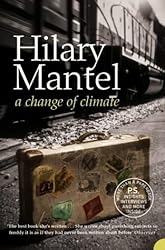
First Chapter First Paragraph: A Change of Climate

Every Tuesday Diane at Bibliophile by the Sea hosts First Chapter First Paragraph Tuesday Intros, where you can share the first paragraph, or a few, of a book you are reading or thinking about reading soon.

Today’s choice is A Change of Climate by Hilary Mantel, a book I’ve borrowed from my local library. It begins:

1970

SAD CASES, GOOD SOULS

One day when Kit was ten years old, a visitor cut her wrists in the kitchen. She was just beginning on this cold, difficult form of death when Kit came in to get a glass of milk.

The woman Joan was sixty years old, and wore a polyester dress from a charity shop. A housewifely type, she had chosen to drip her blood into the kitchen sink. When Kit touched her on the elbow, she threw the knife on to the draining board and attempted with her good hand to cover Kit’s eyes.

By this stage in her life Kit was not much surprised by anything. As she ducked under the woman’s arm she thought that’s our bread-knife, if you don’t mind; but she said, ‘You shouldn’t be doing that Joan, why don’t you come away from the sink, why don’t you sit down on this chair and I’ll get a first-aid kit?’

I haven’t read much more than this but these opening paragraphs have made me want to know more about the ‘Good Souls‘ and the ‘Sad Cases‘.

Hilary Mantel’s work is so diverse with books ranging from  personal memoir and short stories to historical fiction and essays. A Change of Climate is one of her early books, first published in 1994, described on the back cover as ‘a literary family saga’ and ‘a first rate thriller’

At the end of the book there is an About the Author section, which I’ve just glanced over. In answer to one of the interviewer’s questions about the theme of the book, Hilary Mantel replied that there is a central secret, an enormous destructive secret. I didn’t want to spoil the book for myself so I didn’t read any more of her answers. I’ll read the book to find out what that secret is.

What do you think? Would you keep reading?

Cragside: The Turkish Baths

I haven’t done a Saturday Snapshot for months!

Turkish Bath P1090264

Here are some photos of the Turkish Baths at Cragside, in Northumberland that I’ve been meaning to post since our last visit. There’s a lot to see at Cragside. It’s now owned by the National Trust and was formerly the home of William George Armstrong (1810 – 1900). We didn’t manage to see this suite of rooms the first time we visited as there was quite a queue.  But on our second visit there weren’t as many people. You go down stairs from the Library lobby to go into the rooms below the Library. The guide book describes them as:

The suite of rooms includes a steam bath, a cold plunge, a hot bath and a shower, as well as water closets and a changing room. They are the lowest and the first completed part of Norman Shaw’s first addition to the original house. His plan, which shows that modifications were still being made, is dated 5 May 1870, and Armstrong’s friend, Thomas Sopwith, recorded in his diary that €˜the Turkish Bath at Cragside was used for the first time on November 4th 1870€².
The baths were part of Lord Armstrong’s innovative provision of central heating for the whole house. The space occupied by the baths is cleverly situated between chambers with huge water-pipe coils, which, heated from the boiler to the north, were the source of hot air that was ducted up into the main house. (NT guide book for Cragside)

Turkish Bath P1090265

Turkish Bath P1090266Apparently, Lord Armstrong was keen to build up foreign business and thought that:

Chinese or Burmese, or Japanese arms ministers would be more likely to agree to handsome contracts, if they were both well entertained and comfortable – even in a Northumbrian winter. (NT guide book for Cragside)

I think it’s an excellent idea and wish we had space for something similar!

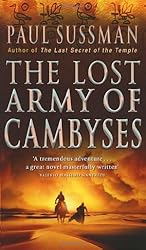
Book Beginning: The Lost Army of Cambyses

After a month of reading library books and new books I’ve got this year I thought it was time to get back into my stock of to-be-read books and picked one at random. It’s The Lost Army of Cambyses by Paul Sussman. Before I began this blog I read Sussman’s The Last Secret of the Temple, which I thought was excellent, so I was looking out for more of his books. Three years later I found this book and it has been sitting unread for the last four years! Time to read it …

The Lost Army of Cambyses is his first book, featuring Inspector Yusuf Khalifa of the Luxor police (as in The Last Secret of the Temple). It begins in 523BC as the Persian army of Cambyses is crossing Egypt’s western desert on their way to destroy the oracle at Siwa:

The Prologue: The Western Desert, 523 BC

The fly had been pestering the Greek all morning. As if the furnace-like heat of the desert wasn’t enough, and the forced marches, and the stale rations, now he had this added torment. He cursed the gods and landed a heavy blow on his cheek, dislodging a shower of sweat droplets, but missing the insect by some way.

‘Damned flies!’ he spat!

As the  account by Herodotus quoted at the front of the book reveals, the story goes that this army never reached its destination and never returned – it was engulfed by a violent sandstorm and disappeared forever.

Chapter 1 picks up the story in Cairo, September 2000, where a mutilated corpse is washed up on the banks of the Nile at Luxor, an antiques dealer is savagely murdered in Cairo, and an eminent British archaeologist is found dead at the ancient necropolis of Saqqara.

The whole thing intrigues me and I’m eagerly reading on …

Every Friday Book Beginnings on Friday is hosted by Gillion at Rose City Reader where you can share the first sentence (or so) of the book you are reading, along with your initial thoughts about the sentence, impressions of the book, or anything else the opener inspires.