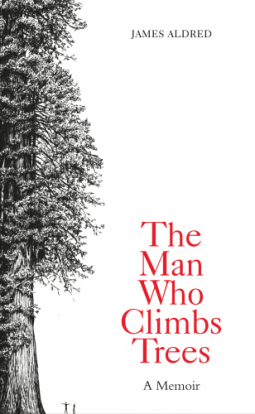
Publication date: 24 August 2017, Ebury Publishing
Source: e-book for review from the publishers
My rating: 5*
It was a delight to read The Man Who Climbs Trees by James Aldred. It is not only full of information but also beautifully written and absolutely fascinating. If you have ever wondered how wildlife/nature documentaries are filmed this book has the answers.
James Aldred, a professional tree climber, wildlife cameraman, and adventurer, explains how he discovered that trees are places of refuge as well as providing unique vantage points to view the world. Trees enthral him, right from the time he first climbed into the canopy of an oak tree in the New Forest. Climbing trees gives him peace within himself and with the world around him. Since he first began climbing trees he has travelled the world climbing many of the world’s tallest trees, filming for the BBC and National Geographic magazine.
It’s incredibly dangerous work. It’s not only the difficulties of climbing some of the world’s tallest trees, but also dealing with extreme weather, attacks from animals, birds and a variety of insects. Perhaps the most horrifying was a sinister rash that appeared all over his body when he was in the Congo. This rash developed into ninety red angry boils, several of them on his head. Then he was woken by something moving beneath the skin of his scalp, squirming and wriggling around; the pain was unbearable. Each boil was home to spine-covered maggots that bot-flies, large black flies with bulbous red eyes, had laid under his skin! He ended up in hospital with cerebral malaria.
I have always loved trees but I’ll never look at them again with the same eyes after reading this book – such strange and wonderful stories of the nature and significance of trees.
The Man Who Climbs Trees is a wonderful book, full of James Aldred’s adventures and his views on life and spirituality. I loved it. His travels brought him into contact with dozens of different religions and philosophies all containing ‘profound elements of truth’ that he respects very much, concluding that ‘spirituality is where you find it’ and he finds it ‘most easily when up in the trees’.
Added on 6 September 2017
There are no photos in this book but there are some in this article and an amazing video James took of the incredible Korowai tribe in Papua building a tree house. It’s well worth watching.
 I read


 The Eden Project was first opened in 2001 and we’™ve been meaning to go there ever since then. Their website says, ‘œEden is all about man’s relationship with and dependence upon plants. Much of our food, our clothes, our shelter and our medicines come from the plant world. Without plants there would be no oxygen for us to breathe, no life on earth.’


 West Africa and South America as you walk through and up the biome passing waterfalls and tropical plants. I saw the biggest, smelliest flower in the world, the Titum Arum, although it had gone beyond its best, as it had flowered. By the time I took this photo my camera had steamed up!
 As it is spring and in England, the main displays were of spring bulbs, being mainly tulips ‘“ such beautiful colours. I thought the best part of this section was the display of the Rites of Dionysus.
 Dionysus was the Greek God of wine and its intoxicating power. I think these statues illustrate nature in its wild, untamed state, clearly capturing the frenzy induced by the music and wine. I liked the stark contrast between the displays of flowers and these sculptures standing on the bare earth.
 Then there is the ‘œCore‘ shaped like a sunflower, which houses exhibitions, paintings and an enormous nutcracker.
  The children had goes at turning the wheel of this massive metal structure. As the handle is turned a big steel ball is raised up to the top of the machine, where it is tipped down a chute, spiralling down to a hammer at the bottom, which then strikes the nut. It was mesmerising to watch.
 Called ‘œSeed’ it was carved out of a boulder extracted from the De Lank Quarry, in Cornwall. There are 1,800 nodes on its surface in Fibonacci spirals, representing the extraordinary growth pattern found in sunflowers, pinecones and daisies. The Seed is four metres in height and three metres wide at its widest point. I wasn’™t sure that I liked it ‘“ it’™s so strange seeing a seed so large and solid; somehow it looked too sterile, but the age of the granite is awesome!
 BooksPlease