The Return of the Native by Thomas Hardy

Blurb from Amazon:

First published serially between January and December of 1878 in the sensationalistic monthly London magazine “Belgravia”, Thomas Hardy’s “The Return of the Native” is the author’s sixth published novel. Set in Egdon Heath, an area of Thomas Hardy’s fictionalized Wessex known for the thorny evergreen shrubs, called furze or gorse, which are cut there by its residents for fuel.

When the story begins, on Guy Fawkes Night, we find Diggory Venn, a merchant of the red mineral called reddle which farmers use to mark their sheep, giving aid to Thomasin Yeobright, whom he is in love with but has unsuccessfully wooed over the preceding two years. Diggory is helping Thomasin, who is in distress having left town with Damon Wildeve under the false promise of matrimony, return home to her aunt, Mrs. Yeobright. Damon has rebuffed Thomasin in favor of the beautiful young Eustacia Vye.

However when Mrs. Yeobright’s son Clym, a successful diamond merchant, returns from Paris, Eustacia loses interest in Damon, seeing a relationship with Clym as an opportunity to escape the Heath in favor of a more glamorous and exciting locale. A classically modern novel, “The Return of the Native” presents a world of people struggling between their unfulfilled desires and the expectations of society. 

My thoughts:

Thomas Hardy is one of my favourite authors and I throughly enjoyed The Return of the Nativewhich I think is one of his best books. I loved the setting on Eldon Heath, which is based on the small heath by Hardy’s childhood home, but is much larger. The ancient round barrows named Rainbarrows, and Rushy Pond, which lie immediately behind Hardy’s childhood home, form the centre of the fictional heath. Hardy’s description of it is detailed, poetically lyrical and beautiful. 
It’s a dramatic and tragic love story. It has a large cast of characters, with lovers who change their affections throughout the novel and it’s full of intrigue with striking moonlit scenes, disputes, heated quarrels and misunderstandings, along with rustic characters and traditional celebrations, for example Guy Fawkes night, May Day and a Mummers’ play at Christmas.

It was first published in 1878 in three volumes with revisions at later dates. The revision I read was published in 1912. Hardy’s Preface establishes that the events described took place between 1840 and 1850. ‘Egdon Heath’ is a combination of various heaths that were later ploughed or planted to woodland. He liked to think of it as the ‘heath of that traditionary King of Wessex – Lear’. The Return of the Native is a complex novel, shocking to its contemporary public because of its depiction of passionate and illicit sexual relationships (tame by today’s standards).

It begins with a description of Egdon Heath, a sombre isolated place, loved by some and hated by others, some regarding it as a prison. Along the ancient highway that crossed the heath the solitary figure of an old man sees a cart ahead of him in the long dry road. Both the driver, who walked beside it, and the cart, were completely red – he was a reddleman, who supplied  farmers with redding for their sheep. He plays an important part in the novel, appearing at significant times and places to great effect on the course of events. 

It’s not a book to read quickly and it transported me back to a time that ceased to exist before I was born, where time moved more slowly, ruled by the seasons and the weather, and with a clearly defined social hierarchy. And yet, I was surprised to find that youngsters were scribbling graffiti on ‘every gatepost and barn’s doors’, writing ‘some bad word or other’ so that a woman can hardly pass for shame some time.’ Learning to write and sending children to school was blamed:

’Ah, there’s too much of that sending to school these days! It only does harm. … If they’d never been taught how to write they wouldn’t have been able to scribble such villainy. Their fathers couldn’t do it, and the country was all the better for it.’ (Page 108)8

Quite simply – I loved it. It’s a love story full of depth, atmosphere and passion, but also of tragedy  and a mix of darkness and light.

The Classics Club Spin Result

Classics Club
The spin number in The Classics Club Spin was announced yesterday. It’s number … 6

which for me is The Return of the Native by Thomas Hardy. The rules of the Spin are that this is the book for me to read by 1 June, 2020.

The Return of the Native

I’m delighted with this as I’ve been meaning to read it for years and never got round to it.

‘To be loved to madness – such was her great desire’

Eustacia Vye criss-crosses the wild Egdon Heath, eager to experience life to the full in her quest for ‘music, poetry, passion, war’. She marries Clym Yeobright, native of the heath, but his idealism frustrates her romantic ambitions and her discontent draws others into a tangled web of deceit and unhappiness.

Early readers responded to Hardy’s ‘insatiably observant’ descriptions of the heath, a setting that for D. H. Lawrence provided the ‘real stuff of tragedy’. For modern readers, the tension between the mythic setting of the heath and the modernity of the characters challenges our freedom to shape the world as we wish; like Eustacia, we may not always be able to live our dreams. (Amazon)

Did you take part in the Classics Spin? What will you be reading?

Classics Club Spin

63269-classic2bspin

It’s time for another Classics Club Spin.  I was wondering if one was due, so I’m pleased to find it is, especially as I haven’t made much progress with reading any off my list recently.

    • Before Sunday 19th April 2020, create a post that lists twenty books of your choice that remain “to be read” on your Classics Club list. This is your Spin List.  I only have 9 unread books left on my list so I’ve listed them twice and added two more books that I’d like to read.
    • You have to read one of these twenty books by the end of the spin period.
    • On 19th April the folks at The Classics Club will post a number from 1 through 20. The challenge is to read whatever book falls under that number on your Spin List by 1st June 2020.


      1. The Riddle of the Third Mile by Colin Dexter
      2. Little Dorrit by Charles Dickens
      3. Parade’s End by Ford Maddox Ford
      4. Smallbone Deceased by Michael Gilbert
      5. Far from the Madding Crowd by Thomas Hardy
      6. The Return of the Native by Thomas Hardy
      7. Love in the Time of Cholera by Gabriel Garcia Marquez
      8. Framley Parsonage by Anthony Trollope
      9. Orlando by Virginia Woolf
      10. The Riddle of the Third Mile by Colin Dexter
      11. Little Dorrit by Charles Dickens
      12. Parade’s End by Ford Maddox Ford
      13. Smallbone Deceased by Michael Gilbert
      14. Far from the Madding Crowd by Thomas Hardy
      15. The Return of the Native by Thomas Hardy
      16. Love in the Time of Cholera by Gabriel Garcia Marquez
      17. Framley Parsonage by Anthony Trollope
      18. Orlando by Virginia Woolf
      19. I’ll Never Be Young Again by Daphne du Maurier
      20. How Green Was My Valley by Richard Llewellyn

Have you read any of these and loved them? Any that you didn’t enjoy?

Oliver Twist by Charles Dickens

Charles Dickens oliver twist etc

5*

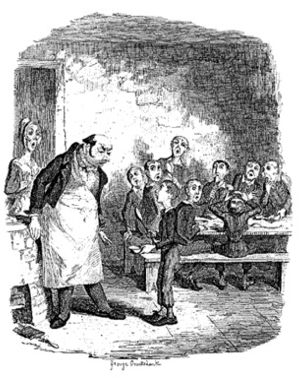
Oliver Twist by Charles Dickens was my latest Classics Club Spin book. I finished reading it on 16th January well before the finish date for the Spin, 31st January. It’s a well known story, although I realised that I only knew the beginning – Oliver’s birth in the workhouse and his early years, that famous scene where he has the audacity to ask for more, and then his escape from the workhouse only to end up in Fagin’s clutches – a den of thieves and pickpockets.

Oliver Twist
‘Please, sir, I want some more.’

I don’t intended to go into any more detail about the story, other than to say that whilst out with the Artful Dodger, attempting to steal handkerchiefs Oliver is caught by the police and rescued by Mr Brownlow. After that the story was new to me, although I knew the names of the other main characters, Nancy and the villain Bill Sykes, with his vicious dog, Bull’s Eye. But other characters in the later parts of the book, such as the Maylie family, Rose, adopted by Mrs Maylie, and her son, Harry and the mysterious man, Monks were new to me. 

Oliver Twist was first published as a serial from 1837-1839, under Charles Dickens’ pseudonym, ‘Boz’. It was his second novel, published in three volumes in November 1839. It’s full of terrific descriptions of the state of society at the time – the grim conditions that the poor suffered, the shocking revelations of what went on in the workhouse, and the depiction of the criminal underworld – the contrast of good and evil. Despite everything that happens to Oliver he remains a good boy, pure and innocent, whereas the villains are evil personified; whilst living with Fagin and his gang he existed in a state of both fascination and terror. Dickens was merciless in the satire he used in this book.

And yet in the middle of the book there is a romantic interlude full of sentimentality and melodrama. Rose Maylie is really a very pale character, being both virtuous and self-sacrificing but she contrasts well with the prostitute Nancy, who pities Oliver and tries to protect him from Fagin and Sykes. As the mystery surrounding Monks’ identity is revealed, Oliver is in more danger than anything he has faced before in his life.

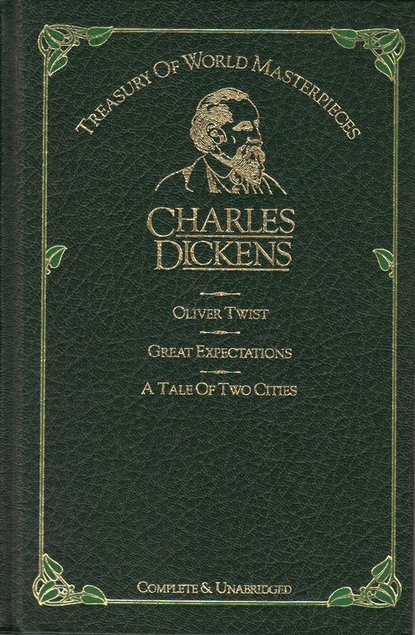
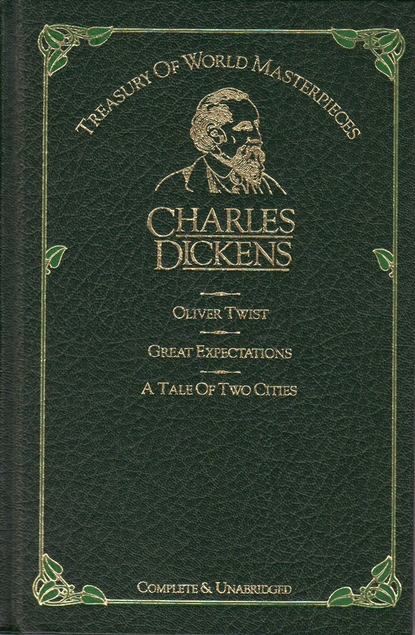
My copy also contains Great Expectations and A Tale of Two Cities (both of which I read as a teenager) and was a birthday present as long ago as 1981, so this is one of my TBRs as well as a Classics Club Spin book. In the introduction to this volume Oliver Twist is described as follows:

The story of Oliver … has become an immortal one. Hitherto Dickens had been content to entertain … with Oliver he tried to reach the deeper passions of his audience, rouse their indignation at the harsh injustice of the Poor Law and open their eyes to the horror of the London slums, while at the same time show that there is  a certain innocence in humanity (personified by Oliver) that can never be sullied. There have been some critics who have found that the two themes make uneasy bedfellows and certain contemporaries of Dickens complained that he was being purely sensational in his horrific descriptions of life in the criminal underworld. Most of his readership, however, have been both fascinated and moved.

And I can say that I too found it shocking, fascinating and moving.

The Classics Club Spin Result

Classics Club
The spin number in The Classics Club Spin was announced yesterday. It’s number … 13

which for me is Oliver Twist by Charles Dickens. The rules of the Spin are that this is the book for me to read by January 31, 2020.

Charles Dickens oliver twist etc

I’m delighted with this as I’ve been meaning to read it for years and never got round to it.

The story of the orphan Oliver, who runs away from the workhouse to be taken in by a den of thieves, shocked readers with its depiction of a dark criminal underworld peopled by vivid and memorable characters – the arch-villain Fagin, the artful Dodger, the menacing Bill Sikes and the prostitute Nancy. Combining elements of Gothic romance, the Newgate novel and popular melodrama, Oliver Twist created an entirely new kind of fiction, scathing in its indictment of a cruel society and pervaded by an unforgettable sense of threat and mystery.

Did you take part in the Classics Spin? What will you be reading?

This is my last post until after Christmas, so I’m wishing you all a very …

Christmas bells