Sunday Salon – Recent, Current and Future Reading

I keep a record of the books I read but it’s meaningless to think of them in terms of how many I read because that depends not only on their length but also on the nature and complexity of the books.  I’ve read three books so far this month:

But that is no indication at all of the amount of reading I’ve been doing. And this is mainly because one of the books I’m currently reading and have been reading for a while is the massive Wolf Hall by Hilary Mantel. I’m nearing the end now with just under 150 pages left to read. I read this morning that Henry has married Anne Boleyn, she has had her coronation and given birth to Elizabeth. Henry, of course, wanted a son and I wondered as I read this whether the words Mantel puts in his mouth were from a contemporary source or were her own in the light of her knowledge of future events. Henry is striding about the palace at Greenwich:

We are young enough, he says, and next time it will be a boy. One day we will make a great marriage for her. Believe me, God intends some peculiar blessing by this princess (my own emphasis). (page 485).

The other book I’m reading is The Very Thought of You by Rosie Alison. I’m torn between wanting to finish it and taking it slowly just because it’s so good. It’s very easy to read (it’s not written in the present tense, which helps enormously) and I could gallop through it at top speed, so different from Wolf Hall, where I sometimes have to flip back a few pages and re-read them to make sure I know what’s going on. The characters in The Very Thought of You are clearly delineated and I don’t have to wonder ‘now who is that?’  as I do in Wolf Hall – thank goodness that book has a Cast of Characters at the front and two family trees as well.

The Very Thought of You begins in 1939 and as I’m reading I’m becoming very aware that I know very little about that time or about the Second World War as a whole. I’ve been meaning to find out more and a while ago I bought Wartime Britain 1939-1945 by Juliet Gardiner, to fill in some of the gaps in my knowledge, so I keep dipping in to that as I read. It looks as though Alison has done her research well.

As for the books I have coming up next to read, I want to get back to reading more Agatha Christie – Death on the Nile for example and  also Set in Darkness, the next Rebus book in my reading of Ian Rankin’s series. But before that I have some review books to read. The vast majority of the books I read are my own or borrowed from the library or friends and family, but every now and then I receive books from publishers. At the moment I have three I haven’t read yet, although I have read the beginning of each one:

There is one more book that I’d love to read right now and that is The Border Line by Eric Robson (a library book). Robson is a broadcaster and he wrote this book about walking the modern border line between England and Scotland from the Solway Firth to Berwick-on-Tweed. It’s a mixture of history and anecdotes with descriptions of the landscape – the cairns, castles, battlefields and boundary stones along the way. This is the area we spent much time in last year when we were looking for a place to move to in the Borders and where we now live.
Sunday Salon

Today I’ve been reading more from Wolf Hall by Hilary Mantel and I’m now almost at the halfway stage. At times I’m loving it and at times I’m thinking why, oh why is she writing this in the present tense? See, it’s getting to me – I’m not overly fond of books in the present tense. And why does she keep using ‘he’ and I’m not sure which ‘he’ she means? Sometimes it’s Thomas Cromwell, but it could be any number of other ‘he’s’ too. But on the whole she’s winning me over and I have to keep on reading. What a character this man Cromwell is, a man who Cardinal Wolsey describes as:

… rather like one of those square-shaped fighting dogs that low men tow about on ropes. Not that you are without a fitful charm, Tom. (page 86)

Cromwell knows that

You don’t get on by being original. You don’t get on by being bright. You don’t get on by being strong. You get on by being a subtle crook … (page 60)

I didn’t expect Wolf Hall to be relevant to the current state of affairs and yet it’s about power, who holds the purse strings, who can command. People, then as now, want change, always hoping for something better. I read this as the present election campaign was in flow with the politicians’ slogans ‘Vote for Change’ and ‘Change that Works for You’. Just see what Geroge Cavendish thought in 1529

‘But what do they get by the change? ‘ Cavendish persists. ‘One dog sated with meat is replaced by a hungier dog who bites nearer the bone. Out goes the man grown fat with honour, and in comes a hungry and a lean man.’ (page 55)

Talking about elections, Thomas Cromwell’s campaign to be ‘elected’ was rather different from today’s methods.  His constituency was Taunton which he held with the agreement of the king and the Duke of Norfolk because seats in the House of Commons were

…  largely, in the gift of the lords; of lords, bishops, the king himself. A scanty handful of electors, if pressured from above, usually do as they’re told. (page 161)

Well, at least that is different these days.

Wolf Hall engages me on different levels – it’s historical fiction of period I used to know well and as I read it all comes back to me – Henry VIII’s wives and all that. It’s also made me think about writing styles and what I’m comfortable reading. It’s a dense book, one that you have to take your time reading and it helps if you know the history because nothing happens quickly in this book, which is full of description and lots of characters. I’m not finding a page-tuner but a fascinating study in particular of Thomas Cromwell.

Wolf Hall is a long book, and I need to vary my reading. I’m also at the beginning of The Very Thought of You by Rosie Alison, very different from Wolf Hall and also listed for the Orange Prize for Fiction. Moving forward 400 years from Tudor England to Britain in the 20th century on the brink of war with Germany is quite a leap, but it still feels like historical fiction. The Very Thought of You begins with Anna’s evacuation from London in September 1939 to Ashton Park, a large Yorkshire estate. This is the calm before the storm.

It’s a very different style from Wolf Hall and I’m enjoying the contrast. So far, it has a warm, family feel about it, yet connected to world events with the parallel activity in Poland as Hitler invaded. The British ambassador in Warsaw, Sir Clifford Norton, watched the city burn and abandoned the embassy as the Nazis and the Soviets invaded.

I don’t envy the Orange Prize judges their task – how do you compare such different books?

Sunday Salon

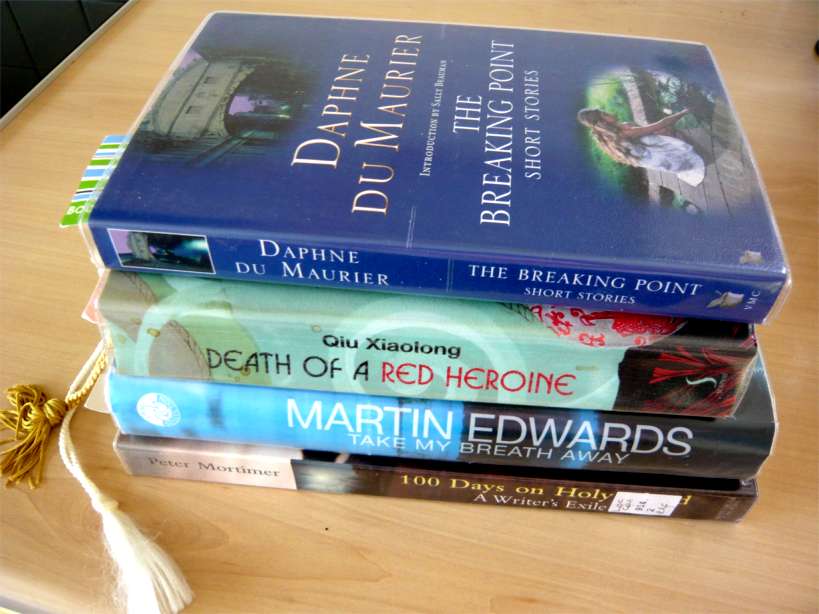
I’ve now started reading 100 Days on Holy Island: a Writer’s Exile by Peter Mortimer, a diary of the time he spent living on Lindesfarne, off the coast of north-east England, in a close-knit community of a 150 people. This is not a book about the history of the island but it is about what it was like for Mortimer to live there on his own away from his  family from January to April 2001.

It began badly as his father died just before Mortimer had planned to leave, and his nephew was very ill after an emergency operation. As it was winter there were few, if any, visitors to the island and the pubs and village store were closed for most of the time:

 It was silent in the way cities are never silent, silence not as a brief interruption from traffic, the humans, the incessant noise of civilisation, but silent as a way of being. What lay beneath the surface of this small settlement I had no idea. But on a bitter cold January night in 2001, it offered up silence as a totally natural state. (page12)

In preparation for his stay he had asked ten northern writers to select  a book (not written by themselves) that they thought might amuse,divert or challenge him during his stay. Nine of them gave him a book and I’m looking forward to discovering what they were. 

I can see already that I’m going to enjoy this memoir and hope the rest of the book lives up to the beginning.

I’ve dipped into The Breaking Point by Daphne du Maurier (short stories) this week and will continue reading that later on. Qiu Xiaolong’s Death of a Red Heroine has had to take a back seat for a while whilst I read these two books and I’m also tempted to start reading Martin Edward’s Take My Breath Away. I just wish I had more than one set of eyes and one brain to cope with reading multiple books – that would be excellent.

Sunday Salon – Which Free* Book to Choose?

 Newbooks magazine arrived on Friday and as usual there are extracts from six books to read before deciding which one (if any) I’ll choose as my ‘free’ copy (*paying just for the post and packing). I haven’t read any of the extracts yet.

These are my initial thoughts on the books:

I have The Angel’s Game out on loan from the library so I probably won’t choose this one. It’s the second novel by Carlos Ruiz Zafon and like his first The Shadow of the Wind is set in Barcelona. It’s a stand-alone story about a writer of sensationalist novels in the 1920s; a tale about the magic of books. The author writes that it is a book to make you step into the storytelling process and become part of it.

This  is also a second novel, narrated by a sensitive thirteen-year old boy. It’s set in the 1960s in a small mining town in Australia and is a “coming-of-age” story. Silvey writes that he wanted to capture the thrill of that age, where everything seems bigger and the stakes seem higher. It’s a time of burned innocence. Infinite dangers. Fresh experiences that are never forgotten.

This was shortlisted for the 2009 Man Booker Prize and I borrowed it from the library last year. I read the beginning but it didn’t grab me then and I returned it unfinished. It’s based on the real-life story of the poet John Clare and the time he spent in an asylum in the 1840s. I was disappointed I couldn’t connect with this book, maybe it was just the wrong time for me to read it.

This one appeals to me. It’s Mari Strachan’s first novel and it’s about Gwenni, a Welsh girl growing up in the 1950s who is bookish, loves playing detective and can fly in her sleep. Mari Strachan writes about her contentment with quietude in the magazine and if her writing in the novel is anything like this I want to read her book. She writes

Quietude is a place in my mind that I travel towards on my own, a place that no one else is able to enter, a place far away from the babble of the world. It’s the place Yeats found in ‘The Lake Isle  of Innisfree’ where ‘peace comes dropping slow’, and the place Wordsworth described as his ‘inward eye that is the bliss of solitude’.

This book appeals to me too. I’ve read one of Andrea Camilleri’s Inspector Montalbano Mystery books and enjoyed it. This is his tenth one and like the others it’s set in Sicily. Montalbano investigates the murder of a young girl whose body is discovered in a trunk. There is an article in the magazine by Stephen Sartarelli on translating Camilleri’s books. He writes:

They are written in a language that is not ‘just’ Sicilian dialect, but a curious pastiche of that particular Sicilian of Camilleri’s native region (Agrigento province) combined with ‘normal’ Italian, contemporary slang, comic stage dialogue, lofty literary flourishes, and the sort of manglings of proper Italian made by provincials who have never learned it correctly.

This is a novel about the Brontes, which also appeals to me. I know nothing about Jude Morgan’s books but looking on Amazon I see he writes historical fiction. In the magazine he writes that he doesn’t ‘dislike contemporary fiction, but too much of  it is preoccupied with the earth-shaking problem of finding the right sexual partner in NW1.’  I like historical fiction, so maybe this would be the one to choose.

Today’s reading will be the extracts from these books which I hope will help me decide which one to pick.

Sunday Salon

Not much reading here today as D and I are off out with the family this afternoon.

This morning I’ll be reading more from Griff Rhys Jones’s memoir Semi-Detached, which is coming on nicely. I’m now up to the part where Griff is in his final year at school. I loved his description of cricket that I read yesterday.

I hate and abhor cricket. I loathe cricket. I abominate cricket. There is only one thing more boring than the abysmal English habit of watching a game of cricket and that is an afternoon playing the wretched game. It is sport for the indolently paralysed. Only three people out of twenty two are engaged in any proper activity. The rest simply sit and wait their turn.

The excruciating tedium of ‘fielding’ – standing about, like a man in a queue with nothing to read, in case a sequence of repetitive events, ponderously unfolding in front of you, should suddenly require your direct intervention … (page 179)

Football is a game. Tiddly-winks is a game. A sack race involves energy and fun. Cricket is like a cucumber sandwich: indulged in for reasons of tradition, despite being totally eclipsed by every other alternative on offer. (page 181)

I can well imagine that fielding would be much more pleasurable if one could read at the same time. One of my fond memories of childhood is going with my parents to watch cricket, but then I did used to lie in the grass making daisy chains.

I’d like to finish reading Hearts and Minds by Amanda Craig this evening, if I have time before I fall asleep. I have very mixed ideas about it right now, varying from liking it to wishing I’d never bothered to pick it up. It’s a tough read – from a subject point of view, that is. This is by no means a ‘comfy’ read, more of a rollercoaster to batter and bruise. But I must finish it before writing about it properly.

Coming up next week I’m looking forward to reading one of these books:

At the moment it’s King Arthur’s Bones that is calling out to me. It’s five interlinked mysteries from Michael Jecks, Susanna Gregory, Bernard Knight, Ian Morson and Philip Gooden.

Sunday Salon – Today’s Reading

Today I’ve been reading Semi-Detached by Griff Rhys Jones (a book I borrowed from the library). This is his memoir of his childhood and adolescence and I’m enjoying reading it. I had a look at what people have written about it on Amazon and found it has some very disparaging comments. I completely disagree – this is not boring or dull, and not at all a ‘celebrity’ memoir. I’ll leave writing about it until I’ve finished it, apart from this little bit about swimming and diving in his local swimming pool. I can identify so much with his account of the diving boards. The diving boards were made up of a lower board and a high dive. And it was scary on the high board. It was best to jump off it first before attempting a dive. Griff describes the experience of his first jump, that ‘sinking, sick-making descent’:

I must have stood there taking counsel and advice for ten minutes before I finally went off for the first time, in a sudden fit of bravado: still talking, without anybody having the chance to advise me, I stepped straight off the edge and fell … arrgh: my internal organs apparently losing their adhesion to my lower abdomen.

I bobbed up quickly and swam frantically, over-energised, to the side and went straight back up. (page 80)

That was me too! I loved it, but how times have changed. My last experience in a swimming pool last year at Center Parcs in Nottingham was terrifying when I went down the flume. It was a rapid descent and I was pushed along by people behind me, ending up underwater, certain that I was going to be drowned and hating the whole thing.

My other reading this morning was The Widow’s Tale by Mick Jackson, a book I received from the publishers via LibraryThing’s Early Reviewers’ Program. This a gentle account of a newly-widowed woman who is coming to terms with her husband’s death after 40 years of marriage. It’s about her thoughts and feelings as she flees  from her London home to rent a cottage in a small Norfolk village.  I have my doubts about the narrator’s voice – at times it comes across as male rather than female, but I’m waiting until I’ve finished it to pass judgement.