The Sunday Salon

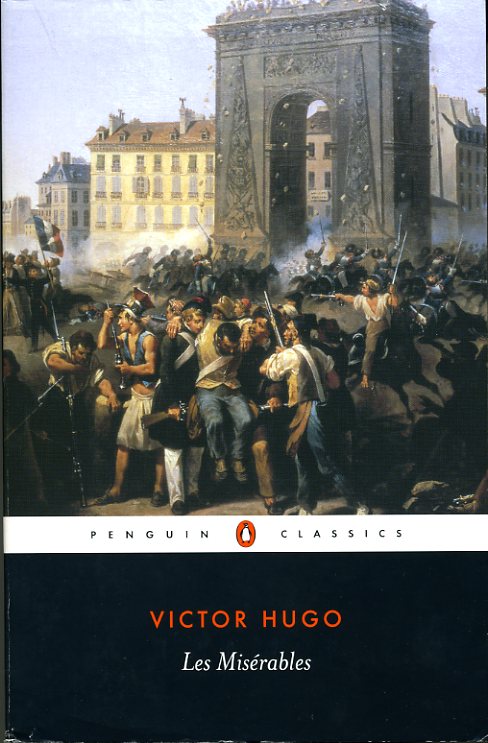
Sunday SalonWhat a gloomy day outside. I knew it was wet when my cat rubbed round my legs first thing this morning. Looking out of the window I could seen a fine sprinkling of snow. That’s all gone now and the rain has set in. What better thing to do than read Les Misérables for a while and then tackle the problem of where to store more books than will fit onto our bookshelves.

Les Misérables

I’ve made good progress this week with reading Hugo’s masterpiece. I’d put it on one side just after meeting Marius, the young aristocrat estranged from his grandfather. This week matters have progressed quite rapidly. Marius walking in the Luxembourg garden sees an elderly gentleman and a beautiful young girl. He falls in love with the girl (who is of course, Cosette). The following pages bring the sordid and wretched conditions of the poor so vividly to life as I read about the true “misérables” of this novel:

Certainly they appeared utterly depraved, corrupt, vile and odious; but it is rare for those who have sunk so low not to be degraded in the process, and there comes a point, moreover, where the unfortunate and the infamous are grouped together, merged in a single, fearful word. They are les misêrables – the outcasts, the underdogs.

I read with bated breath the account of Marius watching through a peephole the terrible happenings in the room next to his as ‘Monsieur Leblanc’ (Valjean) is ambushed, and I wondered how he was going to escape  from both the gangsters and Inspector Javert. I have now finished Part Three, which ends with the introduction of a street urchin, another significant character I assume.

So for the rest of the day it’s more sorting and tidying. D has found a space for another bookcase and in his wonderfully resourceful way remembered he had the parts to make one. He has put them together and now it just needs fixing to the wall and then I can fill it up.

The Sunday Salon

I’ve written before about the number of books I have on the go and today is no exception. Earlier this week I read Anita Shreve’s new novel Testimony, which I’ll write about in another post. Whenever I finish one book even though I’m in the middle of reading others an irrestible urge comes over me to start another. It was a bit difficult to decide but I settled on Wild Mary: the life of Mary Wesley by Patrick Marnham. I’d read and enjoyed Mary Wesley’s The Camomile Lawn many years ago and although I don’t think I’ve read anything else by her I thought this biography might be interesting. This morning’s reading took me nearly to the end of chapter 2. I stopped reading at an interesting point where Mary aged 6 refused to walk to the edge of a cliff with her mother to look down on the waves crashing over the rocks below – not because she was afraid of heights, but because she was frightened of her mother and didn’t trust her an inch. A real cliff-hanger!

Mary Wesley came from a privileged background with military connections on both sides of her family. The first chapter of the book is almost a history lesson informing me that Mary was descended from the Duke of Wellington’s older brother, Richard who became Governor-General of India and in 1797 when he was given an English barony chose the title ‘Baron Wellesley of Wellesley in Somerset’. A privileged background doesn’t always make a happy childhood and Mary, who had 16 governesses, was a “formidably obstructive child” who knew she was unwanted by her mother. From the acknowledgements and list of sources at the end of this book it  promises to be a detailed and well researched biography.

In contrast I’m also reading today Mark Twain’s Adventures of Huckleberry Finn. I started it a few weeks ago and am enjoying it much more than ever I thought I would. I had no idea it was so amusing and I love the way Mark Twain interweaves commentary on racial and class prejudice with the mishaps and adventures of Huck and his companions as they make their way down the Mississippi. This morning’s reading included the wonderful mish-mash the ‘duke’ compiles of Hamlet’s soliloquy. His version mixes together quotes from Hamlet, Macbeth and Richard III and it becomes:

To be or not to be; that is the bare bodkin
That makes calamity of so long life;
For who would fardels bear, till Birnam Wood do come to Dunsinane,
But that the fear of something after death
Murders the innocent sleep,
Great nature’s second course,
And makes us rather sling the arrows of outrageous fortune
Than fly to others that we know not of.

 I hope later on today to get back to Les Miserables as I haven’t made much progress with it for a while. The weather is helping me now as it’s so dark and dank outside with a steady drenching fine rain that looks as though it has settled in for the rest of the day. I was going to go outside and rake up some leaves but I think I’ll settle down with Les Miserables, maybe do some wii fit (I’m in danger of becoming a wii fit addict) and then watch the results show of Strictly Come Dancing – I can’t believe John Sergeant will survive another week, much as I like him!

The Sunday Salon – Reading Today …

This morning I began reading Mark Twain’s Adventures of Huckleberry Finn. Samuel Langhorne Clemens (Mark Twain) was born 30 November 1835, so reading this book takes me back nicely into the Celebrate the Author Challenge, a challenge where you “celebrate” an author’s birthday each month by reading one of their books during their birthday month. Huckleberry Finn is one of those books I’ve been meaning to read for years and never got round to it – so this November I am. So far Huck has left Miss Watson’s house, stifled by being “civilised” but now his drunken brute of a father has got him locked inside his cabin. I plan on reading a few chapters a day.

Next up is Stillmeadow and Sugarbridge, letters between Gladys Taber and her friend Barbara Webster (Shenton). Today I read a few of their letters written in June and July – so very different from the season outside my window. At Sugarbridge Barbara is writing about the way the garden runs riot in the summer, particularly after prolonged heavy rain followed by a hot spell. I do like the way she describes it:

A wave of vegetation sweeps over everything. In a twinkling grass and weeds grow up the gravel drive, poison ivy impudently snakes its vined tongue up the very front steps, the creek bank is a jungle, and what has happened to the garden? Weeds tall as trees wave a united front there … The worst of it all is that midsummer languor has descended, and I have no longer the enthusiasm I could muster earlier in the season. Things have got beyond me. I admit it; I am beaten. So I take refuge in philosophy, always the shelter of defeat.

She could have been describing our garden, which has been really neglected this year. Not that we have had the hot spell she describes – just the heavy rain.

Gladys, meanwhile, on a hot July day is looking forward to Barbara’s visit:

We shall go right to the pond as soon as you unpack your bathing suits. On the terrace the ice bucket will be frosty and fresh mint leaves will be ready for your glasses, and we shall stay ourselves with cheese and crackers and smoked tid-bits  so we won’t have to rush dinner.

It sounds perfect. And I like Gladys’s idea of bringing a book to read aloud after dinner. As she wrote:

I feel reading aloud is an art which we have almost lost sight of, and it is a great pity. Nothing is better than to sit quietly and share the experience of a good book.

This sounds wonderful:

The quick lanterns of the fireflies make a pattern of flickering gold tonight in the meadow, the sky is deep with stars. After a hot day, a summer night is dramatic and wonderful. The cool breath from the heart of the woods slides so softly over the lawn, the world is very still as if the heat of the day had tired it. One feels suddenly the urge to stay up all night, following the moonlit country roads to the pale edge of the horizon. Surely, if we did that, we should find something strange and wonderful!

I can just picture myself there!

Later today I’ll be reading more from Les Miserables. I’m making good progress and am about halfway through now, so I’ll easily finish it this year. Although there are many digressions from the story it does move along quite quickly. I have to keep reminding myself who all the characters are, though, as there are so many. In my last reading session after a longish description  of what was happening in Valjean’s life after he evaded being re-captured by Inspector Javert, I met Marius, who is going to be another major character in the story, I think.

The Sunday Salon

This week I’ve been travelling in time and place in my reading.

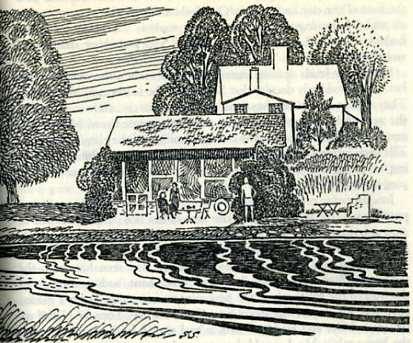
I’ve been in Pennsylvania and Connecticut with Gladys Taber and Barbara Webster reading their letters to each other from Stillmeadow and Sugarbridge over one year in the 1950s (the book was published in 1953; there’s been no mention of the Second World War so I’m guessing the letters were written in the late 1940s or early 1950s). Stillmead and Sugarbridge is a book to savour and read slowly. I’m limiting my reading to a few letters each time I pick up the book. Stillmeadow is the house in Southbury, Connecticut where Gladys Taber lived and Sugarbridge is the house where Barbara and her husband Edward Shenton lived in Pennsylvania. Edward’s drawings illustrate the letters. Between the letters and the illustrations I’m getting a good picture of their lives. Their letters are full of the love of the countryside and their families. When I’ve finished it I’ll write more fully about it. For now here is a quote from Barbara’s first letter in the book, writing in January about what she likes about living at Sugarbridge:

A broken-up day is to me a lost day, and social and business dates, no matter how delightful or important, hang over me with a sense of doom. So I am particularly grateful for those long intervals of country peace when we see no one, nor stir from our studio except for an afternoon ramble over the hills. We no longer live by the clock, slaves to time; we make our own.

She thought that this would not be everyone’s ideal. It sounds good to me.

I first read about Gladys Taber on Nan’s blog and was really pleased when she sent me this book. I would like to know more about Gladys and Barbara and so far I’ve found these websites –  Stillmeadow Friends and also Stillmeadow, where I read that the farm was in danger from development. This was in 2002 and I can’t find out what happened – does anyone know? There is also a website for Edward Shenton, but I can’t find out how Gladys and Barbara met.

Then I’ve jumped back in time to France in the 1820s with Victor Hugo’s Les Miserables. I am only too glad that I don’t live in post revolutionary France. The Battle of Waterloo is now over and Jean Valjean has at last escaped from prison and rescued Cosette from her pitiful life with the cruel Thenardiers. Poor Cosette:

Fear emanated from her so that she might be said to be enveloped in it. Fear caused her to draw her elbows in at her sides and her feet underneath her skirt, to take up as little room as possible and to draw no unnecessary breath; it had become so to speak, the habit of her body, impossible of alteration except that it must grow worse, In the depths of her eyes there was the haggard gleam of terror.

Jean and Cosette are currently on their way to Paris and a better life I hope, but I don’t expect it will be as I still have about 800 pages left to read.

Over next to Regency England in the early19th century with Georgette Heyer’s Friday’s Child. Dialogue makes up a large part of the book, full of 19th century slang. I mentioned this in my last post and in the comments Geranium Cat explained what a “Tiger” is and pointed me to this site – http://www.heyerlist.org/slang.html for more explanations. This book is a mixture of romance, a whirl of social events – balls, masquerades, theatre-going, duels and farce. I’m about halfway in the book and this morning read about the duel between George, Lord Wrotham and Sherry, Anthony Verelst, Viscount Sheringham after Sherry saw George kissing his wife, Hero.

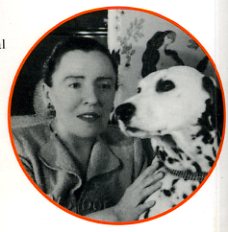
Last and my no means least I’ve popped over to America again. This time to New York with Dodie Smith in 1939 just before the start of World War Two as described in Dear Dodie by Valerie Grove. Dodie and Alec (who she marries) arrive with Pongo, the dalmatian who inspired her to write 101 Dalmatians after leaving England because Alec was a pacifist and a conscientious objector. Dodie was soon cast into gloom, unable to like America and forecasting

years of exile, a world war in progress, losing her audience-sense by being away from England, and possibly also losing all her capital. On three out of four counts her forecast was absolutely correct.

I knew very little about Dodie before and am learning a lot about England at the beginning of the 20th century and theatrical history as well as about Dodie herself – an unsuccessful actress, then a shop assistant at Heals furniture store and then a playwright. It’s fascinating reading about her relationship with people such as Noel Coward, John Gielgud, Gladys Coper, Jack Hawkins and Jessica Tandy, to name but a few.

The Sunday Salon – Starting Books

Sometimes I wish I could just concentrate on reading one book at a time. What usually happens is that I start reading a book and then another one grabs my attention and then yet another one, and another one. Before I know it I’ve started lots of them. Of course I don’t actually read them all at once and often one takes precedence and I spend more time on that one than the others. The problem then is when I’ve finished one I have to start another and so it goes on.

I’ve started reading all these books. The list is not in any order as I don’t keep a record of when I started them.

This has got to stop. Although I have read several pages or even chapters of each when I go back to them I have to refresh my memory and sometimes even start again.

The most shameful one on the list is Les Miserables because I’ve read a big chunk of it. Maybe if I concentrate on two or three – one for reading downstairs and two upstairs (morning and evening) I would do better.

So for the rest of today I’m planning to revive Les Miserables, carry on with Stillmeadow and Sugarbridge and later this evening to continue with The Secret Scripture. Well, that’s the plan, anyway.

The Sunday Salon on a cold wet Sunday

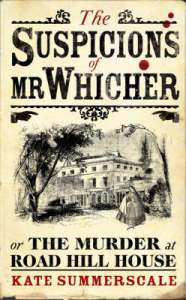
It’s raining and cold here for today’s Sunday Salon post. Summer wasn’t very long this year but then it often isn’t. It wasn’t in England in 1860 according to my reading today in Kate Summerscale’s remarkable book The Suspicions of Mr Whicher or The Murder at Road Hill House, when summer was brought to an end on the evening of 19 July by a tremendous downpour over Somersetshire and Wiltshire. Ditto this year.

This book is the winner of the Samuel Johnson Prize for Non-Fiction and it is terrific (Ian Rankin also thinks so). I’ve read nearly half the book and I only started it yesterday. It’s compelling reading but I do have a growing feeling of discomfort because I’m beginning to feel a bit of a voyeur. There is so much detail, not just of the brutal murder of Saville Kent, aged three, but of everything in the lives of the Kent family and the investigations of Detective Inspector Jonathan Whicher of Scotland Yard.

It’s the most amazing book with all the suspects of a classic murder mystery – the original country house murder. Kate Summerscale has thoroughly researched the case using the National Archives, Family Records Centre, and many libraries and museums, including the London Metropolitan Archives and the Metropolitan Police Historical Collection.

Her sources include not just books, pamphlets, essays and newspaper articles but also maps, railway timetables, and so on and so forth – even the weather details are accurate being taken from press reports and the dialogue is from testimony given in court. Did you know that a defendant was not allowed to give evidence at his or her own trial until 1898? I didn’t.

Then there are also the fascinating descriptions of how writers like Dickens and Wilkie Collins used real life police detectives as models in their novels – for example Bleak House, The Moonstone, and The Woman in White. It makes me want to rush and read those books again. Interspersed with the story of the investigation into the murder are details of the role and status of detective, the origin of the word clue, the comparison of a detective with a “sleuthhound” by Charlotte Bronte and the conduct of newspaper reporters. The word “detect” stems from the Latin “de-tegere” meaning “unroof” and the original figure of the detective was the lame devil Asmodeus who took the roofs off houses to spy on the lives inside! That’s exactly what it feels like reading this book, peering right down to the private lives of the Kent family.

It’s just the most wonderful book, no wonder it won the Samuel Johnson Prize.

I’m just wondering if all the copies of this book have the small red blob on the head of the pages that is on the one I’m reading? A nice touch I think continuing the splashes of blood on the front and back covers.