A New Rebus Story

A new Rebus short story by Ian Rankin, The Very Last Drop was published in The Scotsman today. I couldn’t find it online but it is in a four page pull-out in the paper, complete with illustrations and a photo of Ian Rankin reading his story at the Royal Blind School fundraising event that took place last Thursday at Edinburgh’s Caledonian Brewery.

Rebus, now retired, is on a tour around The Caledonian Brewery as a retirement present from Siobhan Clarke. When the tour guide Albert Simms tells the group about the ghost of Johnny Watt, who had died sixty years ago “almost to the day” after banging his head when he fell in one of the vats overcome by fumes, Rebus’s interest is aroused.  As Siobhan says

Soon as you get a whiff of a case – mine or anyone else’s -you’ll want to have a go yourself. 

He can’t resist looking back at the case, using the company’s archives and back copies of The Scotsman. What he finds is more than a ghost story.

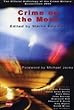
Teaser Tuesday – Crime on the Move

Teaser Tuesdays is a weekly bookish meme, hosted by MizB of Should Be Reading.

Share a couple or more sentences from the book you’re currently reading. You also need to share the title of the book that you’re getting your ‘teaser’ from €¦ that way people can have some great book recommendations if they like the teaser you’ve given!

This week I’ve been reading short stories from Crime on the Move: the Official Anthology of the Crime Writers Association edited by Martin Edwards. The contributors include  Ann Cleeves, Reginald Hill, Michael Gilbert, Keith Miles Martin Edwards and Kate Ellis who wrote Top Deck, the story  I’m quoting from today.

The theme of the collection of the stories in this book is illustrated in Top Deck through Keith’s journey home from work in Liverpool by bus in 1965. What he sees has a profound effect on the rest of his life.

When the bus stopped briefly in the Ullet Road to let somebody off Keith found himself staring straight across into a lighted upstairs window. The curtains were wide open and two people were silhouetted behind the glass; a man and a woman who, for a split second, seemed faintly familiar. The man seemed to have both his hands raised up to the woman’s throat and they were moving slowly to and fro as if the woman was trying to ward him off, trying to save her life. (page 92)

The stories in this collection are varied, succinct and satisfying, ranging from the macabre and eerie to the comic, about journeys on the sea, in the air and on land. This is a book to dip into and enjoy.

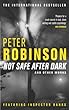
Not Safe After Dark by Peter Robinson

Not Safe After Dark and Other Works is a collection of twenty short stories by Peter Robinson. There are three Inspector Banks stories, one of which Going Back is a novella that had not been published before. The other stories are varied in length, technique and style.

 Of them all I prefer the Inspector Banks stories, in particular Going Back. There isn’t much mystery in this story, but a lot about Banks himself, his youth, relationships with his parents and brother Roy and about his old girlfriend, Kay. It’s his parents’ golden wedding anniversary and Banks goes home for the weekend for the party. He sleeps in his old bedroom with its old glass-fronted bookscase containing a cross-section of his early years’ reading, finds old records he’d forgotten he had, his old school reports, photos and his books of adolescent poetry. His mother treats him like she did as a child, prefering his younger brother Roy and his visit is spoilt by the presence of a new neighbour, the ever-helpful and charming Geoff Salisbury. He is suspicious of Geoff from the start – and with good reason.

Some are historical –In Flanders Field, Missing in Action and The Two Ladies of Rose Cottage. The latterwas inspired by Robinson’s visit to Brockhampton in Dorset where Thomas Hardy was born and also by his interest in Hardy. In 1939 the narrator of the story as a young man first met Miss Eunice and Miss Teresa, who had known Thomas Hardy – was she really the Tess on which he based Tess of the D’Urbervilles? She denied it but then it turned out that Miss Teresa was charged with murder, although  nothing was proved. Years later Miss Eunice had a shocking tale to tell.  This reminded me I still haven’t finished reading Claire Tomalin’s biography of Hardy – The Time-Torn Man.

Of  the other stories I also liked Some Land in Florida, in which Santa ends up in the pool with his electric piano thrown in after him – still plugged in. A private eye, there on holiday isn’t convinced it is an accident. April in Paris is a poignantly sad love story about happened when love turned to hatred.

Some of the stories were written when Robinson was asked for stories on a specific topic – Gone the the Dawgs, about American Football and The Duke’s Wife, a modern telling of Shakespeare’s Measure for Measure.

I enjoyed some of these stories more than others – mainly the longer ones. I do prefer novels where characters and plots are more developed than is possible in a short story. I wrote more about this book here.

Crime Fiction Alphabet: N is for Not Safe After Dark

My choice this week for the Crime Fiction Alphabet meme is N for Not Safe After Dark by Peter Robinson.

This is a collection of twenty short crime stories, including three Inspector Banks stories and an Inspector Banks novella (90+ pages). The title story Not Safe after Dark is just six pages long and yet those six pages are full of tension and suspense as an unnamed man enters a park after dark, even though he knows that such big city parks are dangerous places.

Peter Robinson’s introduction is interesting for me in that he explains how he writes and compares writing a novel to writing short stories. He’s used to thinking in terms of the novel, with it’s ‘broad canvas’ and finds it hard to ‘work in miniature’. Short stories don’t come easily to him.

I carry a novel around in my head for a long time – at least a year, waking and sleeping – and this gives me time to get under the skin of the characters and the story. Also, plotting is probably the most difficult part of writing for me, and being asked to write a short story, which so often depends on a plot twist, a clever diversion or a surprising revelation, guarantees that I’ll get the laundry done and probably the ironing too.

In short stories there is no space to develop the characters or the plot, nor to give different points of view as in a novel. But, as far as I’m concerned, with the stories I’ve read so far in this book Robinson has succeeded in creating convincing stories with believable characters in real settings.

Often reading short stories I’m left wanting more, which is what happened to Robinson with one of these stories. Innocence is a haunting tale of a man accused of murduring a teenage girl. After writing Innocence, which won the Crime Writer of Canada’s Best Short Story Award in 1991, he couldn’t let the story go and went on to write a whole novel expanding on the events of the story. This eventually became Innocent Graves, featuring Inspector Banks (who is not in the short story).

The other stories include a private-eye story set in Florida, a romantic Parisian mystery, a historical story inspired by Robinson’s interest in Thomas Hardy and the place where he was born, and stories about such varied topics as American Football and Shakespeare.

Note: Peter Robinson’s website is here.

Nocturnes: Five Stories of Music and Nightfall by Kazuo Ishiguro

Nocturnes by Kazuo Ishiguro is a quintet of stories exploring the themes of love, music and the passing of time. All have narrators who are musicians. As I wrote in an earlier post I’m not a great fan of short stories but these are better than most as they do flesh out the characters in more detail, although some of them just seem to stop rather than ending, leaving me wanting more. There’s nothing dramatic here, rather they are gentle stories with a touch of nostalgia and a sense of loss for what has gone or what could have been.

The first story is The Crooner set in Venice. A young Hungarian musician playing in a cafe meets his mother’s favourite singer, the ageing Tony Gardner. Tony enlists the musician’s help in seranading his wife, Lindy from a gondola.  He reminisces, looking back with nostalgia over the 27 years he and Lindy have been married. They rehearse the songs he’s going to sing to her, all the while going round in circles passing the same palazzo several times. By the end of the story I was left feeling sad – things were not what they initally seemed.

I wasn’t quite sure what to make of Come Rain or Shine. Ray goes to stay with his friends Emily and Charlie. Their marriage is obviously going through a bad patch and when he is left alone in their flat bored with reading Mansfield Park and browsing their CD collection he can’t stop himself from reading Emily’s diary. What follows is farcical as in his attempts to hide the fact he read the diary he ends up wrecking the room and pretends that it was the neighbour’s dog.

The Malvern Hills, is another sad story about a young musician who’s struggling to make his way in the rock world. He retreats to the Malvern Hills to compose love songs. There he meets an older couple, Swiss folk singers Sonja and Tilo, whose lives are on the point of change.

Noctune, the title story again features Lindy some years later. She and a saxophonist are neighbours, convalescing in a luxury hotel after they’ve both had plastic surgery. A sad bittersweet story as they listen to CDs and then go on a nocturnal walk around the hotel in the early hours of the morning. But their lives have not lived up to their dreams and a plastic surgeon can’t fix that.

The last story Cellists completes the cycle – back in the same cafe in a piazza in Venice seven years later. Tibor, one of the cellists, meets and falls under the spell of Eloise, an American who is apparently a distinguished musician. Their encounter changes his life for the worse.

These stories are full of longing and regret, something which I think Ishiguro does well.

Tuesday Teaser – The Hound of Death by Agatha Christie

teaser-tuesday

Teaser Tuesday is hosted by MizB at Should Be Reading.

Grab your current read.
Let the book fall open to a random page.
Share with us two (2) ‘teaser’ sentences from that page.

Hound of death The Hound of Death is a book of short stories. Today’s teaser is from the second story, The Red Signal on page 46:

And I will tell you this, if the man suffering from a delusion happened to hold his tongue about it, in all probability we should never be able to distinguish him from a normal individual. The extraordinary sanity of the insane is a most interesting subject.