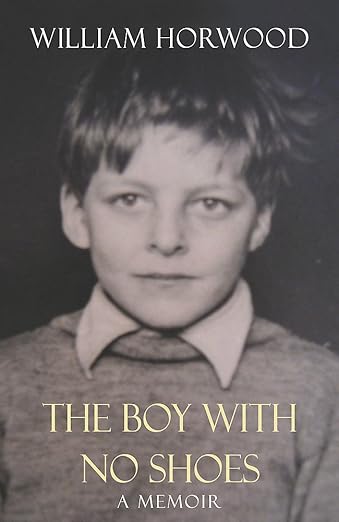
The Boy With No Shoes: a Memoir by William Horwood

Headline Book Publishing| 2004| Hardback edition| 440 pages| 5*

Five-year-old Jimmy Rova is the unwanted child of a mother who rejects him, and whose other children bully him. The one thing he can call his own is a pair of shoes, a present from the only person he feels has ever loved him. When they are cruelly taken away, Jimmy spirals down into a state of loneliness and terrible loss from which there seems no recovery.

This triumphant story of a boy’s struggle with early trauma and his remarkable journey into adulthood is based on William Horwood’s own remarkable childhood in south-east England after the Second World War. Using all the skills that went into the creation of his modern classics, Horwood has written an inspiring story of a journey from a past too painful to imagine to the future every child deserves. (Amazon)

William Horwood is an English novelist. He grew up on the East Kent coast, primarily in Deal. His first novel, Duncton Wood, an allegorical tale about a community of moles, was published in 1980. It was followed by two sequels, forming The Duncton Chronicles, and also a second trilogy, The Book of Silence. William Horwood has also written two stand-alone novels intertwining the lives of humans and of eagles, The Stonor Eagles and Callanish , and The Wolves of Time duology. Skallagrigg, his 1987 novel about disability, love, and trust, was made into a BBC film in 1994. In addition, he has written a number of sequels to The Wind in the Willows by Kenneth Grahame.

When I saw The Boy With No Shoes on the secondhand bookshelves in my local village hall I thought I’d like to read it. It was a great choice as I think it’s one of the best books I’ve read this year. It’s important to read the Author’s Note carefully before you read the book, and not dive straight into it. I had to re-read it after I’d read a few chapters as I was beginning to wonder if this was really fictional. I also wasted time searching on maps to find where he lived growing up.

In his Author’s Note at the front of the book he explained why he wrote about himself as Jimmy Rova:

When I was thirty-four and had been iller than I knew for two long years, my recovery began in the strangest and most magical dream of ways. |I woke one day from dreaming and saw myself when very young, as clearly as in a black and white Kodak photograph. I saw how desperately the little boy I once was had needed someone to talk to in a world where no one wanted to listen. I decided there and then to travel back in time and let myself as adult be listener to the child. This book and my final healing is the result of that imaginative listening, over very many years.

Because the boy seemed other than himself he gave him a different name and changed the name of his home town. By so doing he was able to fill in gaps, paper over the cracks and visit distant places of emotion that he would never have reached.

It is a long and detailed book that took me nearly a month to read. It is beautifully written and as he tells the story of his very early life there are many times when it moved me to tears. His writing is so clear that the places and people he describes spring to life as you read. All the characters have depth and are believable as people.

He is just as good at portraying Jimmy’s feelings and emotions. I could feel his depth of despair, fear and confusion as he describes his first memory about the man in a time long ago who bought him a pair of shoes. That day entered his heart and stayed there forever. He called him The Man Who Was, the man who left him standing in the rain, holding his Ma’s hand, full of fear that he would not be there to keep him safe from Ma, who treated him appallingly, and he would be all alone. All that was left to him were the shoes. So, imagine how awful it was when the shoes disappeared, cruelly taken from him.

But life for Jimmy did eventually get better, especially when Granny came to live with them, but even she could not protect completely from his abusive Ma. I loved all the details of Granny’s time in Africa with ‘The African Gentleman’, who wore a funny hat on his grey and grizzled hair, and his clothes were striped black and yellow. In his hand he carried a wand like a magician. Also unforgettable is his first love, Harriet, and how his mother ended their affair.

There were others too who were kind to him. I loved his description of a new English teacher at the Grammar School, who in contrast to the Head and other teachers believed in the boys. He inspired Jimmy and transformed his life by showing him how to believe he could succeed and how to prepare for his O levels.

There were others too, His Uncle Max who took him hiking in Snowdonia. Moel Saibod was the first mountain he climbed and then others, including Snowdon, the tallest mountain in Wales and England. Then, Mr Boys who taught him to read, Mr Bubbles, a fisherman and his wife, who lived along the shore and taught him all about fishing. I could go on and on, but really if this interests you the best thing is to read the book for yourself. It is a wonderful book, that captures what life was like in the 1950s and even though my childhood was nothing like his, it brought back memories of growing up. I too, as a young woman) climbed Snowdon – Welsh name, Yr Wyddfa (I did not take the Snowdon Mountain Railway either up or down) and also Moel Saibod.
Nonfiction November 2025: Week One

It’s the first week of Nonfiction November and this week (27th October – 2nd November) we are hosted by Heather at Based on a True Story.

The challenge is as follows:

Celebrate your year of nonfiction. What books have you read since this time last year? What were your favorites? Have you had a favorite topic? Is there a topic you want to read about more? What are you hoping to get out of participating in Nonfiction November?

Even though I love nonfiction I don’t read a lot and this year’s total is even lower than usual, with just seven books and I’ve only reviewed four of them, marked *, plus three in Nov/Dec 2024 to make it the full year. I’ve linked the titles to Amazon for those books I haven’t reviewed.

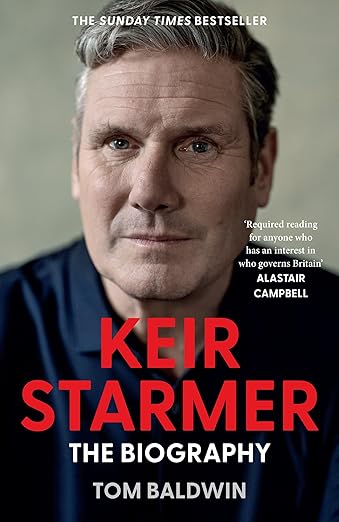
*Keir Starmer: the Biography by Tom Baldwin

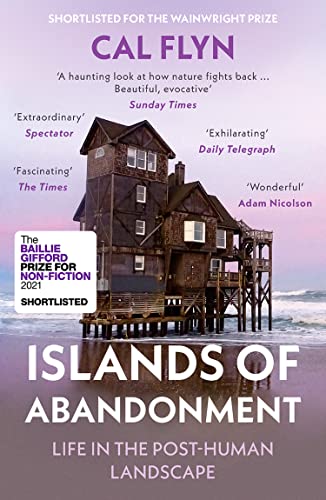
Islands of Abandonment by Cal Flyn – a remarkable book, about abandoned places: ghost towns and exclusion zones, no man’s lands and fortress islands – and what happens when nature is allowed to reclaim its place. It’s not a book to read quickly, but rather one to take your time to take in all the details. It’s fascinating, thoroughly researched and beautifully written.

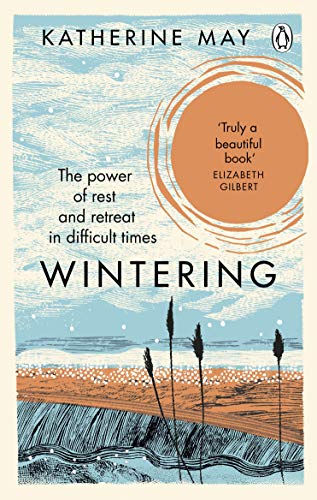
*Wintering by Katherine May

*The Boy With No Shoes: a Memoir by William Horwood – I loved this book

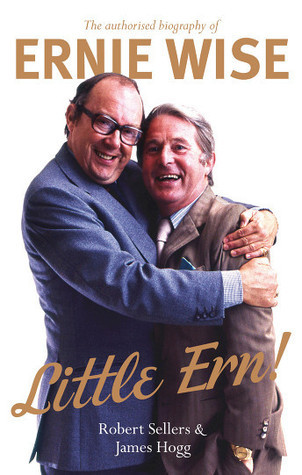
Little Ern!: the Authorized Biography of Ernie Wise by Robert Sellers & James Hogg

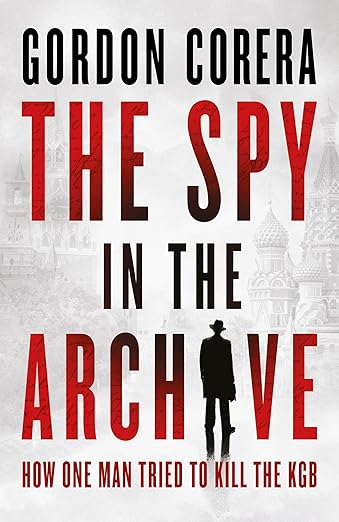
*The Spy in the Archive by Gordon Corera

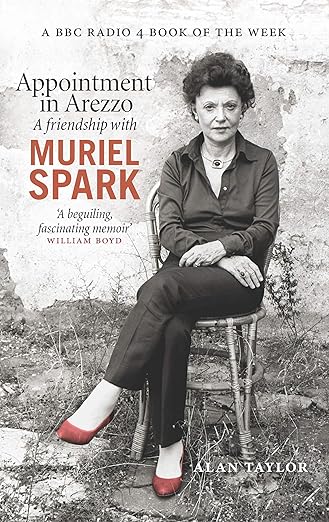
Appointment in Arezzo: A Friendship with Muriel Spark by Alan Taylor – review to follow later

The following are books I began reading in November 2024. I haven’t reviewed any of them, although I wrote a few paragraphs about two of them in my Book Pairings post on November 13th 2024.

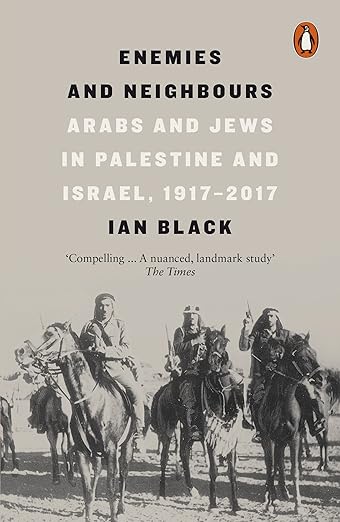
Enemies and Neighbours: Arabs and Jews In Palestine and Israel, 1917-2017 by Ian Black – This is an extremely detailed chronological account of events in this conflict from the years from 1882 preceding the Balfour Declaration in 1917 to 2017. Ian Black was a British journalist who worked for The Guardian holding the posts of diplomatic editor and Europe editor as well as Middle East editor. I’m quoting from his obituary in January 2023: ‘he embodied the correspondent’s duty to show fairness to both parties. That refusal to reinforce the narrative of one side alone informed his writing on the Israel-Palestine conflict from the start.’ So I thought this could be a good place to start. And as far as I can tell it is an unbiased and factual account,with many references to Black’s sources, and it took me a long time to read it

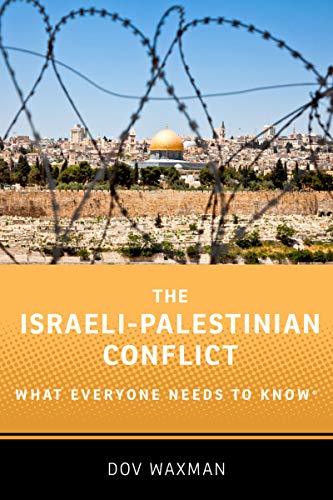
The Israeli-Palestinian Conflict: What Everyone Needs to Know by Don Waxman – This book is more readable than Black’s and is written as a series of questions and answers covering the conflict from its nineteenth-century origins up to the present day (2019). It explains the key events, examines the core issues, and presents the competing claims and narratives of both sides.

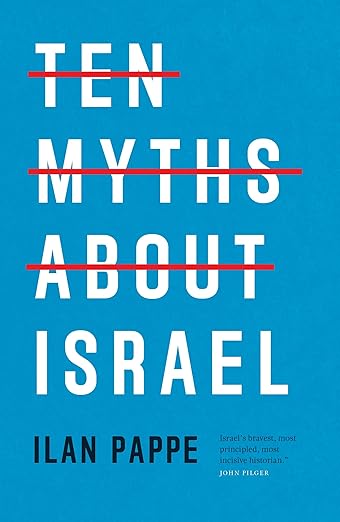
Ten Myths About Israel by Ilan Pappé – this ‘examines the most contested ideas concerning the origins and identity of the contemporary state of Israel’. (Amazon)

By participating in Nonfiction November I’m hoping this will encourage me to read more nonfiction rather than picking up the next novel to read and I’m looking forward to seeing what others recommend.

Updated 30 October 2025

Nonfiction November:Week 5 – New to my TBR

Throughout the month of November, bloggers Liz, Frances, Heather,  Rebekah and Deb invite you to celebrate Nonfiction November with us.

Week 5 (11/25-11/29) New To My TBR:  It’s been a month full of amazing nonfiction books! Which ones have made it onto your TBR? Be sure to link back to the original blogger who posted about that book! (Deb)

I’ve thoroughly enjoyed taking part in Nonfiction November and there are so many fascinating books I could easily add to my TBR list. But I know my limitations, so these are my choices. I’ve listed them in A – Z title order:

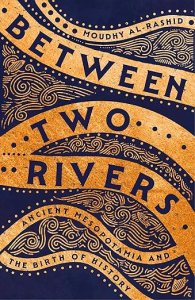
Between Two Rivers: Ancient Mesopotamia and the Birth of History by Moudhy Al-Rashid from Stephanie @ Bookfever. Thousands of years ago, in a part of the world we now call ancient Mesopotamia, people began writing things down for the very first time. Historian Dr Moudhy Al-Rashid brings us closer to this ancient past and the lives of the people who lived in this extraordinary society.

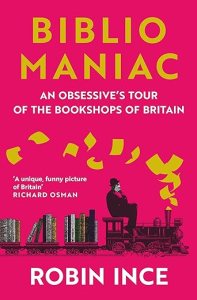
Bibliomaniac: An Obsessive’s Tour of the Bookshops of Britain by Robin Ince – from Liz @ Adventures in Reading, Running and Working from Home. In Autumn 2021, Robin Ince’s stadium tour with Professor Brian Cox was postponed due to the pandemic. Rather than do nothing, he decided he would instead go on a tour of over a hundred bookshops, from Wigtown to Penzance; from Swansea to Margate. Packed with witty anecdotes and tall tales, Bibliomaniac takes the reader on a journey across Britain as Robin explores his lifelong love of bookshops and books – and also tries to find out just why he can never have enough of them.

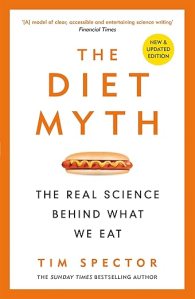
The Diet Myth by Tim Spector – from Annabel @ Annabookbel. Professor Tim Spector demystifies the common misconceptions about fat, calories, vitamins and nutrients. Only by understanding what makes our own personal microbes tick can we overcome the confusion of modern nutrition, and achieve a healthy gut and a healthy body.

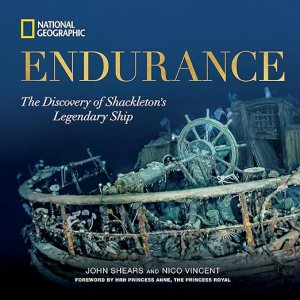
Endurance: The Discovery of Shackleton’s Legendary Ship by John Shears & Nico Vincent – from Stephanie @ Bookfever. In March 2022, an international polar expedition team made an astonishing find: the wreck of Ernest Shackleton’s legendary Endurance, lost in 1915 after being crushed by ice and then swallowed by the Weddell Sea. The harrowing story of Shackleton’s survival and rescue of all 27 men aboard is well known, but the ship has lain unseen for a century, 10,000 feet underwater—until now. The vessel remains incredibly intact, as crystal-clear photography and digital scans from the expedition reveal.

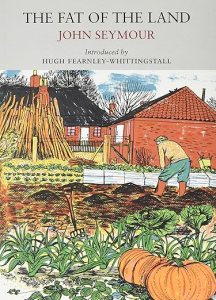
The Fat of the Land by John Seymour – from Liz @ Adventures in Reading, Running and Working from Home. I have The Complete Book of Self Sufficiency by John Seymour, a pioneer of self-sufficiency, first published in 1976, a handbook to living off the land. Years earlier, Seymour had written and published The Fat of the Land, telling of how he and his family settled in Suffolk and began a life entirely separate from the modern world. This new edition comes complete with Sally Seymour’s original illustrations, a foreword by Anne Seymour and a new introduction by Hugh Fearnley-Whittingstall.

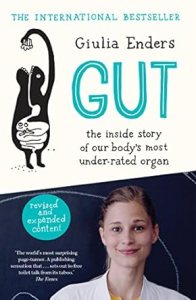
Gut by Gloria Enders – from Annabel @Annabookbel. For too long, the gut has been the body’s most ignored and least appreciated organ, but it turns out that it’s responsible for more than just dirty work: our gut is at the core of who we are. Gut, an international bestseller, gives the alimentary canal its long-overdue moment in the spotlight. Giulia Enders explains the gut’s magic, answering questions like: Why does acid reflux happen? What’s really up with gluten and lactose intolerance? How does the gut affect obesity and mood? Communication between the gut and the brain is one of the fastest-growing areas of medical research—on par with stem-cell research. Our gut reactions, we learn, are intimately connected with our physical and mental well-being.

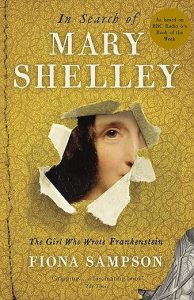
In Search of Mary Shelley: The Girl Who Wrote Frankenstein by Fiona Sampson. From Frances @ Volatine Rune. Fiona Sampson sifts through letters, diaries and records to find the real Mary Shelley. She uncovers a complex, generous character – friend, intellectual, lover and mother – trying to fulfil her own passionate commitment to writing at a time when to be a woman writer was an extraordinary and costly anomaly. Published for the 200th anniversary of the publication of Frankenstein, this is a major new work of biography by a prize-winning writer and poet.

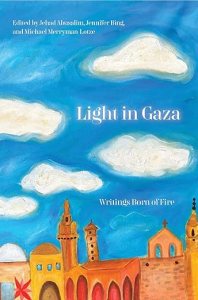
Light in Gaza: Writings Born of Fire, edited by Jehad Abusalim, Jennifer Bing, and Mike Merryman-Lotze – From Rebekah @ She Seeks Nonfiction. This is a moving and wide-ranging anthology of Palestinian writers and artists. It constitutes a collective effort to organize and center Palestinian voices in the ongoing struggle and imagines what the future of Gaza could be, while reaffirming the critical role of Gaza in Palestinian identity, history, and struggle for liberation.

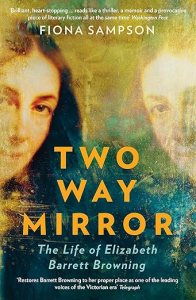
Two Way Mirror: The Life of Elizabeth Barrett Browning by Fiona Sampson. From Frances @ Volatine Rune. This vividly written biography, incorporates recent archival discoveries to reveal the woman herself: a literary giant and a high-profile activist for the abolition of slavery who believed herself to be of mixed heritage; and a writer who defied chronic illness and long-term disability to change the course of cultural history. It holds up a mirror to the woman, her art – and the art of biography itself.

Nonfiction November:Week 4- Mind Openers

Throughout the month of November, bloggers Liz, Frances, Heather,  Rebekah and Deb invite you to celebrate Nonfiction November with us.

Week 4 (11/18-11/22) Mind Openers: One of the greatest things about reading nonfiction is the way it can open your eyes to the world around you—no plane ticket required. What nonfiction book or books have impacted the way you see the world in a powerful way? Is there one book that made you rethink everything? Is there a book that, if everyone read it, you think the world would be a better place? (Rebekah)

Ultra Processed People: Why Do We All Eat Stuff That Isn’t Food … And Why Can’t We Stop? by Chris van Tulleken, who has impressed me on numerous TV programmes on diet and nutrition.

About the Author: ‘He is an infectious diseases doctor at the Hospital for Tropical Diseases in London. He trained at Oxford and has a PhD in molecular virology from University College London where he is an Associate Professor. His research focuses on how corporations affect human health, especially in the context of child nutrition, and he works with UNICEF and the World Health Organization in this area. As one of the BBC’s leading broadcasters, his work has won two BAFTAs. He lives in London with his wife and two children.’

I kept hearing about ultra processed food (UPF), but had little idea what exactly it is, so when I saw this book I thought it would be ideal – and it is! It is absolutely fascinating, a real eye opener, and it has changed what I think about what I eat! For a long time I have checked the labels on food packaging without actually realising what all those additives are, nor how the food has been processed. For example it has definitely put me off eating crisps and Pringles. It is shocking!

But it’s not easy to give a simple definition of what UPF is! A very short definition is that ‘if it’s wrapped in plastic and has at least one ingredient that you wouldn’t usually find in a standard home kitchen, it’s UPF.’ (page 5) It’s the processing that is the problem and the additives that are used - such as emulsifiers, flavour enhancers and sweeteners – and it is addictive.

Description from Amazon: An eye-opening investigation into the science, economics, history and production of ultra-processed food.

It’s not you, it’s the food.

We have entered a new ‘age of eating’ where most of our calories come from an entirely novel set of substances called Ultra-Processed Food, food which is industrially processed and designed and marketed to be addictive. But do we really know what it’s doing to our bodies?

Join Chris in his travels through the world of food science and a UPF diet to discover what’s really going on. Find out why exercise and willpower can’t save us, and what UPF is really doing to our bodies, our health, our weight, and the planet (hint: nothing good).

For too long we’ve been told we just need to make different choices, when really we’re living in a food environment that makes it nigh-on impossible. So this is a book about our rights. The right to know what we eat and what it does to our bodies and the right to good, affordable food.

There are chapters on such subjects as why we can’t control what we eat, how our bodies really manage calories and about will power, how UPF hacks our brains, destroys traditional diets and how it is addictive.

I highlighted so much in this book and I think the simplest way of writing about it is to post some of those passages to give you an idea what is in the book that convinced me to cut out eating ultra-processed food (UPF) as much as possible. It’s not easy as so much is now ultra-processed!

Page 5: UPF now (2023) makes up as much as 60% of the average diet in the UK and the USA.

Page 6: a vast body of data has emerged in support of the hypothesis that UPF damages the human body and increases rates of cancer, metabolic disease and mental illness, that it damages human societies by displacing food cultures and driving inequality, poverty and early death, and that it damages the planet.

Page 153 – 154: most UPF is reconstructed from whole food that has been reduced to its basic molecular constituents which are then modified and re-assembled into food-like shapes and textures and then heavily salted, sweetened, coloured and flavoured. … without additives these base industrial ingredients would probably not be recognisable as food by your tongue and brain: ‘It would be almost like eating dirt’.

Page 189: the basic construction materials of UPF are industrially modified carbs, fats and proteins, and the processes they are put through remove all the chemical complexity. The intensity of ultra-processing means that vitamins are destroyed (or deliberately removed in the case of bleaching), fibre is reduced, and there’s a loss of functional molecules like polyphenols. The result is lots of calories but very little other nutrition. … we may be eating more food to compensate for becoming increasingly deficient in micronutrients. … modern diets lead to malnutrition even as they cause obesity.

I could go on and on, but read this book and see for yourself if it makes you think about what you are actually eating. It is a brilliant book!

Nonfiction November:Week 3 – Book Pairings

Throughout the month of November, bloggers Liz, Frances, Heather,  Rebekah and Deb invite you to celebrate Nonfiction November with us.

Week 3 (11/11-11/15) Book Pairings: This week, pair up a nonfiction book with a fiction title. Maybe it’s a historical novel and the real history in a nonfiction version, or a memoir and a novel, or a fiction book you’ve read and you would like recommendations for background reading. Or two books on two different areas have chimed and have a link. You can be as creative as you like! (Liz)

Liz further clarifies in her Pairings post:  ‘I offer a mix of fiction/nonfiction pairs, fiction/nonfiction/memoir sets and nonfiction/nonfiction.’

After the Hamas-led attack on Israel on October 7, 2023 I decided I needed to know more about what had led up to it. And I found lots of books, including these:

Nonfiction/Fiction – I’m aiming to write more about these books in due course.

Enemies and Neighbours: Arabs And Jews In Palestine And Israel, 1917-2017 by Ian Black (nonfiction)

This is an extremely detailed chronological account of events in this conflict from the years from 1882 preceding the Balfour Declaration in 1917 to 2017. Ian Black was a British journalist who worked for The Guardian holding the posts of diplomatic editor and Europe editor as well as Middle East editor. I’m quoting from his obituary in January 2023: ‘he embodied the correspondent’s duty to show fairness to both parties. That refusal to reinforce the narrative of one side alone informed his writing on the Israel-Palestine conflict from the start.’ So I thought this could be a good place to start. And as far as I can tell it is an unbiased and factual account,with many references to Black’s sources, and it took me a long time to read it. In the Preface Black states:

It tries to tell the story of, and from both sides, and of the fateful interactions between them. … This book is intended for the general reader … It is based on a synthesis of existing scholarship and secondary sources: primary research covering the entire 135-year history is far beyond the capability of any one author. Specialised publications like the Journal of Palestine Studies, Israel Studies, and the Jerusalem Quarterly are vital resources.

I learnt a lot that I hadn’t known before, but I decided I still needed to know more and next I bought:

The Israeli-Palestinian Conflict: What Everyone Needs to Know by Dov Waxman (nonfiction), which I’m still reading.

Dov Waxman is the Rosalinde and Arthur Gilbert Foundation Chair of Israel Studies at the University of California Los Angeles (UCLA) and the director of the UCLA Y&S Nazarian Center for Israel Studies. His research focuses on the conflict over Israel-Palestine, Israeli politics and foreign policy, U.S.-Israel relations, American Jewry’s relationship with Israel, Jewish politics, and contemporary antisemitism. He frequently gives media interviews and public talks on these topics. (Taken from his website).

This book is more readable than Black’s and is written as a series of questions and answers covering the conflict from its nineteenth-century origins up to the present day (2019). It explains the key events, examines the core issues, and presents the competing claims and narratives of both sides. In the Preface Waxman states he has tried

to present the different perspectives and narratives of Israelis and Palestinians and avoid ‘playing the blame game’. … Neither side is wholly innocent or completely guilty, and both have legitimate rights and needs.

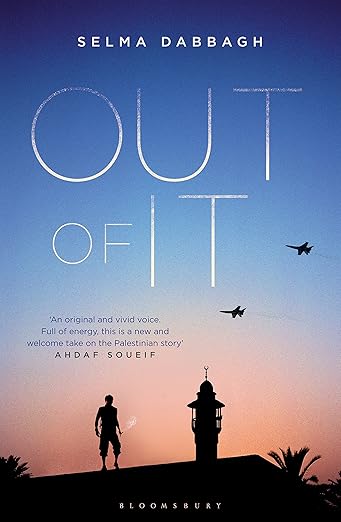
Out of It: a novel about Israel, Palestine and Family by Selma Dabbagh, fiction.

Selma Dabbagh is a British-Palestinian writer and lawyer. Her 2011 debut novel, Out of It was nominated for a Guardian Book of the Year award in 2011 and 2012 and is one of The Guardian’s list of five best books to explain the Israel-Palestine conflict.

I haven’t read this. I saw it reviewed in The Guardian. It’s set in Gaza City during the Second Intifada in the 2000s. It’s about the Mujahed family, chronicling their hopes and dreams as well as their suffering.

Blurb from Amazon:

Gaza is being bombed. Rashid – an unemployed twenty-seven year

old who has stayed up smoking grass watching it happen – wakes to hear that he’s got the escape route he’s been waiting for: a scholarship to London. His twin sister, Iman – frustrated by the atrocities and inaction around her – has also been up all night, in a meeting that offers her nothing but more disappointment. Grabbing recklessly at an opportunity to make a difference, she finds herself being followed by an unknown fighter.

Meanwhile Sabri, the oldest brother of this disparate family, works on a history of Palestine from his wheelchair as their mother pickles vegetables and feuds with the neighbours.

Written with extraordinary humanity and humour, and moving between Gaza, London and the Gulf, Out of It is a tale that redefines Palestine and its people. It follows the lives of Rashid and Iman as they try to forge paths for themselves in the midst of occupation, religious fundamentalism and the divisions between Palestinian factions. It tells of family secrets, unlikely love stories and unburied tragedies as it captures the frustrations and energies of the modern Arab world.

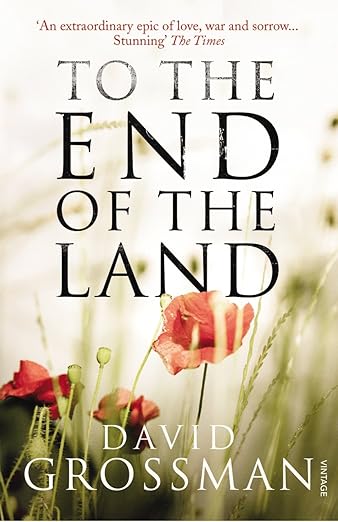
To the End of the Land by David Grossman, translated by Jessica Cohen (fiction) – another book I haven’t read.

David Grossman is one of the leading Israeli writers of his generation, and the author of numerous works of fiction, non-fiction, and children’s literature. His work has appeared in The New Yorker, and been translated into twenty-five languages around the world. He lives on the outskirts of Jerusalem.

Description from Fantastic Fiction:

Ora is about to celebrate her son Ofer’s release from Israeli army service when he voluntarily rejoins. In a fit of magical thinking, she takes off to hike in the Galilee, leaving no forwarding information for the ‘notifiers’ who might deliver the worst news a parent can hear. Recently estranged from her husband, she drags along an unlikely companion: their once best friend Avram, who was tortured as a POW during the Yom Kippur War and, in his brokenness, refused to ever know the boy or even to keep in touch with them.

Now, as they hike, Ora unfurls the story of her motherhood and initiates the lonely Avram in the drama of the human family – a telling that keeps Ofer alive for both his mother and the reader. Her story places the most hideous trials of war alongside the daily joys and anguish of raising children: never have we seen so clearly the reality and surreality of daily life in Israel, the currents of ambivalence about war within one household, the burdens that fall on each generation anew.

Grossman’s rich imagining of a family in love and crisis makes for one of the great antiwar novels of our time.

Nonfiction November:Week 1 – My Year in Nonfiction

Throughout the month of November, bloggers Liz, Frances, Heather,  Rebekah and Deb invite you to celebrate Nonfiction November with us.

Liz writes: ‘Meet your hosts! Liz (that’s me!), who blogs at Adventures in reading, running and working from home, is an editor, transcriber, reader, reviewer, writer and runner. She likes reading literary fiction and nonfiction, travel and biography. Frances blogs about the books she has read at Volatile Rune and is a published poet, reviewer, sometime storyteller and novelist. Heather of Based on a True Story lives in Ohio with her husband, surrounded by lots and lots of critters! Rebekah reviews social justice books on She Seeks Nonfiction. She is a Pittsburgh-based activist, graphic designer, and cat parent. Deb, who blogs at Readerbuzz, is a Texas librarian-for-life who swims, rides her bike, draws, writes, and loves to read nonfiction-that-reads-like-fiction, literary fiction, classics, and children’s picture books.’

I don’t think I’ll be taking part every week, but this week I am.

Week 1 – Your Year in Nonfiction: Celebrate your year of nonfiction. What books have you read? What were your favorites? Have you had a favorite topic? Is there a topic you want to read about more? What are you hoping to get out of participating in Nonfiction November?
(Hosted by Heather of Based on a True Story)

Nonfiction Read Since December 1, 2023, linked to my reviews, where they exist.

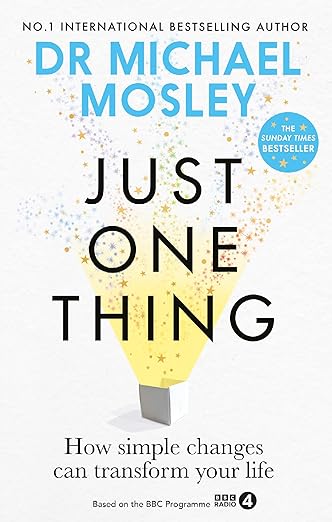
  1. Just One Thing by Michael Mosley 5*
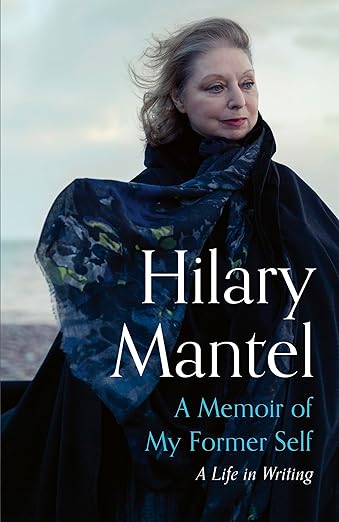
  2. A Memoir of My Former Self by Hilary Mantel 5* – In addition to her celebrated career as a novelist, Hilary Mantel contributed for years to newspapers and journals, unspooling stories from her own life and illuminating the world as she found it. “Ink is a generative fluid,” she explains. “If you don’t mean your words to breed consequences, don’t write at all.” A Memoir of My Former Self collects the finest of this writing over four decades.
  3. Shakespeare: The Man who Pays the Rent by Judi Dench, Brendan O’Hea 5*
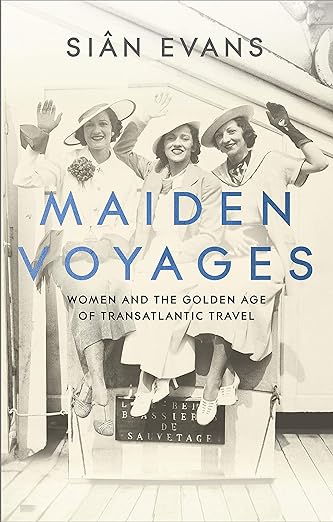
  4. Maiden Voyages by Sian Evans 5*
  5. The Road to Wigan Pier by George Orwell 4*
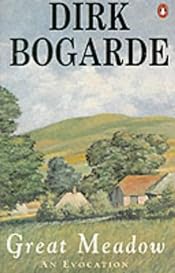
  1. Great Meadow by Dirk Bogarde 5* – Seen through the eyes of a 10-year old in the late 1930s, this novel recaptures an idyllic childhood, a time of love and gentleness with its sounds and scents intact, whilst the world beyond went to war. It was a great pleasure to read, taking me back to a time before I was born, to that time between the two World Wars, covering the years 1930 to 1934. Dirk (Derek) Bogarde was born in 1921 and his sister Elizabeth in 1924. Theirs was a somewhat privileged childhood, with a live-in Nanny, Lally, who also ran their household. Their father was the art editor of The Times and their mother was a former actress.
  2. The Art of Laziness: Overcome Procrastination & Improve Your Productivity by Library Mindset 2* – There’s nothing new in this book for me, but it’s a good reminder about what I already knew.
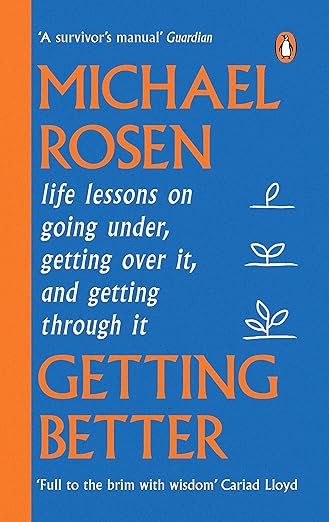
  3. Getting Better by Michael Rosen 5* Michael Rosen has grieved the loss of a child, lived with debilitating chronic illness, and faced death itself when seriously unwell in hospital with Covid. In spite of this he has survived, and has even learned to find joy in life in the aftermath of tragedy. In Getting Better, he shares his story and the lessons he has learned along the way. Exploring the roles that trauma and grief have played in his own life, Michael investigates the road to recovery, asking how we can find it within ourselves to live well again after – or even during – the darkest times of our lives. Moving and insightful, this is a wonderful book.
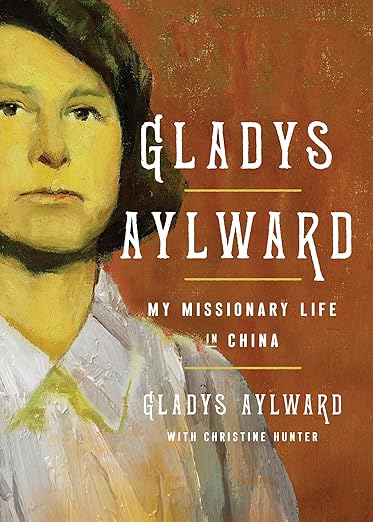
  4. Gladys Aylward: My Missionary Life in China by Gladys Aylward 3* Gladys was convinced that she called to preach the Gospel in China and in 1930 went to Yangchen, in the mountainous province of Shansi, a little south of Peking (Beijing). She worked with a 73-year-old missionary, Jeannie Lawson in an inn where, in the evening, they would entertain their guests with stories from the Bible. Gladys also began taking children into her home, and soon she had an orphanage with about 100 children. Then in 1938 in the spring of 1938, Japanese planes bombed the city of Yangcheng, killing many and causing the survivors to flee into the mountains. Five days later, the Japanese Army occupied Yangchen. She and the children fled walking over the mountains to Sian. In 1957, Alan Burgess,The Small Woman, which I read in my teens. So when I saw this autobiography I was keen to read it.

My favourites are the six books I gave 5 stars to on Goodreads. I like to read books on a wide variety of topics, such as history, philosophy, religion, biography, and diaries and letters. And currently I’m reading Enemies and Neighbours: Arabs and Jews In Palestine and Israel, 1917-2017 by Ian Black, an immensely detailed book; and Islands of Abandonment: Life in the Post-Human Landscape by Cal Flyn, about abandoned places: ghost towns and exclusion zones, no man’s lands and fortress islands – and what happens when nature is allowed to reclaim its place.

By participating in Nonfiction November I’m hoping this will encourage me to read more nonfiction rather than picking up the next novel to read and I’m looking forward to seeing what others recommend.

Are you participating in Nonfiction November this year? Leave me a comment or a link to your post–I’d love to see what you’ve read this year.