My Week in Books: 28 June 2017

This Week in Books is a weekly round-up hosted by Lypsyy Lost & Found, about what I’ve been reading Now, Then & Next.
IMG_1384-0

A similar meme,  WWW Wednesday is run by Taking on a World of Words.

Now: I’m currently reading South Riding by Winifred Holtby.

South Riding

I watched the BBC adaptation when it was broadcast in 2011 (can’t believe it was that long ago), bought the book and then left in on my TBR shelves. I started reading it a few days ago and it’s really good. It’s set in the fictional South Riding of Yorkshire during the Depression. There’s a huge list of characters, the main one being Sarah Burton, newly appointed as headmistress of the local girls’ school. It’s the 1930s, the world is changing (when isn’t it?) and Sarah’s arrival stirs up people’s emotions and prejudices.

Then: Last Seen Alive by Claire Douglas, to be published on 13 July. I loved this story, never quite sure who I could believe. Libby and her husband Jamie decide to do a house swap – but then things start to go wrong – very wrong. I’ll post my review soon.

Last Seen Alive

Next: The Escape by C L Taylor

I quoted the opening of this book in one of my First Chapter, First Paragraph posts and am keen to read it soon.

Blurb:

‘Look after your daughter’s things. And your daughter’¦’

When a stranger asks Jo Blackmore for a lift she says yes, then swiftly wishes she hadn’t.

The stranger knows Jo’s name, she knows her husband Max and she’s got a glove belonging to Jo’s two year old daughter Elise.

What begins with a subtle threat swiftly turns into a nightmare as the police, social services and even Jo’s own husband turn against her.

No one believes that Elise is in danger. But Jo knows there’s only one way to keep her child safe ‘“ RUN.

How’s your week in books been?

My Week in Books: 14 June 2017

This Week in Books is a weekly round-up hosted by Lypsyy Lost & Found, about what I’ve been reading Now, Then & Next.

IMG_1384-0

A similar meme,  WWW Wednesday is run by Taking on a World of Words.

Now: I’m currently reading Beneath a Burning Sky by Jenny Ashcroft.

Blurb:

When twenty-two-year-old Olivia is coerced into marriage by the cruel Alistair Sheldon she leaves England for Egypt, his home and the land of her own childhood. Reluctant as she is to go with Alistair, it’s in her new home that she finds happiness in surprising places: she is reunited with her long-estranged sister, Clara, and falls ‘“ impossibly and illicitly ‘“ in love with her husband’s boarder, Captain Edward Bertram.

Then Clara is abducted from one of the busiest streets in the city. Olivia is told it’s thieves after ransom money, but she’s convinced there’s more to it. As she sets out to discover what’s happened to the sister she’s only just begun to know, she falls deeper into the shadowy underworld of Alexandria, putting her own life, and her chance at a future with Edward, the only man she’s ever loved, at risk. Because, determined as Olivia is to find Clara, there are others who will stop at nothing to conceal what’s become of her . . .

Beneath a Burning Sky is a novel of secrets, betrayal and, above all else, love. Set against the heat and intrigue of colonial Alexandria, this beautiful and heart-wrenching story will take your breath away.

Then: I’ve just finished reading Miraculous Murders: Locked-RoomMurders and Impossible Crimes edited by Martin Edwards which I really enjoyed. My review will follow soon.

Blurb:

Impossible crime stories have been relished by puzzle-lovers ever since the invention of detective fiction. Fiendishly intricate cases were particularly well suited to the cerebral type of detective story that became so popular during the ‘˜golden age of murder’ between the two world wars. But the tradition goes back to the days of Edgar Allan Poe and Wilkie Collins, and impossible crime stories have been written by such luminaries as Arthur Conan Doyle, G.K. Chesterton, Dorothy L. Sayers and Margery Allingham. This anthology celebrates their work, alongside long-hidden gems by less familiar writers. Together these stories demonstrate the range and high accomplishment of the classic British impossible crime story over more than half a century.

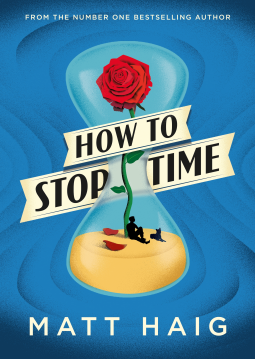
Next: This is such a difficult decision as there are so many books I want to read and I always hesitate to say which one I’ll read next. But I think I’ll read How to Stop Time by Matt Haig, with the usual proviso that when the time comes I may decide to read a different book.

Blurb:

‘I am old. That is the first thing to tell you. The thing you are least likely to believe. If you saw me you would probably think I was about forty, but you would be very wrong.’
Tom Hazard has a dangerous secret. He may look like an ordinary 41-year-old, but owing to a rare condition, he’s been alive for centuries. From Elizabethan England to Jazz Age Paris, from New York to the South Seas, Tom has seen a lot, and now craves an ordinary life.

Always changing his identity to stay alive, Tom has the perfect cover – working as a history teacher at a London comprehensive. Here he can teach the kids about wars and witch hunts as if he’d never witnessed them first-hand. He can try and tame the past that is fast catching up with him. The only thing Tom mustn’t do is fall in love.

How to Stop Time is a wild and bittersweet story about losing and finding yourself, about the certainty of change and about the lifetimes it can take to really learn how to live.

They say you shouldn’t judge a book by its cover, which is a good thing as I don’t like anything about this cover – it doesn’t say ‘read me’ to me. But the synopsis does.

How about you? Have you read any of these books?  If so, what did you think of them? And what have you been reading this week?

My Week in Books: 7 June 2017

This Week in Books is a weekly round-up hosted by Lypsyy Lost & Found, about what I’ve been reading Now, Then & Next.

IMG_1384-0

A similar meme,  WWW Wednesday is run by Taking on a World of Words.

Now: I’m currently reading two books, both of which were published yesterday. I’ve nearly finished The Ministry of Utmost Happiness by Arundhati Roy. I’ve struggled with this book, on the verge of abandoning it several times. For now, all I’m saying is that I loved her first novel, The God of Small Things and I’m deeply disappointed by this, her second. I’ll write more when I’ve finished it.
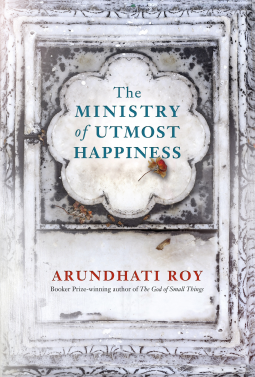
Blurb:

The Ministry of Utmost Happiness takes us on an intimate journey across the Indian subcontinent – from the cramped neighbourhoods of Old Delhi and the glittering malls of the burgeoning new metropolis to the snowy mountains and valleys of Kashmir, where war is peace and peace is war, and from time to time ‘normalcy’ is declared. Anjum unrolls a threadbare Persian carpet in a city graveyard that she calls home.

We encounter the incorrigible Saddam Hussain, the unforgettable Tilo and the three men who loved her – including Musa whose fate as tightly entwined with hers as their arms always used to be. Tilo’s landlord, another former suitor, is now an Intelligence officer posted to Kabul. And then there are the two Miss Jebeens: the first born in Srinagar and buried, aged four, in its overcrowded Martyrs’ Graveyard; the second found at midnight, in a crib of litter, on the concrete pavement of New Delhi.

At once an aching love story and a decisive remonstration, a heart-breaker and a mind-bender, The Ministry of Utmost Happiness is told in a whisper, in a shout, through tears and sometimes with a laugh. Its heroes are people who have been broken by the world they live in and then rescued, patched together by acts of love-and by hope. For this reason, fragile though they may be, they never surrender. Braiding richly complex lives together, this ravishing and deeply humane novel reinvents what a novel can do and can be. And it demonstrates on every page the miracle of Arundhati Roy’s storytelling gifts.

The other book I’m reading is Miraculous Murders: Locked-RoomMurders and Impossible Crimes edited by Martin Edwards and I’m glad to say this is not disappointing.
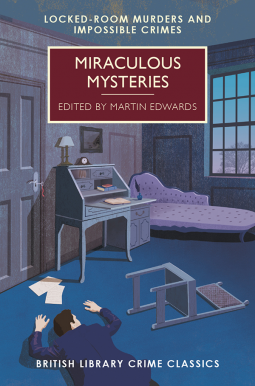
Blurb:

Impossible crime stories have been relished by puzzle-lovers ever since the invention of detective fiction. Fiendishly intricate cases were particularly well suited to the cerebral type of detective story that became so popular during the ‘˜golden age of murder’ between the two world wars. But the tradition goes back to the days of Edgar Allan Poe and Wilkie Collins, and impossible crime stories have been written by such luminaries as Arthur Conan Doyle, G.K. Chesterton, Dorothy L. Sayers and Margery Allingham. This anthology celebrates their work, alongside long-hidden gems by less familiar writers. Together these stories demonstrate the range and high accomplishment of the classic British impossible crime story over more than half a century.

Then: The last book I finished reading was Past Encounters by Davina Blake, which I really enjoyed. My review will follow soon (I hope, as I’m a bit behind with writing reviews).

Past EncountersBlurb
From the moment Rhoda Middleton opens one of her husband’s letters and finds it is from another woman, she is convinced he is having an affair. But when Rhoda tracks her down, she discovers the mysterious woman is not his lover after all, but the wife of his best friend, Archie Foster. There is only one problem – Rhoda has never even heard of Archie Foster.

Devastated by this betrayal of trust, Rhoda tries to find out how and why her husband, Peter, has kept this friendship hidden for so long. Her search leads her back to 1945, but as she gradually uncovers Peter’s wartime secrets she must wrestle with painful memories of her own. For if they are ever to understand each other, Rhoda too must escape the ghosts of the past.

Taking us on a journey from the atmospheric filming of Brief Encounter, to the extraordinary Great March of prisoners of war through snow-bound Germany, this is a novel of friendship, hope, and how in the end, it is the small things that enable love to survive.

Next: I think I’ll read Beneath a Burning Sky by Jenny Ashcroft, with the usual proviso that when the time comes I may decide to read a different book.
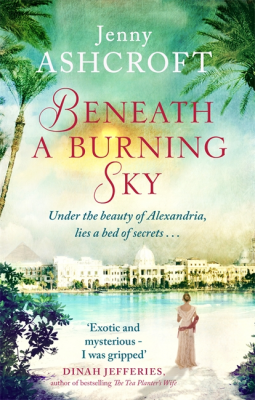
Blurb:

When twenty-two-year-old Olivia is coerced into marriage by the cruel Alistair Sheldon she leaves England for Egypt, his home and the land of her own childhood. Reluctant as she is to go with Alistair, it’s in her new home that she finds happiness in surprising places: she is reunited with her long-estranged sister, Clara, and falls – impossibly and illicitly – in love with her husband’s boarder, Captain Edward Bertram.

Then Clara is abducted from one of the busiest streets in the city. Olivia is told it’s thieves after ransom money, but she’s convinced there’s more to it. As she sets out to discover what’s happened to the sister she’s only just begun to know, she falls deeper into the shadowy underworld of Alexandria, putting her own life, and her chance at a future with Edward, the only man she’s ever loved, at risk. Because, determined as Olivia is to find Clara, there are others who will stop at nothing to conceal what’s become of her . . .

Beneath a Burning Sky is a novel of secrets, betrayal and, above all else, love. Set against the heat and intrigue of colonial Alexandria, this beautiful and heart-wrenching story will take your breath away.

Have you read any of these books? What do you think about them?
My Week in Books: 3 May 2017

This Week in Books is a weekly round-up hosted by Lypsyy Lost & Found, about what I’ve been reading Now, Then & Next.

IMG_1384-0

A similar meme,  WWW Wednesday is run by Taking on a World of Words.

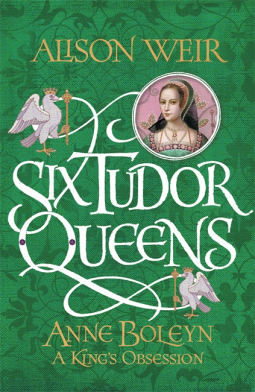
Now: I’m reading Six Tudor Queens: Anne Boleyn: A King’s Obsession by Alison Weir, which will be published by Headline on 18 May 2017. it is a long and detailed book, parts of which I’m finding tedious and repetitive, but I’m nearing the end now and it is picking up speed just a tiny bit!

Blurb:

The young woman who changed the course of history.

Fresh from the palaces of Burgundy and France, Anne draws attention at the English court, embracing the play of courtly love.

But when the King commands, nothing is ever a game.

Anne has a spirit worthy of a crown – and the crown is what she seeks. At any price.

ANNE BOLEYN. The second of Henry’s Queens. Her story.
History tells us why she died. This powerful novel shows her as she lived.

Then: The last two books I read were The Hanged Man of Saint-Pholien by Georges Simenon, a Maigret mystery, which I really enjoyed. My review will follow soon.

The Hanged Man of Saint-Pholien (Maigret, #4)


On a trip to Brussels, Maigret unwittingly causes a man’s suicide, but his own remorse is overshadowed by the discovery of the sordid events that drove the desperate man to shoot himself.

I also finished reading Wives and Daughters by Elizabeth Gaskell, which I loved. It’s a story of romance, scandal and intrigue within the confines of a watchful, gossiping English village during the early nineteenth century. I’ll soon be writing a review of this too.

Wives and Daughters

Next: I think I’ll read A Place of Execution by Val McDermid, one of my TBR books, with the usual proviso that when the time comes I may decide to read a different book.

A Place of ExecutionBlurb:

On a freezing day in December 1963, thirteen-year-old Alison Carter vanishes from her village. Nothing will ever be the same again for the inhabitants of the isolated hamlet in the English countryside. A young George Bennett, a newly-promoted inspector, he is determined to solve this case’”even if it just to bring home a daughter’s dead body to her mother.

As days progress, the likelihood that Alison has been murdered increases when a gruesome discovery is made in a cave. But with no corpse, the barest of clues, and an investigation that turns up more questions than answers, Bennett finds himself up against a stone wall…until he learns the shocking truth’”a truth that will have far-reaching consequences.

Decades later, Bennett finally tells his story to journalist Catherine Heathcote. But just when the book is posed for publication, he pulls the plug on it without explanation. He has new information that he will not divulge. Refusing to let the past remain a mystery, Catherine sets out to uncover what really happened to Alison Carter. But the secret is one she might wish she’d left buried on that cold, dark day thirty-five years ago.

I’m wondering what you are reading/have read recently too.

My Week in Books: 26 April 2017

This Week in Books is a weekly round-up hosted by Lypsyy Lost & Found, about what I’ve been reading Now, Then & Next.

IMG_1384-0

A similar meme,  WWW Wednesday is run by Taking on a World of Words.

Now: I’m reading Wives and Daughters by Elizabeth Gaskell, which I’ve nearly finished. It is my Classics Club Spin book.

Blurb:

It’s a story of romance, scandal and intrigue within the confines of a watchful, gossiping English village during the early nineteenth century. When seventeen-year-old Molly Gibson’s widowed father remarries, her life is turned upside down by the arrival of her vain, manipulative stepfather. She also acquires an intriguing new stepsister, Cynthia, glamorous, sophisticated and irresistible to every man she meets. 

I’m also reading Caedmon’s Song by Peter Robinson, one of his stand-alone books.

Blurb:

On a balmy June night, Kirsten, a young university student, strolls home through a silent moonlit park. Suddenly her tranquil mood is shattered as she is viciously attacked.

When she awakes in hospital, she has no recollection of that brutal night. But then, slowly and painfully, details reveal themselves – dreams of two figures, one white and one black, hovering over her; wisps of a strange and haunting song; the unfamiliar texture of a rough and deadly hand . . .

In another part of England, Martha Browne arrives in Whitby, posing as an author doing research for a book. But her research is of a particularly macabre variety. Who is she hunting with such deadly determination? And why?

Then: The last book I read is Night Falls on Ardamurchan by Alasdair Maclean. My review will follow soon.

Blurb:

Since its first publication in 1984, ‘Night Falls in Ardnamurchan’ has become a classic account of the life and death of a Highland community.

The author weaves his own humorous and perceptive account of crofting with extracts from his father’s journal – a terse, factual and down to earth vision of the day-to-day tasks of crofting life.

It is an unusual and memorable story that also illuminates the shifting, often tortuous relationships between children and their parents. Alasdair Maclean reveals his own struggle to come to terms with his background and the isolated community he left so often and to which he returned again and again.

In this isolated community is seen a microcosm of something central to Scottish identity – the need to escape against the tug of home.

Next: I think I’ll read Six Tudor Queens: Anne Boleyn: A King’s Obsession by Alison Weir, which will be published by Headline on 18 May 2017.

Blurb:

The young woman who changed the course of history.

Fresh from the palaces of Burgundy and France, Anne draws attention at the English court, embracing the play of courtly love.

But when the King commands, nothing is ever a game.

Anne has a spirit worthy of a crown – and the crown is what she seeks. At any price.

ANNE BOLEYN. The second of Henry’s Queens. Her story.
History tells us why she died. This powerful novel shows her as she lived.

But I’m tempted to slip in a Maigret book first: The Hanged Man of Saint-Pholien by Georges Simenon.

The Hanged Man of Saint-Pholien (Maigret, #4)

Blurb:

A first ink drawing showed a hanged man swinging from a gallows on which perched an enormous crow. And there were at least twenty other etchings and pen or pencil sketches that had the same leitmotif of hanging.
On the edge of a forest: a man hanging from every branch.
A church steeple: beneath the weathercock, a human body dangling from each arm of the cross. . . Below another sketch were written four lines from François Villon’s Ballade of the Hanged Men.

On a trip to Brussels, Maigret unwittingly causes a man’s suicide, but his own remorse is overshadowed by the discovery of the sordid events that drove the desperate man to shoot himself.

Penguin is publishing the entire series of Maigret novels in new translations. This novel has been published in previous translations as Maigret and the Hundred Gibbets and The Crime of Inspector Maigret.

My Week in Books: 8 March 2017

This Week in Books is a weekly round-up hosted by Lypsyy Lost & Found, about what I’ve been reading Now, Then & Next.

IMG_1384-0

A similar meme,  WWW Wednesday is run by Taking on a World of Words.

Now: I’m reading Northanger Abbey by Val McDermid and to compare and

Northanger Abbey (The Austen Project, #2) contrast I’m also reading Northanger Abbey by Jane Austen.

Northanger Abbey

I first read the Austen version many years ago and reading it now it’s only vaguely familiar. The McDermid version is amazingly similar in a modern context – Cat Morland goes to the Edinburgh Festival instead of to Austen’s Bath, John Thorpe is really awful, much worse than Austen’s Thorpe. McDermid’s Cat uses Facebook, instead of writing in a journal as Austen’s young ladies do and so on. I haven’t got them to Northanger Abbey itself in either version. It’s funny comparing the two books written almost 200 years apart.

And by way of yet more contrast I’m also reading See What I Have Done by Sarah Schmidt. This has a really creepy feel, looking into the mind of Lizzie Borden – it’s compelling reading.

Blurb:

Lizzie Borden took an ax
And gave her mother forty whacks
When she saw what she had done,
She gave her father forty-one.

Or did she?

In this riveting debut novel, See What I Have Done, Sarah Schmidt recasts one of the most fascinating murder cases of all time into an intimate story of a volatile household and a family devoid of love.

On the morning of August 4, 1892, Lizzie Borden calls out to her maid: Someone’s killed Father. The brutal ax-murder of Andrew and Abby Borden in their home in Fall River, Massachusetts, leaves little evidence and many unanswered questions. While neighbors struggle to understand why anyone would want to harm the respected Bordens, those close to the family have a different tale to tell’”of a father with an explosive temper; a spiteful stepmother; and two spinster sisters, with a bond even stronger than blood, desperate for their independence.

As the police search for clues, Emma comforts an increasingly distraught Lizzie whose memories of that morning flash in scattered fragments. Had she been in the barn or the pear arbor to escape the stifling heat of the house? When did she last speak to her stepmother? Were they really gone and would everything be better now? Shifting among the perspectives of the unreliable Lizzie, her older sister Emma, the housemaid Bridget, and the enigmatic stranger Benjamin, the events of that fateful day are slowly revealed through a high-wire feat of storytelling.

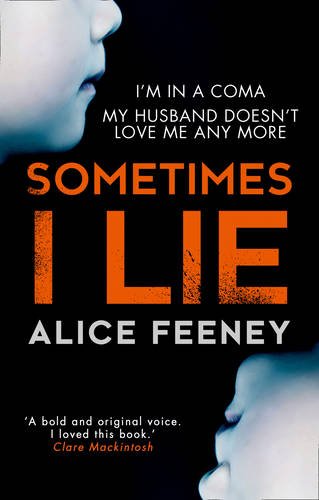
Then: The last book I read is Sometimes I Lie by Alice Feeney, an absolutely amazing and gripping psychological thriller due out on 23 March 2017. My review will follow soon. I loved it.

Next: I never decide what to read next until the time comes to choose a new book. It could be one of my TBRs – I’ve been neglecting them a bit this year. So, it could be The Gathering by Anne Enright, which is also one of the books I provisionally earmarked to read for the Begorrathon.

The Gathering

Blurb:

The nine surviving children of the Hegarty clan gather in Dublin for the wake of their wayward brother Liam. It wasn’t the drink that killed him – although that certainly helped – it was what happened to him as a boy in his grandmother’s house, in the winter of 1968.

The Gathering is a novel about love and disappointment, about thwarted lust and limitless desire, and how our fate is written in the body, not in the stars.

What are you reading this week’¦and in the future?