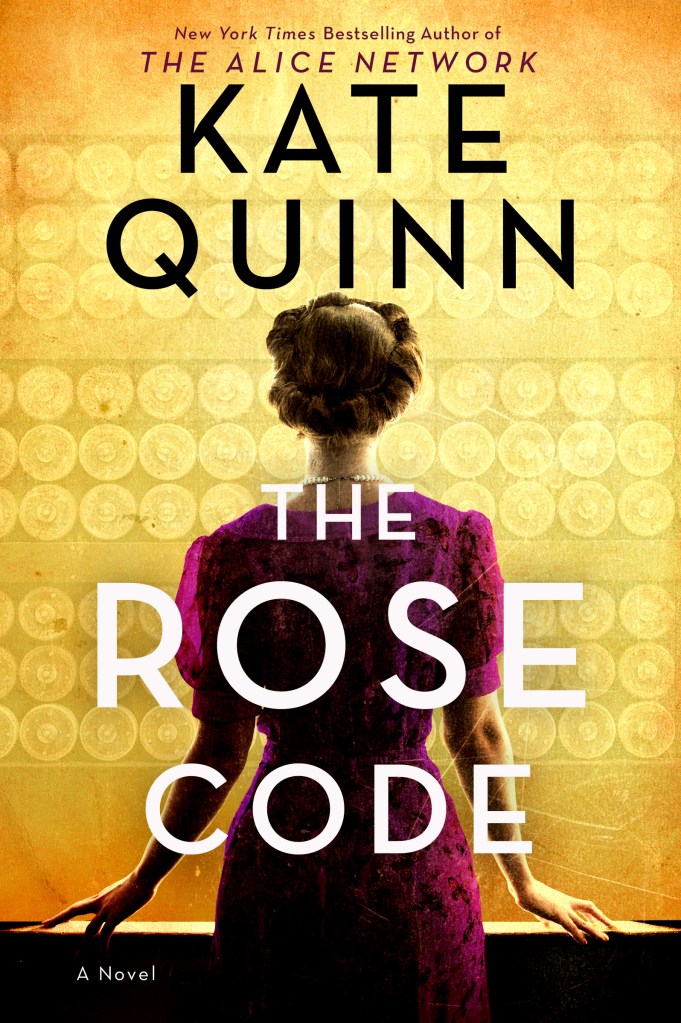
The Rose Code by Kate Quinn

Harper Collins| 18 March 2021| 645 pages| 3*

1940, Bletchley Park, Buckinghamshire.

Three very different women are recruited to the mysterious Bletchley Park, where the best minds in Britain train to break German military codes.

Vivacious debutante Osla has the dashing Prince Philip of Greece sending her roses – but she burns to prove herself as more than a society girl, working to translate decoded enemy secrets. Self-made Mab masters the legendary codebreaking machines as she conceals old wounds and the poverty of her East-End London upbringing. And shy local girl Beth is the outsider who trains as one of the Park’s few female cryptanalysts.

1947, London.

Seven years after they first meet, on the eve of the royal wedding between Princess Elizabeth and Prince Philip, disaster threatens. Osla, Mab and Beth are estranged, their friendship torn apart by secrets and betrayal. Yet now they must race against the clock to crack one final code together, before it’s too late, for them and for their country.

My Thoughts:

I have very mixed thoughts about The Rose Code. On the one hand it’s just the sort of book I love – historical fiction with a thrilling story and interesting characters that kept me wanting to read on and yet also made me want it to last as long as possible. On the other hand, it’s unevenly paced, with a slow start and a rushed ending that was somewhat of an anti-climax. My favourite character was Beth and I enjoyed reading how her character developed from a shy down trodden young woman into a brilliant cryptanalyst.

But when I first began reading it earlier this year I stopped after the opening pages and only picked it up again a couple of weeks or so ago. I initially stopped as the storyline involving Prince Philip made me very uncomfortable – Prince Philip was still alive when this book was written and when I first started to read it. He died in April this year.

The book begins in 1947 as Osla Kendall, a journalist working for the Tatler, is wondering what to wear for the Royal Wedding. She is in a ‘foul mood‘ as she wonders what to wear to the wedding of Princess Elizabeth and Lieutenant Philip Mountbatten.

Historical fiction mixes fact and fiction with both real and imaginary characters and I don’t have a problem with that. The character of Osla Kendall is based on a real person – in her Author’s Note Kate Quinn writes that she is ‘lightly fictionalized from the real-life Osla Benning, a beautiful, effervescent, Canadian-born heiress and Hut 4 translator who was Prince Philip’s long-term wartime girlfriend.‘ But by the time of the Royal Wedding Osla Benning was already married, not pining after Prince Philip. In writing their story Kate Quinn was not writing from facts but from her imagination as she put words in her characters’ mouths and described their emotions thoughts and feelings, which, of course, she could not have known.

However, I got over my dislike and read on – after all, this is fiction, not an accurate historical account. I like to know which is fact and which is fiction when I read historical fiction. So, after reading the review copy I received via NetGalley, I decided I needed to buy the published book and read the Author’s Note. And I’m glad did because I was relieved to find that Kate Quinn goes into a lot of detail to identify which characters are real and which fictional and how she has fictionalised them. She also reveals that she has also deviated from the historical records ‘to serve the story.’ I think this explains why I was uncomfortable with the book and why I don’t often read historical romances.

With thanks to NetGalley and to the publishers for my review copy.
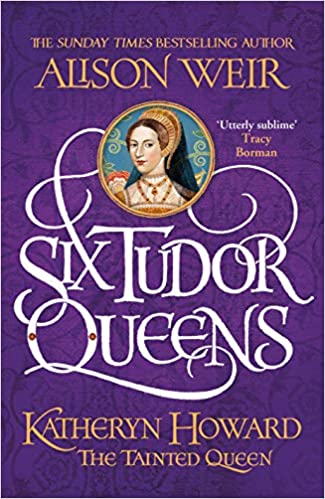
Six Queens: Katheryn Howard the Tainted Queen by Alison Weir

Headline Review| 20 August 2020| 479 pages| Review copy| 2*

I wanted to read this book because I knew very little about Henry VIII’s 5th wife, except that she was beheaded on the grounds that she had committed adultery and treason.

Description

A NAIVE YOUNG WOMAN AT THE MERCY OF HER AMBITIOUS FAMILY.

At just nineteen, Katheryn Howard is quick to trust and fall in love.

She comes to court. She sings, she dances. She captures the heart of the King.

But Henry knows nothing of Katheryn’s past – one that comes back increasingly to haunt her. For those who share her secrets are waiting in the shadows, whispering words of love… and blackmail.

Having read it, I don’t think I know much more, except that Katheryn Howard comes across as a very shallow character, obsessed with sex, with luxury in all its forms, naive and easily manipulated. Alison Weir excels in her descriptive writing, bringing the Tudor court to life in all of its settings, locations, clothes and jewellery.

It has glowing reviews on Amazon full of praise and it is based on extensive research. Clearly other people love this book, but I didn’t. For me it came across as a romance novel, primarily focused on Katheryn’s imagined thoughts, emotions, and sexual encounters. It is simply written, but with too many cliches and modernised text.

Alison Weir’s Author’s Note is much more interesting than her novel, in which she acknowledges her sources, including Dr. Nicola Tallis’ unpublished DPhil thesis, All the Queen’s Jewels, 1445 – 1548, and a number of biographies of Katheryn Howard. She refers to original sources she used as the basis of the book – contemporary writers and wills, portraits showing her rich clothes and jewellery – jewels that have been tentatively identified in Katheryn Howard’s inventory.

She used these sources for the narrative of the book, weaving them into the dialogue and modernising the speech ‘where Tudor English looks out of place in a modern text.’ She states that ‘apart from fictionalising the historical record’ she has invented very little.’ There is also a Dramatis Personae, usefully indicating which characters are fictional and a Timeline, which is also very useful.

I think the Author’s Note is the best part of the book. There is rather too much of ‘fictionalising the historical record’ for me in the novel. I don’t like writing about a book I didn’t enjoy when I know so much work has gone into it and clearly other people have loved it. But this is just my opinion, for what it is worth.

With thanks to NetGalley and to the publishers for my review copy.
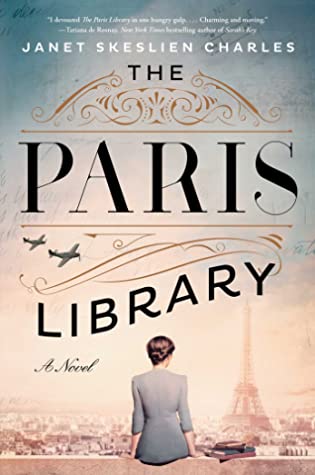
The Paris Library by Janet Skeslien Charles

Two Roads| 9th February 2021| 369 pages| Review copy| 3*

Before I read the summary of the book the title led me to think this was about the Bibliothèque Nationale de France, located in Paris. It’s not, it’s about the American Library in Paris.

PARIS, 1939
Odile Souchet is obsessed with books, and her new job at the American Library in Paris – with its thriving community of students, writers and book lovers – is a dream come true. When war is declared, the Library is determined to remain open. But then the Nazis invade Paris, and everything changes.
In Occupied Paris, choices as black and white as the words on a page become a murky shade of grey – choices that will put many on the wrong side of history, and the consequences of which will echo for decades to come.

MONTANA, 1983
Lily is a lonely teenager desperate to escape small-town Montana. She grows close to her neighbour Odile, discovering they share the same love of language, the same longings. But as Lily uncovers more about Odile’s mysterious past, she discovers a dark secret, closely guarded and long hidden.

As an ex-librarian I had high hopes that I would love The Paris Library. It’s historical fiction, based on the true Second World War story of the librarians at the American Library in Paris. It was established in 1920 by the American Library Association with books and periodicals donated by American libraries to US soldiers serving their allies in World War I. Since then it has developed into the largest English language lending library in Europe.

I liked the details about the Library, and about the work the library staff did during the War, including delivering books by hand to their Jewish subscribers in Paris after they were not allowed to enter the Library.

Charles’ helpful Author’s Note gives a fascinating insight into the background to the novel and explains that she had spent several years researching it. She had worked in the American Library in 2010 and her colleagues had told her the story of the Library during the Second World War and had given her access to documents, correspondence and contacts. She met with some of the staff who had worked there and was able to bring their stories up to date. Odile and Lily are both fictional characters.

Although I enjoyed the factual elements of the novel and the wartime storyline, I didn’t enjoy it as much as I had hoped. I was disappointed with the fictional stories, in particular Lily’s story in Montana in the 1980s. I really didn’t see the point of introducing her character simply to show what happened to Odile after the end of the War. Her story took the novel into the genres of YA and romantic fiction, neither of which hold much appeal for me. Overall I thought it was slow going and towards the end of the book my interest flagged making it a struggle to finish it.

With thanks to NetGalley and to the publishers, Two Roads for my review copy.

Coming Up For Air by Sarah Leipciger

A remarkable true story richly re-imagined

On the banks of the River Seine in 1899, a young woman takes her final breath before plunging into the icy water. Although she does not know it, her decision will set in motion an astonishing chain of events. It will lead to 1950s Norway, where a grieving toy-maker is on the cusp of a transformative invention, all the way to present-day Canada where a journalist, battling a terrible disease, risks everything for one last chance to live.

Taking inspiration from a remarkable true story, Coming Up for Air is a bold, richly imagined novel about the transcendent power of storytelling and the immeasurable impact of every human life.

Coming Up For Air is Sarah Leipciger’s second novel. It is a beautiful novel, a story of three people living in different countries and in different times. How their stories connect is gradually revealed as the novel progresses. As the author explains at the end of the novel is is a mix of fact and fiction and has its basis in truth. There is grief and loss and despair in each story, but above all, it is about love, and the desire to live.

Each story was compelling and, for once in a book that alternates between the characters, I thought the changes were just at the right moment in each one.

It begins with the unknown young woman in Paris, L’Inconnue, telling the story of her life that led to her suicide. Her death in the Seine is vividly described. As she fell in the cold water, initially she discovered the desire to live, as her body thrashed about not wanting to drown, her lungs fighting for air, for oxygen. It’s poignant and moving, set at the end of the 19th century bringing the city to life, where she lives as a lady’s companion to an old friend of her grandmother’s.

The second story is that of Norwegian, Pieter Akkrehamn, beginning in 1921, when he used to spend his summers with his grandparents on Karmoy Island. He went swimming in the North Sea, diving down several metres, holding his breath for over a minute in the freezing cold water, as the cold reached his chest, squeezing his lungs. His story is revealed, as he grieves for his little son. He is a toymaker, bored with making wooden toys, who turned to soft plastics and began making dolls with soft faces and bendable knees. What he eventually developed was truly remarkable.

The vital importance of being able to breathe comes to the fore in the third story – that of Anouk, a journalist in Canada. Anouk has cystic fibrosis and is on the list for a lung transplant. Her story is one of how she and her parents dealt with her illness, enabling her to combine her love for water and swimming with managing her cystic fibrosis, all the time struggling to breathe.

I think Sarah Leipciger is a great storyteller. It is an inspiring book, beautifully written, which emphasises the importance of the air we breathe and the desire to live. I loved it so much that I hope to read her first novel, The Mountain Can Wait.

With my thanks to NetGalley and to Random House for my review copy.

  • Publisher ‏ : ‎ Random House UK Transworld Digital (19 Mar. 2020)
  • Language ‏ : ‎ English
  • Print length ‏ : ‎ 320 pages

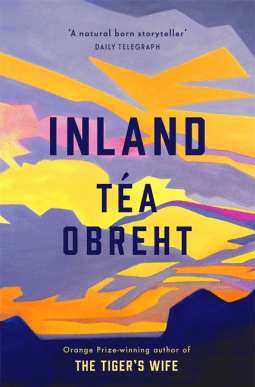
Inland by Téa Obreht

Weidenfeld & Nicolson| 13 August 2019| 386 pages| Review copy| 3*

Nora is an unflinching frontierswoman awaiting the return of the men in her life, biding her time with her youngest son – who is convinced that a mysterious beast is stalking the land around their home – and her husband’s seventeen-year-old cousin, who communes with spirits.

Lurie is a former outlaw and a man haunted by ghosts. He sees lost souls who want something from him, and he finds reprieve from their longing in an unexpected relationship that inspires a momentous expedition across the West.

Mythical, lyrical, and sweeping in scope, Inland is grounded in true but little-known history. It showcases all of Téa Obreht’s talents as a writer, as she subverts and reimagines the myths of the American West, making them entirely – and unforgettably – her own.

My thoughts:

Inland by Téa Obreht has had many accolades, including being named one of the best books of the year by The Guardian, Time, Washington Post, Entertainment Weekly, Esquire, Good Housekeeping, and The New York Public Library. I love the cover and the description made me keen to read it. It’s a book that has been on my NetGalley shelf for far too long, I’m sorry to say, mainly because each time I began reading it I struggled to understand what was going on.

It is a book of two halves really, alternating between the two storylines as the blurb outlines. I found the Lurie narrative difficult to follow at first. It’s vague – at times I didn’t know who was who, who was talking, who was a camel and who was a person. I did work it out eventually! Lurie is a former outlaw, who sees and talks to the dead. He is haunted by the spirit of Hobb, a kid of four or five. But Lurie’s story is slow and meanders. I was losing interest, and often the location was unclear as he moved from place to place. However as I got further into his story I did form a clearer picture of his life as he joined the Camel Corps and became a cameleer. (I was fascinated to discover that camels were used in the American West as pack animals.)

But it’s the second story of Nora Lark and her family, which is much clearer and easier for me to understand. It saved the book for me and made me keen to read on. They are living in Arizona in a homestead. There’s been no rain for months and their water supply is nearly exhausted. Emmett, her husband has gone to get more water and has not returned . Her two sons have gone to look for him, and Nora is left at home with her youngest son, Toby, who is terrified by a mysterious beast he sees around their house at night, and Josie, her husband’s seventeen year old ward and cousin, who see spirits. Nora’s daughter, Evelyn died before her sons were born, under mysterious circumstances, and she is constantly in Nora’s mind as she imagines her growing up and having conversations with her.

Several times as the narrative turned from Nora back to Lurie, I was about to give up on the book, but I wanted to know what happened to the Larks and to find out how the two strands would interlink, or if indeed they ever did interlink (they do). As I read on I began to understand more about Lurie and his life, but it was hard work. If I re-read it I think I would enjoy it more, but I don’t feel inclined to right now. But I really liked Nora’s story and the depiction of life in the American West during the mid-to-late 19th century.

In her acknowledgements Téa Obreht explains that Inland is a work of imagination based in part on the journals, letters and reports of the men who were part of at least one aspect of this history and on the work of the historians of the American West.

My thanks to the publishers and NetGalley for my review copy, with apologies for taking so long to read the book.

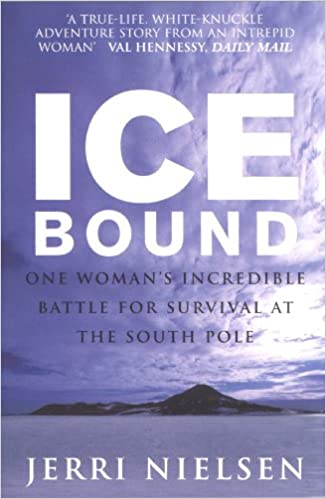
Ice Bound by Jerri Nielsen with Maryanne Vollers

Ebury Press | 2001 | 379 p | Own copy | 5*

I read Ice Bound: One Woman’s Incredible Battle for Survival over two months, taking my time. Dr Jerri Nielsen was a forty-six year old doctor working in Ohio when in 1998 she made the decision to take a year’s sabbatical at the Amundsen-Scott South Pole Research Station in Antarctica, the most remote and perilous place on earth. She had just been through an acrimonious divorce and could no longer see her children.

The first part of the book describes life at the South Pole in detail, the layers of clothing needed in the extreme cold, the adjustments to living at 11,000 feet above sea level, and the difficulties of living at the pole with power failures, fires, frostbite, boredom, memory loss, nausea, and getting lost in the darkness and total whiteout. But she also describes the friendships she made and how she felt about celebrating her forty-seventh birthday at the South Pole:

It was the best birthday I had had since childhood. I was forty-seven and surrounded by friends, in a community that needed me, in a place that I loved, discovering more every day about what truly mattered in life. (page 138)

It’s about half way into the book that she describes when in the dark Antarctic winter of 1999 she discovered a lump in her breast. Whilst the Pole was cut off from the rest of the world in total darkness she treated herself, taking biopsies and having chemotherapy, until she was rescued by the Air National Guard in October 1999. She said this about her experience:

I can say that after living at the South Pole nothing can possibly terrify me, even looking at my own death. That is one of the many things this place does to you. Nothing after that really matters. (page 190)

The descriptions of the polar landscape are just beautiful:

I was fascinated by the concept of twilight and its three discrete stages. Yet all I truly understood was that the world outside the Dome seemed beautiful and alien every day. Now the sky was deep purple with bands of orange on the horizon. I was outside watching the sky one day when I saw my first aura. It looked like a shimmering green curtain, rolling in a solar wind, with pink searchlights shooting into the atmosphere like heaven’s own movie premier. The rest was silence and space. (page 147)

This is a true story of survival under extreme circumstances, of courage and endurance. Even without cancer I cannot imagine coping with life at the South Pole. I was diagnosed with breast cancer in 2011 and had a lumpectomy and radiotherapy so I have experienced some of what she went through, but it was nothing compared to what Jerri Nielssen had to go through. To take my own biopsies and administer my own chemotherapy like she did would be beyond me. It is hard for me to read even now years later and I found it immensely moving.

The book alternates between narrative and personal letters and emails and in her acknowledgments Jerri Nielssen thanks Maryanne Vollers for her help in telling her story. It held me spellbound from beginning to end.

I wanted to know what happened next to her. The book has an Epilogue that describes how she was treated – mastectomy, more chemotherapy and radiation. The cancer then went into remission, but in 2005 it returned in her bones and liver, later spreading to her brain and she died in June 2009. A brave and truly inspirational woman.