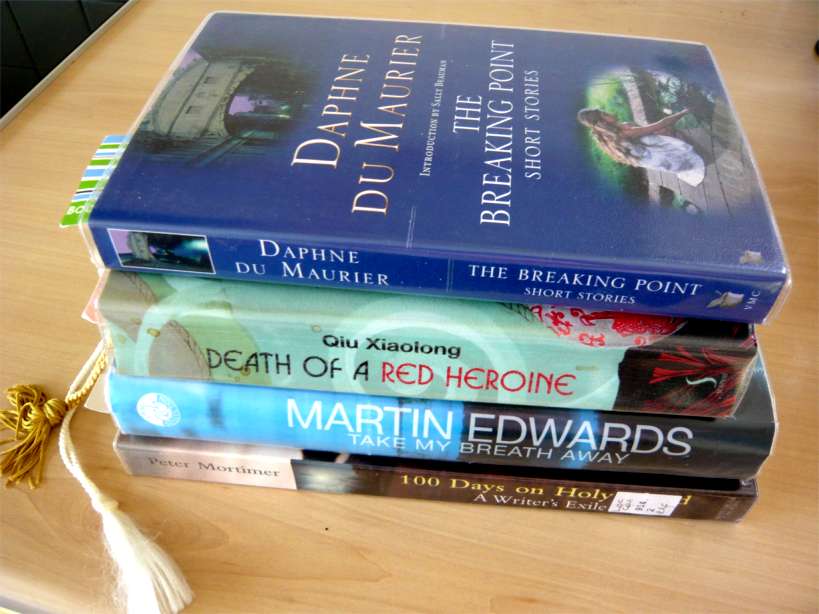
After I finished reading 100 Days On Holy Island the main impression it made on me was that Peter Mortimer endured his hundred days there, feeling insecure, wanting company and to be accepted. He always felt an ‘outsider’, not accepted by the locals. He recognised his paranoia:
Part of Mortimer’s paranoia while on Lindisfarne was of being constantly observed and judged, that my every act was noted and recorded by some amorphous body established purely to note down all behaviour of nosy incomers such as I. The truth, of course, was that people had their own lives to live but anyone in a similar position to mine will know what I mean. (page 199)
This sense of being an outsider pervades the book. It can’t have helped that people knew he was on the island in order to write about his experience. He wasn’t there as a tourist, nor had he gone to settle there, but he went with the intention of seeing how he coped with living there for one hundred days and writing about it. This book is written with empathy for the island and its inhabitants but because of his sense of being an ‘incomer’ all the time I was reading it I found it uncomfortable, whether he was sitting in one of the pubs on his own, or visiting some of the people he did get to know, or spending time on St Cuthbert’s Isle alone.
I now know a bit more about the geography of the island, and the way the tide cuts it off from the mainline (which I knew before but this book emphasises the isolation it brings). Most of all I suppose I know more about Peter Mortimer, a writer I had never heard of before. He is a playwright and a poet. His other memoirs are The Last of the Hunters about the six months he spent at sea working with North Shields fisherman, and Broke Through Britain, about his 500 mile odyssey from Plymouth to Edinburgh.
His time on Holy Island was from January to April 2001, when foot and mouth disease swept through the UK, and although it never got to Holy Island it was affected by the closure of the countryside. The islanders were hit by the threat to the tourist trade. It was freezing cold, blasted by snow storms and afflicted by power cuts. It was also a bad time for Mortimer to be away from his family, as his father died just before he went, his mother was in hospital desperate to see him, his son had his 17th birthday and his nephew was seriously ill. Although he did go and visit his mother, he couldn’t have picked a worse time, which may well be a major reason he struggled there on his own.
Holy Island (also known as Lindisfarne) is a place of pilgrimage, known as the Cradle of Christianity, a place of spiritual heritage. I don’t think Mortimer mentioned Lindisfarne Priory in his book and very little about Lindisfarne Castle, either. This is not a guide book, nor is it about the history of the island, or about Christianity. He does examine his own beliefs and went to the talks on faith at the Heritage Centre, but realised that he
was having trouble with these lecture overall; not the people so much as the basis. I wasn’t enthused. They didn’t tap into my own life passions, the things that excited and moved me, which I was becoming increasingly aware, had very little to do with religion. (page 194)
He spent time doing jobs such as clearing the overgrown garden of one of the island pubs, painting Ray Simpson’s (who ran the society of St Aidan and St Hilda) bathroom and decorating it with a haiku, dragging a stone from one of the beaches and inscribing it with another haiku. He also helped out at the island school, went to lots of meetings, and walked around as much of the island as he could. The days he spent on St Cuthbert’s Isle are interesting. He called that his Three Tides for St Cuthbert. St Cuthbert taught at the monastery on Holy Island and when he died in 687 he was buried in the church, although eventually his bones were buried at Durham. St Cuthbert’s Isle is the place Cuthbert went for solitude and to meditate. Mortimer describes it thus:
The island was bleak terrain, tortured volcanic rock on the top of which was tufted spongy grass whose uneven surface and hidden potholes made walking difficult. The stone remains of Cuthbert’s cell were slightly sunken, offering some slight protection from the wind, which was, it appeared, on a 24-hour-a-day, 7-day-a week contract. At one end of the cell was an impressive oak cross erected 60 years previously. …
The sky seemed massive. The view back to Holy Island took in the Priory ruins, St Mary’s church and the row of desirable properties named Fiddler’s Green. Through the binoculars I could trace the progress of the Dinky-sized cars on the distant causeway. This would continue to 11.30am. To the west, across the water, lay the mass of the Northumberland mainland. (page 195)
In some ways I found it a remarkable book which kept me wanting to read it but by the end his own wish to go back home got the better of me and I was glad it ended.
His own summary of the book and his stay on Holy Island ends the book:
I wrote various small poems during my 100 days and finish with another tiddler completed soon after my return, an image that stayed in my mind and in some ways reinforces the fact that I can never belong to, yet never will be free of, that small huddled island which is simultaneously well known and yet not known at all.
On the Cullercoats carpet
My yanked-off boots
spill North Shore sand.
 I’m reading Emma Kennedy’s The Tent, the Bucket and Me. As the subtitle explains this is about her ‘Family’s Disastrous Attempts to go Camping in the 70s‘, and that is not an understatement. I wish that I had the same powers of recall as Emma does to remember what I thought, felt and said at the age of 3. Emma is of course, writing comedy. It reminds me of those TV programmes that make you think ‘this just wouldn’t happen in real life’. I’m not saying that what she writes about didn’t happen, but I do suspect it’s been embellished somewhat.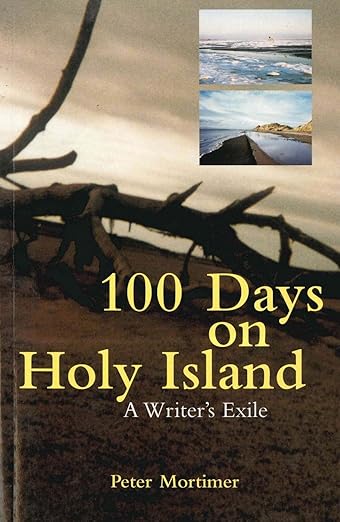


 wait their turn.
 The Music Room
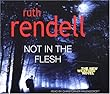 Dave and I listened to this in the car whilst travelling to Northumberland and back. This is an Inspector Wexford mystery – a man taking his dog for a walk discovers a severed hand, which turns out to be part of a skeleton wrapped in a purple sheet. The police have to discover the identity of the victim – and of the body of a second corpse found in a nearby house. Both have been lying undiscovered for at least ten years. I’m not used to listening to books and I did find it a bit difficult to follow. Of course, the sat nav and traffic news kept interrupting which didn’t help, but even so I did get confused. There were too many people and sub-plots. Maybe I should read the book.
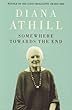 I loved this memoir. Diana Athill comes across as an honest writer, not afraid to say what she thinks, now she is no longer an editor. As the title indicates, she writes about what it is like getting towards the end of her life. At the time of writing she was 89 years old and looking back on her life with few regrets. This is a book I may well buy to re-read at leisure.
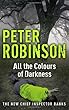 I have mixed feelings about this book, parts of it really interested me, but I could have done without the terrorist attack and involvement of MI5 and MI6. This is only the 2nd Inspector Banks book I’ve read and it’s the 18th in Robinson’s series. I think that doesn’t matter as I had no difficulty in sorting out his relationships and although other cases are referred to this reads OK as a stand-alone book. What I did have difficulty with was believing the spy stuff – one of the victims had been a spook. What I do like is Robinson’s descriptive writing eg:
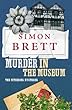 This is the fourth in Simon Brett’s Fethering Mysteries series. It’s set in Bracketts, an Elizabethan house, the former home of Esmond Chadleigh, a celebrated poet during his lifetime. The house is about to be turned into a museum, although not all the Trustees agree. Carole Seddon has been co-opted onto the Board of Trustees and when a skeleton is discovered in the kitchen garden she soon becomes involved in solving the mystery. Then Sheila Cartwright, the bossy domineering former Director of the Trustees is shot, and Carole finds her own life is in danger.
 BooksPlease