Heartstone by C J Sansom: Book Review

Mantle (Macmillan) 2010
Pages 640
ISBN 9781405092739
Dimensions 234mm x 153mm   Weight 0.95 kg

Publisher’s blurb:

Summer, 1545. England is at war. Henry VIII’s invasion of France has gone badly wrong, and a massive French fleet is preparing to sail across the Channel . . .

Meanwhile, Matthew Shardlake is given an intriguing legal case by an old servant of Queen Catherine Parr. Asked to investigate claims of ‘monstrous wrongs’ committed against his young ward, Hugh Curteys, by Sir Nicholas Hobbey, Shardlake and his assistant Barak journey to Portsmouth. There, Shardlake also intends to investigate the mysterious past of Ellen Fettiplace, a young woman incarcerated in the Bedlam.

Once in Portsmouth, Shardlake and Barak find themselves in a city preparing for war. The mysteries surrounding the Hobbey family and the events that destroyed Ellen’s family nineteen years before, involve Shardlake in reunions both with an old friend and an old enemy close to the throne. Soon events will converge on board one of the king’s great warships gathered in Portsmouth harbour, waiting to sail out and confront the approaching French fleet. . .

This is the fifth novel in the Matthew Shardlake series and to my mind although it’s good, I think it’s not quite as good as the others. Compared to the earlier books it’s a bit plodding as Shardlake goes on numerous journeys. But that aside it’s great on detail about life in Tudor times. There’s the war against the French, details about how the troops were recruited and trained, about the French attack on Portsmouth and the sinking of the Mary Rose. Actually I found that more interesting than the mystery surrounding Hugh Curteys, which I’d guessed quite early on, although it began well with Shardlake out of his usual area of expertise, going through the records at the Court of Wards.

The story about Ellen Fettiplace is more intriguing. Ellen had been an inmate in the Bedlam for 19 years and Shardlake discovered that there was no order of lunacy to authorise her imprisonment. His searches lead him to Rolfswood, the place where Ellen had lived. There he eventually discovers the terrible truth. Shardlake is dedicated to protecting the underdog, championing those unable to help themselves and above all to justice and truth, disregarding his own safety. But his dedication has become obsessive and there were times when I agreed with Barak that he should let go and return to London.

As usual, reading Sansom’s historical novels there is the echo of the past repeating itself. In this one I found myself thinking of the nature of war, the power that national leaders have in making decisions and the effects it has on ordinary people who get dragged into the battles willy-nilly. His research is excellent, his characters are well drawn and the atmosphere and sense of place are convincing. Whilst I was reading I was transported to Tudor England at a time of war.
Borrowed Books

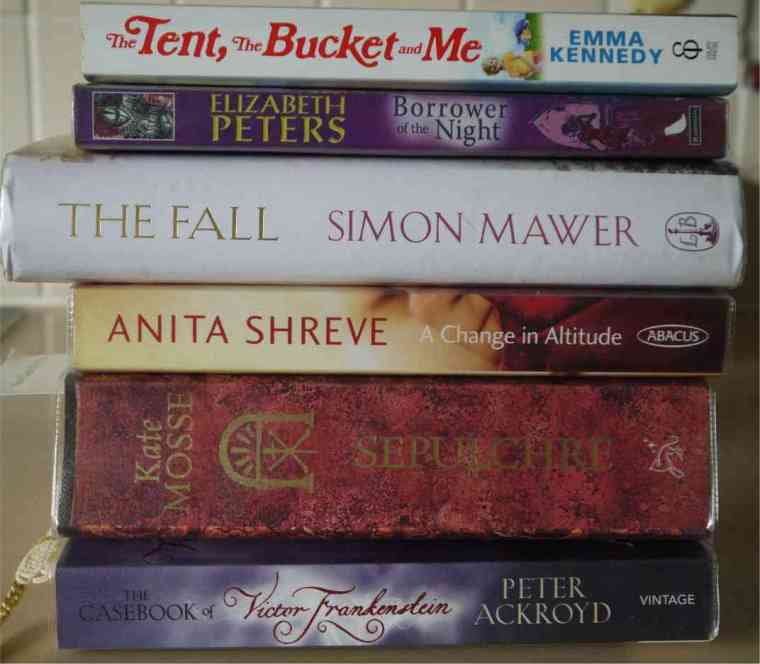
The mobile library came last week. I wasn’t going to borrow many, if any books, but there were some on the shelves that looked interesting and the van isn’t coming again until 21 October so I thought, why not borrow them. Then we went to our granddaughter’s 10th birthday party on Saturday and our son lent me a book too. It’s the top one in the pile shown below. Finally we went into town yesterday and as I returned a book to the library there I had a quick look round and borrowed the book at the bottom of the pile.

Borrowed Books

From top to bottom they are:

  • The Tent, the Bucket and Me: My Family’s Disastrous Attempts to go Camping in the 70s by Emma Kennedy. Apparently (I say this because I haven’t got that far in the book) they go to Carnac where we also went camping (well in a caravan) in the 80s. I checked on Amazon and this book has widely different reviews – some love it and think it very funny and others think it’s dreadful and not at all funny. I wonder which ‘camp’ I’ll be in.
  • Borrower of the Night: a Vicky Bliss Murder Mystery by Elizabeth Peters. I haven’t read anything by Elizabeth Peters, but as I’ve seen some reviews on a few blogs, I thought I’d have a look at this one. I haven’t started it yet. Vicky Bliss is an art historian, beautiful and brainy, according to the back cover. This one is about a search for a missing masterwork in wood by a master carver who died in Germany in the 16th century.
  • The Fall by Simon Mawer. I’ve read one other by by Simon Mawer – The Gospel of Judas, which I’d enjoyed. The Fall is the story of Rob and Jamie, friends from childhood, with a passion for mountaineering and climbing. From just a quick look at it, I see that it begins in Snowdon (another place where went on holiday and have camped and climbed (well D climbed, I just walked). Jamie and Rob take on greater challenges, culminating in the Eiger’s North Face. The jacket description appealed to me: ‘a story that captures nature at its most beautiful and most brutal, and which unlocks the intricacies at the heart of human relationships.’
  • A Change in Altitude by Anita Shreve. I’ve not been too keen on the latest books by Anita Shreve, although I loved her earlier ones, so I thought I’d borrow this one rather than buy it. I have started to read it, but just a few pages in it hasn’t ‘grabbed’ me yet. It’s about two couples on a climbing expedition to Mount Kenya when a horrific accident occurs.
  • Sepulchre by Kate Mosse. I read Labyrinth a few years ago (before I began this blog) and at the time I noted that it was ‘OK but too long’. So this is another book I decided not to buy, but if I saw it in the library I’d borrow it. It is enormously long! So far I’ve read a few chapters, set in 1891 in Paris and I’m not sure whether I’ll ever finish it. It’s a time-split book, divided 1891 and 2007, ‘the story of a tragic love, a missing girl, a unique set of tarot cards and the strange events of a cataclysmic night.’ (from the back cover)
  • The Casebook of Victor Frankenstein by Peter Ackroyd. I’ve always enjoyed Peter Ackroyd’s books and this one looked like a candidate for the RIP Challenge (as does Sepulchre). So far I’ve read about Victor Frankenstein’s love of learning and his desire to know the secrets of nature and the source of life. He has met Shelley at Oxford University, attended lessons at the dissecting room of St Thomas’s Hospital in London and is fascinated by Humphrey Davy’s experiments with electrical experiments. So far, so good. This book also has very mixed reviews on Amazon and in the press – the Guardian, ‘disappointing‘ and the Telegraph, ‘a brilliant jeu d’esprit.’

The links are to Amazon.co.uk (except for the press reviews). The only book to get consistent reviews on Amazon is The Fall. I don’t take much notice of these reviews, unless I know the reviewer, but I find it interesting to read such varying responses.

Portrait of an Unknown Woman by Vanora Bennett: Book Review

I didn’t write about Portrait of an Unknown Woman by Vanora Bennett as soon as I’d finished reading it, which is a pity because I only made a few notes whilst reading and now my memory of it is fading fast. It took me some time to get really involved in the story, which is a mixture of fiction and history. I liked the historical elements very much. The fictional side mixed in quite well but I found some of it a bit too sentimental and somewhat contrived.

It’s the story of Sir Thomas More’s fall from Henry VIII’s favour and that of his adopted daughter Meg Giggs and her love for two men – John Clements, the family’s former tutor, and the painter, Hans Holbein. Bennett puts forward a theory about John Clements’ true identity drawn from an analysis and an interpretation of two paintings by Hans Holbein of the More family and also his painting, The Ambassadors. I was fascinated by this and the detail in the paintings, enhanced by the inclusion in the book of a reproduction of the plan for Holbein’s first portrait of the More Family painted in 1527 -28 and a colour reproduction of  a second portrait of the family attributed to Holbein, even though it is signed ‘Rowlandas Lockey’.

I liked the way Bennett portrayed different aspects of Sir Thomas More’s character; in his early life he was a humanist and friend of Erasmus, later a courtier and Henry VIII’s Catholic chancellor, who persecuted Protestant heretics. This contrasts with his family life, where he is relaxed, generous and gentle and Meg cannot reconcile her knowledge of him as a father with his cruel and fanatical persecution of the heretics.

It combines a love story, art history and historical fiction providing an insight into the Tudor period at a time of great social and religious change.

Musing Mondays – Currently Reading

Monday Musings is hosted by Should Be Reading.

This week’s question is:

What are you currently reading? Would you recommend it to others? Is it part of a series (if so, which one)? What are you thinking about it? What book(s) would you compare it to, if any?

Currently I’m reading A Dark Adapted Eye by Barbara Vine. I think it’s the first one Ruth Rendell wrote under the pseudonym Barbara Vine. I’m still in the opening chapters and working out the relationships between the characters. It’s a psychological crime novel about a family with secrets. The blurb reads:

Brilliantly plotted. Vine is not afraid to walk down the mean streets of the mind and can build up an almost tangile atmosphere of menace and unease. (Daily Telegraph)

It’s not part of a series, although the Vine books are all psychological crime novels and from what I’ve read so far I would certainly recommend it if you like that sort of book.

I’m also reading Death on the Nile by Agatha Christie, featuring Hercule Poirot. I haven’t read this before, although I’ve seen the film with Peter Ustinov as Poirot and the TV version starring David Suchet, so as I’m reading it I’m remembering what happens and can visualise the setting in Egypt on the Nile alongside the Pyramids. I like the way Christie sets up so many possible suspects and then reveals how each one couldn’t be the murderer. I think I remember who did it, and how – but I could be wrong. As I like Agatha Christie I’d recommend any of her books, and this one is a classic.

I have a third book on the go, although at present it’s lagging behind as I’m enjoying the other two books so much. It’s Portrait of an Unknown Woman by Vanora Bennett, historical fiction set in Tudor England (Henry VIII) with Thomas More’s family. That’s not to say that I’m not enjoying this book, but it’s quite slow to get going – or rather I’m slow at reading it, because it is quite detailed and not a lot happens at first.

It covers the same period as Wolf Hall by Hilary Mantel, when Henry VIII wants a divorce from Katherine of Aragon to marry Anne Boleyn, but there is little comparison between these two books apart from that. I suppose I’d compare it to Philippa Gregory’s books. And if you like detailed and well-researched historical fiction, then it is for you.

Best Books January to June

Kerrie at Mysteries in Paradise recently asked what are your favourite crime fictionbooks so far this year, which got me to thinking about my favourite books as a whole (not just crime fiction). About half the books I read are crime fiction and the other half is a mixture of fiction (of many genres) with a smattering of non fiction.

After much thought I’ve decided on these ten books as my favourite reads so far. I’ve only included one book from Ian Rankin and Agatha Christie, although I’ve read several from each that I rate as highly as the ones I’ve chosen. Six of the books are crime fiction (marked *), there is one non fiction and one book of short stories. They are listed in the order that I read them.

I hope to vary my reading during the rest of 2010, maybe a few more non-fiction books as I have several biographies/autobiographies I’d love to read and more classics, but I expect crime fiction will still be high on my list of best books by the end of the year.

Teaser Tuesday

Teaser Tuesdays is a weekly bookish meme, hosted by MizB of Should Be Reading.

Share a couple or more sentences from the book you’re currently reading. You also need to share the title of the book that you’re getting your ‘teaser’ from €¦ that way people can have some great book recommendations if they like the teaser you’ve given!

After feasting on Ian Rankin’s Rebus books, I’ve gone back to reading Portrait of an Unknown Woman by Vanora Bennett.  After reading Wolf Hall I’m in the mood for more about Thomas More, and this time the spotlight is on his family and in particular his adopted daughter Meg and her involvement with John Clement, the former family tutor and later President of the Royal College of Physicians and Hans Holbein, the German portrait painter.

Here is Hans Holbein’s reaction on meeting Meg:

She stopped a bit breathless, and looked provocatively at him. Hans Holbein had never seen a woman looking provocative in this completely unflirtatious way, any more than he’d ever come across a woman who had read the Imitation of Christ. She was challenging his mind instead of his body. But Erasmus had told him about More’s family school. This must be what happened to women when you taught them Latin and Greek and the skills of argument. (page 97)