My Antonia by Willa Cather

I’d included My Antonia on my Classics Club list of books to read because I’d enjoyed reading A Lost Lady a few years ago (my post on that book is here). So when it popped up in the Classics Club Spin as the book to read in August/September I was pleased.

I liked it, but not as much as A Lost Lady. I think it’s because it’s a bit fragmented, made up of  a series of short stories. But it’s beautifully written with vivid descriptions of people and places. Published in 1918 it’s set in America at the beginning of the 20th century – the story of immigrant settlers and in particular that of Antonia Shimerda and her family as told by Jim Burden. Jim and Antonia meet as children, when he had come to live with his grandparents on their farm in Nebraska. Antonia’s family is from Bohemia, speaking very little English and living in a sort of shed, little more than a cave. They spend a lot of time together as Jim teaches Antonia to speak English.

Jim recounts various episodes as they grow up together. Gradually they drift apart and lose contact, as Jim left for college eventually becoming a lawyer, whilst Antonia stayed in Nebraska. They meet again years later. It’s a story of hardship and suffering, of poverty, people struggling to make a living from the land, and of the attitudes towards immigrants, women and children. It’s also about being an outsider and the importance of belonging, which makes it most poignant that to her father Antonia is ‘My Antonia’.

But the thing that stands out for me is the beauty of Cather’s descriptions of the countryside and as I read I highlighted many passages – this for example:

Presently we saw a curious thing: there were no clouds, the sun was going down in a limpid gold-washed sky. Just as the lower edge of the red disk rested on the high fields against the horizon, a great black figure suddenly appeared on the face of the sun. We sprang to our feet, straining our eyes toward it. In a moment we realized what it was. On some upland farm, a plough had been left standing in the field. The sun was sinking just behind it. Magnified across the distance by the horizontal light, it stood out against the sun, was exactly contained within the circle of the disk; the handles the tongue, the share black against the molten red. There it was, heroic in size, a picture writing on the sun.

Even while we whispered about it, our vision disappeared; the ball dropped and dropped until the red tip went beneath the earth. The fields below us were dark, the sky was growing pale, and that forgotten plough had sunk back to its own littleness somewhere on the prairie. (page 186)

But it’s not just descriptive, it conveys the timelessness of human nature, of how people interact and think, their prejudices, unreliability and of their love for each other. I was struck by this definition of happiness:

I was entirely happy. Perhaps we feel like that when we die and become part of something entire, whether it is sun and air, or goodness and knowledge. At any rate, that is happiness: to be dissolved into something complete and great. When it comes to one, it comes as naturally as sleep. (page 11)

Yet this is a sad book, full of nostalgia and poignancy. There’s such a contrast between the hardness of the life of the settlers and the loving gentle family life that Jim’s grandparents provide for him and their generosity towards their neighbours. Overall, though it is the character of Antonia that caught my attention and in the episodes that weren’t about her I lost interest somewhat. So, a mixed reaction – there are parts that I thought were outstanding and parts that left me rather unsatisfied.
Relics of the Dead by Ariana Franklin

As soon as I’d finished reading The Death Maze I began Ariana Franklin’s third book in her Mistress of the Art of Death series, Relics of the Dead. Now this one was more to my liking and I enjoyed it very much.

The date is 1176, the setting is Glastonbury where the monks, after a fire had destroyed their monastery, discovered two skeletons buried in their graveyard. The question is  – are these the remains of King Arthur and Queen Guinevere? The problem is that Henry II needs evidence that they are not – that the legendary Arthur is indeed dead and not the ‘Once and Future King’, sleeping but waiting for the right time to lead the belligerent Welsh against him. Henry’s solution is to send Adelia Aguilar, the anatomist, to examine the bones for evidence, preferably to establish that no one can say that the bones are not that of Arthur and his queen. Given that this is the 12th century and the technology wasn’t there to prove the age and identity of the bones, Adelia assisted by Mansur, does a pretty good job in her investigation, despite attempts on her life.

Where Relics of the Dead stands out is in the depiction of Glastonbury, a mysterious, spiritual place, ‘one of the world’s sacred centres, a place where the division between man and God was thinner than anywhere else‘, a place where ‘there was a special magnetism that pulled people to worship a presence her long before Christ had set foot on his native heath.’ But Adelia, that down-to-earth, practical woman couldn’t feel it – for her all mysteries had to have an explanation. And she was determined to find it.

I’ve always liked the stories about King Arthur and the beliefs about his life and death, about Excalibur (which does feature in this book), about Guinevere’s affair with Lancelot,  and the Holy Grail (which do not). As well as a strong sense of place and atmosphere the characters are well-drawn and believable, even if some aspects of the plot required quite a hefty suspension of disbelief (which I managed easily enough).

Similarly I wasn’t bothered by Franklin’s use of modern language – in her Author’s Note, she had noted that she was sometimes criticised for making her characters use modern language and explained that ‘in 12th century England the common people spoke a form of English even less comprehensible than Chaucer’s in the 14th, the nobility spoke Norman French and the clergy Latin. Since people then sounded contemporary to each other, and since I hate the use of what I call ‘Gadzooks’ in historical novels to denote a past age, I insist on making them sound contemporary to us.’ If she had used such ‘gadzooks’ language I don’t think I’d have got very far into the book. And, it didn’t occur to me that her dialogue was anachronistic.

Franklin also used a lot of terms common to the age, such as ‘Mort d’Ancestor’, which she did explain within the text, so that that too did not bother me. In fact I liked it, I think it added to the atmosphere and I did enjoy looking up such terms for more information in a book I used to use a lot when I worked in a local archive repository – The Local Historian’s Encyclopedia by John Richardson, a fascinating book.

Ariana Franklin was the pseudonym of Diana Norman. She died in 2011. The last book in the series is The Assassin’s Prayer (published as Murderous Procession in the US), continuing Adelia’s story.

The Death Maze by Ariana Franklin

Normal service has been resumed – thankfully!! – I’m back to writing on this blog thanks to my son.

It seems quite a while since I finished reading Ariana Franklin’s The Death Maze (published as The Serpent’s Tale in the US), so these are just a few thoughts about the book.

Back in 2007 I’d really enjoyed her first book, Mistress of the Art of Death (which I wrote about here) and I was eager to read the next book about Adelia Aguilar, the 12th century anatomist employed by Henry II. But I was a bit put off by reports that The Death Maze was not as good, and other books grabbed my attention. Time passed, the third book came out – Relics of the Dead – and curiosity got the better of me so I bought both books, and eventually I got round to reading them – one after the other.

Yes, The Death Maze does not live up to the first book for me, but it’s still enjoyable. Rosamund Clifford, Henry II’s mistress has been poisoned, allegedly by Eleanor of Aquitane, Henry’s wife. Adelia is summoned to investigate her death. So, she sets off to Oxford, accompanied by her baby daughter, Allie, her servant Gyltha and the Saracen, Mansur, who has to pose as the doctor whilst Adelia pretends to be his assistant. Adelia was a graduate of the School of Medicine in Salerno, which, unlike England, allowed women to train as physicians; in England her forensic skills would have been considered witchcraft.
Rosamund had lived in a strange and sinister tower surrounded by a maze, constructed of walls of granite with blackthorn planted against them. So, the first problem Adelia had to solve was to find the way through the maze. She was then faced with the gruesome discovery of Rosamund’s dead body. The main thrust of the book centres on Eleanor’s moves to overthrow Henry II, and after Eleanor and her supporters capture Adelia, they take her to the nunnery at Godstow, where they wait snowbound for the right moment to launch their rebellion.

I think the book works well as historical fiction, even though as Ariana Franklin wrote in her Author’s Notes that there is only a brief reference to Rosamund Clifford in the historical records and so this is a fictional portrayal based on legend. And she inserted a fictional rebellion in England in a gap in the medieval records. It has whetted my appetite to know more about the period. But as crime fiction, I was rather disappointed because although I found the details of Rosamund’s death interesting, there was actually very little about Adelia’s investigation, very little for her to exercise her forsenic skills, which was one of the elements I’d enjoyed in Mistress of the Art of Death. 

This is my second book for Carl’s  R.I.P.VII challenge and it also slots into the Historical Fiction Challenge and the Mount TBR Challenge 2013.

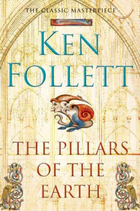
The Pillars of the Earth by Ken Follett

I’ve been working my way through some of the books I’ve owned for ages – books I really wanted to read when I bought them, but have since just sat on the bookshelves unread for a variety of reasons. I’ve had The Pillars of the Earth by Ken Follett for five years! The main reason I haven’t read it before now is its length – it has 1,076 pages!

I can’t remember now why I bought this book, possibly it was because I like historical novels and I like historic buildings and The Pillars of the Earth is set in 12th century England during the time of the civil war between Stephen and Matilda/Maud (she’s known by both names – in this book she’s called Maud, but at school we were taught her name was Matilda). It’s also the story of the building of a cathedral.

I was interested in the details of building a cathedral, the architecture and building techniques, but it is in essence a family saga. However it is so long-winded and repetitive that I began to think Follett must have written it as maybe three books and then joined them together without editing them, or maybe he was reminding himself of what he’d written earlier – it took him years to complete the book.

It’s a bit like a soap opera – terrible things happen, the characters overcome them and recover only to be knocked down again by more terrible events –  violence, power struggles and rape and pillage abound. It’s a bit simplistic with a really bad, evil character and a saintly one, a beautiful woman and a witch-type and so on. But it kept me entertained without having to think too hard and I even found myself thinking about it when I wasn’t reading, wondering what could possibly happen next. Parts of the novel came to life more than others – one being near the end of the book with the story of Thomas à Becket’s murder in Canterbury Cathedral.

There is a sequel, World Without End, set in the same place and featuring descendants of the original characters nearly 200 years after the events in The Pillars of the Earth. I’m not rushing to read it!

There was a TV version – I didn’t see it!

The Birthday Boys by Beryl Bainbridge

 I was absolutely fascinated by The Birthday Boys by Beryl Bainbridge, a novel about Captain Scott’s last Antarctic Expedition. It’s narrated by Captain Robert Falcon Scott and the other four men who died in the Antarctic having reached the South Pole – Petty Officer Edgar (Taff) Evans in June 1910; Dr Edward (Uncle Bill) Wilson, July 1910; Captain Scott: The Owner (Con), March 1911; Lt Henry Robertson (Birdie) Bowers, July 1911; and Capt Lawrence Edward (Titus) Oates, March 1912.

It’s fascinating not just as an account of the expedition, but also because it gets inside each man’s mind, it seemed to me, vividly describing the events as they progressed to the South Pole and the terrible conditions they had to endure. Beryl Bainbridge’s imagination and research combined make this a dramatic heroic story and an emotional roller-coaster set in the beautiful but deadly dangerous frozen landscape of the Antarctic.

Each character is distinctly drawn, each one revealing his thoughts, fears and hopes and the interaction between them reveals their personality clashes and friendships. The prejudices and class distinctions of the period come through strongly. The setting is superb – I could see the landscape and feel the dangers.

I finished reading this book nearly two weeks ago and apart from their final days one other episode stands out in my mind and that is the journey to the Emperor Penguin rookery at Cape Crozier undertaken by Wilson, zoologist Cherry-Garrard (Cherry) and Bowers. This section is narrated by Bowers. The journey was nearly seventy miles – Bowers described it:

I never thought the Owner would let us go, not with the Polar trek only three months off, but somehow Bill managed to talk him round. To reach the rookery where temperatures often register 100 degrees of frost, it’s necessary to scramble down cliffs exposed to blizzards sweeping ferociously across hundreds of miles of open snow plain. And all this in the dark! Exciting stuff, what? (page 133)

It took them far longer than they had anticipated and they endured dreadful conditions; at times they were ‘half delirious with exhaustion‘ and had ‘frost-bitten fingers bulging like plums.’ But Bowers thought:

It may be that the purpose of the worst journey in the world had been to collect eggs which might prove a scientific theory, but we’d unravelled a far greater mystery on the way – the missing link between God and man is brotherly love. (page 158)

Scott comes over as a sympathetic character, complicated, introspective and at times indecisive, and impatient at others. He is concerned that Amundsen will beat them to the Pole and is able to talk over his feelings with Wilson:

He understands me well enough to know that my continual harping on Amundsen’s  chances of beating us to the Pole isn’t down to self-interest, or a longing for glory, simply a desire to reach, in an endless process of addition and subtraction, a kind of mathematical peace. One hundred dogs, none of them presumably having fallen down a crevasse, must surely equal formidable odds.

It’s ironic that the same situation should be happening to me all over again. It’s barely three years since Shackleton sneaked off and nearly pipped me to the post. There again, I’d made no secret of my intentions. I’m not stupid enough to think of the Pole as mine, but I do detest underhandedness. (pages 116 – 117)

At times I had to remind myself that I was reading a novel, but then again there were passages where I had to remind myself that these events really did take place as they seemed so fantastical. Beryl Bainbridge has written a most remarkable book, full of facts seamlessly woven into the narrative, and full of emotion and feeling. It is one of the best books I’ve read this year.

Reading The Birthday Boys has made me keen to read other books about the Polar expeditions and as I wrote in this post I have South with Scott and Race to The End to look forward to reading.

Note: The Birthday Boys fits into these Reading Challenges: Historical Fiction Reading Challenge, Mount TBR Challenge and What’s In a Name Challenge (book with a celebration in the title).

The English Spy by Donald Smith

I’d gone to my local library to collect Road to Referendum by Iain Macwhirter, a book I’d reserved after I read about on FictionFan’s blog, and was browsing the shelves when this book, The English Spy caught my eye. Road to Referendum is about the run up to the Independence Referendum to take place in Scotland in September 2014. It also has chapters on Scottish history leading up to the present day as background.  So, it was quite a coincidence finding The English Spy as this is a novel about the build up to the political Union of England and Scotland in 1707 – the Union that Independence for Scotland would break.

My knowledge of the Act of Union in 1707 was limited to just the fact that by that union Scotland and England, together with Ireland and Wales, became the United Kingdom and I thought it was to settle the successor to Queen Anne who was childless and ill. Of course, it was much more complicated than that and The English Spy tells the story of how Daniel Defoe, at that time still known as Daniel Foe, was sent to Scotland under secret instructions from the English government to persuade the Scots to give up their independence. It’s a fascinating story of intrigue and backstabbing amongst the members of the Scottish parliament!

The narration moves between multiple viewpoints, mainly in the first person and some in the third person of various characters, some obviously historical figures and others possibly(?) fictional ones. There are Foe’s own account, letters between Isobel Rankin, his landlady in Edinburgh and her friend Nellie in Glasgow, the journal of Lord Glamis and a third person narrative of Robert Harley, the first Earl of Oxford. There are several other characters who pop in and out of the story – Lady O’Kelly and Aeneas Murray amongst others. This is a story about spies and the struggle between various factions for power and once I had got the characters sorted in my mind I was swept along with the intrigue and dangers of the times, keen to see how the Union came about.

The English Spy is a mix of fact and fiction but A Warning to the Reader at the beginning of the book clarifies that Daniel Defoe had indeed been sent to Scotland and was required to provide London with ‘clandestine reports on affairs in the north’. The Scottish Government was led by the Marquis of Queensberry who favoured union with England and the Duke of Hamilton was opposed to the union. Donald Smith warns:

Yet why did Scotland surrender its hard won and long cherished independence? The historians remain divided. What is offered here is fiction, yet as Defoe himself shows, the truths or apparent deceits of fiction may be uncomfortably closer to home.

Now, over 300 years later the question of independence for Scotland is still in question!

Dr Donald Smith is a founding member of the Scottish Storytelling Forum and of Edinburgh’s Guid Crack Club, and he is currently Director of the Scottish Storytelling Centre at The Netherbow.  He has written, directed or produced over fifty plays and is a founding director of the National Theatre of Scotland.

Now to read what Road to Referendum has to offer.