Saturday Snapshots: Stirling Castle

We spent last week in Scotland. Except for Monday the weather was atrocious with torrential rain on most days. But Monday brought blue skies and glorious sunshine, so we took advantage of the good weather and visited Stirling Castle, maintained and managed by Historic Scotland. This is a most spectacular castle standing high on a volcanic rock. It was one of the most favoured homes of Scottish kings and queens from the 12th century, although it is an ancient site.

I have many photos – here is just a small selection:

A statue of King Robert the Bruce stands outside the modern entrance to the castle:

Robert the Bruce statue

In the background is the National Wallace Monument which overlooks the scene of Scotland’s victory at the Battle of Stirling Bridge in 1297.

Stirling Castle Forework

The Forework (above) was installed by James V around 1500, originally the main entrance, it is now an inner entrance to the castle.

The photo below shows the Queen Anne Garden, which on Monday was being used for a crossbow demonstration – children were queuing to have a go for themselves. Behind the garden is James V’s Renaissance Palace of Princelie Virtue which he had built for himself and his French Queen, Mary of Guise (the parents of Mary Queen of Scots) on the site of earlier buildings.

The pale golden building peeping out beyond the Palace is the Great Hall, commissioned by James IV (who died at Flodden Field in 1513) and completed in 1503. It almost glows in the sunlight because it is covered with ‘king’s gold’ limewash. It has been renovated and was reopened by Queen Elizabeth II in 1999.

Stirling Castle Queen Anne Garden

Just visible in the photo above are the statues on the facade of the Palace and the Prince’s Walk. The statues are grotesque and warlike, portraying monsters hurling missiles south against any invaders. They include one of the Devil, with breasts:

Stirling Castle Devil Statue

There is so much to see and so much history within the Castle that I’d really like to go again one day. As well as the Official Souvenir Guide Book there are guided tours of the castle and an audio tour that you can listen to on your own, if you prefer – which I did.

I have far too many photos for one post, so maybe ‘ll post more photos in due course.

For more Saturday Snapshots see Alyce’s blog At Home With Books.
Saturday Snapshot: Views of the Holy Island of Lindisfarne

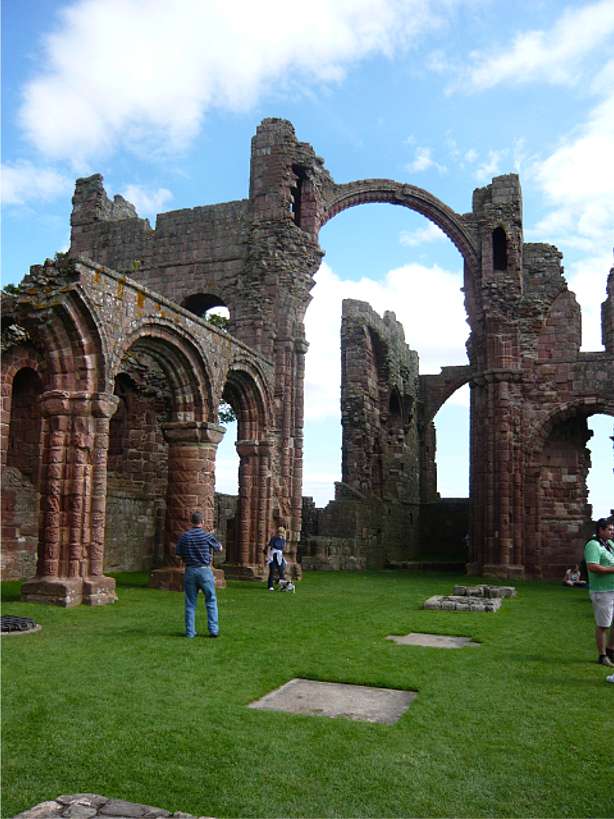
Lindisfarne is one of my favourite places, cut off from the mainland of Britain twice a day by the tides and accessed over a causeway. We went there last Tuesday and here are a few photos I took then together with one I took on an earlier visit.

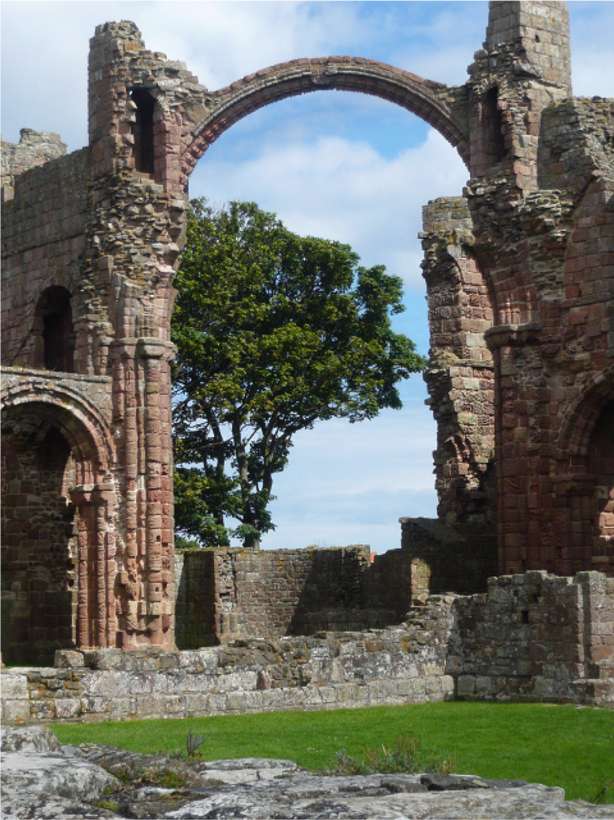
Lindisfarne Priory was founded in 635 by Aidan, an Irish monk who came to the island from the monastery on Iona, founded by St Columba. It was the home of the Lindisfarne Gospels.

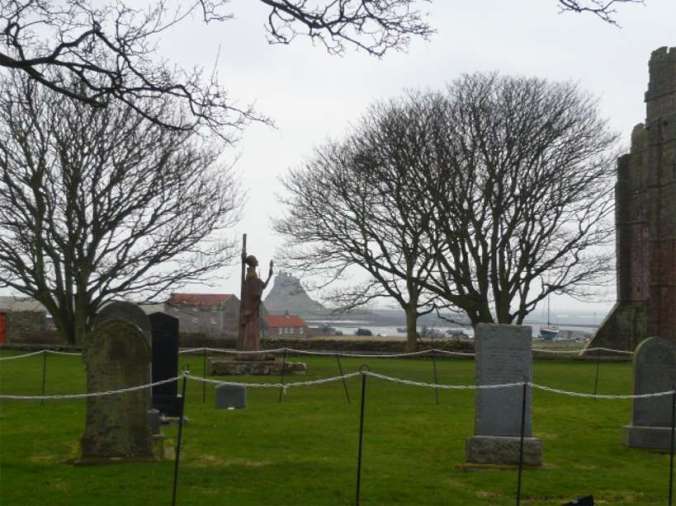
I took the photo below in February 2011, on a cold winter’s day. It shows the statue of St Aidan in the Priory grounds with Lindisfarne Castle, across the bay, in the background.

The monastery was originally wooden buildings  and the remains that we see today are those of the 12th century priory, probably standing on the site of the 7th century monastery. The Priory’s former grandeur is still there to see:Lindisfarne was also the home of Cuthbert, who became the prior in 685. Eleven years after his burial it became a shrine when his body was exhumed and was found to be undecayed. One hundred years later when the monks fled from the island during Viking raids they took his relics with them, eventually re-establishing his shrine in Durham Cathedral in 995.

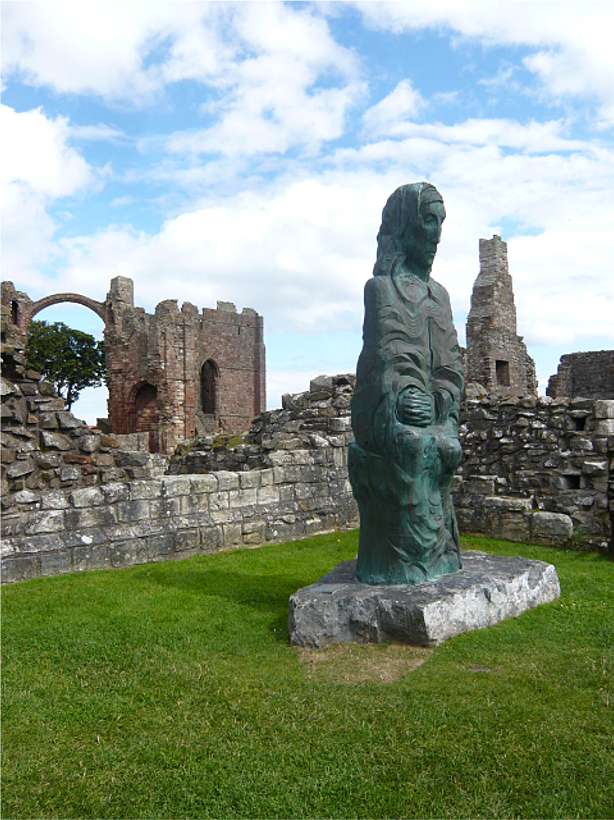
This sculpture of St Cuthbert is cast in bronze, originally carved from an elm tree. It shows a contemplative Cuthbert:

Last Tuesday was one of the hottest days of the year. We had intended to visit the castle as well, but as so many other people had the same idea we just went for a walk round the foot of the castle, then along the coast and back inland.

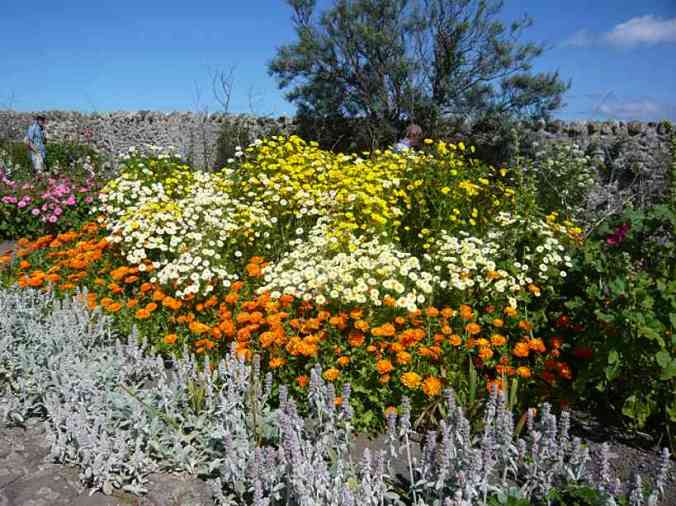
We stopped for a look at the walled garden designed by Gertrude Jekyll in 1911.

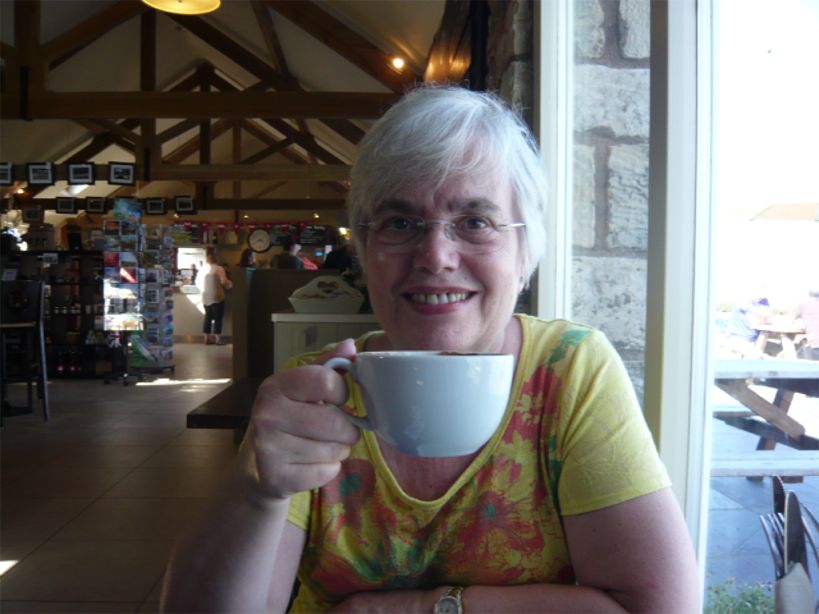
And then carried on to the coast line: On the way home we stopped at The Barn at Beal, on the mainland, just over the causeway, for a cup of coffee.

A Saturday Snapshot post – see more on Alyce’s blog At Home with Books.

Saturday Snapshot

On a grey, dismal day in May we visited Smailholm Tower in the Scottish Borders. It’s a four-storey tower house on a base of volcanic rock, a stark feature on the skyline between Kelso and Selkirk in the Tweed Valley.

(click on the photos to enlarge)

It was built in the 15th century by the Pringle family on Smailholm Craig, providing protection from the elements and from raiding parties of English reivers (raiders).

Standing 650ft (200m) above sea level, it’s walls are 9ft (2.5m) thick and 65ft (20m) high and it has one small entrance in the south wall and tiny windows.

Inside it’s quite dark and most of my photos inside aren’t very good. There’s a spiral staircase giving access to all five floors and the battlements.

In 1645 the Pringle family sold the tower and Smailholm Craig to the Scott family. Sir Walter Scott lived at Smailholm for a while with his grandmother and Aunt Janet after he’d had polio because they thought the fresh country air would be good for him. It was his aunt who told him tales of the Border countryside which gave him his passion for folklore and history.

The three upper floors house an exhibition of costume figures and tapestries to illustrate Sir Walter Scott’s Minstrelsy of the Borders, his collection of ballads. The photo below is of the Queen of the Fairies:

and below is one of little Walter Scott and his Aunt Janet:

I was fascinated by the roof of the tower, because it’s covered in turf, making a living roof:

There are spectacular views of the surrounding countryside on the way up. Below is the view of the Eildon Hills through a window:and even more panoramic views from the battlements:

For more Saturday Snapshots see Alyce’s blog At Home With Books.
Saturday Snapshot: Bamburgh Castle

Last Monday we visited Bamburgh Castle on the coast in Northumberland overlooking the North Sea. It’s a dramatic sight, a huge castle extending over ¼ of a mile, built on a volcanic outcrop, 45 metres above sea level. (Click on the photos to enlarge.)

Bamburgh Castle from the carpark

Bamburgh Castle was bought by Lord Armstrong (who built Cragside) and renovated by him at the end of the 19th century. The castle still belongs to the Armstrong family, and is open to the public. It also hosts weddings and corporate events and has been used as a film location since the 1920s, featuring in films such as Ivanhoe (1952), El Cid (1961), Mary, Queen of Scots (1972), and Elizabeth (1998).

The entrance is through two gatehouse towers, which still have some of the original stonework. They were altered and added to in the 19th century.

Gatehouse Towers

From there you walk along the Battery Terrace, with its cannons facing the sea, placed there ready to defend the castle when Napoleon threatened to invade Britain.

Battery Terrace

From the Battery Terrace you can see Lindisfarne to the north and the Farne Islands to the south. Lindisfarne is just a dot on the horizon above the first cannon in the photo.

Inner Farne on the horizon

The photo below is of the Keep, which was originally built in the 12th century. It sits on a massive plinth to prevent attackers digging beneath it and setting fires to collapse it.

The Keep

And finally a view of Bamburgh Castle taken from the road from Seahouses to Bamburgh:

Bamburgh Castle taken from Seahouses

See Alyce’s blog At Home With Books for more Saturday Snapshots.

Saturday Snapshot

Not very far from where we live stands Twizel Castle, high up on the hillside above the River Till. You can see it from the road glimpsed through the trees. I imagined what it was like to have lived there and wondered who had built it. It’s now in ruins, was it one of the castles that had been attacked centuries ago by the Scots, from just over the border?

Twizel Castle

One day instead of just looking as we passed it we stopped and walked up to see it properly. It’s up a steep footpath:

Footpath up to Twizel Castle

and this is what we found:

Twizel Castle

and inside, dereliction:

Twizel Castle inside

It’s amazing it’s still standing:

Twizel Castle

This castle is not what it seems. It was never lived in as it’s an 18th century castle that was never completed. It stands on the site of a medieval tower house, that was, indeed, destroyed by the Scots in 1496. It’s a Grade 2 Listed Building and is on English Heritage’s At Risk Register. For more information see Images of England and Gatehouse Gazetteer.

See more Saturday Snapshots on Alyce’s blog At Home With Books.

Saturday Snapshot: Cragside Again

Following on from last Saturday’s snapshots of Cragside here are a few more photos.

There were many other visitors when we were there and it was difficult sometimes to get a good photo and I had to be quick before someone moved in front of my camera. So, some of my photos are a bit out of focus and rather dark. (It’s amazing that you can take photos in National Trust properties – in the past it was strictly forbidden. I asked one of the room stewards why they allowed them now and he explained that because you can take photos on mobile phones it was impossible to stop people. It’s good to take your own photos, but actually there are much better ones than mine in the guidebook.)

The first room we saw was the kitchen. As you can see the area is fenced off. It’s not very big but there are also sculleries and larder and cellar storage beneath the kitchen, with a ‘dumb waiter’ to carry food and equipment up and down. The Butler, Housekeeper and Cook each had their own areas.

In the next photo you can see the spits with joints of meat in front of the range.

There is a dishwasher. Rather primitive compared to the modern models this dishwasher has wire compartments for crockery, a motor turned it whilst hot soapy water was squirted into it from a boiler. This had been invented in 1886 by a wealthy American, Josephine Cochrane whose servants had chipped her fine china.

None of the rooms at Cragside are very large, apart from the Drawing Room, and I could imagine being comfortable in most of them, such as the Dining Room. It has a lovely inglenook fireplace with stained glass windows designed by William Morris.

The windows either side represent the Four Seasons. the photo below shows two of the windows – Spring and Summer.

I still have more photos, but these are enough for one post. (Click the photos to see a larger view.)

Cragside is open to visitors from today. I  would really like to go there again this year, there is so much I didn’t take in and I only had a brief look at the grounds.

See more Saturday Snapshots on Alyce’s blog At Home With Books.