Dante’™s Florence Week 5 Part Two

Dante’™s Exile from Florence

Dante entered politics in 1295 and in 1300 he became a Prior, one of the Governors of the City giving him great prestige. It was a dangerous time with fighting between the factions of Guelfs and Ghibellines. The Guelfs supported the Pope, opposing the Ghibellines who supported the Holy Roman Emperor. The political situation was very complicated and became more so when the Guelfs split into two opposing factions, known as the Whites and the Blacks. The Whites, including Dante, opposed the Pope wanting more control of their own affairs ‘“ Dante thought the Pope, Boniface VIII was corrupt and was too involved with temporal affairs. He wanted more independence for Florence and a split between the Church and the State. Dante attacked the Pope and the Church in The Divine Comedy, for example in Canto 19 Inferno he describes the punishment for simony, the crime of buying a position within the church and denounces Boniface as a simonist.

In 1302 Dante was accused of fraud and as he refused to pay the fine he was sentenced to death by burning and was banished from Florence. He was offered an amnesty in 1315, but the conditions were too humiliating for him to accept and he never returned to Florence. He refers to his exile in The Divine Comedy through a conversation in Canto 17 Paradiso XVII with his great-great grandfather Cacciaguida, with Cacciaguida forecasting Dante’s exile from Florence:

‘œYou will leave everything you love most dearly;
This is the arrow which is
loosed first
From the bow of exile.

You will learn how salt is the
taste
Of other people’™s bread, how hard the way
Going up and down other
people’™s stairs.’

Dante spent 19 years in exile. He championed writing in the vernacular and in 1304 he published De Vulgari Eloquentia(On Eloquence in the vernacular). He started to write The Divine Comedy in 1306/7 and finished it just before his death in 1321 in Ravenna. During, 1315 ‘“ 1316 whilst he was the guest of Can Grande della Scala in Verona he wrote part of Purgatorio. Below is Maria Spartali Stillman’s painting of Dante in Verona, showing Dante surrounded by a group of admiring women.

In 1317 he was offered a home by Guido Novello da Polenta in Ravenna, where he completed Purgatorio and began Paradiso. Can Grande was a patron of the arts and sheltered exiles, giving Dante his own apartments and treating him very well. Dante dedicated Paradiso to Can Grande in gratitude.

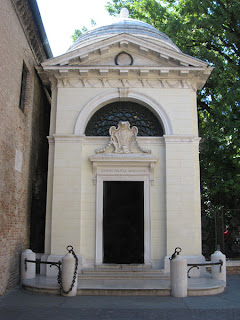
Dante died on 14 September 1321and was buried in the Church of San Francesco in Ravenna, where there is a shrine containing his sarcophagus and a votive lamp.

Despite requests from Florence to return his body to the city, Dante’™s tomb in the church of Santa Croce is empty.

Dante’s Florence Week 5 Part One

By the end of the 13th century Florence was a bustling and prosperous city. We looked at a painting by Lord Leighton – Cimabue’s Celebrated Madonna is carried in Procession through the Streets of Florence, 1853-1855. The Victorians had an intense interest in Dante. In this painting, which was bought by Queen Victoria, Cimabue’™s painting of the Madonna, a hugh altarpiece is carried through the streets of Florence. Giotto, a pupil of Cimabue, is shown in white, with Dante on the far right.

In week 4 we had looked at the new city walls designed by Arnolfo Di Cambio. Di Cambio’™s crowning achievement was, however, his design for a new cathedral. The old cathedral was considered to be too small and too coarse. As the population of the city increased the new cathedral was designed with a hugh interior space to accommodate the whole population. Dedicated to Santa Maria del Fiore, it was started in 1296 and took many years to complete. Old buildings were knocked down to make way for it, including the hospital and the old cathedral, dedicated to Santa Reparata.

It seems that Di Cambio originally planned a wooden dome, but this was replaced by Brunelleschiժs dome which was completed in 1436. We looked at a copy of his outline plan for the cathedral (the original of the drawing is in the Museo dellժOpera del Duomo) and also at Poccettiժs drawing (c. 1587) of the fa̤ade of the Duomo, which shows the fa̤ade as it was before it was covered over in the 19th century by the current fa̤ade. This shows the mosaics, reliefs and statues designed by Di Cambio.

The illustration (copied from the course handout) is not very clear but does give an impression of what the façade was like. Only a few of the original sculptures have survived, including the ‘˜Madonna of the Glass Eyes’™, the Annunciation to the Shepherds and a statue of Pope Boniface VIII, the luxury loving, warrior pope whom Dante opposed. these are now in the Museo dell’Opera del Duomo.

I particularly like the story of Dante’™s stone ‘“ the Sasso di Dante – where Dante is supposed to have sat and watched the cathedral being built. A plaque embedded in the wall of one of the houses opposite the cathedral was placed in memory of his special seat.

This was one of the places of pilgrimage during the 19th century for the nobility on the Grand Tour of Europe.

Under the shadow of a stately Pile,
The dome of Florence, pensive and alone,
Nor giving heed to aught that passed the while,
I stood, and gazed upon
a marble stone,
The laurelled Dante’s favourite seat. ‘¦

From Wordsworth, Memorials of a tour in Italy, 1837 At Florence

Di Cambio also began the design of the Palazzo Vecchio, a very important building that housed the Priors, the governors of the city and is now the town hall and a museum. The crenulated Arnolfo Tower is characteristic of a fortified building. Uberti family buildings were demolished to make way for the Palazzo.

Dante’s Exile in Week 5 Part Two

Dante’s Florence Week 4

Banking

Florence was a city of innovations. The Florin was first minted in 1252 and became a kind of medieval Euro. It was stamped with the symbols of the city ‘“ the lily, the secular symbol on one side with St John, the patron saint on the other side. Bills of Credit and the double entry system of book keeping were invented in Florence. The Bardi and Peruzzi families were the main banking families with agents right across Europe. Their money came from the textile industry ‘“ wool from as far away as the Cotswolds in England was imported and processed by the thousands of people employed by the Humiliati Order of monks. The Wool Guild was in the heart of the city with barn sheds for drying the wool, with loggia below so that the air could circulate. There was even a fortified wool factory further up the Arno.

The Guilds ‘“ Patrons of Art

The Bankers Guild was established in 1206, St Matthew being the Patron Saint of Bankers. Membership of a guild was a necessary qualification to take part in the government of the city and Dante was enrolled in the Guild of Apothecaries, which included artists, doctors, musicians and writers. He entered politics in 1295 and became the Superintendant of Roads and Planning. The Bargello housed the civic government and the head of police. It was built in 1255 before Dante was born, was the place of execution and is now the National Museum.

References in The Divine Comedy to finance and commerce

Dante’™s audience had a mercantile background and his father was said to have been a notary/money lender. The question of trading for profit was a difficult issue as usury was considered to be a sin. Dante describes Hell in The Divine Comedy as being full of people who had profited from the corruption and abuses of the use of money. To avoid this wealthy families donated money to found chapels as a means of expiating their sins.

Art of the Period

There were also great innovations in art during this period, with a move away from the rigid hieratical Byzantine style to a more natural, expressive style – for example Cimabue’™s Madonna is a huge work, showing angels at the sides of the throne still in the Byzantine style but showing the move away to more naturalism. Giotto’™s Ognissanti Madonna of 1310 shows a more natural portrayal of the mother and child and there is a greater sense of mass and solidity with greater depth and perspective. The angels look as though they really are looking up at the Madonna and child


In The Divine Comedy Dante refers to artistic arrogance in his conversation in Purgatory with Oderiso, an illuminator from Gubbio. He talks of the transient nature of fame and the penalty of pride. Oderiso was supposedly friendly with Giotto and at that time Giotto was greatly praised and had taken precedence over Cimabue:

‘Brother’ he said, the sheets coloured by Franco
The Bolognese, are more brilliant than mine:
The honour is now all his, and mine is less.

Certainly I should not have been so polite
When I was alive, because of my great desire
To excel in this, my heart was engrossed with it.

The penalty of such pride is paid here;
And I should not be here yet, if it were not
That, while I could still sin, I turned to God.

O empty glory of human endeavour!
How little time the green remains on top,
Unless the age that follows is a dull one!

Cimabue thought he held the field
In painting, and now the cry is for Giotto,
So that the other’s fame is now obscured.”
Purgatorio XI 82-96

The Death of St Francis by Giotto in the Bardi Chapel, in the church of Sante Croce shows the move towards much greater realism in painting such as in the range of emotions shown on the monks’™ faces as they surround St Francis on his bier.

Development of the city
Arnolfo Di Cambio(born 1240 ‘“1250 died early 1300s)

Di Cambio was an architect, sculptor and painter. He trained in Sienna under Nicolo Pisano and worked on the marble pulpit in the Sienna Duomo. In 1284 he was called to Florence by the city officials to design the new city walls. The walls made from used materials from the old walls and the lopped towers (as a result of the height restrictions on the towers). When completed the walls were 5 ½ miles long, 7 feet thick and 47 feet high, with massive iron- studded gates (a few of these remain). The gates were closed every evening. The walls were of course for defence, but they also gave the city shape and a sense of belonging to the citizens; were a way of regulating taxes and tolls and were a symbol of the strength, power and prestige of Florence.

He brought both classical and gothic styles of architecture to Florence. He designed the loggia of Orsanmichele, then a corn-market; was involved in work on the Badia, and the design of the façade of Santa Croce is attributed to him.

More about Di Cambio, art, and Dante’s exile in week 5.

Dante’™s Florence – Week 3

During week 3 we looked at the expansion of Florence as more people came into the city. In Dante’™s day there were about 45 towers, or 90 or more, depending upon the source you check and today there are about 20 still standing, showing the progression from the early plain and simple tower into the grander palaces, with more and bigger windows, columns, loggias and decorated with the families’™ coats of arms.

We looked at slides of a number of towers showing the development from defensive, military type towers to house towers and palaces.


La Castagna – The Chestnut Tower (also known as Dante’™s tower), across from Dante’™s House is an example of a plain, simple military tower, used in Dante’™s time by an order of priors who voted on decisions by placing a chestnut in a box – hence the name. The holes are where there were planks joining the tower to neighbouring houses and the windows decrease in size higher up the tower.


An example of a tower that existed during Dante’™s day is the medieval Mannelli Tower, located at one end of Ponte Vecchio. This was built to defend the bridge and shows the development of the design from the simple cube, having more windows (in pairs) and decorated with lions’™ heads. It’™s interesting because when the Vasari Corridor was added to the bridge at the end of the 16th century to enable the Grand Duke to move freely from one side of the bridge to the other, the Mannelli family refused to demolish it to make way for the Corridor. So the Corridor had to be built around the Tower, thus bypassing it.

We also looked at the cylindrical Pagliazza Byzantine Tower that was a prison in Dante’™s day and is now part of the Hotel Brunelleschi, the Buondelmonte Tower, and the Alberti Tower.

As the city prospered new city walls were built bringing the churches outside the original walls within the city boundaries. By the end of the 13th century the population had grown to approximately 90,000 and was second only in size to Paris. Its wealth came from textiles and banking, with an emerging merchant class coming into the city for employment. This also brought social problems and the mendicant orders ‘“ travelling preachers from Umbria and Emilia who wanted to enrich the people’™s spiritual life. These were different from the monastic orders, reaching out to people. Dante’™s writing forms a parallel as he wrote in the vernacular making his work accessible to all.


The Church of San Miniato on the opposite side of the Arno was in a wild and woody setting when Dante knew it. In the Divine Comedy he likens the entrance to Purgatory to the ascent to the church. It is an ancient church from the 11th century with a 13th century Tuscan Romanesque style façade similar to that of the Baptistery ‘“ green and white marble. Inside there is a beautiful 13th century gold and black mosaic in the apse in the Byzantine style, with the palm symbolising the Resurrection accompanied by the symbols for the four Evangelists.

Illustrations (except for the Chestnut Tower) are from Wikipedia.

To follow: Banking, Guilds and Art of the Period.

Courtly Love in Florence

Last week on my course on Dante’™s Florence we looked at the development of the city, and the concept of ‘˜courtly love’™ in relation to Dante’™s La Vita Nuova (New Life).

Today we know Florence as a Renaissance city and there is little left of the medieval city that Dante knew. Originally a Roman city, by the end of the 13th century it was an expanding wealthy city bounded by its 12th century walls.

The earliest view of Florence is in the fresco of the Madonna of Mercy 1342, now in the Museo del Bigallo. It shows the city walls, towers, and the Cathedral, which was much smaller then and its dome had not been added. The Campanile was not yet built and the most prominent building was the Baptistery. The churches and religious establishments now within the city were outside the medieval walls, for example Santa Trinita, Santa Maria Novella, Santa Croce (containing the tombs of Michelangelo and Galileo and a monument to Dante who died in exile in Ravenna in 1321),

The River Arno runs through Florence, crossed by four bridges, including the Ponte Vecchio, built in 1345 after Dante’™s death. It replaced a 12th century bridge that had been destroyed by floods in 1333. Floods have been a perennial problem, the worst one being that in 1966, when many buildings and works of art were damaged. The Ponte Vecchio was the only bridge in the city that survived the bombing during the Second World War.

Although Dante referred to the river in The Divine Comedy as the ‘œcursed and unlucky ditch’ as it was used as a rubbish tip, it has always been important to the city as the means of transporting goods and also for the textile industry. Wool was washed in the river and as it was used by tanners and purse makers in Dante’™s day it must have been a very smelly place. Well known now for its shops there have always been shops on the bridge ‘“ butchers in the 15th century, then goldsmiths from the 16th century onwards.

Other prominent features of the city were the towers, as in other Italian towns (most notably San Gimignano). These were built from the 11th century onwards, with an average height of 225 feet. There were two types, defence and tower houses. I can’™t imagine living in one, the only means of getting up to the rooms was by trap doors and ladders ‘“ I find it hard just getting into our loft! Representations of the towers can be seen in Cimabue’™s Santa Trinita Madonna, now in the Uffizi Gallery, showing the Madonna and Child seated on a hugh throne surrounded by saints and angels and towers.

Set against the backdrop of this medieval city Dante theologised the concept of ‘˜courtly love’™. This concept had originated with the troubadours in France and had developed as poets paid homage to and idolised married women from afar. In Dante’™s case he fell in love at first sight with Beatrice Portinari when he was nine. Later they were both married (to other people) but he continued to put Beatrice on a pedestal, regarding her as a miraculous being. His love was unrequited and she died when she was 24, leaving Dante in despair. He wrote La Vita Nuova (1294) after her death in which he expressed, in a series of sonnets, his love and passion for her and his despair and grief at her death.

Dante’s Florence

I’ve never ever had any inclination to read Dante’s Divine Comedy before, but I’ve now ordered a copy from Amazon. This is because I have enrolled on a course called Dante’s Florence. My initial interest was Florence not Dante. We have had some beautiful holidays in Italy; the last one (in 2000) was near Florence and then we only had one day in Florence itself. I loved Francesco da Mosto’s TV series on Italy and have wanted to go back to see more of the country – in particular Florence and Venice. So when a friend said she was taking a course on Dante’s Florence I jumped at the chance to find out more.

It was the first session yesterday and I really enjoyed it. This is the description of the course: ‘Studying Dante could not be more divine! Experience the Florence of Dante’s day, including the art and architecture and the poet’s relationship with his native city as conveyed in his writings.’ My impression of Dante’s Inferno was that it is long and difficult and this was reinforced when the tutor said that most people who read The Divine Comedy manage to read through Purgatory and Hell, but few reach Paradise. It’s not necessary to read it for this course, but now I want to know more.

It’s only a six week course and covers a lot of topics including Florentine art and architecture of the thirteenth and early fourteenth centuries, Dante’s relationship with Florence with reference to The Divine Comedy and La Vita Nuova, and his legacy in art and literature.

Dante’s Florence was a much smaller city than today, but there are still some buildings from that period. I was pleased that I had visited some on our visit in 2000, in particular the Baptistry. This was built in the 11th and 12th centuries and Dante was baptised there in 1265. I remember sitting in the Baptistry, gazing with wonder and admiration at the magnificent ceiling decorations in its dome, and walking on the ancient mosaic floor. I have always been fascinated by mosaics, the intricate patterns and marvelled at their composition.

Dante loved learning, hunting and sport, was involved in the struggle for power between the Church and the State, and fought in the Battle of Campaldino in 1289. The great love of Dante’s life was Beatrice Portinari, who he met when he was nine and she was eight. They never married. Dante and Beatrice by Henry Holiday shows him gazing at her as she passes by ignoring him.

I hope we will be looking at the Pre-Raphaelite paintings when the tutor discusses Dante’s legacy to art, as one of my favourite paintings is Beata Beatrix by Dante Gabriel Rossetti. Dante wrote La Vita Nuova in despair at Beatrice’s death and we’ll be studying that next week.