It’s time again for Six Degrees of Separation, a monthly link-up hosted by Kate at Books Are My Favourite and Best. Each month a book is chosen as a starting point and linked to six other books to form a chain. A book doesn’t need to be connected to all the other books on the list, only to the one next to it in the chain.
I’ve been away so this post is a little late!
This month we start with Ghost Cities by Siang Lu , the winner of the 2025 Miles Franklin Literary Award, This is Amazon’s description:
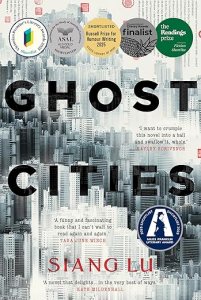
Ghost Cities – inspired by the vacant, uninhabited megacities of China – follows multiple narratives, including one in which a young man named Xiang is fired from his job as a translator at Sydney’s Chinese Consulate after it is discovered he doesn’t speak a word of Chinese and has been relying entirely on Google Translate for his work.
How is his relocation to one such ghost city connected to a parallel odyssey in which an ancient Emperor creates a thousand doubles of Himself? Or where a horny mountain gains sentience? Where a chess-playing automaton hides a deadly secret? Or a tale in which every book in the known Empire is destroyed – then re-created, page by page and book by book, all in the name of love and art?
Allegorical and imaginative, Ghost Cities will appeal to readers of Haruki Murakami and Italo Calvino.
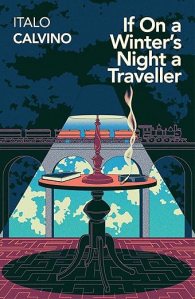
My First link is a book by Italo Calvino – If on a Winter’s Night a Traveller, which I borrowed from the library a few years ago. It’s composed of stories of menace, spies, mystery, premonition—with explorations of how and why we choose to read, make meanings, and get our bearings or fail to. It has an excellent beginning but as I read on all the stops and starts became disjointed. I renewed it a few times but eventually I decided to abandon it and returned it unfinished.

Cloud Atlas by David Mitchell is my second link because it is a book I abandoned three times before trying it again, after watching the movie, which is fantastic – a kaleidoscope of visual delights, the scenery, the settings and the costumes are blazes of colour and drama. Cloud Atlas covers a time period from the 19th century to a post apocalyptic future. It is an amazing creation (‘amazing‘ is a very overused word, but in this instance very apt), at times confusing and at times brilliant.
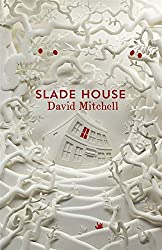
My Third link is also by David Mitchell. It’s Slade House, a book I loved as soon as I started reading it. It’s a mixture of a ghost story, science fiction and horror. Something nasty happens every nine years at the end of October at Slade House. I read it as a fantasy, something that I couldn’t believe could ever happen (or at least, I hope not). People are invited or are drawn into Slade House and find themselves in a strange and dangerous situation, and there is no way out.
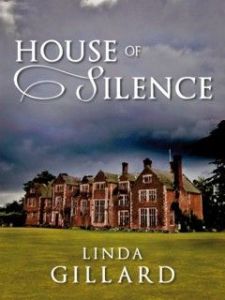
Which brings me to my fourth link House of Silence by Linda Gillard, a novel about families and their secrets – in particular one family, the Donovans. When Gwen Rowland meets Alfie Donovan she becomes interested in his family and persuades him to let her spend Christmas with them at the family home, Creake Hall, an old Elizabethan manor house. It raises issues of memory and identity, mental illness, loss and love.
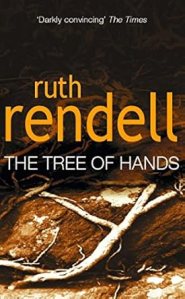
Mental illness is my Fifth link in The Tree of Hands by Ruth Rendell, one of her best standalone books. When Benet was about fourteen, she and Mopsa, her psychologically disturbed mother had been alone in a train carriage, when Mopsa, had tried to stab her with a carving knife. It’s a psychological thriller, full of suspense, with several twists and turns that made me unsure how it would end. I was delighted by the final twist!
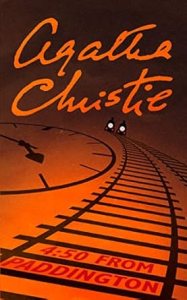
Agatha Christie wrote several books featuring trains. My sixth link is one of those books, 4.50 from Paddington. This begins when Mrs McGillicuddy was going home from Christmas shopping in London when she saw from the window of her train a murder being committed in a train travelling on a parallel line. But nobody believes her because there is no trace of a body and no one is reported missing. Nobody, that is except for her friend Miss Marple. But she is getting older and more feeble and she hasn’t got the physical strength to get about and do things as she would like. So, she enlists the help of Lucy Eyelesbarrow.
My chain is made up of books I abandoned books and books I loved. It’s taken me from a book about megacities in China to a murder mystery on a London train.
What is in your chain?
Next month (October 4, 2025), we’ll start with Dominic Amerena’s novel about authors and publishing, I Want Everything.

 BooksPlease