A – Z of TBRs: J, K and L

I’m now up to J, K, and L in my A – Z of TBRs, a series of posts in which I take a fresh look at some of my TBRs to inspire me to read more of them by the end of the year, or maybe to decide not to bother reading them after all. These TBRs are all physical books – I’ve not included e-books. Previously I’ve just chosen books for these posts by using the titles, but this time I’ve also chosen books by using the authors’ last names.

I’m enjoying searching my shelves – finding books I’d forgotten were there (the disadvantage of shelving books behind others).
TRBs jkl

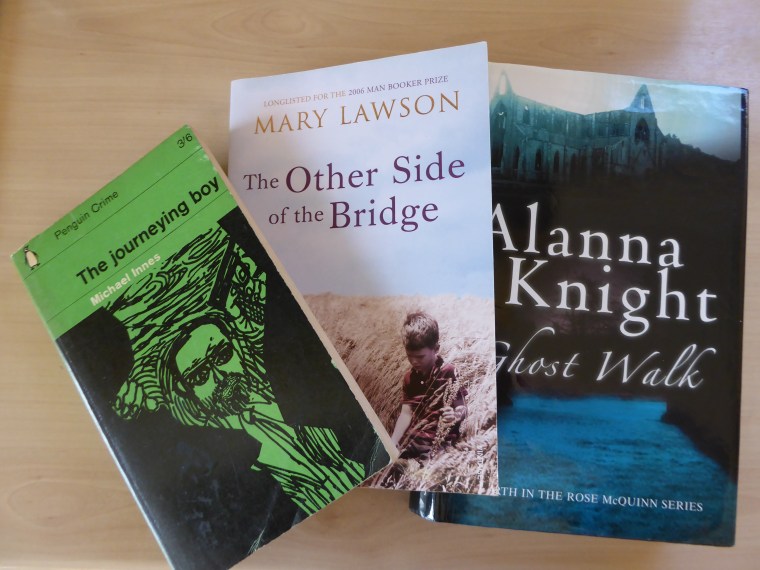
– is for The Journeying Boy by Michael Innesa book I’ve had for three years. This is a green Vintage Penguin, first published in 1949, and in this edition in 1961. Humphrey Paxton, the son of one of Britain’s leading atomic boffins, has taken to carrying a shotgun to ‘shoot plotters and blackmailers and spies’. His new tutor, the plodding Mr Thewless, suggests that Humphrey might be overdoing it somewhat. But when a man is found shot dead at a cinema, Mr Thewless is plunged into a nightmare world of lies, kidnapping and murder – and grave matters of national security.

I’m not sure now that I do want to read this book. It looks quite daunting, with lots of description and  literary allusions as shown in this extract – the cinema goers had been watching a film, Plutonium Blonde:

Another squalid crime … Circumstances had made Inspector Cadover a philosopher, and because he was a philosopher he was now depressed. This was the celebrated atom film. This was the manner in which his species chose to take its new command of natural law. Fifty thousand people had died at Hiroshima , and at Bikini ironclads had been tossed in challenge to those other disintegrating nuclei of the sun. The blood-red tide was loosed. And here it was turned to hog wash at five shillings the trough, and entertainment tax five shillings extra. That some wretched Londoner had met a violent death while taking his fill seemed a very unimportant circumstance. To track down the murderer – if murderer there was – appeared a revoltingly useless task. Mere anarchy was loosed upon the world – so what the hell did it matter? (page 51)

K – is for Ghost Walk by Alanna Knight (on my TBR shelves for four years), the fourth in the Rose McQuinn series. This is historical crime fiction set in 1897 in Edinburgh three years after Rose McQuinn’s husband, Danny, disappeared in Arizona. Believing him to be dead, she returned to Scotland to start her life afresh. Now a ‘Lady Investigator, Discretion Guaranteed‘, she is about to marry her lover, Detective Inspector Jack Macmerry of the Edinburgh Police when a nun from the local convent claims to have received a letter from Danny, and after two suspicious deaths, it seems that a ghost is about to walk back into her life…

I’ve read and liked the first book in this series, The Inspector’s Daughter, and am hoping it won’t matter that I’ve not read the second and the third books.

I had no idea what were the views of Edinburgh City Police on the subject of female detectives or the milder term ‘lady investigators’, but I could guess that that they regarded criminal investigation as a ‘men only’ province.

I felt so impatient with authority. Would a day ever dawn when women ceased to be regarded as playthings or breeding machines, when they would be given equal rights with men. My hackles rose in anger at the suffragettes’ gallant struggles as portrayed in a recent pamphlet which I had been at pains to keep concealed from Jack.  (page 34)

L – is for The Other Side of the Bridge by Mary Lawson, a book I’ve had for 10 years! I was so keen to read it when I first bought it after loving her first novel, Crow Lake. It’s about two brothers, Arthur and Jake.  Arthur is older, shy, dutiful, and set to inherit his father’s farm. Jake is younger and reckless, a dangerous man to know. When Laura arrives in their 1930s rural community, an already uneasy relationship is driven to breaking point…

Arthur’s earliest memory was of standing in the doorway of his parents’ room, looking at his mother as she lay in bed. It was the middle of the day but nonetheless she was in bed, and Arthur didn’t know what to make of it. The bed was very large and high and Arthur could only just see her. She had her face turned towards the window. Then Arthur’s father called from the bottom of the stairs that the doctor was coming, and she turned her head, and Arthur saw that she was crying. (page 25)

What do you think? Do you fancy any of them? Would you ditch any of them?
First Chapter First Paragraph: The Dry

eca8f-fistchapEvery Tuesday Diane at Bibliophile by the Sea hosts First Chapter First Paragraph Tuesday Intros to share the first paragraph sometimes two, of a book that she’s reading or is planning to read soon.

This week’s first paragraph is from The Dry  by Jane Harper, her debut novel, which has received many accolades and is shortlisted for the CWA Gold Dagger award. The Gold Dagger is awarded to the best crime novel of the year.

The Dry

Prologue

It wasn’t as though the farm hadn’t seen death before, and the blow flies didn’t discriminate. To them there was little difference between a carcass and a corpse.

The drought had left the flies spoiled for choice that summer. They sought out unblinking eyes and sticky wounds as the farmers of Kierwarra levelled their rifles at skinny livestock. No rain meant no feed. And no feed made for difficult decisions as the tiny town shimmered under day after day of burning blue sky.

Chapter One

Even those who didn’t darken the door of the church from one Christmas to the next could tell there would be more mourners than there were seats. A bottleneck of black and grey was already forming at the entrance as Aaron Falk drove up, trailing a cloud of dust and cracked leaves.

Blurb:

WHO REALLY KILLED THE HADLER FAMILY?

I just can’t understand how someone like him could do something like that.

Amid the worst drought to ravage Australia in a century, it hasn’t rained in small country town Kiewarra for two years. Tensions in the community become unbearable when three members of the Hadler family are brutally murdered. Everyone thinks Luke Hadler, who committed suicide after slaughtering his wife and six-year-old son, is guilty.

Policeman Aaron Falk returns to the town of his youth for the funeral of his childhood best friend, and is unwillingly drawn into the investigation. As questions mount and suspicion spreads through the town, Falk is forced to confront the community that rejected him twenty years earlier. Because Falk and Luke Hadler shared a secret, one which Luke’s death threatens to unearth. And as Falk probes deeper into the killings, secrets from his past and why he left home bubble to the surface as he questions the truth of his friend’s crime.

It’s not only shortlisted for the CWA Gold Dagger it has also received:

  • The Gold Australian Book Industry Award for Book of the Year
  • Australian Book Industry Award for Fiction Book of the Year
  • Waterstones Thriller of the Month
  • The Simon Mayo Radio 2 Book Club Choice
  • Sunday Times Crime Thriller of the Month

What do you think?  Would you continue reading? 

When a book receives so much praise I’m sometimes sceptical and avoid a book for a while at least. But with The Dry I think that I’d just be sticking my head in the sand. I’ll be reading it very soon.

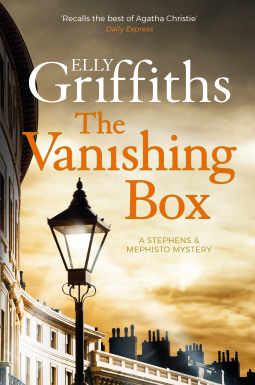
The Vanishing Box by Elly Griffiths

Publication date: 2 November, 2017, Quercus Books

Source: review copy via NetGalley

My rating: 3*

Blurb:

Christmas 1953. Max Mephisto and his daughter Ruby are headlining Brighton Hippodrome, an achievement only slightly marred by the less-than-savoury support act: a tableau show of naked ‘living statues’. This might appear to have nothing in common with DI Edgar Stephens’ investigation into the death of a quiet flowerseller, but if there’s one thing the old comrades have learned it’s that, in Brighton, the line between art and life – and death – is all too easily blurred…

My thoughts:

This is the fourth book in the DI Stephens and Max Mephisto series. Known as the ‘Magic Men’ they had been part of a top-secret espionage unit during the War.

It is set in 1953 at Christmas just a few months after the previous book in the series, The Blood Card and magician Max Mephisto is still sceptical about performing magic on TV with his daughter Ruby in a show called Magician and Daughter. Meanwhile his old friend, DI Edgar Stephens and his team are faced with solving the murder of Lily Burtenshaw, who had been strangled and found in her room tied to a chair, leaning forward and pointing to an empty crate with ‘King Edward Potatoes’ written on the side.

Max and Ruby are performing at the Brighton Hippodrome using a human sized version of the Vanishing Box in their act. The variety show also includes an act called the Living Tableaux, showing scenes from famous paintings or classical statutory, posed by a troupe of showgirls, naked apart from skimpy flesh coloured pants. Two of the showgirls, Betty and Janette, have become friends with Lily and are lodging at the same boarding house, but Edgar wonders if there is another connection between Lily and the Living Tableau? There is something so theatrical about the way the body was posed. Edgar and his two sergeants, Emma Homes and Bob Willis, begin their search for the killer, looking for motives and suspects. Then more murders are discovered and it becomes a desperate hunt to find the killer before he/she strikes again.

I enjoyed this book but for me there is too much focus on the main characters and their relationships. Edgar is engaged to Ruby, although Max is still not too happy about it.  However, his work means he isn’t able to spend much time with her. Meanwhile Emma’s feelings for him are getting stronger and their relationship deepens as she is drawn into deadly danger. Max’s relationship with Mrs M, his landlady in Brighton, is winding down and he is attracted to Florence, another one of the showgirls.

I liked the insight into the 1950s, particularly the theatre life. Illusion and misdirection play a large part – from the acts in the variety show to the murders, and all is not what it seems. The misdirection in the form of several twists and turns threw me off course.The clues are there, if you can but see them, yet I still had little idea who the killer could be until very near the end.

My thanks to Quercus Books and Netgalley for an advance review copy of this book ahead of publication on 2nd November.

First Chapter First Paragraph: An Artist of the Floating World

eca8f-fistchapEvery Tuesday Diane at Bibliophile by the Sea hosts First Chapter First Paragraph Tuesday Intros to share the first paragraph sometimes two, of a book that she’s reading or is planning to read soon.

This week’s first paragraph is from An Artist of the Floating World by Kazuo Ishiguro, who has been awarded this year’s Nobel Prize for Literature.

An Artist of the Floating World (Faber Fiction Classics) by [Ishiguro, Kazuo]

It begins:

If on a sunny day you climb the steep path leading from the little wooden bridge still referred to around here as ‘the Bridge of Hesitation’ you will not have  to walk far before the roof of my house becomes visible between the tops of two gingko trees. Even if it did not occupy such a commanding position on the hill, the house would still stand out from all others nearby, so that as you come up the path, you may find yourself wondering what sort of wealthy man owns it.

Blurb (from Amazon):

It is 1948. Japan is rebuilding her cities after the calamity of World War Two, her people putting defeat behind them and looking to the future. The celebrated artist, Masuji Ono, fills his days attending to his garden, his house repairs, his two grown daughters and his grandson; his evenings drinking with old associates in quiet lantern-lit bars. His should be a tranquil retirement. But as his memories continually return to the past – to a life and career deeply touched by the rise of Japanese militarism – a dark shadow begins to grow over his serenity.

There are some books that draw me in right from the beginning – and this is one of them. I’m hoping it lives up to its promise. I like the way Ishiguro paints a picture setting the scene in my mind as though I’m standing there looking at the view.

What do you think?  Would you continue reading?


A Darker Domain by Val McDermid

A Darker Domain (Karen Pirie, #2)

This is the second book in Val McDermid’s Kate Pirie series, a series that really should be read in order as A Darker Domain reveals one of the outcomes of the first book, The Distant Echo.

Description from Amazon:

Twenty-five years ago, the daughter of the richest man in Scotland and her baby son were kidnapped and held to ransom. But Catriona Grant ended up dead and little Adam’s fate has remained a mystery ever since. When a new clue is discovered in a deserted Tuscan villa – along with grisly evidence of a recent murder – cold case expert DI Karen Pirie is assigned to follow the trail.

She’s already working a case from the same year. During the Miners’ Strike of 1984, pit worker Mick Prentice vanished. He was presumed to have broken ranks and fled south with other ‘scabs’… but Karen finds that the reported events of that night don’t add up. Where did he really go? And is there a link to the Grant mystery?

The truth is stranger – and far darker – than fiction.

My thoughts:

The first thing that struck me when I began reading this book is that is not divided into chapters. Instead the text is divided by date and place, which initially is a bit confusing, moving between the two cases Karen is investigating. However, I soon got the hang of it.

I like the mix of fact and fiction in A Darker Domain, using the Miners’ Strike as the backdrop to the mystery of Mick Prentice’s disappearance. It is intricately plotted, with a large cast of characters and it’s deceptively easy to read – it’s easy to pass over significant facts that you realise later are of importance.

I like Karen Pirie, who had been a Detective Constable in the second part of the first book, The Distant Echo. Now she is a Detective Inspector in charge of the Cold Case Review Team in Fife. She describes herself as

a wee fat woman crammed into a Marks and Spencer suit, mid-brown hair needing a visit to he hairdresser, might be pretty if you could see the definition of her bones under the flesh. (page 6)

In the tradition of fictional detectives she’s an independent character, who takes little notice of her ineffectual boss, who she nicknames the ‘Macaroon’, undermining his authority. But she is hard-working and tenacious.

I like the contrasts Val McDermid portrays, such as the ‘darker domain‘ of the miners’ lives, the rich landowner wanting to find his grandson, and the beautiful setting in Tuscany where the members of a troupe of puppeteers, are squatting in a ruined villa.

I also like the mix of the two cases, which, as this is crime fiction, I fully expected would at some point interlink. The question is how do they interlink? Val McDermid has a neat way of leading you along the wrong lines with her twists and turns, culminating in the final paragraph. But the ending seemed rushed, tacked on, almost as an afterthought, which left me bemused and feeling rather flat. So, not as good as The Distant Echo but still an entertaining book.

  • Paperback: 400 pages
  • Publisher: HarperCollins; First Thus edition (2 April 2009)
  • Language: English
  • ISBN-10: 0007243316
  • ISBN-13: 978-0007243310
  • Source: a library book
  • My rating: 3.5* (rounded up to 4* on Goodreads)

Reading Challenges: my 4th book for R.I.P. XII

I hope to read the next book in the series, The Skeleton Road, before the end of the year.

Six Degrees of Separation: from Like Water for Chocolate to The Spy Who Came In From The Cold

Six Degrees of Separation is a monthly link-up hosted by Kate at Books Are My Favourite and Best. Each month a book is chosen as a starting point and linked to six other books to form a chain. A book doesn’t need to be connected to all the other books on the list, only to the one next to it in the chain.

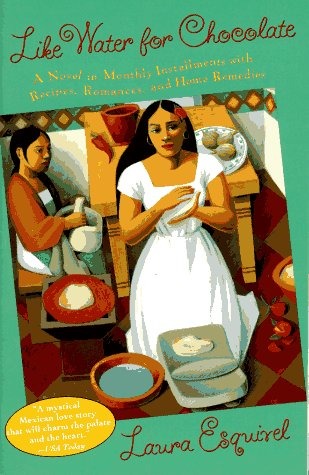
This month the chain begins begin with a book that Kate says people may not have discovered, were it not for the hugely popular movie version – Laura Esquivel’s Like Water for Chocolate. I hadn’t discovered it at all until now! But I see that it’s a ‘bestseller’, a book about passion and the magic of food (including recipes), a tale of family life in  Mexico.

Like Water for Chocolate

The first link in my chain is a book also set partly in Mexico:

The Lacuna

The Lacuna by Barbara Kingsolver is the story of Harrison Shepherd, the son of a Mexican mother and an American father and it’s told through his diaries and letters together with genuine newspaper articles, although whether they reported truth or lies is questionable. As you can see from the cover swimming plays a part in this book. As a boy, Harrison, loved swimming and diving into a cave, which was only available at certain tides, a cave that was there one day and gone the next – a lacuna.

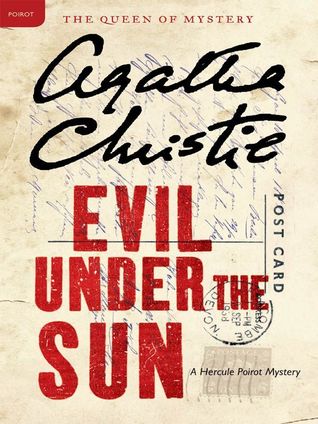
Swimming also features in Evil Under the Sun by Agatha Christie.

Evil Under the Sun (Hercule Poirot, #23)

Poirot is on holiday in Devon staying in a seaside hotel. It’s August, the sun is hot, people are enjoying themselves, swimming and sunbathing until Arlena is found dead – she’d been strangled.

The next book in my chain is also crime fiction  – Blue Heaven by C J Box.

Blue Heaven

This is a story set in North Idaho about two children, Annie and William who decide to go fishing without telling their mother, Monica, and witness a murder in the woods. One of the killers sees them and they run for their lives. It’s fast-paced and full of tension right to the end.

I chose Half of a Yellow Sun by Chimamanda Ngozi Adichie as the next link, a book that also has a colour in its title.

Half of a Yellow Sun

It’s based on the Nigeria-Biafra War of 1967 – 70. Focusing on the struggle between the north and the south, the Igbo, Yoruba and Hausa people, it brings home the horrors brought about by war, the ethnic, religious and racial divisions and the suffering that results.  It is also a novel about love and relationships, a beautiful and emotional book without being sentimental and factual without being boring.

Another book about war, but this one is non-fiction about a spy operation during World War Two – Operation Mincemeat by Ben Macintyre.

Operation Mincemeat: The True Spy Story That Changed the Course of World War II

It’s about the Allies’ deception plan in 1943, code-named Operation Mincemeat, which underpinned the invasion of Sicily. It was framed around a man who never was. I thought it was so far-fetched to be almost like reading a fictional spy story. I marvelled at the ingenuity of the minds of the plans’ originators and the daring it took to carry it out.

Operation Mincemeat led me to think about a fictional spy in The Spy Who Came in from the Cold by John Le Carré.

The Spy Who Came In from the Cold

This is set in the Cold War period in the 1960s and tells the story of Alex Leamas’s final assignment. It’s a dark, tense book and quite short, but very complicated; a story  full of secrecy, manipulation, of human frailty and its duplicitous nature.

What a journey! My chain moves through time and place – from Mexico to Devon, North Idaho, Nigeria, Sicily and Berlin. It encompasses fiction and non-fiction and takes in several wars. All, except for the book that starts the chain, are books I’ve read and enjoyed. Six Degrees of Separation is always fascinating to compile and I’m always surprised at where it goes and where it ends up. Who would have thought that a book about family life in Mexico would end up linked to a spy novel about the Cold War?