Book Review: The Cipher Garden by Martin Edwards

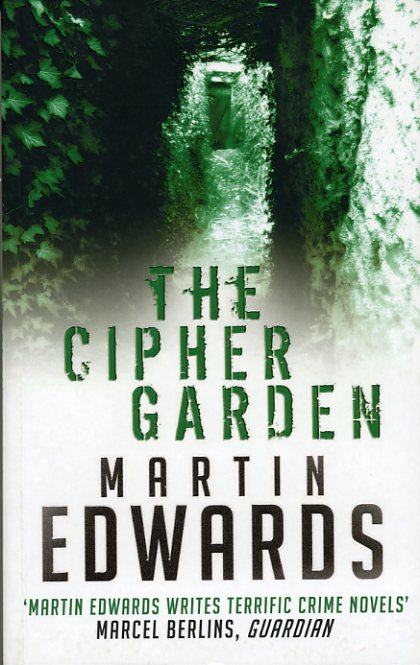
cipher-garden001The Cipher Garden by Martin Edwards has to be one of the best books I’ve read this year.

Set in the Lake District this murder mystery has everything – a beautiful setting captured so well by Martin Edwards, believable characters, and an unsolved murder with a good mixture of mystery and suspense. It’s a well paced, intricate and tense drama that kept me gripped right to the end.

Daniel Kind (see also The Coffin Trail and The Arsenic Labyrinth, my reviews are here and here) joins forces again with DCI Hannah Scarlett (in charge of the Cold Case Review Team) in investigating the murder of Warren Howe, brutally killed in the peaceful village of Old Sawrey, close to Near Sawrey the home of Beatrix Potter. There are plenty of suspects as Warren was a “serial philanderer “ who made scores of enemies and never worried if he trod on people’s toes. An anonymous tip-off to the police and a series of poison pen letters trigger the investigation and long-buried sins are brought to light before the killer is revealed.

Daniel is also tracking down the history of Tarn Cottage, which he and Miranda are renovating. The cottage garden poses a mystery – it is an ” old and melancholic private garden, mysterious and overgrown”, known locally as the Cipher Garden. The original owners and builders of Tarn Cottage, Jacob and Alice Quillers, died of broken hearts on the same day, one year exactly after the death of their son at the end of the Boer War in 1902. Not only is the layout puzzling with its tangled mess of paths meandering aimlessly leading nowhere, false turns and dead ends but the plant choice is also odd- mandrake, hellebore, foxgloves, belladonna and monkey puzzle trees.  

Here are a few quotes to whet your appetite:

The gathering dusk had become a favourite time for Daniel. He wandered outside the cottage and savoured the scent of old roses, and the colours mingling on the fell, tints of blue and indigo deepening as the sky grew dark. The slopes looked so rich and sensuous that if he could only brush them with his fingertips, it would be like touching velvet. (page 45)

Marc Amos’s bookshop flirted with the senses. If the whiff of old books and background Debussey were insufficiently seductive, the casual visitor would be lured from the craft shops in the courtyard by the rich aromas wafting from the cafeteria. It shared the ground floor of the old mill building with a maze of ceiling-to-floor shelves. Leigh Moffat’s succulent home-based desserts had found fame beyond this corner of the South Lakes and as many people gorged on her lemon cake and Death by Chocolate as on the tens of thousands of books in the store. (page 69)

Your husband has vanished and you come home from work one day to find that the bloke you hired to sort out your garden has been scythed to death and deposited in a trench he excavated himself. But that’s not all. He wasn’t some boring stranger, he was an ex. Someone you got over in your teens, someone you still pass the time of day with. There’s always the tug of nostalgia, if hardly romance. How do you think it made me feel, Chief Inspector? (page 144)

Martin is working on the fourth book in his Lake District Mystery series – The Serpent Pool, which he is aiming to publish in 2010.  I’ll be looking out for that one! He also writes a Crime Writing Blog – Do You Write Under Your Own Name? and has a website Martin Edward’s Books.

For another review see Dorte’s blog.

Reading Notes

I finished reading two of Ian Rankin’s books recently, neither of which feature Rebus. The first one was A Cool Head, which he wrote for the World Book Day Quick Reads Promotion.  As you would expect it is a very quick read at 107 pages in a large font size. But I found it surprisingly complex and had to keep reminding myself who was who and who did what.

It’s about Gravy (called Gravy because he works in the graveyard) and what happens to him when his friend Benjy turns up at the graveyard in a car Gravy doesn’t recognise. Benjy who has a bullet hole in his chest asks Gravy to hide him and look after his gun.  Then he dies and Gravy finds a bag full of money in the car. Gravy then finds himself caught up in a most unpleasant sequence of events. What happens next is told from the different characters perspective in short sharp chapters. A fast paced book that kept me entertained, but not a great read.

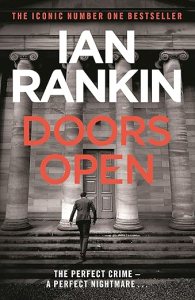
Then a much longer and more satisfying book – Doors Open; the first Rankin book post-Rebus and I was immediately swept along with the action.  It’s about an art heist – planned by Mike Mackenzie, a self-made man, rich and bored with life, Robert Gissing, the head of Edinburgh’s College of Art and Allan Crickshank a banker with a passion for art that he cannot afford to buy on his salary. Between them they devise a plan to steal some of the most valuable paintings from the National Gallery of Scotland on the day that buildings normally closed to the public throw open their doors and invite them in – one such building being the warehouse at Granton where the National Gallery stored their overflow. It was going to be the perfect crime – so perfect that nobody would know the paintings had been stolen. That is until Chib Calloway, a gangster who was at school with Mike, gets involved.

This is full of action, as violence and mayhem erupt and I just had to read chapter after chapter as quickly as I could to find out how or if they were going to get away with it and then as their options seemed to disappear how the book would end. I liked so much about this book – the story, the characters, the view of the art world and how as one door closed another door opened …

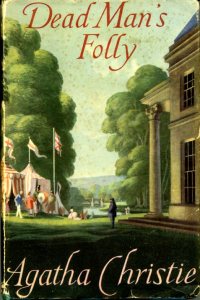
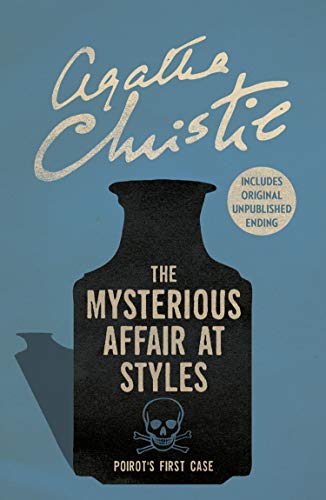
The Mysterious Affair at Styles

Mysterious Affair at StylesThis is the first novel by Agatha Christie, written in 1916 and first published in 1920. In it she created Hercule Poirot, the famous Belgian detective and introduced Captain Hastings and Inspector Japp.

I thoroughly enjoyed The Mysterious Affair at Styles. Old Mrs Inglethorp is found dying in her bedroom and although by the end of the book I guessed who had murdered her, I was completely bamboozled most of the way through the book by all the clues and false trails.

The novel is set during the First World War I at Styles Court, a country house in Essex, owned by the very wealthy Mrs Inglethorp, who had shocked her family by marrying Alfred Inglethorp, 20 years her junior. Captain Hastings had been invalided home from the Front and was invited to stay at Styles, the home of a friend, John Cavendish, Mrs Inglethorp’s son.  When she dies from strychnine poisoning there are plenty of suspects. Captain Hastings enlists the help of Poirot, who is living in Styles St Mary with other Belgian refugees, to investigate the matter.

I am so used to seeing David Suchet as Poirot and was delighted to find his portrayal of Poirot is so accurate:

Poirot was an extraordinary-looking little man. He was hardly more than five feet four inches, but carried himself with great dignity. His head was exactly the shape of an egg, and he always perched it a little on one side. His moustache was verys tiff and military. The neatness of his attire was almost incredible; I believe a speck of dust would have caused him more pain than a bullet wound.

This is a most ingenious and intricately plotted book, with  plenty of suspects to exercise those “little grey cells”. I do enjoy those detective stories where you’re given the clues that have been dropped into the narrative throughout the book in a seemingly haphazard way and then are reorganised  at the end as Poirot does in this one to explain how and why the murder was committed. So in this book we have a shattered coffee cup, a splash of candle grease, a bed of begonias, a charred fragment of a will, a fragment of green material, an overheard argument, a tilting table, a locked purple dispatch-case and so on and so on. Helpfully the book includes diagrams of the house and the murder scene.

The only other thing I’ll say about who-did-it is that it’s the person I first thought of and then was fooled into changing my mind!

Click here to read more reviews of Agatha Christie’s books.

This is the 10th library book I’ve read this year. I’m well on target for reading 25 library books in 2009 for the Support Your Library Challenge.

The Coffin Trail by Martin Edwards

A while ago I read The Arsenic Labyrinth by Martin Edwards, the third in his Lake District Mystery series of books, which I wrote about here. Now I’ve read The Coffin Trail,  the first in the series.

Daniel Kind and his partner Miranda have just moved to Tarn Cottage near Brackdale, a beautiful village in the Lakes in a hidden valley. The Cottage used to be the home of Barrie Gilpin, who was suspected of the brutal murder of Gabrielle Anders and Daniel had met Barrie, when as a boy he had spent a fortnight’s holiday at Brackdale. Barrie had died before he could be arrested and Daniel can’t imagine how the Barrie he knew could possibly have murdered anybody. He starts asking the locals questions about it.

So when the police set up a new team to investigate cold cases led by DCI Hannah Scarlett, who had been on the original team investigating the murder of Gabrielle, Daniel’s questions trigger a phone call to the team resulting in the revival of the case.

I was completely involved with the characters and swept along by the mystery. The setting is superb, the Lake District is vividly described, as is Daniel and Miranda’s renovation of the cottage, and the bookshop owned by Marc, Hannah’s partner. I liked all the detail in this book. I could see the coffin trail, the steep stony track that had been used years ago as the route mourners took to bury their dead at the chuch over the fells. It leads to the Sacrifice Stone, an ancient pagan site, where Gabrielle’s body had been found. I could see the bookshop in a section of a converted mill, with its creaking floorboards:

They creaked, just as Daniel believed, all floorboards in secondhand bookshops should creak. It was an essential part of the ambiance, like the giddy sense of claustrophobia that came from squeezing between tottering towers of books and clouds of dust that had to be blown from the ancient volumes lingering in the darkest recesses.

Daniel, an Oxford historian, is used to investgating the past and this leads to his meeting Hannah, partly because he is trying to find out more about his father, Ben who had been Hannah’s boss. Daniel had lost touch with his father after his parents’ divorce. Miranda meanwhile is becoming less enchanted with the idea of living in the cottage away from her job in London and as Daniel and Hannah spend some time together the potential for their relationship arises. I must admit that I took to Hannah rather more than I did to Miranda.

This is a nicely complicated book with complex relationships  and sub-plots. There are plenty of questions to be answered. Can Daniel and Miranda live happily in Tarn Cottage? Did Barrie kill Gabrielle? And if he didn’t who did? Ben Kind and Hannah were never convinced at the time of his guilt and as the cold case team investigate aided by Daniel’s persistence more secrets emerge. I was kept guessing right to the thrilling end of this book.

The Mirror Crack’d From Side to Side

 The Mirror Crack’d From Side To Side by Agatha Christie first published 1962.

 Miss Marple was feeling rather down and a bit weak after an attack of bronchitis. Her doctor prescribes ” a nice juicy murder” for her to unravel and not long after the ideal opportunity arose with the death of Heather Badcock. Heather had gone to a fete at Gossington Hall held by her idol, the glamorous movie star Marina Gregg. She died after drinking a poisoned cocktail, just after meeting Marina. The title is taken from Tennyson’s The Lady of Shalot, a convincing image of Marina’s reaction on meeting Heather – “… ‘the curse has come upon me’, cried the Lady of Shalott.” Heather was the sort of person no-one would want to murder, she was a very kind woman who always did things for other people. Her trouble was that she was sure she knew the best thing to do and she was only really interested in herself. Such people Miss Marple observed “live dangerously – though they don’t know it themselves.” So why was she killed and was Marina really the intended victim?

I remember seeing the TV adaptation of this book with my favourite Miss Marple – Joan Hickson – and although I did remember who had committed the murder I didn’t remember the motive, nor how it had happened. As I read on it all came back to me – just what the curse was.  As usual with Agatha Christie’s books,which are so deceptively easy to read, all is not straight forward and there are many complications and twists before the denoument. 

There was lots to enjoy in this book – not just the puzzle of the murder, but also the setting and the characterisation. The setting is St Mary Mead, once an idyllic English  village, now threatened by the “Development” of rows of new houses which at first didn’t seem real to Miss Marple – it “was like a neat model built with child’s bricks” and the people looked unreal to her. She thought it all looked “terribly depraved”. Then she realised that although everything and everyone looked and sounded different the human beings were the same as they always had been. It’s from her understanding of human nature that she is able to solve the crime.

I also liked the characterisation of Miss Marple, now an old lady thought incapable of looking after herself and the neat way she handles Miss Knight her live-in companion who talks to her as though she is a child. In fact all the characters have that touch of reality that brought them alive.  Their idiosyncracies are what makes them seem real people.

agatha_christie_rc

 For more reviews of Agatha Christie’s books have a look at the Agatha Christie Reading Challenge Carnival.

library-challenge

This is the ninth library book I’ve read this year so I’m well on target to read at least 25 library books by the end of December. Click on the logo for links to other bloggers reviews of  library books.

The Falls – Ian Rankin

The Falls (Inspector Rebus, #12)

I loved The Falls by Ian Rankin.  This is set in Edinburgh where a university student Philippa Balfour, known as ‘Flip’ to her friends and family has disappeared.  DI Rebus and his colleagues have just two leads to go on – a carved wooden doll found in a tiny coffin at The Falls, Flip’s home village, and an Internet game involving solving cryptic clues. Rebus concentrates on the tiny coffin and finds a whole series of them have turned up over the years dating back to 1836 when 17 were found on Arthur’s Seat, the extinct volcano within Holyrood Park, east of Edinburgh Castle. DC Siobhan Clarke meanwhile tries to solve the cryptic clues.

There are many things I liked about this book – the the interwoven plots, throwing up several suspects; the historical references to Burke and Hare, the 19th century resurrectionists; the spiky relationship between Rebus and his new boss Gill Templeton; Siobhan Clarke whose liking for doing things independently matches Rebus’s own maverick ways; and above all the setting in and around Edinburgh. All the way through I kept changing my mind about “who did it” and it was only just before the denoument that I worked it out.  This is a very satisfying book and I’m looking forward to reading more Rebus books very soon.