Teaser Tuesday

Teaser Tuesday is a weekly event hosted by MizB of Should be Reading.

My teaser today is from The Adventure of the Dancing Men in Favourite Sherlock Holmes Stories by Arthur Conan Doyle.

Holmes had been seated for some hours in silence, with his long thin back curved over a chemical vessel in which he was brewing a particularly malodorous product. His head was sunk upon his breast, and he looked from my point of view like a strange, lank bird, with grey dull plumage and a black top-knot.

‘So, Watson, said he, suddenly, ‘you do not propose to invest in South African securities?’ (page 57)

Favourite Sherlock Holmes Stories is a collection of twelve stories that Arthur Conan Doyle rated as his very best. It includes what Conan Doyle described as ‘the grim snake story’, The Speckled Band, and The Red-Headed League and The Dancing  Men on account of the originality of the plot of each.

It  also includes his first story – A Scandal in Bohemia; the story that deceived the public with the erroneous death of Holmes –  The Final Problem;  and the story that explained away the alleged death of Holmes – The Empty House.

Crime Fiction Alphabet – C is for Christopher Brookmyre

At first glance I wouldn’t have thought that Christopher Brookmyre would be my sort of author. He writes gritty,down to earth crime fiction, with no punches withheld. And when my son first lent me Quite Ugly One Morning I wasn’t at all sure that I would like it. I was wrong, I loved it – see here.

Brookmyre, a Scottish author, tackles corruption and social injustice in his books; they are satirical and full of bite, full of tension and pace. Before he became a full-time writer he was a journalist. After writing Quite Ugly One Morning he went on to write:

(Links go to Wikipedia)

For a critical perspective of Christopher Brookmyre’s work see this article at Contemporary Writers and for summaries of his books go to his page at Little, Brown Book Group.

Crime Fiction Alphabet is hosted by Kerrie at Mysteries in Paradise.

Payment Deferred by Joyce Holms: Book Review

I like puzzles and that is one of the things I like about crime fiction – solving the puzzle. The problem for crime fiction authors must be judging it correctly – how to drop the clues into the narrative in a subtle way so that the reader doesn’t get the solution too easily. I like being able to work it out for myself – but not too soon. In Payment Deferred, Joyce Holms has managed it well.

Paperback: 288 pages
Publisher: Bywater Books (30 Aug 2007)
Language English
ISBN-10: 1932859314
ISBN-13: 978-1932859317
Source: Gift from the author

This is the first of Joyce Holms’s series of books featuring Tam Buchanan and Fizz Fitzpatrick. Tam is a lawyer who spends Monday mornings giving legal advice at a community centre in Edinburgh. Fizz is soon to be a mature student of Law and much against Tam’s better judgement talks her way into becoming his assistant. She looks like a teenager, but is actually 26, with a talent for getting people to talk to her.

Murray Kingston, an old friend of Tam’s, is released from prison having served three years convicted of molesting his daughter after his wife’s death. When he turns up at the community centre wanting Tam to clear his name and help him get his daughter back it is Fizz who persuades Tam to review the evidence. Murray believes he was set up.

I thought this was a well plotted book,which moves at a good pace, with a good sense of location (Edinburgh and Berwick) and convincing characters, particularly Fizz and Tam – the relationship between the two of them developed from lukewarm to exasperation. Having solved the case they part:

“See you around Buchanan,” she said coldly, as the doors slid shut between them.

Buchanan sagged back against the wall and closed his eyes. He felt utterly depleted.

“See you around, Fizz”, he whispered to the empty landing, and the words blew away like dry leaves into the silence.

But even as he said it, he knew with absolute certainty that he wouldn’t be shot of her so easily.

After a minute or two he started to laugh, and couldn’t stop.

Their partnership was not at an end, as there are eight more books in the series. I’ve already read the most recent – Missing Link.

Details of all Joyce’s books are on her website.

Teaser Tuesday

My teaser today is from Agatha Christie’s The Secret Adversary, which I’ve just started to read. This is the first Tommy and Tuppence mystery first published in 1922. It begins:

“Tommy, old thing!”

“Tuppence, old bean!”

The two young people greeted each other affectionately, and momentarily blocked the Dover Street Tube exit in doing so. The adjective “old” was misleading. Their united ages would certainly not have totalled forty-five. (Kindle Loc 56-61)

Teaser Tuesday is a weekly event hosted by MizB of Should be Reading.

Crime Fiction Alphabet – Letter B – W J Burley

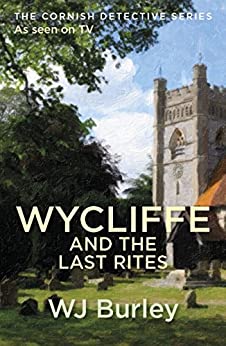
This week I’ve chosen to feature W J Burley to illustrate the letter B for Kerrie’s Crime Fiction Alphabet. I knew of  his Wycliffe novels but had never read any, or watched any of the TV dramatisations, so I came to Wycliffe and the Last Rites with no preconceptions. I really don’t know why I never watched the 1990s TV series starring Jack Shepherd as Wycliffe, but as I didn’t I was able to form my own image of him in my mind directly from the book.

William John Burley was born in Falmouth, Cornwall in 1914. His first book was published in the 1968. All in all he produced 22 more Wycliffe books and 5 others. He died in 2002 whilst he was writing his 23 Wycliffe book. There is more information about him at this website – W J Burley.

Wycliffe and the Last Rites
Paperback: 192 pages
Publisher: Orion; New Ed edition (7 Nov 2002)
Language English
ISBN-10: 075284931X
ISBN-13: 978-0752849317
Source: I bought it

Description from the back cover:

A bizarre murder shakes the Cornish village of Moresk. Arriving at church on Easter morning the vicar discovers the body of a woman sprawled across the chancel steps. To add to the horror, the church is filled with the discordant sound of an organ chord, the notes apparently chosen at random and wedged down.

Has the church been desecrated by a Satanist ritual? Chief Superintendent Wycliffe sees the crime more as an expression of hatred directed at others in the community, besides the dead woman. His investigation, however, is frustrated at every turn, and when another horrific murder is committed Wycliffe thinks he knows who the killer is. But can he prove it?

My thoughts:

This novel has a strong sense of location, with many passages describing the beautiful countryside of Cornwall. The characters are also well defined – a small local community focussing on the twin sisters, Katherine Geach and Jessica Dobell. The relationship between them is strained, with Jessica having a sense of guilt about a hit and run accident she’d witnessed 16 years earlier and admitting that she hadn’t played fair with Katherine.  After their parents’ deaths Jessica had inherited the family farm and lived there with the Vintners and their son, a strange family filled with hatred and resentment over their reduced circumstances. Then there is the Vicar and his sister, who had been forced to move from their previous parish, the houseboat man, Lavin, who is badly disfigured following an accident, and Arnold Paul, the organist and his ‘brother’.

Detective Chief Superintendent Wycliffe is a quiet character who thinks things through before divulging his suspicions to his colleagues. He delegates tasks to his team leaving himself free to concentrate on the victim. To him ‘hope is an ultimate resource’. His evening walks are a necessity for him to ponder what he has discovered and he is calm and collected:

It was characteristic that he should walk rather than drive or be driven; he refused to allow his days to become crowded with events in a frenetic succession of images like a television screen, lacking even commercial breaks to aid digestion. (pages 44 -5)

His problem in finding the murderer is that all the possible leads pointed to a limited range of possible suspects but none of them matched his specification for the criminal. It seemed he had to believe the impossible. It’s a tightly plotted book, concisely and precisely written and I enjoyed it very much. I have one other book of Burley’s to read – Wycliffe and the House of Fear. After that I’ll be looking out for his other books.

Sunday Salon – Current Books

This week I’ve finished reading two crime fiction books:

and posts on these books will be on my blog this coming week.

I’m still reading Eden’s Outcast: the story of Louisa May Alcott and Her Father by John Matteson. So far I’ve been reading about Bronson Alcott and his unorthdox ideas about educating and bringing up children.  It was quite a coincidence I thought, when I was reading the Daily Express in the coffee shop recently and came across a review of Fruitlands: The Alcott Family and their Search for Utopia by Richard Francis. The reviewer describes this book as a

… richly textured history of the life and times of a back’‘to’‘nature community in 19th-century America. It was called Fruitlands, though Fruitcakes would have been more apt.
(Read more from this review.)

I haven’t got up to this venture so far in Eden’s Outcasts. There are many entries in the index under ‘Fruitlands’ so I expect to find out much more about it. His career as a teacher was not a success and it seems that his venture into communal farming wasn’t either.

I spent other reading time this week downloading more books onto my Kindle and have read the opening paragraphs of most of them. It really is so easy to get carried away and add more books to my to-be-read lists! But I only bought one book this week, so that’s not too bad.

It’s Reading Like a Writer by Francine Prose and it’s been on my wish list for a long time. I read fairly quickly and know that I often read too quickly to take in all the detail. Prose writes that reading quickly can be ‘a hindrance‘ and that it is ‘essential to slow down and read every word‘. She also contradicts the advice to novice writers ‘to show, not tell‘, when ‘the responsibility of showing should be assumed by the energetic and specific use of language‘. Using Alice Munro’s short story Dulse as an example, she says:

There are many occasions in literature in which telling is far more effective than showing. A lot of time would have been wasted had Alice Munro believed that she could not begin her story until she had shown us Lydia working as an editor, writing poetry, breaking up with her lover, dealing with her children, getting divorced, growing older, and taking all the steps that led up to the moment at which the story rightly begins.

Most interesting, I thought.

I still haven’t got used to Kindle’s use of locations as opposed to page numbers – the extract above is from Location 409 – 12. Nor have I mastered the technique of transferring my highlighted passages and notes from the Kindle to the computer!

I’m also reading The Matchmaker of Kenmare by Frank Delaney. This is an Advance Uncorrected Proof; the book is scheduled to be on sale on 8 February. It’s the first book I’ve read by Delaney, described by the publisher as a

… lush and surprising historical novel, rich as a myth, tense as a thriller …

From what I’ve read of it so far I’d go along with that description, except for the tenseness – but it’s early days yet. It’s set in 1943 in Ireland, a neutral country in the Second World War. It’s a long book and takes its time in setting the scene and introducing the characters. It promises well.