Death in the Clouds by Agatha Christie: a Book Review

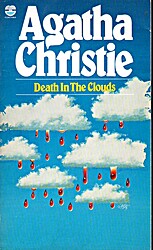
Death in the Clouds is a kind of locked room mystery, only this time the ‘locked room’ is a plane on a flight from Paris to Croydon, in which Hercule Poirot is one of the passengers.

In mid-air, Madame Giselle, is found dead in her seat. It appears at first that she has died as a result of a wasp sting (a wasp was flying around in the cabin) but when Poirot discovers a thorn with a discoloured tip it seems that she was killed by a poisoned dart, aimed by a blowpipe.

At the inquest the jury’s verdict is that the murderer is Poirot! However the coroner refuses to accept this and finds that the cause of death was poison with insufficient evidence to show who had administered the poison. All the other passengers and flight attendants are suspects and Poirot together with Inspector Japp, studies the passenger list with details of their belongings. There is a helpful plan of the cabin at the front of the book showing who sat where, including a crime fiction writer, a flute-playing Harley Street doctor, two French archaeologists, a dentist, a hairdresser, a Countess (formerly an actress), a woman who is a compulsive gambler, a crime writer and a businessman . Despite all this I was quite unable to work out who did it.

The question is who could have acquired the rare poison and how could it have been shot at Madame Giselle without anyone noticing that happening. Why would anyone want to kill her, and how were any of the suspects connected with her? Even when Poirot details the clues, including the Clue of the Passenger’s Baggage (and I read through the list a few times), I still didn’t work it out.

Apart from the ingenious mystery, which the coroner describes as the most astonishing and incredible case he had ever dealt with, there were other things I enjoyed in reading this book. First of all the ‘psychological moments’  in which people don’t notice what is happening in front of them because their attention is diverted. Then there is the way Christie makes fun of crime fiction writers and readers, making Japp comment that:

I don’t think it healthy for a man always to be brooding over crime and detective stories, reading up all sorts of cases. It puts ideas into his head. (page 63)

Poirot’s denouement at the end of the book clears up all the confusion, detailing his impressions, precise ideas and methods in dealing with the case. Looking back through the book, all the clues were there, of course, but so cleverly concealed that in most cases I had overlooked them or not realised their significance. A most enjoyable book!

  • Paperback: 336 pages
  • Publisher: HarperCollins; Masterpiece edition (Reissue) edition (3 Mar 2008)
  • Language English
  • ISBN-10: 000711933X
  • ISBN-13: 978-0007119332
  • Source: I bought the book
  • My rating 4/5

Dandy Gilver and the Proper Treatment of Bloodstains by Catriona McPherson

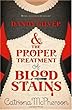
I hadn’t come across any of Catriona McPherson’s books until the publishers emailed me about her latest book – Dandy Gilver and an Unsuitable Day for a Murder, which is coming out in the spring and they kindly sent me the fifth in the Dandy Gilver series – Dandy Gilver and the Proper Treatment of Bloodstains. Given that it has the sort of title and jacket cover that normally make me avoid a book, I was pleasantly surprised to find that I really enjoyed this book. It just goes to show not to judge a book by its cover.

It’s set in Edinburgh in 1926, when Dandy (short for Dandelion Dahlia!), a wealthy aristocrat who is also an amateur sleuth, receives a letter from Lollie Balfour asking for help as she is convinced that her husband is going to kill her. The only way Dandy can investigate is for her to go undercover as lady’s maid to Lollie. She manages to pass as a  lady’s maid (albeit an inexperienced one) with the other household servants, who with just one exception, all have stories of how horrible Mr Balfour is. And then he is found dead in his bedroom, a locked room, stabbed with ‘a long, bone-handled knife, lodged to its hilt and standing straight up out of his neck, pooled all round with blood that was almost black.’

There are plenty of suspects for his murder, including Lollie herself, and Dandy has to work out who is telling the truth. I had my suspicions quite early on but hadn’t quite foreseen the actual outcome or culprit. Even though I didn’t get it right I was on the right lines, which is pleasing and in any case I wouldn’t have liked it to be too easy to work out the puzzle.

Along with a good plot, the characters are all well defined and distinct and although at one point I thought the amount of description of the miners’ strike was just that bit too detailed, it has a great sense of time and place reflecting the mood of the 1920s during the general strike. And now I do know the proper treatment for bloodstains.

  • Hardback: 291 pages
  • Publisher:Thomas Dunne Books (2009)
  • Language English
  • ISBN-13: 978-0312654184
  • Source: the publishers

My rating 4.5/5

I wonder how I’ve managed to be totally unaware of Catriona McPherson‘s books up to now. She is a Scottish writer who now lives in Northern California. I’ll certainly read more of her books in future.

Mini Reviews

I’ve been reading books recently and not writing anything about them. So, before they drop out of my mind completely here are a few notes:

Body Parts: Essays on Life Writing by Hermione Lee – this is a book about writing biography, which I’ve been reading on and off since I started it in 2007! I first wrote about my impressions in this post. It’s very good with an interesting selection, although some essays are a lot shorter than others. As with all books about writing it includes books and authors I haven’t read – and makes me want to read them – Eudora Welty for one. There are essays on T S Eliot, J M Coetzee, Jane Austen and Virginia Woolf, to name but a few.

My rating 4/5

A Wrinkle in Time by Madeleine L’Engle – I bought this book several years ago, so it’s one off my to-be-read list. A fantasy/science fiction magical classic and 1963 Newbery Medal winning book, which I thoroughly enjoyed. It’s the story of Meg and Charles, searching for their father, a scientist, lost through a ‘wrinkle in time’, with wonderful characters such as Mrs  Whatsit, Mrs. Who and Mrs. Which to help them.

My rating 4.5/5

Maigret in Court by Georges Simenon. Maigret is two years from retirement and is wondering about this with foreboding. He does seem rather tired as he investigates the murder of a woman and small child. The book begins in court as Maigret gives evidence against Gaston Meurat, but he is beginning to have doubts that Meurat is the murderer and carries on investigating to save Meurat from execution. A complicated story, packed into 126 pages, that at times had me completely puzzled.

My rating 3/5

I read two books on Kindle:

Breakfast at the Hotel Deja Vu by Paul Torday. I rather liked this little e-book about a politician, a former MP exposed in the expenses scandal and staying in a hotel abroad, whilst he recovers from an illness and writes his memoirs. All is not as it seems, however, as each day he discovers he hasn’t actually written anything.And just who are the woman and young boy he sees each morning?

My rating 4/5

Crime in the Community by Cecilia Peartree – a free e-book from Amazon. I was disappointed with this one – too wordy, and convoluted. It’s about a small group of people who are supposed to be organising events to improve their community, but who actually don’t do anything except go to meetings. I found this part quite true to life for some committees I’ve known. But then it got tedious and eventually too far-fetched with a retired spy, a missing person and a mental breakdown.

My rating 2/5

Best Crime Fiction Reads 2011

Kerrie at Mysteries in Paradise is collecting lists of best crime fiction reads for 2011 – the books don’t have to have been published in 2011, but must be crime fiction.

These are the books that I’ve rated with 5 and 4.5 stars:

  1. Exit Lines by Reginald Hill 5/5
  2. Drawing Conclusions by Donna Leon 5/5
  3. The Janus Stone by Elly Griffiths 5/5
  4. Blood Harvest by S J Bolton 5/5
  1. Wycliffe and the Last Rites by W J Burley 4.5/5
  2. The Silent World of Nicholas Quinn by Colin Dexter 4.5/5
  3. The Art of Drowning by Frances Fyfield 4.5/5
  4. The Stabbing in the Stables by Simon Brett 4.5/5
  5. Gently Does It by Alan Hunter 4.5/5 (Kindle)
  6. Cop Hater by Ed McBain 4.5/5
  7. The Case of the Lame Canary by Erle Stanley Gardner 4.5/5
  8. Intimate Kill by Margaret Yorke 4.5/5
  9. Murder on the Orient Express by Agatha Christie 4.5/5
  10. Dumb Witness by Agatha Christie 4.5/5
  11. The Hanging Wood by Martin Edward (Kindle) 4.5/5
  12. Awakening by S J Bolton (Kindle) 4.5/5
  13. Dandy Gilver and the Proper Treatment of Bloodstains by Catriona McPherson 4.5/5 – review to follow


Teaser Tuesday

Currently I’m reading Agatha Christie’s The Clocks, which incidentally, is on ITV on Boxing Day -one of the Agatha Christie’s Poirot series. Reading the preview it doesn’t sound as though they have stuck too closely to the plot, but never mind.

This description of a bookshop near the British Museum appealed to me:

Inside, it was clear that the books owned the shop rather than the other way about. Everywhere they had run wild and taken possession of their habitat, breeding and multiplying and clearly lacking any strong hand to keep them down. The distance between bookshelves was so narrow that you could only get along with great difficulty. There were piles of books perched on every shelf or table.

On a stool in a corner, hemmed in by books, was in a old man in a pork-pie hat with a large flat face like a stuffed fish. He had the air of one who has given up an unequal struggle. He had attempted to master the books, but the books had obviously succeeded in mastering him. He was a kind of King Canute of the book world, retreating before the advancing tide of books. (page 170)

I don’t suppose this will be included in the drama, but I hope it will.

I’m about halfway through the book and Poirot has yet to appear!

For more Teaser Tuesdays go to Should Be Reading.

A Trio of Maigret Books

Recently I’ve been reading Maigret books – three on the run – The Madman of Bergerac, The Hotel Majestic and The Friend of Madame Maigret – by Georges Simenon.

First, The Madman of Bergerac, which I enjoyed the most of the three. It’s an early Maigret novel first published in 1932. There is a deranged killer on the loose, who pierces his victims’ hearts with a needle. Maigret is on the train on his way to visit Leduc, an old colleague near Dordogne, when he finds himself sharing a compartment with a restless stranger who jumps off the train. On an impulse Maigret follows and ends up being shot in the shoulder and laid up in bed for two weeks at a Bergerac hotel, the Hotel d’Angleterre.

He conducts his inquiries from his bed, helped by Leduc and his wife, Madame Maigret. He reflects:

There is something slightly intoxicating about a narrow escape from death. and then to lie in bed and be cosseted … Especially in an atmosphere of unreality …

To lie in bed and let your brain work  of itself, just for the fun of it, studying a strange place and strange people through a sunlit window … (page 23)

It’s a complicated story and I had no idea who the murderer was. It’s a short book, quickly and easily read and a satisfying mystery. I liked the personal aspects, the insight into some of Maigret’s mind, his analysis of the crime and the local people, and his relationship with his wife – who cooks his meals for him at the hotel.

My rating: 4/5

Next, The Hotel Majestic, first published in 1942. Another complicated mystery for Maigret to solve. The body of Mrs Clark, the wife of a wealthy American is found strangled in the basement of the Hotel Majestic. Suspicion falls on Prosper Donge, a hotel employee, who finds the body and Maigret travels to a nightclub in Cannes to find out more about his background – and Mrs Clark’s.

I found this book a little frustrating as Maigret’s intuitive powers leads him to the solution. He has hunches, which are not made clear to the reader and spends time pondering the psychology of the characters. At times I felt very like Mr Clark, who doesn’t speak French and has to keep asking ‘what’s he on about?’

My rating: 3/5

Finally, The Friend of Madame Maigret, first published in 1950. What I particularly liked about this book is Madame Maigret’s involvement in the story. She actually does some detective work! It begins when Madame Maigret is sitting on a bench in a square when a young woman in a blue suit and white hat asks her to mind her little boy. She doesn’t return for several hours, then snatches the child from Madame Maigret and drives off in a taxi.

Meanwhile, Maigret is investigating a reported murder, although there is no corpse, just two human teeth in the ashes of Monsieur Steuvels’s furnace. Steuvals is the obvious suspect, but acting for him is the young lawyer, Liotard, who treats Maigret as his special enemy, claiming Maigret is out of date:

… a detective of the old school, of the period when the gentlemen of the Quai des Orfèvres could, if they chose, give a man the third degree until exhaustion drove him to make a confession, keep him in their hands for weeks, pry shamelessly into people’s private lives, in fact a period when any kind of trick was considered fair play. (pages 56-7)

Are these two stories connected? It seems unlikely at first. Maigret is dissatisfied, with too many people mixed up in the cases,which get ever more complicated and new characters appearing about whom Maigret knows almost nothing. He just wants to start the investigations again. It’s only when Madame Maigret comes up with a vital clue that he is able to make any headway.

My rating: 3.5/5

Reading these three books, one after the other has given me a much more rounded picture of Maigret than if I’d read them in isolation. Maigret is a big man, who smokes a pipe, actually he has many pipes, wears a bowler hat – often on the back of his head, who works mainly by intuition and analysis of the facts, is a bit handy with his fists, and has a happy home life. The stories are intricate, with many characters, have well developed plots, a great sense of location and at under 200 pages are quick, satisfying books.

Georges Simenon (1903 – 1989) was a Belgian writer who wrote nearly 200 books, 75 of them featuring Maigret, from 1931 to 1972.