At Bertram’s Hotel by Agatha Christie

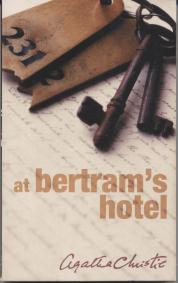
At Bertrams Hotel 001

I try to read at least one Agatha Christie book a month. This month’s book is At Bertram’s Hotel, a Miss Marple book, first published in 1965, and written when Agatha Christie was seventy five.

Synopsis (from book cover):

An old-fashioned London Hotel is not quite as reputable as it makes out’¦

When Miss Marple comes up from the country for a holiday in London, she finds what she’s looking for at Bertram’s Hotel: traditional decor, impeccable service and an unmistakable atmosphere of danger behind the highly polished veneer.

Yet, not even Miss Marple can foresee the violent chain of events set in motion when an eccentric guest makes his way to the airport on the wrong day’.

My view:

Miss Marple is now the same age as Agatha Christie was at the time she was writing At Bertram’s Hotel and some of her thoughts and reactions are most likely to be those of the author herself  – reflections on comfort for example – most appreciative of her bed, and a beautifully cooked breakfast, a real breakfast with properly poached eggs and enjoying ‘a delightful morning of shopping’ at the Army& Navy Stores.  But Miss Marple is not one of the main characters in this book, although she does play a vital role.

In some ways, Bertram’s Hotel itself is a leading ‘character’. It’s ‘dignified, unostentatious and quietly expensive‘, patronised by clergymen, ‘dowager ladies of the aristocracy up from the country’ and ‘girls on their way home from expensive finishing schools.’ It’s Miss Marple’s choice when her nephew and his wife decide to do something for ‘poor old Aunt Jane’ and pay for her week’s stay. And yet it doesn’t seem real to her, the fact that it didn’t seem to have changed over the years made her think that it ‘really seemed too good to be true.’ (page 26)

There’s a long build up to any crime being committed and It’s only towards the end of the book that a murder occurs. Scotland Yard are concerned about a crime network that is getting too big and organised:

Robbery on a big scale was increasing. Bank hold-ups, snatches of pay-rolls, thefts of consignments of jewels sent through the mail, train robberies. Hardly a month passed but some daring and stupendous coup was attempted and brought off safely. (page 49)

(I was reminded that Agatha Christie was writing this at the time of, or shortly after the ‘Great Train Robbery’ of 1963 in which a gang of robbers held up a mail train and made off with £2.6 million (equivalent to £41 million now) – later in the book a train robbery takes place in Ireland.)

A number of characters are introduced quite quickly and I had to keep reminding myself who they were and how they fitted into the story. There’s the hotel staff, including Henry the ‘perfect butler’ and the visitors, including Lady Sedgewick and a number of elderly ladies, Colonel Luscombe and other retired military gentlemen, Canon Pennyfather, a vague forgetful white-haired elderly cleric, Elvira Blake, Colonel Luscombe’s ward and the police, including Chief Inspector Davy (nicknamed ‘Father’ by his staff – a nickname that I thought irritating and out of place, probably intended to make him seem paternal and safe). There is also the mysterious Mr Robinson, who I’ve come across in some of Agatha Christie’s other books.

The novel meanders along through a number of subplots before reaching the climax, which I thought was a bit signposted. The ending is both predictable and surprising with a final twist in the last sentence that pleased me.

One of the things I like about At Bertram’s Hotel are the little insights into Miss Marple’s mind – and her past. For example she had first visited Bertram’s Hotel as a  girl of fourteen with her uncle and aunt, her Uncle Thomas had been a Canon of Ely. And I was delighted to discover that she had known romance because when she was a young woman she had had a friendship with ‘a very unsuitable young man‘ whose name she has forgotten. But her mother had firmly nipped that friendship in the bud, which later Jane realised was wise although at the time Jane Marple, ‘that pink and white eager  young girl … such a silly girl in many ways’ had ‘cried herself to sleep for at least a week.’ (page 26)

As in other books featuring Miss Marple it’s her characteristic curiosity, what she preferred to call ‘taking an interest in other people’s affairs’, that is crucial to the plot. She is very good at overhearing conversations and she’s a light sleeper. She’s also very perceptive and just a touch cynical, no longer the silly girl of her youth.

  • Paperback: 224 pages
  • Publisher: HarperCollins; Masterpiece edition edition (1 July 2008)
  • Language: English
  • ISBN-10: 0007121032
  • ISBN-13: 978-0007121038
  • Source: I bought the book
  • My Rating: 4/5

Crime Fiction Alphabet 2012 – summary

Kerrie’s Crime Fiction Alphabet came to the end last week. This is the third time I’ve taken part and as before I thoroughly enjoyed taking part. Thanks, Kerrie.

The rules of the meme are that you have to write a blog post about crime fiction related to the letter of the week and your post MUST be related to either the first letter of a book’s title, the first letter of an author’s first name, or the first letter of the author’s surname.

I had very little difficulty in finding books to fit the rules and mainly read whatever I wanted and slotted them in wherever they would fit. The exception to that was, of course, that pesky letter X and I resorted to having a title that sounded as though it began with X.

Many were books by old favourites, such as Agatha Christie (3 books) and some by new-to-me authors, such as Dana Stabenow, Michael Innes, M R Hall, Chris Pavonne and Suzanne Young.

Here’s my list – a mixture of titles and authors’ names:

I rated most of the books between 3/5 to 4/5 with two at 5/5:

and The Chalk Circle Man by Fred Vargas at 4.5

My Day in Books 2012: a meme

Today I was going to write a post about one of the books I’ve read recently but then I saw that Cornflower had posted this meme: ‘œMy Day in Books’. I did this last year and fancied doing it again with this year’s books. The task is to complete the sentences using the titles of books you have read this year.  Here’s what I came up with:

I began the day by The Secret River

before breakfasting on Red Bones (that’s all there was!)

and admiring The Victorian Chaise-Longue.

On my way to work I saw The Woman in White

and walked by The House of Silk

to avoid Our Mutual Friend

but I made sure to stop at The Village.

In the office, my boss said, Death Comes to Pemberley

and sent me to research The Murder on the Links.

At lunch with My Cousin Rachel

I noticed A Man Lay Dead

in A Room Full of Bones

greatly enjoying  A Quiet Life!!

Then on the journey home, I contemplated Endless Night

because I have A Weekend with Mr Darcy

and am drawn to Dancing Backwards.

Settling down for the evening in A Place of Greater Safety

I studied Dark Matter

by Blue Lightning

before saying goodnight to (the) Bad Boy.

I’ve written posts about most of them. Here are the links If anyone wants to to read what I thought about the books:

Crime Fiction Alphabet: Letter Z

We have reached the final letter in Kerrie’s Crime Fiction Alphabet and to illustrate the letter Z I’m focusing on:

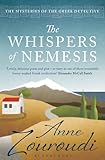
The Whispers of Nemesis by Anne ZouroudiThis book is the fifth in Zouroudi’s series about Hermes Diaktoros of Athens, the Greek Detective.

Summary (from Anne Zouroudi’s website):

It is winter in the mountains of northern Greece and as the snow falls in the tiny village of Vrisi a coffin is unearthed and broken open. But to the astonishment of the mourners at the graveside, the remains inside the coffin have been transformed, and as news of the bizarre discovery spreads through the village like forest fire it sets tongues wagging and heads shaking.

Then, in the shadow of the shrine of St Fanourios (patron saint of lost things), a body is found, buried under the fallen snow – a body whose identity only deepens the mystery around the exhumed remains. There’s talk of witchcraft, and the devil’s work – but it seems the truth, behind both the body and the coffin, may be far stranger than the villagers’ wildest imaginings. Hermes Diaktoros, drawn to the mountains by a wish to see an old and dear friend, finds himself embroiled in the mysteries of Vrisi, as well as the enigmatic last will and testament of Greece’s most admired modern poet.

The Whispers of Nemesis is a story of desperate measures and long-kept secrets, of murder and immortality and of pride coming before the steepest of falls.

My view:

Hermes is a detective with a difference. Just who he is and who he works for is never explained. He’s most definitely not a policeman and when asked he says he works for a ‘higher power’ than the police. He is described as ‘the fat man’. He wears a cashmere overcoat of midnight blue, a grey suit with a subtle stripe and a waistcoat, and white tennis shoes. He has owlish glasses and thick curly greying hair. His name is his

… ‘father’s idea of humour. He’s something of a classical scholar.  And in the spirit of my namesake, I call these’ – he indicated his white tennis shoes – ‘my winged sandals.’  (page 94)

It is this element of the novels that appeal to me – that and the quirky mysteries. And this book certainly is about a strange mystery about the life and death of the poet Santos Volakis. A local man, he had died some four years earlier choking on an olive stone. In his will he had stipulated that his bequests would only be available when his bones ‘finally see daylight’. So the rite of exhumation, which is customary in rural Greece four years after a death was important to his family and friends, but no one was prepared for the shock that it delivered when the bones were revealed.

I found it a little difficult at first following the sequence of events and identifying who was who, but I soon worked it out. I also had worked out what the mystery was well before the the end, which actually added to my enjoyment of reading the book. The setting is superb, placing you so completely in Greece in winter amongst believably real people.

Each of the books in the Hermes Diaktoros series features one of the Seven Deadly Sins ‘“ in this one it is the sin of pride. Nemesis is the bringer of retribution.

  • Paperback: 304 pages
  • Publisher: Bloomsbury Paperbacks (7 Jun 2012)
  • Language: English
  • ISBN-10: 1408821915
  • ISBN-13: 978-1408821916
  • Source: I bought the book
  • My Rating: 3.5/5

1. The Messenger of Athens (2007)
2. The Taint of Midas (2008)
3. The Doctor of Thessaly (2009)
4. The Lady of Sorrows (2010)
5. The Whispers of Nemesis (2011)
6. The Bull of Mithros (2012)

Thanks to Kerrie for organising the Crime Fiction Alphabet. I’ve listed the books I’ve read in a page (see Index tab at the top of the blog) and soon I’ll do a summing up post about the highlights.

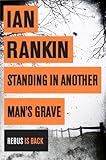
Standing in Another Man’s Grave by Ian Rankin

Yesterday I received Ian Rankin’s new book, Standing in Another Man’s Grave and it’s looking good.

It begins:

He’d made sure he wasn’t standing too near the open grave.

Closed ranks of other mourners between him and it. The pall-bearers had been called forward by number rather than name – six of them starting with the deceased ‘s son. Rain wasn’t quite falling yet, but it had scheduled an appointment.

The deceased is a retired policeman. The unnamed man, standing at the funeral had known him. He was desperate for a cigarette. After the coffin is lowered into the grave one of the mourners approaches him with a nod of recognition:

‘John’, he said.

‘Tommy’, Rebus replied, with another nod.

Rebus is back!

With the rain now falling he heads for his car, turns on the car’s CD player and Jackie Leven’s voice emerges singing about standing in another man’s grave. Except he isn’t – the track is called ‘Another Man’s Rain’.

I paused and decided to look for the track. Here it is:

I’m trying to read this book slowly, but the plot and Rebus is gradually pulling me in. I just have to keep turning the pages. So, it’s back to the book now.

Fro more Book Beginnings on Friday see Gilion’s blog Rose City Reader.

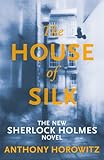
The House of Silk by Anthony Horowitz

*I enjoyed reading Anthony Horowitz’s book, The House of Silk. It’s pacy, full of atmosphere and mystery, and above all it captures the essence of Sherlock Holmes and Dr Watson. Horowitz’s plot is cunning, full of twists and turns, with allusions to Conan Doyle’s stories.

Synopsis from the book cover:

It is November 1890 and London is gripped by a merciless winter. Sherlock Holmes and Dr Watson are enjoying tea by the fire when an agitated gentleman arrives unannounced at 221b Baker Street. He begs Holmes for help, telling the unnerving story of a scar-faced man with piercing eyes who has stalked him in recent weeks. Intrigued, Holmes and Watson find themselves swiftly drawn into a series of puzzling and sinister events, stretching from the gas-lit streets of London to the teeming criminal underworld of Boston and the mysterious ‘House of Silk’ . . .

My view:

The book is narrated by Watson as he looks back on two of the most puzzling and sinister cases he and Homes had to solve November 1890 – that of The Man in the Flat Cap and The House of Silk. The first involves an art dealer, Mr Carstairs who is being threatened by a member of the American Flat Cap Gang, whereas the second concerns the murder of Ross, a new member of the Baker Street Irregulars, the scruffy, ragged gang of street urchins Sherlock Holmes uses to help him track down criminals. For a while I couldn’t see how these cases connected, or indeed if they did, as Horowitz effortlessly spun the wool over my eyes .

I haven’t read anything by Anthony Horowitz before, although when I read that he is a TV screenwriter, including Midsomer Murders, Foyles War and Poirot to his name I realised that I’ve certainly enjoyed his work before. He’s also written bestselling children’s books, including the Alex Rider series.

I’m not often keen on pastiches,  prequels or sequels written by a different author from the original but this one is the exception. The House of Silk is vastly entertaining, a page-turner, full of detail and great characterisation, with Holmes at the peak of his powers, even though it nearly costs him his life. I do hope there will be a second book.

*Edited after first publishing – see comments*.