Crime Fiction Alphabet – Letter I

Rebus’s Scotland: A Personal Journey by Ian Rankin is my choice to illustrate the letter I in Kerrie’s Crime Fiction Alphabet.

If you like the Rebus books, like me, then you’ll also like this book. It is fascinating to read, with insights into Ian Rankin’s own life and that of the character he has invented, along with his thoughts on Scotland and the Scottish character. It’s partly autobiographical, blending his own life with Rebus’s biography. It also describes many of the real life locations of the books, in particular Edinburgh, Rebus’s own territory.

I particularly enjoyed Ian Rankin’s views on writing – how writers mine their own experiences, reshaping their memories to create fiction and the similarities between novelists and detectives:

Both seek the truth, through creating a narrative from apparently chaotic or unconnected events. Both are interested in human nature and motivation. Both are voyeurs. (The Edinburgh-born Muriel Spark says that she and her fellow novelists ‘loiter with intent’ – playing on the idea of a criminal activity.) I certainly enjoy dipping into other people’s lives, giving fresh texture and tone to them, while Rebus has his own reasons for prying into everyone else’s secrets. (page 31)

He went on to quote from The Hanging Garden and then The Falls giving Rebus’s reasons – which were ‘to stop him examining his own frailties and failings.’

I’ve read all the Rebus books – links to my posts are in the Author Index (the tab at the top of the blog). Some of these are brief and last year I decided to make a page on each one to flesh them out a bit more. So far, that just remains an intention, although the parent page has a list of all the books. In preparing to write Rebus’s Scotland Ian Rankin re-read all his Rebus books. Here is his own analysis:

Authors seldom read their own work: by the time a book has been published, we’re busy with our next project. When a story is done, it’s done – reading it through would only make most authors want to tinker with it. Having said that, I enjoyed the majority of the Rebus novels. Knots & Crosses I thought wildly overwritten – definitely a young man’s book. Dead Souls possesses too many characters and story-lines: at points it confused even its author! But several books which had seemed real chores to write surprised me with their deftness – Set in Darkness and Let it Bleed especially. (I think they probably seemed chores because of the amount of political detail they had to embrace – it’s never easy to make politics seem exciting to the layman.) (page 125)

Throughout this book Ian Rankin quotes liberally from his books to illustrate the points he makes. He begins with a chapter on the place where he was born and grew up, which was in the same cul-de-sac as John Rebus – even in the same house. But really, of course, Rebus was not born there. He was created in a bed-sit in Edinburgh where Rankin was living and writing. He deals with Rebus’s ‘prodigious intake of alcohol‘, the Oxford Bar, his taste in music, the city of Edinburgh (Rebus’s territory) and Fife, where Rebus and Rankin have shared memories. I like the way he writes about Rebus as though he were a real person, sometimes admitting that he’s not sure what Rebus will do, but at the same time acknowledging that he is his creation.

An excellent book. My only criticism is that I would have loved it to have an index – maybe I’ll do one for myself

  • Paperback: 224 pages
  • Publisher: Orion; New Ed edition (1 Jun 2006)
  • Language English
  • ISBN-10: 0752877712
  • ISBN-13: 978-0752877716
  • Source: my own copy

Crime Fiction Alphabet: Letter H

Letter HThis week it’s time for the letter H in Kerrie’s Crime Fiction Alphabet and I’ve chosen Reginald Hill’s Exit Lines, which is a Dalziel and Pascoe crime novel.

I first knew of Dalziel (pronounced Dee-ell) and Pascoe from the BBC television series starring Warren Clarke and Colin Buchanan, without realising that the stories were based on Reginald Hill’s books. I’ve since read a few of the books and not in the order Hill wrote them, although I have read the first one that introduced Chief Superintendent Andy Dalziel and DS Peter Pascoe – A Clubbable Woman, first published in 1970. There are now 24 in the Dalziel and Pascoe series.

Reginald Hill grew up in Cumbria and is a former resident of Yorkshire, which is the setting for his police procedural novels. After serving in the army he went to Oxford University and then became a teacher, before giving that career up in 1980 to be a full-time writer. He has won numerous awards, including the Crime Writers’ Association Cartier Diamond Dagger for his lifetime contribution to the genre. He has also written another mystery series featuring Joe Sixsmith and numerous other books, including some under the pseudonyms Patrick Ruell, Dick Morland and Charles Underhill.

Exit Lines, first published in 1984 is the eighth book in the series and Pascoe is now a Detective Inspector. He and Ellie, his wife are celebrating their daughter’s first birthday on a cold and storm-racked November night when he is called out to investigate the death of an old man found in his bath bruised and bleeding. This is just the first of three deaths that night. All three victims were elderly and died violently and a drunken Dalziel is a suspect in one as it seems he was driving the car that hit an elderly cyclist. The third victim was found dying, having fallen whilst crossing the recreation ground.

Each chapter is headed with famous last words – exit lines from literary and historical people, such as George V – ‘Bugger Bogner’ and Oscar Wilde – ‘Either this wallpaper goes or I do’.  The emphasis is on death and dying, and the ageing process is alarmingly illustrated not only through the lives of the victims but also by the sad portrayal of Ellie’s father as his senile dementia develops.

The plot is intricate, each separate case being linked in one way or another. There is some comic relief in the character of Constable Tony Hector, nicknamed ‘Maggie’s Moron’:

PC Hector had been the first officer on the scene and was therefore a potential source of illuminating insights. Unfortunately he was to Pascoe the last person he would have wished first. His principal qualification for the police force seemed to be his height. He was fully six feet six inches upright, though at some stage in his growth he had reached a level of embarrassment which provoked him to shave off the six inches by curving his spine forward like a bent bow and sinking his head so far between his shoulders that he gave the impression that he was wearing a coat-hanger beneath his tunic.

Although Dalziel  denies he was driving the car that hit the cyclist his actions are extremely suspect and he is sidelined, Pascoe leading the investigations. Just what Dalziel was up to doesn’t become clear until the end of the book. Exit Linesis an excellent crime fiction novel which kept me guessing until the end, and although I did have an inkling about Dalziel’s actions, the causes of the three deaths were a surprise to me.

Crime Fiction Alphabet – G is for …

… Erle Stanley Gardner

I was wondering what to choose to illustrate the letter G in Kerrie’s Crime Fiction Alphabet, but as I was writing how I began reading crime fiction I realised that it had to be Erle Stanley Gardner, the creator of Perry Mason. My introduction to Gardner’s books was the TV series with Raymond Burr as Perry Mason.

Gardner was born in  1889 and practised as a lawyer in California. He began writing detective fiction and gave up his practice in 1933, after publishing The Case of the Velvet Claws. He wrote under numerous pseudonyms, writing non-fiction as well as fiction. He died in 1970.

All his detective novels have a legal background, most reaching a climax in a court scene. In the Perry Mason novels (I haven’t read any of his other books) Mason is a lawyer-cum-detective who achieved fantastic results by using his legal knowledge together with fast talk, bluff and double bluff.

I have two Perry Mason books, The Case of the Lame Canary and The Case of the Substitute Face,  published by Penguin Books in green and white paperbacks. This description of the latter, first published in 1938, is taken from the back cover:

C Walker Moar used to be a book-keeper to the Product Refining company, Los Angeles: then one day he walked out and the office missed twenty-five thousand dollars. Mrs Moar sought Perry Mason’s help on a journey from Honolulu to the United States mainland, and Perry got to know the other travellers – their pretty daughter Belle, two other girls, a man with a broken neck, and a millionaire. Then things started to happen – a storm, a murder, a man washed overboard, and an accusation that launched the lawyer-detective into battle as soon as the ship docked. Bluffing, threatening, and fighting with a typical disregard for the niceties of the law, he rushes his adversaries onward to a brilliant cross-examination and the dramatic end of the story.

As I expected this book is fast-paced with lots of action and as I was reading it I had difficulty in solving the mystery as Perry Mason switches from one tack to another as the case progressed. I loved recalling what were once familiar characters – Mason himself, powerful, confident, who works hard to get to the truth and to defend his clients. At one point in this book, it seems to Paul Drake as if he’s ‘going off half-cocked’ and Della Street explains that it’s no use arguing with him because

His mental system is deficient in mystery vitamins, and fighting calories, and he’s out to balance his diet once and all. (page 71)

Paul Drake, who runs his own Private Detective Agency is on hand to help Mason, together with Della Street, Mason’s secretary. Although the other characters are described in detail there is little physical description of the main characters, which leaves me free to visualise them as I remember them from the TV series. The relationship between Perry and Della is most interesting and he obviously wants to move on from employer/employee but at the end Della protests:

Let’s not get too sentimental. You know as well as I do that you’d hate a home if you had one. You’re a stormy petrel flying from one murder case to another. If you had a wife you’d put her in a fine home – and leave her there. You don’t want a wife. But you do need a secretary who can take chances with you – and you have another case waiting in Los Angeles. (page 222)

A most enjoyable book.

Crime Fiction Alphabet – Letter F

This week Kerrie’s Crime Fiction Alphabet has reached the letter F and I’ve chosen to highlight Frances Fyfield and in particular her novel The Art of Drowning.

Frances Fyfield is a British crime writer who as a lawyer worked for the Crown Prosecution Service. She has written a number of books and won the following awards:

  • Edgar Awards – Best Novel Nominee (1990): A Question of Guilt
  • Dagger Awards – Best Novel Nominee (2006) Safer Than Houses
  • Dagger Awards – Best Novel Winner (2008) Blood from Stone

The Art of Drowning

  • Paperback: 384 pages
  • Publisher: Sphere; New edition edition (4 Oct 2007)
  • Language English
  • ISBN-10: 0751536202
  • ISBN-13: 978-0751536201
  • Source: Library Book

Description from Amazon:

Rachel Doe is a shy accountant at a low ebb in life when she meets charismatic Ivy Schneider, nee Wiseman, at her evening class and her life changes for the better.

Ivy is her polar opposite: strong, six years her senior and the romantic survivor of drug addiction, homelessness and the death of her child. Ivy does menial shift work, beholden to no one, and she inspires life; as do her farming parents, with their ramshackle house and its swan-filled lake, the lake where Ivy’s daughter drowned. As Rachel grows closer to them all she learns how Ivy came to be married to Carl, the son of a WWII prisoner, as well as the true nature of that marriage to a bullying and ambitious lawyer who has become a judge and who denies her access to her surviving child.

Rachel wants justice for Ivy, but Ivy has another agenda and Rachel’s naïve sense of fair play is no match for the manipulative qualities of the Wisemen women.

My thoughts:

This is a very edgy and tense crime thriller as Rachel determines to find Carl and bring about a reconciliation between him and Ivy and her parents. Right from the start I felt all was not it seemed to be on the surface and actually disliked most of the characters. But that didn’t prevent me liking this book.  The story is compelling, well paced and full of that creepy feeling of something not quite right – sinister references to past events signalling that not all the characters can be trusted – just who is telling the truth and how did Ivy’s daughter die?

Crime Fiction Alphabet – Letter E

I’ve chosen Edgar Wallace’s The Clue of the Twisted Candle to illustrate the letter E in Kerrie’s Crime Fiction Alphabet. This is the first book by Edgar Wallace (1875 – 1932) that I have read. I downloaded it from Gutenberg. I’m not sure when it was first published – from different sources it appears to between 1916 and 1918. Edgar Wallace was a prolific writer and produced 175 novels, including The Four Just Men, screenplays, including the original draft of King Kong and many short stories.

The Clue of the Twisted Candle is not the one of the most puzzling murder mysteries I’ve read. It’s a bit rambling and disjointed. Basically it’s about John Lexman a writer of crime novels, his wife Grace, and Remington Kara a wealthy Greek/Albanian, a rich and handsome man who is also a notorious criminal. Grace fears Kara, whose marriage proposal she had rejected. T X Meredith, an Assistant Police Commissioner and friend of Lexman’s is investigating Kara, who in apparent fear of his life has made his bedroom into a virtual safe:

… its walls are burglar proof, floor and roof are reinforced concrete, there is one door which in addition to its ordinary lock is closed by a sort of steel latch which he lets fall when he retires for the night and which he opens himself personally in the morning. The window is unreachable, there are no communicating doors, and altogether the room is planned to stand a siege.

Lexman is found guilty of killing a moneylender, Vassalaro and imprisoned. He escapes from prison just after, unknown to him, he has been pardoned and T X is convinced that he and Grace have been abducted by Kara. In due course, Kara is found murdered inside this locked room and a small twisted Christmas candle is found inside in the middle of the room, along with the stub of an ordinary candle under the bed. The mystery is who murdered Kara and how did the murderer escape from the locked room? Why does Belinda Mary, Kara’s secretary disappear, and what is the explorer, George Gathercole’s  role? It’s not too difficult to work out who killed Kara. Everything is explained before a gathering of international police officials at the end of the book and the ingenious method of escaping from the locked room is revealed. All in all an entertaining book, but not one to tax the ‘little grey cells’ very much.

Crime Fiction Alphabet – D

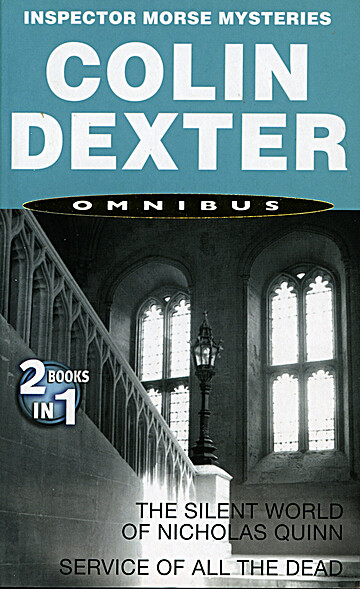
This week’s letter is D in Kerrie’s Crime Fiction Alphabet series and I’ve chosen to feature Colin Dexter’s The Silent World of Nicholas Quinn, the third Inspector Morse book  first published in 1977.

For years I’ve been watching and enjoying Inspector Morse on TV. We used to live not far from Oxford and one of the pleasures of watching the series was identifying the locations. One evening we went with a group of friends on a Morse pub tour, (organised by ourselves) visiting a few of the pubs featured in the books – one of our favourites used to be The Trout Inn at Wolvercote, before it was renovated when you could get an old fashioned Sunday Roast, with waiter service.

I don’t remember seeing an episode of The Silent World of Nicholas Quinn, so apart from visualising John Thaw and Kevin Whately as Morse and Lewis I was free to see the novel through Colin Dexter’s words. My copy is a secondhand book – an Omnibus containing Service of All the Dead as well as The Silent World of Nicholas Quinn.

Description from the back cover:

Morse had never ceased to wonder why, with the staggering advances in medical science, all pronouncements concerning times of death seemed so disconcertingly vague.

The newly appointed member of the Oxford Examinations Syndicate was deaf, provincial and gifted. Now he is dead . . .

And his murder, in his north Oxford home, proves to be the start of a formidably labyrinthine case for Chief Inspector Morse, as he tries to track down the killer through the insular and bitchy world of the Oxford Colleges . . .

My View

I thoroughly enjoyed reading this book. As the blurb on the back cover indicated the time of Quinn’s death is of prime importance, but then so is the place of his death. His deafness, as I expected is also crucial. Morse and Lewis come across as well defined characters, and so do all the other characters – Quinn’s colleagues and neighbours. The setting, as I expected, is excellent, but then I am familiar with Oxford.

For a long time when reading I had little idea who the culprit was. It has a most complicated plot that kept me guessing right to the end. It’s one of those books that I want to start again as soon as I finished it to see  just which clues I’d missed. Morse, himself, was baffled too but eventually worked it out successfully, whilst Lewis struggled to catch up with his train of thought, as this extract shows:

(Morse speaking first) ‘Remember this, then: Quinn couldn’t hear what he didn’t see.’

Am I supposed to see why all that is important, sir?’

‘Oh, yes. And you will do, Lewis, if only you think back to the Friday when Quinn was murdered.’

‘He was definitely murdered on the Friday, then?’

‘I think if you pushed me I could tell you to within sixty seconds!’  He looked very smug about the whole thing and Lewis felt torn between the wish to satisfy his own curiosity and a reluctance to gratify the chief’s inflated ego even further. Yet he thought he caught  a glimpse of the truth at last … Yes, of course. Noakes had said … He nodded several times, and his curiosity won.

‘What about all the business at the cinema, though? Was that all a red herring?’ (pages 243-4)

Reading the book I realised that Colin Dexter not only knows Oxford very well (which wasn’t news to me!) but also was very familiar with the workings of  an Examination Board and understood the difficulties of lip-reading. The reason for this is that after being a teacher, because of his deafness he became the Senior Assistant Secretary at the University of Oxford Delegacy of Local Examinations (UODLE) in Oxford, just like Quinn.