Crime Fiction Alphabet 2011: The List

Kerrie’s Crime Fiction Alphabet came to the end last week, which left me wondering what were its highlights for me. Before I began I decided that I would use it to read books from my to-be-read list and in the main that is what I did.

The rules of the meme are that you have to write a blog post about crime fiction related to the letter of the week and your post MUST be related to either the first letter of a book’s title, the first letter of an author’s first name, or the first letter of the author’s surname.

I thought that I would try to stick to the authors’ names (either first or last) rather than the title and in the main that is what I did, with 21 of the letters.The letters A, P, R and S relate both to the authors’ names and to the titles.

Some were books by old favourites, such as Agatha Christie and some by new-to-me authors, such as Anne Zouroudi.

The ones I enjoyed the most (in A – Z order) are:

  • Agatha Christie’s Autobiography reading it was like listening to Agatha Christie talk to me.
  • Colin Dexter – The Silent World of Nicholas QuinnI wanted to start it again as soon as I’d finished it.
  • P D James – The Private Patient – a thoughtful book, with precise descriptions of people and places and yet it is tense and dramatic.
  • Donna Leon – Drawing Conclusions – a book I didn’t want to end!
  • Dan Waddell – The Blood Detective – even though there are parts (not many) that were just a bit too graphic for me.

Here is the complete list:

My thanks go to Kerrie as I have thoroughly enjoyed reading through the Crime Fiction Alphabet and also reading what my fellow bloggers have read too – some of whom wrote about specific topics instead of sticking to the rules :) – I think they are most ingenious! Kerrie has listed a summary of the A- G posts, with the rest of the alphabet coming soon.

Crime Fiction Alphabet: Z is for Zouroudi

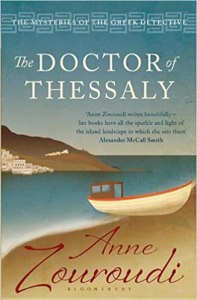
For the last letter of Kerrie’s Crime Fiction Alphabet I’ve chosen The Doctor of Thessaly by Anne Zouroudi. It’s a good book to end this round of the Alphabet, by an author whose books I’ve seen on the bookshelves but have never read before.  I enjoyed it.

Anne Zouroudi was born in England, has lived for some years on the Greek islands and now lives in the Derbyshire Peak District. The Doctor of Thessaly is the third in the series of her Mysteries of the Greek Detective, about Hermes Diaktoros, a mysterious fat man. I was never sure who he worked for, or how he knew of the mystery to solve. Each of the books in the series features one of the Seven Deadly Sins – in this one it is envy, a tale of revenge and retribution.

Set in the little Greek village of Morfi, it begins with Chrissa, a jilted bride weeping on the beach, and then moves on quickly to the discovery of the local doctor, the victim of an attack that has left him horribly scarred and blind. He is the absent bridegroom. Meanwhile Hermes has arrived in the village, waiting to be served at the kafenion:

Adonis, riding by, stared at the man – a big man, perhaps even fat, whose curly, greying hair was a little too long, and whose glasses gave him an air of academia. Beneath a beige trench-coat, he wore a suit without a tie; beside him lay a holdall of green leather. In Eva’s comfortable chair he seemed relaxed, drawing on a freshly lit cigarette, one foot crossed over the other; and it was the stranger’s feet that drew Adonis’s eyes. The fat man was wearing tennis shoes – old fashioned, canvas shoes, pristinely white. (page 9)

Hermes involves himself with the mystery of who attacked the doctor, made more puzzling because the doctor doesn’t want his attacker to be found. At the same time the village is expecting a visit from a government minister, an event that not all the locals want to be successful, and the family of the garage owner is going through some traumatic experiences. Hermes helps out in some unorthodox ways.

Just who is Hermes Diaktoros, I wondered as I read this book? My knowledge of Greek mythology is very rusty, but the clue is in his name, I think – Hermes, the messenger of the gods. He wore shoes with wings, and this Hermes is indeed fleet of foot in his pristine tennis shoes.

There are many things I like about this book, not just the mystery and the references to mythology, but also the characters and the setting which evoke the scenes of a little Greek village so well and the close-knit almost claustrophobic relationship of its inhabitants. And there is a map of the area and a list of characters.

I really must read the other books in the series:

  • The Messenger of Athens
  • The Taint of Midas
  • The Lady of Sorrows
  • The Whispers of Nemesis

Thanks to Kerrie for organising the Crime Fiction Alphabet.

Crime Fiction Alphabet: Letter Y

My choice for Kerrie’s Crime Fiction Alphabet this week is Margaret Yorke’s Intimate Kill.

Margaret Yorke has written numerous crime fiction novels and is a past chairman of the Crime Writers’ Association (CWA). In 1999 she was awarded the CWA’s Cartier Diamond Dagger Award for her outstanding contribution to the genre.

Intimate Kill was first published in 1985 and I think it’s an excellent example of her work  Margaret Yorke writes in a fluent style, one that draws you into the story effortlessly. Stephen Dawes has been released from prison after serving 10 years of a life sentence for murdering his wife, Marcia. Her body had never been found. Stephen knew he was innocent and believed that she had killed herself, making him out to be the murderer, devastated when he had asked for a divorce. He is determined to find out how she did it.


Intimate KillThe book is divided into three parts. Part One deals with Stephen’s search for the truth about Marcia’s death and for his daughter. Stephen’s marriage had not been a happy one and he’d been having an affair with Ruth Watson which resulted in the birth of his daughter, Susannah. Part Two moves back in time eleven years, dealing with the events that led up to Marcia’s disappearance and subsequent events. In Part Three Stephen discovers the truth and nearly loses his own life.

It’s not difficult to work out what actually happened but that doesn’t detract from the pleasure of reading this book. Margaret Yorke is so skilled in characterisation that she has captured the emotions and feelings, as well as the weaknesses and ambitions of all the characters. I believed in all of them. The plot moves swiftly and with a real sense of evil as the tension mounts.

Crime Fiction Alphabet: X

Kerrie’s Crime Fiction Alphabet has now reached, for me at least, the most difficult letter of the alphabet. Last year I wrote about Qiu Xiaolong’s  A Loyal Character Dancer and I had intended to read another of his books for the letter X – Death of a Red Heroine. But time and inclination overtook me and I haven’t read it yet.

So, I was going to pass on this letter until I came across X, Y, Z: a Story Told by a Detective (1883) by Anna Katherine Green, a short mystery free on Kindle. It’s only 97 pages and didn’t take long to read.

I hadn’t heard of Anna Katherine Green (1846 – 1935), but according to Wikipedia she was an American poet and novelist and was one of the first American authors to write detective fiction. She published about 40 novels and her first book, The Leavenworth Case was a bestseller, praised by Wilkie Collins. Looking at Amazon, I think most of her books are available free as e-books.

The narrator, an un-named detective has been assigned to investigate a gang of counterfeiters and being told of a number of suspicious-looking letters addressed to X, Y, Z, Brandon, Mass., discovers a completely different crime. (We’re told at the end that the counterfeiters were discovered but not by the narrator.) After waiting to see who collects these letters the detective follows the trail to the house of the wealthy and secretive Benson family where a fancy dress ball is to take place that evening. When  Mr Benson is found dead it is up to the detective to unmask the guilty person.

It wasn’t difficult to work out who the culprit was. Its greatest attraction for me is that it is an example of crime fiction written before the ‘Golden Age’, a forerunner of detective fiction. It’s written in a somewhat formal and stilted style, and is melodramatic as this extract describing Mr Benson’s death shows:

Mr Benson at once turned the key, but no sooner had he done so than he staggered back. For an instant or two of horror he stood oscillatiing from side to side, then his frame succombed, and the terrified eyes of his children beheld his white head lying low, all movement and appearance of life gone from the form that but a moment before towered so proudly above them.

With a shriek, the daughter threw herself down at his side, and even the cheek of Hartley Benson grew white as he leaned over his father’s already inanimate body.

“He is dead!” came a wild cry from her lips. “See! he does not breathe. Oh! Hartley, what could have happened? Do you think that Joe -”

“Hush!” he exclaimed, with a furtive glance around him.

But it moves swiftly along, with clearly defined characters and a well-described setting and it interested me enough to want to investigate more of Green’s novels.

Crime Fiction Alphabet: W is for Dan Waddell

I’m not sure whether  The Blood Detective by Dan Waddell is historical crime fiction or genealogical crime fiction. One thing is certain it is crime fiction and one that I was thoroughly immersed in. If I gave books stars on this blog I would have given it 5 stars, if only the ending wasn’t so graphic. It’s the sort of scene that if I was watching it on TV it would have had me peeping through my fingers or even covering my eyes completely until it was over. There are bits of graphic violence earlier in the book, which I could just about cope with, but the grisly stuff at the end was a step too far for me.

That said it’s a fascinating fast-paced book linking the crimes of the past – the events of 1879 – to a series of murders in the present. DCI Grant Foster enlists the help of genealogist Nigel Barnes to track down the killer who has left cryptic clues carved into his victims’ bodies.

I used to work with archives, much of it helping people track down their family histories and so was very familiar with the sources Nigel uses to discover the original killer. I loved the way Waddell wove this into his story. Nigel Barnes is a convincing character and manages to solve both the modern day murders and the historical ones too, not only through family history but also through working out the topography of London through the years.  I loved that part of the book.

Dan Waddell as well as writing crime novels is the author of Who Do You think You Are?, the accompanying book of the TV series – one of my favourites, so it’s no surprise that The Blood Detective is so good on genealogy. He has his own website and also writes regularly on the Murder is Everywhere blog. His next book featuring Nigel Barnes is Blood Atonement and despite my phobia about graphic violence I’m planning to read that one too.

The Blood Detective

  • Paperback: 416 pages
  • Publisher: Penguin (7 Aug 2008)
  • Language English
  • ISBN-10: 9780141025650
  • ISBN-13: 978-0141025650
  • ASIN: 0141025654
  • Source: library book

The Crime Fiction Alphabet is hosted by Kerrie at Mysteries in Paradise. All you have to do is write a post relating to the letter of the week – either the first letter of the book title or of the author’s first or second name.

Crime Fiction Alphabet: V is for Val McDermid

Until now I’ve steered clear of reading any of Val McDermid‘s books and the reason is that I can’t stand to watch the violence and torture scenes in TV series such as Wire in the Blood. But recently I’ve been thinking that maybe I wasn’t being fair to judge a writer’s work on films based on the books. So I decided to check out a Val Mcdermid book from the library to see for myself.

There are many to choose from but I picked the shortest one, thinking if I didn’t like it I wouldn’t waste much time reading it.

Cleanskin is one of the Quick Reads series, aimed at “adults who’ve stopped reading or find reading tough, and for regular readers who want a short, fast read.” 

Summary (adapted from the back cover where Jack Farrell is erroneously called Jack Farlowe!):

When career criminal, Jack Farrell’s body is found washed-up on a Suffolk shore, it looks to the police like a clear-cut case. Broken-hearted at his daughter’s death, he has drowned himself – good riddance and one less crime to solve, according to CID. Then again, maybe not. For, one by one, Farrell’s enemies are being killed. And the horrific manner of their deaths makes drowning look like a day at the beach!

My thoughts:

Val McDermid’s style in this long short story is clear, straight-forward and chatty. The narrator is DCI Andy Martin. He’s the world expert on Jack Farrell, a criminal known as a ‘cleanskin‘ because he had no criminal record:

Farrell’s crew ran just about every dirty racket you could think of: drugs, guns, hookers, porn. You name it they were into it. They bought and sold human lives like they were bargains on eBay. (page 2)

Martin identifies Farrell’s body from the vivid tattoos still visible on his battered and bloated body. Being a novella the action is fast paced, the characters are briefly sketched and although I had worked out some of the mystery, the final dénouement came as a surprise. And there is a certain amount of  graphic description of the gruesome methods of killing and torture, so I’m still not sure about reading any of Val McDermid’s other books.

Can anyone recommend where I should start – bearing in mind that I am squeamish?

Cleanskin:

  • Paperback: 128 pages
  • Publisher: HarperCollins; World Book Day edition edition (18 May 2006)
  • Language English
  • ISBN-10: 0007216726
  • ISBN-13: 978-0007216727
  • Source: Borrowed from the library

A Crime Fiction Alphabet post – for more posts featuring the letter V see Kerrie’s blog.