Crime Fiction Alphabet: K is for The Crimson Rooms by Katharine McMahon

Kerrie at Mysteries in Paradise hosts the Crime Fiction Alphabet each week. It has now reached the letter K and my choice is Katharine McMahon’s book The Crimson Rooms.

I bought The Crimson Rooms a couple of years ago because I’d enjoyed reading Katharine McMahon’s The Rose of Sebastopol, which I read in 2008. It’s been sitting with the other to-be-reads on my bookshelves since then and I hadn’t realised that this is not only historical fiction, but also historical crime fiction.
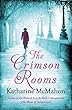
It’s set in London in 1924, with Britain still coming to terms with the aftermath of the First World War. Evelyn Gifford, one of the few pioneer female lawyers, lives at home with her mother, aunt and grandmother, still mourning the death of her brother James in the trenches. Evelyn is woken in the early hours one morning to find Meredith and her child, Edmund, aged 6 on the doorstep, claiming that Edmund is James’s son. Evelyn and the other women are thrown into confusion as Meredith upsets their memories of James.

Meanwhile Evelyn carries on with her work, taking on the case of Leah Marchant, who wants to get back her children who had been taken into care. She was accused of trying to kidnap her own baby. It’s early days for women to be accepted as lawyers and Evelyn struggles to defend Leah who distrusts her and wants Daniel Breen, Evelyn’s boss to defend her.

She is also involved in defending Stephen Wheeler, an old schoolfriend of Daniel’s. Stephen is accused of murdering Stella, his young wife of a fortnight. It’s obvious to Evelyn and Daniel that Stephen is innocent, but at first he refuses to talk and defend himself. After a humiliating experience in court, barrister Nicholas Thorne offers to help Evelyn much to her dislike. But she finds herself drawn to him and wonders how much she can trust him.

I was thoroughly engrossed in this book. It was not just the court cases, I was fascinated by the account of early women lawyers, represented by Evelyn, the central character. It clearly shows the prejudice these women had to overcome just to qualify as lawyers, never mind the difficulties of persuading law firms to employ them and clients to accept them. Katherine McMahon has included a Chronology of Women in Law from 1875 to 1950 at the back of the book and an analysis of why it took so long for women to be accepted. Evelyn is based on Carrie Morrison, who was the first British woman to be become a solicitor.

It’s not just about crime and the court cases, it’s also a novel about the way people’s lives were affected by the War, how men were unable to resume their old lives, some damaged by shell-shock and the horrors they had taken part in, or witnessed during the war. Women, too, had their lives completely changed, so many had their marriage prospects destroyed, and were replaced by work, becoming career women.

Katherine McMahon has done extensive research of the period but it all sits easily within the narrative. It’s beautifully written, full of imagery that creates a vivid picture of the setting and the characters. For example, she describes the moon:

… an extraordinary crescent moon which had, in the last few minutes, risen above the river, with the old moon burdening its lap like a fat round cushion.

and I like this description of one of the characters as she walked from the garden towards the house,

… the trailing hem of her robe a pool of ivory, her hair a swathe of black silk. (page 207)

Katharine McMahon’s other books are:

  • The Alchemist’s Daughter
  • A Way through the Woods
  • Footsteps
  • Confinement
  • After Mary
  • The Season of Light

More details are on her website.

Crime Fiction Alphabet: J is for …

ithe letter Js for … Peter James

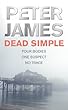
Peter James is an author I’ve been aware of for a while and although I’ve owned a couple of his books until recently I hadn’t read them. Now I’ve read Dead Simple I realise I should have read it years ago – I didn’t know what I was missing. It’s really good.

Peter James is currently the Chair of the Crime Writers’ Association. As well as being a crime fiction writer he is also a film producer and script writer. He has sold more than a million books internationally and has been translated into 35 languages. His most recent books, set in Brighton, feature Detective Superintendent Roy Grace – there are 8 in the series, the first being Dead Simple.There is full list of all his books with summaries on his website.

Dead Simple is anything but simple. There are plenty of twists and turns in this story of a race against time to find Michael Harrison who disappeared after what was supposed to be a harmless stag night prank three days before his wedding. Michael’s fiancée, Ashley and his mother are frantic with worry, but surely Mark, his best man and business partner must have some idea where he is, even though he missed the stag night himself.

Detective Superintendent Roy Grace is in charge of the investigation, which has added impetus for him as his wife disappeared eight years earlier and has never been found. When all the usual sources had failed to find her he had turned to psychics and mediums for help and he eventually resorts to consulting them again in this case.

It’s told from a number of viewpoints which gives a rounded view of the events and yet the full picture is never quite in view. There are hints that led me to suspect the outcome, but not completely. Some of it does seem rather far-fetched but it’s totally gripping, building to a tremendous climax.

I shall certainly be seeking out the other 7 books in his Grace series, and his earlier books too, which according to the author information in Dead Simple, all reflect his ‘deep interest in medicine, science and the paranormal.’

For more blog posts featuring the letter J in The Crime Fiction Alphabet go to Mysteries in Paradise.

Crime Fiction Alphabet: I is for Innes

Michael Innes is the pseudonym of John Innes Mackintosh Stewart (1906 – 1994), a British scholar and novelist, and is my choice to illustrate the letter I in Kerrie’s Crime Fiction Alphabet.

He was born near Edinburgh, the son of a Scottish professor, and attended Edinburgh Academy, then Oriel College, Oxford where he won the Matthew Arnold Memorial Prize in 1939 and honours in English. He was a Lecturer, then a Professor in English at different universities, finishing his academic career in 1973 as a Student (Fellow) at Christ Church Oxford.

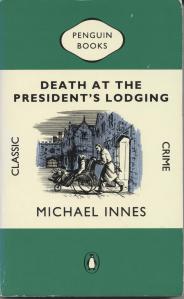
He published many novels, and short stories as well as books of criticism and essays under his own name, including biographical works on Rudyard Kipling and Thomas Hardy. Writing as Michael Innes he wrote many crime novels, the first being Death at the President’s Lodging, written in 1934 during his sea voyage to Australia. It was the first of his 29 books about his Scotland Yard detective, John Appleby, published in the UK in 1936, and in the USA in 1937 as Seven Suspects, to avoid readers thinking it dealt with the US President.

In an essay written in 1964 Innes described his writing methods – during the academic year he wrote for two hours before breakfast. He thought that reading detective stories was addictive (I have to agree with that!) and that he managed to escape the compulsion to read them by writing his own mysteries (maybe I should try that). He thought in depth characterisation wasn’t right in detective stories and he avoided having real problems or feelings intrude on his characters. He regarded crime fiction solely as escapist literature.

Death at the President's Lodging 001I’m currently reading Death at the President’s Lodging – a used Penguin Books edition published in 1958, one of the green and white crime fiction books.

It’s set in a fictional English college, St Anthony’s (much like an Oxford college) where the President of the college has been murdered, his head swathed in a black academic gown, a human skull beside his body and surrounding it, little piles of human bones.

As I would expect from a professor of English, Innes’s writing is intellectual, detailed, formal and scattered with frequent literary allusions and quotations.  The plot is complex and in the nature of a puzzle. There are plenty of characters, the suspects being the dons of the college. As well as Appleby there are the local police, headed up by Inspector Dodd, who acts as a foil to Appleby’s intellectual approach to the murder. I’ll write more about the book when I’ve finished it.

For a list of Michael Innes’s work see Wikipedia.

Crime Fiction Alphabet: H is for The Hanging in the Hotel

The Crime Fiction Alphabet has reached the letter H this week and I’ve chosen Simon Brett’s The Hanging in the Hotel. I listened to the audiobook read by Simon Brett. This is the fifth book in his Fethering Mysteries series.

Synopsis from Fantastic Fiction:

A young solicitor is found hanged from his four-poster bed in a country house hotel following an all-male society dinner the night before. Jude doesn’t believe it was suicide, and with her friend Carole’s help, it would appear that The Pillars of Sussex are involved in a grand collusion. 

Jude and Carole are neighbours and they often find themselves involved in solving murders! They’re an interesting pair, Carole a retired civil servant, cautious and analytical, Jude, impulsive, an alternative healer and very inquisitive (nosey). Jude perseveres in believing the young solicitor’s death was murder, despite the police insistence that it was suicide. Her belief is reinforced when her friend Suzy Longthorne, the hotel’s owner, wants to keep things hushed up and accepts it was suicide. There are too many inconsistencies for Jude to accept that idea. The Pillars of Society are an obnoxious bunch, misogynists, who drink too much and are very fond of themselves, and they are the prime suspects.

Jude and Carole go over and over the events, discussing the whys and wherefores, talking to everyone concerned, who all seem to have impeccable alibis, and following up lots of red herrings.There was just too much speculation and introspection which slowed down the action.  The murderer could have been anyone and by the end I didn’t much care who it was.

I didn’t like this book as much as the others that I’ve read, namely The Body on the Beach, the first in the Fethering series, The Stabbing in the Stables and Murder in the Museum. It may be because I was listening, rather than reading, so I shall still read more of the Fethering books.

Crime Fiction Alphabet: G is for Sue Grafton

This week’s letter in Kerrie’s Crime Fiction Alphabet is the Letter G.

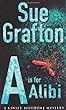
Sue Grafton is the author of the alphabet- titled series of books featuring Kinsey Millhone, a private investigator. So far there are 22 books in the series covering the letters A – V. For the full list see Sue Grafton’s website.

The books are set in and around the fictional town of Santa Teresa, California, based on Santa Barbara, where Grafton has a home in the suburb of Montecito. She was born in 1940, the daughter of detective novelist C. W. Grafton. She began writing at the age of 18 and before writing the Kinsey Millhone novels she was a TV scriptwriter. I think it’s remarkable that her novels have been published in 28 countries and in 26 languages, including Bulgarian and Indonesian, but she has no wish to sell the film and television rights to her books. Based on the one book of hers that I’ve read, A is for Alibi, I think they would make an excellent TV series, but maybe it’s a good decision. TV adaptations have a most irritating tendency of changing plots and the characters rarely match up to my mental images! 

A is for Alibi was first published in 1982.

Synopsis from Grafton’s website:

When Laurence Fife was murdered, few mourned his passing. A prominent divorce attorney with a reputation for single-minded ruthlessness on behalf of his clients, Fife was also rumored to be a dedicated philanderer. Plenty of people in the picturesque Southern California town of Santa Teresa had a reason to want him dead. Including, thought the cops, his young and beautiful wife, Nikki. With motive, access, and opportunity, Nikki was their number one suspect. The jury thought so too.

Eight years later and out on parole, Nikki Fife hires Kinsey Millhone to find out who really killed her late husband.

A trail that is eight years cold. A trail that reaches out to enfold a bitter, wealthy, and foul-mouthed old woman and a young boy, born deaf, whose memory cannot be trusted. A trail that leads to a lawyer defensively loyal to a dead partner’”and disarmingly attractive to Millhone; to an ex-wife, brave, lucid, lovely’”and still angry over Fife’s betrayal of her; to a not-so-young secretary with too high a salary for too few skills’”and too many debts left owing: The trail twists to include every turn until it finally twists back on itself with a killer cunning enough to get away with murder.

My view:

I thought this was a well constructed and convincing murder mystery. Kinsey is a likeable, strong character. In this first book she comes across as a loner. She’s 32, twice divorced with no children or pets, or indeed any ties, although she does have plenty of friends and contacts who help out with her investigations and she goes jogging – a lot. There are  some cameos of characters, who I suspect feature in the later books. There is her landlord Henry Pitts, a former baker aged 81 who makes a living devising crossword puzzles. Kinsey is ‘halfway in love’ with Henry.

It’s a fast-paced book, easy to read and with no gory details, which I have to skim read in other books (the equivalent of watching the TV  behind my fingers). I liked it and now will have to find the other books in the series.

Crime Fiction Alphabet: F is for Fatherland

This week it’s the letter F in Kerrie’s Crime Fiction Alphabet. I’ve chosen Fatherland by Robert Harris.

It’s a fast-paced thriller set in Germany in 1964, but not the historical Germany of that date, because Hitler is approaching his 75th birthday, and Germany had won the Second World War ‘“ it’s historical fiction that never was ‘“ an alternative history. And yet many of the characters actually existed, their biographies are correct up to 1942 and Harris quotes from authentic documents in the book. The Berlin of the book is the Berlin that Albert Speer planned to build.

What is definite is that this is a murder mystery, beginning with the discovery of the naked body of an old man, lying half in the Havel, a lake on the outskirts of Berlin. The homicide investigator is Xavier March of the Kriminalpolizei (the Kripo) and the victim is Josef Buhler, one of the former leading members of the Nazi Party who had been instrumental in devising ‘˜the final solution’. As March digs deeper, despite being taken off the case by the Gestapo, he discovers  a larger conspiracy as more of the former leading Nazis are murdered.

March is in some ways a typical cop, disillusioned, sceptical and suspicious of authority. He’s also divorced and losing the respect of his son, with disastrous effects. He isn’t the only one investigating the deaths. Charlie Maguire, a female American journalist has her own reasons for wanting to uncover the murderer and together they travel to Zurich to inspect the private Swiss bank account of one of the victims.

It’s a complex book and leads March into a very dangerous situation as he discovers the truth. It’s a real page-turner, full of suspense and consequently I read it very quickly, eager to know what happened next and what lay behind the murders. The ending is suitably ambiguous – it’s not the sort of book where all the loose ends are neatly tied up. Neither is the alternative history element dominant, although I did find all the little details fascinating. For example Churchill and the Royal Family have gone to Canada and Joseph Kennedy is the US president. It is predominantly crime fiction, that makes you think about the nature of good and evil and about the ways in which society handles corruption.