Classics Club May Meme

The Classics Club

I recently joined the The Classics Club. Each month there is a meme – a question to answer and this is my first one.

Tell us about the classic book(s) you’re reading this month. You can post about what you’re looking forward to reading in May, or post thoughts-in-progress on your current read(s).
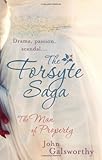
I’ve just started to read A Man of Property the first book in the Forsyte Saga by John Galsworthy, a book I’ve been meaning to read for some years. My copy contains this first novel plus Indian Summer of a Forsyte. It begins in June 1886 with an ‘at home’ at the house of old Jolyon Forsyte to celebrate the engagement of Miss June Forsyte, old Jolyon’s granddaughter, to Mr Philip Bosinney, an architect. The rest of the family all attend and are introduced to the reader, explaining their relationships. There is a family tree at the beginning of the book that helps me to understand who they all are.

I watched the first TV dramatisation of The Forsyte Saga way back in 1967 and the later production in 2002, so I know the story – or at least I remember the gist of it and can visualise Damien Lewis as Soames Forsyte and Gina McKee as Irene (I even remember Nyree Dawn Porter as Irene!)

I think the sequence of books in the Saga is a little confusing, so I’ve listed the books to clarify the sequence for myself:

The first trilogy, comprising:

  1. A Man of Property published in 1906 followed by Indian Summer of a Forsyte: a short interlude, published in 1918 (I have this book, which is the version shown above).
  2. In Chancery published in 1920 and another short interlude: Awakening (1920) – I don’t have this.
  3. To Let published in 1921 – I don’t have this.
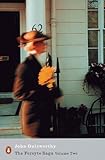
A Modern Comedy, written between 1924 and 1928. I have these books in one volume,  called The Forsyte Saga Volume Two comprising:

  1. The White Monkey (1924)
  2. The Sliver Spoon (1926)
  3. Swan Song (1928)

But there are also Two Forsyte Interludes: A Silent Wooing / Passers By (1928)
On Forsyte Change (1930), which I don’t own.

And a further trilogy called End of the Chapter (I don’t own this), comprising:

  1. Maid in Waiting (1932)
  2. Flowering Wilderness (1933)
  3. Over the River (1933)

I think I’ve got that sorted out now!
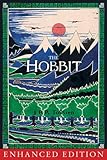
The Hobbit by J R R Tolkien

Many years ago I read Tolkien’s The Lord of the Rings and loved the story, so much so that over the years I’ve re-read the books several times. Somehow I’ve ignored The Hobbit, or There and Back Again, maybe thinking that because it’s a children’s book it was too late for me to appreciate it. So even though I’ve had a copy for years it’s only now that I’ve got round to reading it, spurred on by seeing the film this year. (I read the enhanced version on Kindle.) How wrong I was not to have read it before – The Hobbit is a book that all ages can enjoy.

It’s an adventure story of a quest set in a fantasy world, so beautifully written that it seems completely believable. Bilbo Baggins, a hobbit, is recruited through Gandalf, the wizard, to accompany a party of thirteen dwarves, led by Thorin, on their quest to recover the dwarves’ treasure stolen by Smaug the dragon and regain possession of the Lonely Mountain. Along the way Bilbo grows in confidence and becomes a hero, meeting elves, outwitting trolls, fighting goblins, and above all gaining possession of the ring from Gollum.

The enhanced version has a foreword by Christopher Tolkien, complete with illustrations including manuscript pages and unused drawings, in which he describes how and why his father came to write The Hobbit: he would stand in front of the fire in his study and tell stories to Christopher (then aged between four and five years old) and his brothers. One story, this story, he said, was a long story about a small being with furry feet, which he thought he would call a “Hobbit”. This was in about 1929. The book was eventually published in 1937, written whilst Tolkien was engrossed in writing the myths and legends told in The Silmarillion. He hadn’t intended The Hobbit to be connected to the mythology, but his tale gradually became larger and more heroic as he wrote it.

The Hobbit sold very quickly and people asked for a sequel. At first Tolkien thought that writing more details about Gandalf and the Necromancer (Sauron) would be too dark and that many parents “may be afraid that certain parts of it would be terrifying for bedtime reading.” He also wrote:

Mr Baggins began as a comic tale among conventional and inconsistent Grimm’s fairy-tale dwarves, and got drawn into the edge of it – so that even Sauron the terrible peeped over the edge. And what more can hobbits do? They can be comic, but their comedy is suburban unless it is set against things more elemental. (location 339)

Three days after writing those words he wrote:

I have written the first chapter of a new story about Hobbits – “A long expected party.”

That was the first chapter of The Lord of the Rings. (location 339)

It also includes recently discovered audio recordings of J.R.R. Tolkien reading excerpts from The Hobbit, including the dwarves’ party song, the account of their capture by the three trolls, and Bilbo Baggins’s creepy encounter with Gollum.

The Hobbit is an excellent first book for Carl’s Once Upon a Time VII.

Pride and Prejudice 200th Anniversary

Title page from the first edition of the first volume of Pride and Prejudice 1813

Today is the 200th anniversary of the publication of Jane Austen’s Pride and Prejudice and to mark the occasion the Jane Austen Centre in Bath is hosting a 12 hour readathon (click this link to go to the readathon site) of the book. It’s taking place at the Centre in Gay Street and will be filmed and broadcast around the world live on the internet.

From 11am this morning Pride and Prejudice will be read in short 10 minute segments by up to 140 celebrities, authors, politicians, musicians, Olympians, school children, competition winners and personalities.

My Day in Books 2012: a meme

Today I was going to write a post about one of the books I’ve read recently but then I saw that Cornflower had posted this meme: ‘œMy Day in Books’. I did this last year and fancied doing it again with this year’s books. The task is to complete the sentences using the titles of books you have read this year.  Here’s what I came up with:

I began the day by The Secret River

before breakfasting on Red Bones (that’s all there was!)

and admiring The Victorian Chaise-Longue.

On my way to work I saw The Woman in White, 

and walked by The House of Silk

to avoid Our Mutual Friend

but I made sure to stop at The Village.

In the office, my boss said, Death Comes to Pemberley

and sent me to research The Murder on the Links.

At lunch with My Cousin Rachel

I noticed A Man Lay Dead, 

in A Room Full of Bones, 

greatly enjoying  A Quiet Life!!

Then on the journey home, I contemplated Endless Night

because I have A Weekend with Mr Darcy

and am drawn to Dancing Backwards.

Settling down for the evening in A Place of Greater Safety

I studied Dark Matter

by Blue Lightning

before saying goodnight to (the) Bad Boy.

I’ve written posts about most of them. Here are the links If anyone wants to to read what I thought about the books:

November Prompt: A Classics Challenge

This year I’ve been taking part in A Classics Challenge hosted by Katherine of November’s Autumn. The goal is to read at least seven classics in 2012 and every month Katherine is posting a prompt to help us discuss the books we are reading.

There are several questions for this month’s prompt:

Of all the Classics you’ve read this year is there an author or movement that has become your new favorite? Which book did you enjoy the most? Or were baffled by? Who’s the best character? The most exasperating? From reading other participants’ posts which book do you plan to read and are most intrigued by?

Before I started this challenge I’d have said my favourite author is Jane Austen. She’s still a favourite, but I must add Charles Dickens as a favourite too. It follows that the books I enjoyed the most are by those authors – in particular Pride and Prejudice and A Tale of Two Cities.

I haven’t been baffled by any of the books.

I think one of the ‘best’ characters in the classics I’ve read is Marian Halcombe from The Woman in White. She’s feisty, loyal, passionate, clever, resourceful and assertive.

The most exasperating are also from The Woman in White. They are Laura and Frederick Fairlie  because both are quite irritating – Laura because she is so insipid and her father because he is such a selfish hypochondriac.

After reading Jane’s post about Barchester Towers I decided it was time I read Anthony Trollope’s Barchester Chronicles and have begun with reading The Warden. The novels and their characters are all new to me as I’ve never watched any of the TV dramatisations.