Classics Club Spin: Result

1056472It is No. 10 on my list, which is Washington Square by Henry James. I’m pleased with this – it’s not too long so I should be able to fit it in. Currently I’m reading three books, which I hope to finish by the end of November and then I’ll start Washington Square.

The only other book I’ve read by Henry James is The Turn of the Screw, which I enjoyed and thought was a dark and melodramatic tale, about good and evil. I think Washington Square will be a bit lighter.

Books Read in October

October was a good reading month for me. I read 11 books, which were a mixed bag of different genres, but all fiction this month, with two books from my to-be-read shelves. I’ve already written about some of the books (the links are to my posts):

1.The Shining by Stephen King (Kindle)

2.Ten Little Niggers by Agatha Christie

3. Over My Dead Body by Hazel McHaffie

4. The Year of Miracle and Grief by Leonid Borodin

5. The Idea of Perfection by Kate Grenville (library book)

6. A Murder is Announced by Agatha Christie (a book from my to-be-read shelves)

When I started this blog I wanted to write something about each book I read. I’ve never managed to do that and now I’ve decided that there are some books I don’t want to write about at all and for some I just want to write a few words. That’s not because I didn’t enjoy the books but simply because sometimes I just want to read and then go on to another book.

These are the books without posts (with links to Amazon UK):

6.Once Upon a Castle by Alan S Blood (Kindle, LibraryThing Early Reviewers) – a story about children evacuated to Northumberland during World War II, this had so much potential and it just wasn’t achieved. It is basically a series of short stories and I thought there were too many episodes packed into it. It needs more detail and development to be convincing. It’s unevenly paced, as though the author didn’t know how to finish it and rushed the ending. The supernatural elements come across as confusing rather than mysterious or spooky.

5. The Shooting Party by Isabel Colegate – I liked this novel, which chronicles the events of one day at a shooting party on an Oxfordshire country estate. There is a great sense of foreboding right from the start with the statement: ‘It was an error of judgment which resulted in a death. It took place in the autumn before the outbreak of what used to be known as the Great War.’ Although I could see how this was foreshadowing the slaughter of the First World War, for me it was the knowledge that a death was going to take place, right from the opening paragraphs, that was uppermost. I kept wondering who was going to die, what was the error of judgment, who was going to do the killing. I was surprised.

I did think it was rather too slow, too drawn out in parts but that maybe because I’m used to much faster paced books. I also had to keep reminding myself of the characters – their relationships to each other and at times I got confused and had to back track.

But its main attraction for me was the focus on a society that was soon to be destroyed by the devastation wrought by the First World War. Isabel Colegate writes beautifully depicting the class structure of the times, the rich aristocrats and their servants, ‘the stranglehold of the rich on the life-blood of the working man‘, ideas about manliness, the realization that civilisation as they knew it was coming to an end, contrasting it to a vision of England that had not existed even then for many years:

Doesn’t England mean a village green, and smoke rising from cottage chimneys, and the rooks cawing in the elms, and the squire and the vicar and the schoolmaster and the jolly villagers and their rosy-cheeked children? (page 100)

7. The Great Gatsby by F Scott Fitzgerald (a re-read). I really like this book – a portrait of the Jazz Age in all of its decadence and excess.

8. Dying Fall by Elly Griffiths (library book) – This is the fifth of her Ruth Galloway books. Ruth travels from her home in Norfolk up to the north of England €“ Lancashire, to be precise Blackpool, Lytham, Pendle, Preston and Fleetwood €“ because Dan Golding a friend from university has died in a house fire. He had written to her just before his death with news of an amazing find. It turns out that Dan was murdered and Ruth and Inspector Harry Nelson are instrumental in discovering the truth. It’s yet another book I’ve read about the whereabouts of King Arthur’s Bones €“ this time it seems he’s the Raven King. A satisfying if undemanding read.

11. Mrs Harris goes to Moscow by Paul Gallico (a book from my to-be-read shelves). This is a lovely little book. Mrs Harris is a London char lady who wins a trip to Moscow, where she wants to find her employer’s long-lost love. Mayhem ensues when she is thought to be Lady Char (the Russians not understanding what a ‘char lady’ is had converted it to ‘Lady Char’) and also a spy.

I sometimes borrow books and after reading the first few pages return them without reading any more, with no qualms. But it is very rare that I return a book unfinished after reading just over a quarter of it. That is just what I did with The Assassin’s Prayer by Ariana Franklin. I thought it was repeating much the same sort of scenarios (albeit in different locations) than her earlier books and I got fed up – so back it went.

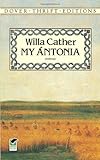
My Antonia by Willa Cather

I’d included My Antonia on my Classics Club list of books to read because I’d enjoyed reading A Lost Lady a few years ago (my post on that book is here). So when it popped up in the Classics Club Spin as the book to read in August/September I was pleased.

I liked it, but not as much as A Lost Lady. I think it’s because it’s a bit fragmented, made up of  a series of short stories. But it’s beautifully written with vivid descriptions of people and places. Published in 1918 it’s set in America at the beginning of the 20th century – the story of immigrant settlers and in particular that of Antonia Shimerda and her family as told by Jim Burden. Jim and Antonia meet as children, when he had come to live with his grandparents on their farm in Nebraska. Antonia’s family is from Bohemia, speaking very little English and living in a sort of shed, little more than a cave. They spend a lot of time together as Jim teaches Antonia to speak English.

Jim recounts various episodes as they grow up together. Gradually they drift apart and lose contact, as Jim left for college eventually becoming a lawyer, whilst Antonia stayed in Nebraska. They meet again years later. It’s a story of hardship and suffering, of poverty, people struggling to make a living from the land, and of the attitudes towards immigrants, women and children. It’s also about being an outsider and the importance of belonging, which makes it most poignant that to her father Antonia is ‘My Antonia’.

But the thing that stands out for me is the beauty of Cather’s descriptions of the countryside and as I read I highlighted many passages – this for example:

Presently we saw a curious thing: there were no clouds, the sun was going down in a limpid gold-washed sky. Just as the lower edge of the red disk rested on the high fields against the horizon, a great black figure suddenly appeared on the face of the sun. We sprang to our feet, straining our eyes toward it. In a moment we realized what it was. On some upland farm, a plough had been left standing in the field. The sun was sinking just behind it. Magnified across the distance by the horizontal light, it stood out against the sun, was exactly contained within the circle of the disk; the handles the tongue, the share black against the molten red. There it was, heroic in size, a picture writing on the sun.

Even while we whispered about it, our vision disappeared; the ball dropped and dropped until the red tip went beneath the earth. The fields below us were dark, the sky was growing pale, and that forgotten plough had sunk back to its own littleness somewhere on the prairie. (page 186)

But it’s not just descriptive, it conveys the timelessness of human nature, of how people interact and think, their prejudices, unreliability and of their love for each other. I was struck by this definition of happiness:

I was entirely happy. Perhaps we feel like that when we die and become part of something entire, whether it is sun and air, or goodness and knowledge. At any rate, that is happiness: to be dissolved into something complete and great. When it comes to one, it comes as naturally as sleep. (page 11)

Yet this is a sad book, full of nostalgia and poignancy. There’s such a contrast between the hardness of the life of the settlers and the loving gentle family life that Jim’s grandparents provide for him and their generosity towards their neighbours. Overall, though it is the character of Antonia that caught my attention and in the episodes that weren’t about her I lost interest somewhat. So, a mixed reaction – there are parts that I thought were outstanding and parts that left me rather unsatisfied.

The Classics Club August question: Forewords/Notes

The Classics Club question for August is:The Classics Club

Do you read forewords/notes that precede many classics?  Does it help you or hurt you in your enjoyment/understanding of the work?

I might scan read the foreword/introduction before reading a book, but because these often give away the plot I certainly don’t read it all, if I read any of it. It just spoils a book. I’ve noticed that in some books (not usually classics, though) that the author has added an Afterword/ Historical Note (for historical fiction) which I prefer, and sometimes I’ll glance over it whilst I’m reading the book, reading it properly when I’ve finished the book.

I usually read the introduction after I’ve finished the book, because often it enhances my reading, giving insights into its themes that I may not have thought about, or explains references I missed. It does help too to know some details of an author’s life, what influenced their writing and how they were thought of by their contemporaries. An example of this is the Introduction to Henry Fielding’s Tom Jones, which begins with an account of contemporary criticism of the novel – it was seen as a lewd book and was blamed for a couple of earthquakes in London the spring after it was published. But then it goes into too much detail about the plot and the characters, even though the editor describes it as ‘a brief summary’.

Actually the introductions are usually too long to read when I just want to get on with the book.

The Classics Club Spin – the Result

The Classics Club

The Classics Club Spin number this time is 4, and number 4 on my list of 20 titles is …

…  My Antonia by Willa Cather and I’m really pleased. I read A Lost Lady over four years ago and at that time I was very keen to read more of Willa Cather’s books. So I’m glad the Spin has given me the push to read this one. It’s not very long so I hope I’ll have read it and aim to post about it on 1 October.

The Classics Club Spin

The Classics ClubIt’s time for another Classics Spin.

I took part in the last Classics Club Spin when the book I read was Barnaby Rudge by Charles Dickens, a long book (845 pages), so for this spin I fancied reading something shorter.

Here’s my list of ‘shorter’ books – some are very short but there is one very long one of 959 pages (it’s number 12 – what do you bet that will be the number that comes out of the spin!)

  1. Lady Susan, The Watsons, Sanditon by Jane Austen
  2. Out of Africa by Karen Blixen
  3. The Thirty Nine Steps by John Buchan
  4. My Antonia by Willa Cather
  5. A Journal of the Plague Year by Daniel Defoe
  6. Moll Flanders by Daniel Defoe
  7. Lazy Tour of Two Idle Apprentices by Charles Dickens
  8. Silas Marner by George Eliot
  9. Washington Square by Henry James
  10. Three Men in a Boat by Jerome K Jerome
  11. The Call of the Wild by Jack London
  12. Gone with the Wind by Margaret Mitchell
  13. Anne of Green Gables by Lucy Maud Montgomery
  14. Black Beauty by Anna Sewell
  15. Travels with a Donkey in the Cevennes by Robert Louis Stevenson
  16. Gulliver’s Travels by Jonathan Swift
  17. Walden by Henry James Thoreau
  18. The Color Purple by Alice Walker
  19. The Time Machine by H G Wells
  20. Ethan Frome by Edith Wharton