Keeping the World Away by Margaret Forster

Keeping the World Away

I expect a book by Margaret Forster to be good and this one is no exception. It is essentially the story of a painting, a variant of Gwen John’s The Corner of the Artist’s Room in Paris, as over the years it passes from one woman to another.
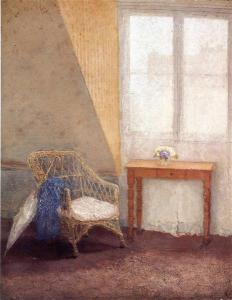
a-corner-of-the-artist-s-room-paris.jpg!Large

I knew very little about Gwen John before I read Keeping the World Away and now I want to know more. (Fortunately there is a list of books about her in the back of the book.)

The title of the book comes from a quotation from Gwen John’s Papers in the National Library of Wales:

“Rules to Keep the World away: Do not listen to people (more than is necessary); Do not look at people (ditto); Have as little intercourse with people as possible; When you come into contact with people, talk as little as possible … ” 3 March 1912

It seems from this novel that Gwen John was completely infatuated and in thrall to the artist Rodin. She became his lover and tried to please him by being tranquil and calm and striving for harmony in her life. Inwardly, however she “felt volcanic, as though burning lava filled her and would explode with the force of what was beneath it, her overwhelming passion for him.”

Her room was the image of how Rodin wished her to be and she painted a sunlit corner of it where it was “all peace and calm and serenity” in contrast to Gwen herself who “radiated energy”. She rearranged the room and painted several versions; with the window open, with an open book on the table, with flowers on the table, with and without the parasol.

I wished that the whole book had been about Gwen John. However, it’s about the painting and how its successive owners acquire it and what it means to each of them. It gets lost, is stolen, turns up on a market stall, is bought, given away and fought over. As each new owner is introduced there are links between them, but each time the painting passed to a new person I wanted to know more about each of them.

The painting is seen as expressing a yearning for something unobtainable, having an air of mystery, conveying a sense of waiting, of longing, of anticipation of someone’s arrival, painful, soothing or uplifting, empty, and symbolic of an independent, simple life free of entanglements. It becomes part of the lives of its owners. The novel starts with Gillian, the school girl reflecting that art speaks for itself, regardless of the artist’s intention. “She was convinced  that art should be looked at in a pure way, uninfluenced by any knowledge of the artist or the circumstances in which it had been painted.” It ends with Gillian, the aspiring artist, reflecting on the nature of art and the purpose of this painting – “Had that not been its purpose? To keep the world away, for a few precious moments, at least every time it was looked at?”

I can’t quite agree with Gillian. I can see that seeing a painting in isolation from the artist can be a pure experience, but I’m always filled with curiosity both about artists and authors – who they were, when they lived, what was going on in the world they lived in and how it affected their work. However, I also think that a painting is like a book in that they can both be interpreted in many ways regardless of the artist’s or author’s intentions.

This is a remarkable book, which I’m sure I shall read again and again.

(This book meets the criteria for the Celebrate the Author Challenge – Margaret Forster’s birthday is in May.)

The Chrysalids by John Wyndham


My copy of The Chrysalids by John Wyndham is the Penguin Books edition published in 1955. This is the second book I’ve read in the Once Upon a Time Challenge.

As this is science fiction and I’d read The Kraken Wakes, about an alien invasion of Earth and I know that The Day of the Triffids (which I haven’t read) is about grotesque animal eating plants, I was expecting The Chrysalids to be about monster insects hatching out of pupae. It isn’t.

It’s a post-apocalyptic novel set in an imaginary Labrador. The people have vague recollections of the ‘Old People’ who lived before the Tribulation (maybe a nuclear war), which they believe God sent to punish the population for their sins. The society they live in now is strictly governed by a fundamentalist interpretation of the Bible, one of the few books that survived the Tribulation. Anything that deviates from the Norm had to be rooted out and destroyed or sent to the Fringes. This applied to people, animals and plants. David Strorm has grown up in a house where the walls are covered in texts such as,

‘THE NORM IS THE WILL OF GOD’, ‘THE DEVIL IS THE FATHER OF DEVIATION’ and ‘WATCH THOU FOR THE MUTANT!’

So when he realises that his friend Sophie has six toes he is worried, and with reason. Sophie is not the only deviant from the Norm, David himself and a group of other young people have telepathic powers and can tune in to each other’s thoughts. When they realise that Petra, David’s little sister is developing even stronger telepathic abilities, David and Petra and his friends flee to the Fringes, where they expect to find fearsome mutations, but hope to find sanctuary. Petra’s long-range telepathy puts them in touch with a woman in Sealand, on the other side of the world, who promises to rescue them.

Wyndham’s story still has relevance today, with its central theme of intolerance of anyone or anything that does not conform to what is considered to be ‘normal’. Intolerance based on what a group of people ‘know’ to be the truth is always scary, especially when they persecute others who believe or think differently. The question of identity is also explored – what it is to be an individual and also part of society. His characters are real people, the story is compelling, and I had to read on to find out what happened as the tension built.

The title, I suppose, comes from the analogy with the evolution of insects from grubs to the adult stage. The people of Labrador are stuck in the chrysalis stage; they have not evolved and do not want to change. David and his friends are changing however and moving towards a more advanced stage of humanity. As the woman from Sealand tells them:

The essential quality of life is living; the essential quality of living is change; change is evolution; and we are part of it.

It’s a book I should like to re-read, now that I know the story. I thoroughly enjoyed it.

Winter In Madrid by C. J. Sansom

The devastation, desolation and waste of war had me in tears as I was reading Winter In Madrid. I already knew from reading his 16th century crime thrillers that C. J. Sansom is a master storyteller and this book exceeded my expectations. It is an action packed thrilling war/spy story and also a moving love story and historical drama all rolled into this tense and gripping novel.

Sansom vividly conveys the horror and fear of the realities of life in Spain during the Spanish Civil War and the first two years of the Second World War. The opening chapter dramatically sets the tone for the book with the brutality of the Battle of Jarama in 1937 then leaps straight into the bombing of London in 1940. Then Harry Brett, traumatised by his injuries at Dunkirk is sent to Spain to spy for the British Secret Service. He is plunged into the terrible living conditions in Madrid where people are starving, children are left homeless to fend for themselves and wild dogs roam the rubble of bombed houses.


He turned into a square. Two sides had been shelled into rubble, all the houses down, a chaos of broken walls rising from a sea of shattered bricks and sodden rags of bedding. Weeds had grown up between the stones, tall scabrous dark-green things. Square holes in the ground half filled with green scummy water marked where cellars had stood. The square was deserted and the houses that had been left standing looking derelict, their windows all broken.

Harry had never seen such destruction on such a scale; the bombsites in London were small by comparison. He stepped closer, looking over the devastation. The square must have been intensively shelled. Everyday there was news of more raids on London – did England look like this now?

This is a long and detailed book, but it moves along rapidly, with believable characters, including the bullying Ambassador, Sir Samuel Hoare, Alan Hillgarth, the chief of intelligence (both of whom are real historical figures), diplomats, Spanish Monarchists and Falangists and the ordinary Spanish people. Franco’s Madrid is shown as a place where fear, poverty and corruption stalk the streets; where hatred and suffering are paramount. It’s a chilling picture, but Harry finds love too when he meets Sofia and plans her escape with him to England after he has completed his mission.

The question is will Franco maintain Spain’s neutrality and enter the war in support of Hitler? Harry’s cover is as an interpreter, whilst his mission is to make contact with Sandy Forsyth, who he had known at public school in England, gain his confidence and discover the truth behind the rumour that gold deposits have been discovered in Spain, which would boost the economy making Spain less reliant on British support. Harry, a reluctant spy, soon finds himself in danger. He is plagued by memories of another school friend Bernie Piper, an ardent Communist who had enlisted in the International Brigades and had disappeared, reported killed at the Battle of Jarama. Barbara, an ex- Red Cross nurse, now Sandy’s girlfriend and Bernie’s former lover is convinced Bernie was not killed She appeals to Harry for help in finding Bernie, and so the story moves to its climax.

With its haunting themes of corruption, murder, the power of authority and heroism Winter In Madrid captivated my imagination. I expect it will be made into a film but I don’t think I could bear to watch it after enjoying this book so much.

Note: This book qualifies for the following Challenges – From the Stacks (I’ve had it unread for months), the Chunkster Challenge (it’s 530 pages) and What’s In a Name?