Sunday Salon – Current Books

I finished reading The Fall by Simon Mawer yesterday. It is the story of Rob Dewar and Jamie Matthewson from their childhood up to Jamie’s death 40 years later. But it’s also the story of their parents and how their lives are interlinked. I found it enthralling, one of those books that make me want to look at the ending to see how it all turns out. I managed to stop myself, however, and read impatiently to the end anxious to know what actually happened between them all.

It moves between the two generations beginning in the present day, when Rob hears on the news that Jamie, a renowned mountaineer has fallen to his death in Snowdonia. No one is sure whether it was an accident or suicide. Then it moves  back 40 years to the time when the two boys met, both fatherless – Jamie’s dad, Guy went missing when climbing Kangchenjunga and Rob’s parents are divorced, and back yet further again to 1940 when Guy Matthewson met the boys’ mothers – Meg (later calling herself Caroline) and Diana. And so  the drama unfolds in the mountains of Wales and the Alps, culminating on the North Face of the Eiger.

The Fall is not just a gripping account of the dangers of rock climbing and mountaineering, but it’s also a love story, with the intricacies of relationships, and love, loss and betrayal at its core. The love stories and the climbing scenes are both shown through the imagery of falling with all its ambiguities – actual falls, falling in love, falling pregnant and falling from grace. It’s beautifully written, capturing not only the mountain landscape but also London during the Blitz. This is the second excellent book by Mawer that I’ve read, even though it has a rather predictable ending.

I’m still reading Agatha Christie’s  An Autobiography and will be for some time as it is long and detailed – 550 pages printed in a very small font, which makes it impossible for me to read it in bed. But it is fascinating. It’s not just an account of her life but is full of her thoughts and questions about the nature of life and memory:

I am today the same person as that solemn little girl with pale flaxen sausage-curls. the house in which the spirit dwells, grows, develops instincts and tastes and emotions and intellectual capacities, but I myself, the true Agatha, am the same. I do not know the whole Agatha. The whole Agatha, so I believe, is known only to God.

So there we are, all of us, little Agatha Miller, and big Agatha Miller, and Agatha Christie and Agatha Mallowan proceeding on our way – where? That one doesn’t know – which of course makes life exciting. I have always thought life exciting and I still do. (page 11)

I’ll be writing more about Agatha Christie on Wednesday for my contribution to the Agatha Christie Blog Tour.

Saturday Selection

I’m nearing the end of The Fall by Simon Mawer, so it’s time to think about what to read next. I have one non-fiction book on the go – Agatha Christie’s An Autobiography, which will take some time to read, and after that I have a memoir – Seeing Things by Oliver Postgate and a biography – The Pantomime Life of Joseph Grimaldi by Andrew McConnell Stott, lined up to read.

But I need to decide which novel to read next. I’m thinking of one of these:

  • The A.B.C. Murders by Agatha Christie. This is a Poirot murder mystery, considered by Charles Osborne in The Life and Crimes of Agatha Christie to be ‘positively brilliant in its imagination and originality.’ It’s about time I read another Agatha Christie book.
  • Heartstone by C J Sansom – the fifth in the Matthew Shardlake series, set in England in 1545 when England was at war with France. I’ve been waiting to get this for ages, it seems. I bought it on Thursday when I saw it half-price in Tesco’s. I’ve loved the other Shardlake books.
  • The Lost Art of Gratitude by Alexander McCall Smith, the sixth Isabel Dalhousie novel, a philosophical detective story. I’ve enjoyed all the other Isabel Dalhousie books I’ve read so I have to read this too.
  • Her Fearful Symmetry by Audrey Niffennegger – a ghost story about love, loss and identity. I’m not sure I’ll like this as I found The Time Traveler’s Wife irritating, but when I found  it on the library shelves, I decided it was worth looking at it at least. I see I’m in the minority with my opinion about The Time Traveler’s Wife – there are an astounding 1,111 reviews on Amazon, 757 5 stars and 79 1 stars – but at least I’m not alone in my dislike!

I’ve been itching to read Heartstone but The Lost Art of Gratitude and Her Fearful Symmetry are both library books and are due back soon, so maybe I’ll start one of those. Maybe not, because Heartstone is so inviting!

Teaser Tuesday – The Tent, the Bucket and Me

I’m reading Emma Kennedy’s The Tent, the Bucket and Me.  As the subtitle explains this is about her ‘Family’s Disastrous Attempts to go Camping in the 70s‘, and that is not an understatement. I wish that I had the same powers of recall as Emma does to remember what I thought, felt and said at the age of 3. Emma is of course, writing comedy. It reminds me of those TV programmes that make you think ‘this just wouldn’t happen in real life’. I’m not saying that what she writes about didn’t happen, but I do suspect it’s been embellished somewhat.

Emma Kennedy would be great on Rob Brydon’s programme Would I Lie to You? All the events she describes would be ideal for the programme because no-one would believe they were true from the way she describes them. Passages in this book both make me laugh out loud and groan at the stupidity that led up to them. Just imagine you’re three, you’re drenched in wee (from a bucket full of the stuff that had tipped over when you tried to sit on it) and your parents told you to run naked round the car in a howling gale to wash off the wee! And that was Emma’s introduction to the joys of life under canvas.

There are more than enough toilet incidents, but these are not the only disasters that befall Emma and her teacher parents Tony and Brenda.  Having put up a frame tent in a howling gale in a field on the side of a cliff they abandon the tent and break into an empty caravan on the campsite, only to find that it went from bad to worse. The caravan was ‘ a stinking hole’, the back window blew out and, fighting against the wind the front end of the  caravan came off its bricks. They managed to jump out just as:

The caravan groaned; a deep crunch shattered out from its underbelly. With one terrifying yaw, the rear cracked up to the verical, tipped over and then rolled end over end, crashing down the field, metallic smashes punching through the howling wind. Then with one sliding finale, the caravan fell off the edge of the cliff.

‘We’re in hell!’ wailed Mam, as she watched it go. ‘Hell!’ (page 37)

They’d been in the eye of a force-ten gale, without realising it. Nothing daunted they carry on camping (holidays, that is) for the next 9 years.

Weekly Geeks – What Makes an Author Last?

This week’s discussion topic is inspired by the fact that on September 15 the world celebrates the 120th anniversary of the birth of Agatha Christie.

Have you read Christie’s books? Recently? What do you think it is about them that has given them such lasting value?
Or perhaps you have another favourite author whose works have outlasted those of their contemporaries? Maybe you’re a fan of Charles Dickens whose work is still widely known and studied while those of his contemporary, Edward Bulwer-Lytton, languish in relative obscurity.
What do you think it is that gives your favourite long-lasting author an edge? Is longevity all to do with quality? Quantity? Style perhaps? Or luck?
Agatha Christie is a great favourite of mine. I read a great many of her books as a teenager when I first came across her books and I’ve been taking part in the Agatha Christie Reading Challenge – my contribution to the current blog tour will be 22 September.

I’ve already written quite a lot about Agatha Christie’s books so for this post I thought I’d I’d write about another favourite author – Jane Austen. I first read Pride and Prejudice even before I knew anything about Agatha Christie. I can’t compare the two because they are so different – Jane only wrote six novels, Agatha over 80, Jane’s are romantic fiction, whereas Agatha wrote crime fiction, and so on.

Jane Austen’s lasting appeal is certainly down to the quality of her writing. Her characters are timeless. She portrays flirts, bores, snobs, the self-centred and foolish people as well as high-principled characters such as Jane Bennet (in Pride and Prejudice), who is determined to see good in everyone.  Her characters are amusing and well drawn, with great depth so that we are convinced of their reality. But her books aren’t sentimental and they are full of wit and humour. She writes about serious subjects treating them with humour and irony. In fact she delighted in a sense of the ridiculous, with such characters as Lady Catherine de Burgh and Mr Collins (Pride and Prejudice). And then there is Mr Darcy, handsome and aloof, a man who has won the heart of many women readers and also TV viewers with Colin Firth’s portrayal in the 1995 TV production.

Jane Austen’s England was at war with both America and France and the French Revolution was being fought across the Channel, but little of this is seen in her novels, just as it didn’t directly affect much of the nation. England was then largely a rural, agricultural society and Jane’s characters live in that world – a world of social inequality, one in which the role of women was very different from that of today. And for me this too is part of her appeal. She takes me into that world as I read her books. And yet because she was more interested in relationships, courtship, love and marriage than in national or international affairs her work has a timeless quality.

Her popularity is widespread from the academic to the popular. Her books are studied in schools and universities and they have been dramatised for the stage, TV and radio, and made into films and musicals. The first stage production was the 1906 play of Pride and Prejudice. In 1940 it was made into a film starring Laurence Olivier as Mr Darcy and Greer Garson as Elizabeth. Later two musicals of Pride and Prejudice were produced called First Impressions, Jane Austen’s first title for the book. Since then numerous TV productions of all her books have been made, and sequels, prequels and adaptations galore. More recently Pride and Prejudice has entered the zombie world with Pride and Prejudice and Zombies, (a book I cannot bear the thought of reading!) and also Bollywood with Bride and Prejudice.

There are numerous biographies, Jane Austen clubs and societies, in the United Kingdom, Australia and North America. The Jane Austen Centre in Bath, the Cobb at Lyme Regis and the house she lived in at Chawton are places of pilgrimage for her fans. And there are several blog sites dedicated to celebrating Jane Austen’s work, including:

Writing this has made me want to re-read her books and read for the first time The Watsons, Lady Susan and Sanditon. I also have Jane Austen’s Letters to read.

Borrowed Books

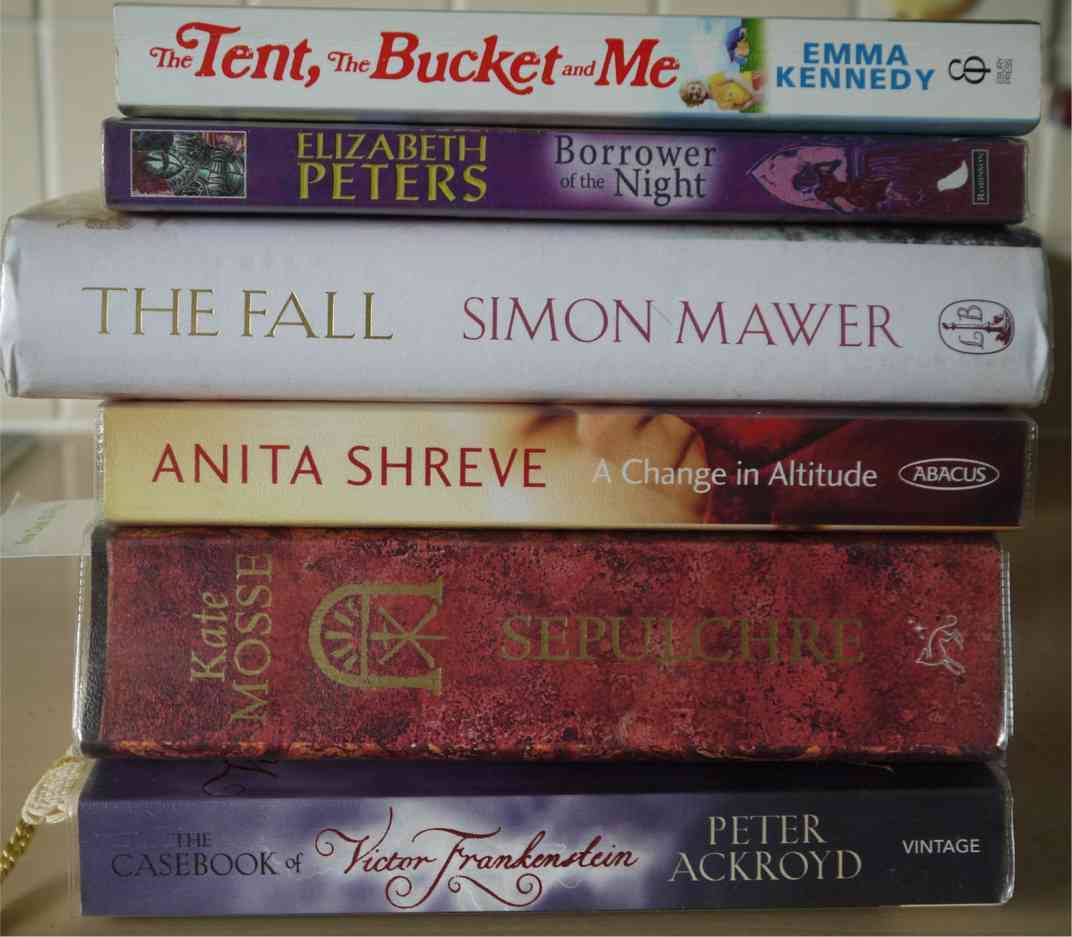
The mobile library came last week. I wasn’t going to borrow many, if any books, but there were some on the shelves that looked interesting and the van isn’t coming again until 21 October so I thought, why not borrow them. Then we went to our granddaughter’s 10th birthday party on Saturday and our son lent me a book too. It’s the top one in the pile shown below. Finally we went into town yesterday and as I returned a book to the library there I had a quick look round and borrowed the book at the bottom of the pile.

Borrowed Books

From top to bottom they are:

  • The Tent, the Bucket and Me: My Family’s Disastrous Attempts to go Camping in the 70s by Emma Kennedy. Apparently (I say this because I haven’t got that far in the book) they go to Carnac where we also went camping (well in a caravan) in the 80s. I checked on Amazon and this book has widely different reviews – some love it and think it very funny and others think it’s dreadful and not at all funny. I wonder which ‘camp’ I’ll be in.
  • Borrower of the Night: a Vicky Bliss Murder Mystery by Elizabeth Peters. I haven’t read anything by Elizabeth Peters, but as I’ve seen some reviews on a few blogs, I thought I’d have a look at this one. I haven’t started it yet. Vicky Bliss is an art historian, beautiful and brainy, according to the back cover. This one is about a search for a missing masterwork in wood by a master carver who died in Germany in the 16th century.
  • The Fall by Simon Mawer. I’ve read one other by by Simon Mawer – The Gospel of Judas, which I’d enjoyed. The Fall is the story of Rob and Jamie, friends from childhood, with a passion for mountaineering and climbing. From just a quick look at it, I see that it begins in Snowdon (another place where went on holiday and have camped and climbed (well D climbed, I just walked). Jamie and Rob take on greater challenges, culminating in the Eiger’s North Face. The jacket description appealed to me: ‘a story that captures nature at its most beautiful and most brutal, and which unlocks the intricacies at the heart of human relationships.’
  • A Change in Altitude by Anita Shreve. I’ve not been too keen on the latest books by Anita Shreve, although I loved her earlier ones, so I thought I’d borrow this one rather than buy it. I have started to read it, but just a few pages in it hasn’t ‘grabbed’ me yet. It’s about two couples on a climbing expedition to Mount Kenya when a horrific accident occurs.
  • Sepulchre by Kate Mosse. I read Labyrinth a few years ago (before I began this blog) and at the time I noted that it was ‘OK but too long’. So this is another book I decided not to buy, but if I saw it in the library I’d borrow it. It is enormously long! So far I’ve read a few chapters, set in 1891 in Paris and I’m not sure whether I’ll ever finish it. It’s a time-split book, divided 1891 and 2007, ‘the story of a tragic love, a missing girl, a unique set of tarot cards and the strange events of a cataclysmic night.’ (from the back cover)
  • The Casebook of Victor Frankenstein by Peter Ackroyd. I’ve always enjoyed Peter Ackroyd’s books and this one looked like a candidate for the RIP Challenge (as does Sepulchre). So far I’ve read about Victor Frankenstein’s love of learning and his desire to know the secrets of nature and the source of life. He has met Shelley at Oxford University, attended lessons at the dissecting room of St Thomas’s Hospital in London and is fascinated by Humphrey Davy’s experiments with electrical experiments. So far, so good. This book also has very mixed reviews on Amazon and in the press – the Guardian, ‘disappointing‘ and the Telegraph, ‘a brilliant jeu d’esprit.’

The links are to Amazon.co.uk (except for the press reviews). The only book to get consistent reviews on Amazon is The Fall. I don’t take much notice of these reviews, unless I know the reviewer, but I find it interesting to read such varying responses.

Agatha Christie Blog Tour

On 15 September 2010 Agatha Christie would have been 120 years old.

Over at the ACRC Blog Carnival we are taking part in world wide celebrations with a blog carnival tour from 1-30 September 2010.

My contribution will be on 22 September. The schedule for the blog tour is at the Agatha Christie Reading Challenge site, where you can check out what the other participants write each day.