TBR – New Additions

There have been 5 additions to my to-be-read piles in January. I won an Amazon voucher from Dorte which she kindly gave away to celebrate her second blog anniversary. With that I got :

  • Daphne by Justine Picardie – I love Daphne du Maurier’s books, so this novel about her appealed to me. It’s set in 1957 on the Cornish coast where she is researching Branwell Bronte, and also in present day London where a lonely young woman struggles with her thesis on du Maurier and the Brontes.
  • The Janus Stone by Elly Griffiths – I read Elly Griffiths’ first book, The Crossing Places with great pleasure. This is the second case for Ruth Galloway, forensic archaeologist. She is called in to investigate when builders demolishing a large house in Norwich discover the skeleton of a child – minus a skull – beneath a doorway.

I received two books from publishers:

  • The Red Coffin by Sam Eastland – via LibraryThing’s Early Reviewers. This is the second Inspector Pekkala mystery set in the Soviet Union in 1939 on the brink of the Second World War. Colonel Nagorski, the designer of Stalin’s F-34 tank, known as the ‘Red Coffin’ is murdered and Pekkala is ordered to investigate. I haven’t read the first Pekkala mystery, but this appealed to me as being something out of my comfort zone.
  • Blotto, Twinks and the Ex-King’s Daughter by Simon Brett – from the publishers. I’ve read a few of Simon Brett’s mysteries and when the publishers emailed me wondering whether I’d like to read a ‘really funny mystery novel’ I thought I would. This is described as a ‘gloriously silly new series’ set in a little English town in the 1920s, featuring a pair of aristocratic siblings.

And I bought one book:

  • True Grit by Charles Portis – for my Book Group meeting at the end of February. A real change for me as I haven’t read any cowboy books for years. I saw the film with John Wayne many years ago – this book is a tie-in with a new film starring Jeff Bridges, Matt Damon and Josh Brolin. I didn’t even know it was a book first of all.

And then there are the books I’ve downloaded on my Kindle, most of them free classics and some are duplicates of my printed books, which I thought would be handy to have as e-books.

Crime Fiction Alphabet – D

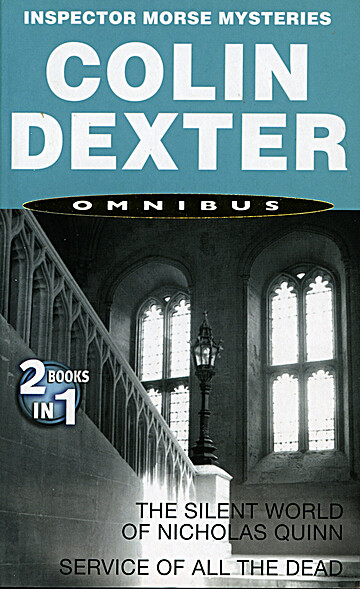
This week’s letter is D in Kerrie’s Crime Fiction Alphabet series and I’ve chosen to feature Colin Dexter’s The Silent World of Nicholas Quinn, the third Inspector Morse book  first published in 1977.

For years I’ve been watching and enjoying Inspector Morse on TV. We used to live not far from Oxford and one of the pleasures of watching the series was identifying the locations. One evening we went with a group of friends on a Morse pub tour, (organised by ourselves) visiting a few of the pubs featured in the books – one of our favourites used to be The Trout Inn at Wolvercote, before it was renovated when you could get an old fashioned Sunday Roast, with waiter service.

I don’t remember seeing an episode of The Silent World of Nicholas Quinn, so apart from visualising John Thaw and Kevin Whately as Morse and Lewis I was free to see the novel through Colin Dexter’s words. My copy is a secondhand book – an Omnibus containing Service of All the Dead as well as The Silent World of Nicholas Quinn.

Description from the back cover:

Morse had never ceased to wonder why, with the staggering advances in medical science, all pronouncements concerning times of death seemed so disconcertingly vague.

The newly appointed member of the Oxford Examinations Syndicate was deaf, provincial and gifted. Now he is dead . . .

And his murder, in his north Oxford home, proves to be the start of a formidably labyrinthine case for Chief Inspector Morse, as he tries to track down the killer through the insular and bitchy world of the Oxford Colleges . . .

My View

I thoroughly enjoyed reading this book. As the blurb on the back cover indicated the time of Quinn’s death is of prime importance, but then so is the place of his death. His deafness, as I expected is also crucial. Morse and Lewis come across as well defined characters, and so do all the other characters – Quinn’s colleagues and neighbours. The setting, as I expected, is excellent, but then I am familiar with Oxford.

For a long time when reading I had little idea who the culprit was. It has a most complicated plot that kept me guessing right to the end. It’s one of those books that I want to start again as soon as I finished it to see  just which clues I’d missed. Morse, himself, was baffled too but eventually worked it out successfully, whilst Lewis struggled to catch up with his train of thought, as this extract shows:

(Morse speaking first) ‘Remember this, then: Quinn couldn’t hear what he didn’t see.’

Am I supposed to see why all that is important, sir?’

‘Oh, yes. And you will do, Lewis, if only you think back to the Friday when Quinn was murdered.’

‘He was definitely murdered on the Friday, then?’

‘I think if you pushed me I could tell you to within sixty seconds!’  He looked very smug about the whole thing and Lewis felt torn between the wish to satisfy his own curiosity and a reluctance to gratify the chief’s inflated ego even further. Yet he thought he caught  a glimpse of the truth at last … Yes, of course. Noakes had said … He nodded several times, and his curiosity won.

‘What about all the business at the cinema, though? Was that all a red herring?’ (pages 243-4)

Reading the book I realised that Colin Dexter not only knows Oxford very well (which wasn’t news to me!) but also was very familiar with the workings of  an Examination Board and understood the difficulties of lip-reading. The reason for this is that after being a teacher, because of his deafness he became the Senior Assistant Secretary at the University of Oxford Delegacy of Local Examinations (UODLE) in Oxford, just like Quinn.

Sunday Salon

Reading today:

Eden’s Outcasts: the Story of Louisa May Alcott and Her Father by John Matteson. I’m making heavy weather of this book, mainly because I’m finding Bronson Alcott such a difficult person. I’m only reading a few pages each morning, which is about all I can put up with Bronson’s self-centred approach to life.

It will take me a while to finish this book as it’s over 400 pages long. So far, I’m up to page 118, and Bronson has tried and failed at almost everything he has undertaken in his search for perfection. His efforts at running a school have failed and he is about to embark on a new project – a self-sufficient commune, a ‘beacon of morality in a fallen world.’  This was to be ‘an earthly heaven‘, anything that came from the work of slaves was excluded, they would do away with money, shun the use of animal products and rely as little as possible on animals for work.

He asked Emerson to join him in his venture and also to back him financially. Emerson refused and wrote in his diary:

For a founder of a family or institution, I would as soon exert myself to collect money for a madman. (page 114)

I have to agree with Emerson.

There has been little yet in this book about Louisa but I’m hoping that will soon change as she is now 11 and beginning to rebel against her father, who baffles him with her stubbornness.

I’ve also started to read Perfume: the Story of a Murderer by Patrick Suskind. I’m not sure yet what I think of this novel. It begins well, grabbing my attention with a description of the birth of Jean-Baptiste Grenouille in Paris just before the French Revolution began. The description of the smells of Paris at that time is breath-taking in its awfulness:

The streets stank of manure, the courtyards of urine, the stairwells of mouldering wood and rat droppings, the kitchens of spoiled cabbage and mutton fat; the unaired parlours stank of stale dust, the bedrooms of greasy sheets, damp featherbeds, and the pungently sweet aroma of chamber-pots. The stench of sulphur rose from the chimneys, the stench of caustic lyes from the tanneries, and from the slaughterhouses came the stench of congealed blood. People stank of sweat and unwashed clothes; from their mouths came the stench of rotting teeth, from their bellies that of onions, and from their bodies, if they were no longer very young, came the stench of rancid cheese, and sour milk and tumorous disease.  (page 3)

Grenouille born in this stink, is not an attractive character either. Having no odour of his own but a highly developed sense of smell, he is a strange character to say the least. On the trail of an elusive but exquisite smell he tracks it down to a young girl and kills her to possess  her scent for himself.

Peter Ackroyd is quoted on the back cover:

A meditation on the nature of death, desire and decay.

I’m reserving judgement for the time being.

The Secret Adversary by Agatha Christie: Book Review

The Secret Adversary was first published in 1922. It was Agatha Christie’s second book and the first featuring Tommy and Tuppence. In this book they have just met up after World War One, both in their twenties: ‘an essentially modern-looking couple’. They are both stony broke and decide to set up a joint venture under the name of the Young Adventurers Ltd, initially intending to hire themselves out to commit crimes.

A Mr Whittington overhears their conversation and offers Tuppence their first assignment, but when she tells him her name is ‘Jane Finn’ he acts very strangely and thinks she is blackmailing him. From then on Tommy and Tuppence set out to find Jane Finn, a name Tommy had overheard from a conversation in the street.

Reading it reminded somewhat of Enid Blyton’s adventure books, mixed up with P G Wodehouse’s books. It’s a spy/detective story that is fast and furious with Tommy and Tuppence landing themselves in all sorts of dangerous situations. It’s also full of red herrings and they’re never very sure who they can trust. Tommy and Tuppence advertise for information relating to Jane Finn and have two responses. One is from Mr Carter, from British Intelligence who tells them that Jane Finn, a survivor from the torpedoed Lusitania, was handed a certain document – a secret agreement, with a ‘new and deadly significance’. The second response is from Mr Julius P Hersheimmer, a young American, who says he is Jane’s cousin and wants to find her.

Just who is the mysterious Mr Brown, the secretive mastermind behind a plot to unite all of England’s enemies, overthrow the government and cause anarchy?  There is no clue to his real identity, he remains elusive and always in the background. But it becomes clear that he is one of two people and as I read I swung from believing it to be one character to the other.

One point of interest is the brief mention of Inspector Japp, of Scotland Yard. His role in this is merely incidental.

I enjoyed this book and I liked Tommy and Tuppence, who by the end realise they are in love. Agatha Christie only wrote five books featuring this couple. Unlike Miss Marple and Hercule Poirot, Tommy and Tuppence age as the books were written:

  • Partners in Crime: a book of short stories
  • N or M?
  • By the Pricking of My Thumbs
  • Postern of Fate.

Format: Kindle Edition
File Size: 378 KB
Print Length: 229 pages
Source: Project Gutenberg EBook

ABC Wednesday – B is for Robert Browning

I first read some of Robert Browning’s poems in a little book that belonged to my father. It’s a very little book, but it was enough to interest me. Later at school I studied some of his poems and was given The Poems of Robert Browning as a prize:

Browning was born in Camberwell in 1812, the son of a Bank of England clerk. His poems were influenced by Shelley and his first published poem Pauline eventually attracted Wordsworth’s attention. In 1846 he married Elizabeth Barrett and they spent most of their lives together in Italy, until Eabeth’s death in 1861. He died in Venice in 1889 and is buried in Westminster Abbey.

I suppose his most famous poem is Home Thoughts from Abroad:

Oh, to be in England
Now that April ‘s there,
And whoever wakes in England
Sees, some morning, unaware,
That the lowest boughs and the brushwood sheaf
Round the elm-tree bole are in tiny leaf,
While the chaffinch sings on the orchard bough
In England’”now!

And after April, when May follows,
And the whitethroat builds, and all the swallows!
Hark, where my blossom’d pear-tree in the hedge
Leans to the field and scatters on the clover
Blossoms and dewdrops’”at the bent spray’s edge’”
That ‘s the wise thrush; he sings each song twice over,
Lest you should think he never could recapture
The first fine careless rapture!
And though the fields look rough with hoary dew,
All will be gay when noontide wakes anew
The buttercups, the little children’s dower
‘”Far brighter than this gaudy melon-flower!

But the poem that I first aroused my interest in my father’s little book is Porphyria’s Lover, which begins:

The rain set early in to-night,
The sullen wind was soon awake,
It tore the elm-tops down for spite,
And did its worst to vex the lake:
I listen’d with heart fit to break.
When glided in Porphyria; straight
She shut the cold out and the storm,
And kneel’d and made the cheerless grate
Blaze up, and all the cottage warm;
Which done, she rose, and from her form
Withdrew the dripping cloak and shawl,
And laid her soil’d gloves by, untied
Her hat and let the damp hair fall,
And, last, she sat down by my side
And call’d me. When no voice replied,
She put my arm about her waist,
And made her smooth white shoulder bare,
And all her yellow hair displaced,
And, stooping, made my cheek lie there,
And spread, o’er all, her yellow hair,
Murmuring how she loved me’”she
Too weak, for all her heart’s endeavour,
To set its struggling passion free
From pride, and vainer ties dissever,
And give herself to me for ever.

Her lover, however, though happy and proud knowing she loved him, took her hair and wound it round her throat and strangled her. He then sat with her, her head upon his shoulder all night long:

‘And yet God has not said a word.’

This may have been the first dramatic murder scene I read.  This article in Wikipedia analyses the poem.

It contrasts with this poem, which is another favourite of mine, Pippa’s Song (from the poem Pippa Passes: A Drama):

The year’s at the spring,
And day’s at the morn;
Morning’s at seven;
The hill-side’s dew-pearl’d;
The lark’s on the wing;
The snail’s on the thorn;
God’s in His heaven’”
All’s right with the world!

I haven’t read a biography of Robert Browning, but Margaret Forster has written an excellent one about Elizabeth Barrett Browning which tells of how the two met and eloped and their subsequent lives together. She has also written a novel, Lady’s Maid a fictionalised account of Elizabeth’s maid and her involvement in the couple’s lives. Another novel of interest is Flush, by Virginia Woolf, the story of Elizabeth’s spaniel.

See more B’s at ABC Wednesday.

Teaser Tuesday

Teaser Tuesday is a weekly event hosted by MizB of Should be Reading.

My teaser today is from The Adventure of the Dancing Men in Favourite Sherlock Holmes Stories by Arthur Conan Doyle.

Holmes had been seated for some hours in silence, with his long thin back curved over a chemical vessel in which he was brewing a particularly malodorous product. His head was sunk upon his breast, and he looked from my point of view like a strange, lank bird, with grey dull plumage and a black top-knot.

‘So, Watson, said he, suddenly, ‘you do not propose to invest in South African securities?’ (page 57)

Favourite Sherlock Holmes Stories is a collection of twelve stories that Arthur Conan Doyle rated as his very best. It includes what Conan Doyle described as ‘the grim snake story’, The Speckled Band, and The Red-Headed League and The Dancing  Men on account of the originality of the plot of each.

It  also includes his first story – A Scandal in Bohemia; the story that deceived the public with the erroneous death of Holmes –  The Final Problem;  and the story that explained away the alleged death of Holmes – The Empty House.