B is for British Writers Since 1945

I saw this list on Books and Bicycles who  found it at Musings from the Sofa and My Porch. It’s the Sunday Times list of ‘The 50 Greatest British Writers Since 1945.‘ So I thought I’d see how many I’ve read and it would be good for ABC Wednesday – B, a good choice for a Book Lover on a Book Blog.

1. Philip Larkin – I must have read some of his poetry but right now I can’t think of any.
2. George Orwell – yes, Animal Farm.
3. William Golding – Lord of the Flies – at school.
4. Ted Hughes – some.
5. Doris Lessing – no.
6. J. R. R. Tolkien  ‘“ read The Hobbit and Lord of the Rings trilogy.
7. V. S. Naipaul – no.
8. Muriel Spark – several novels, including The Prime of Miss Jean Brodie.
9. Kingsley Amis – no.
10. Angela Carter – no.
11. C. S. Lewis – the Narnia books, plus some of his nonfiction.
12. Iris Murdoch – yes, several including The Bell and The Sea, The Sea.
13. Salman Rushdie – No.
14. Ian Fleming – No, but I have Diamonds Are Forever in my tbr piles .
15. Jan Morris – No.
16. Roald Dahl – Yes.
17. Anthony Burgess – No.
18. Mervyn Peake – The Gormenghast trilogy.
19. Martin Amis – No.
20. Anthony Powell – started A Dance to the Music of Time, but didn’t finish.
21. Alan Sillitoe – No.
22. John Le Carré – Not yet – have Tinker, Tailor, Soldier, Spy waiting to be read.
23. Penelope Fitzgerald – No.
24. Philippa Pearce – who?
25. Barbara Pym – read some.
26. Beryl Bainbridge – read Master Georgie and According to Queeney – preferred this one
27. J. G. Ballard -Yes, loved Empire of the Sun.
28. Alan Garner – read several years ago, most recent was The Owl Service.
29. Alasdair Gray – who?
30. John Fowles – read The French Lieutenant’s Woman and The Magus – both really good.
31. Derek Walcott – Yes, for Open University course.
32. Kazuo Ishiguro – Yes – excellent, although I thought Never Let Me Go was so chilling.
33. Anita Brookner – Yes, years ago.
34. A. S. Byatt – Yes, but still haven’t read The Children’s Book.
35. Ian McEwan -Yes, love his books
36. Geoffrey Hill – Yes, for Open University course.
37. Hanif Kureishi – who?
38. Iain Banks -No – have The Wasp waiting to be read.
39. George Mackay Brown – who?
40. A. J. P. Taylor – No.
41. Isaiah Berlin – No.
42. J. K. Rowling – Yes.
43. Philip Pullman – Yes – great books.
44. Julian Barnes – Yes,  Arthur and George.
45. Colin Thubron – No.
46. Bruce Chatwin – Not yet, have On the Black Hill waiting to be read.
47. Alice Oswald – who?
48. Benjamin Zephaniah – who?
49. Rosemary Sutcliff – Yes, as a child.
50. Michael Moorcock – who?

I’ve read books by nearly half of these authors and haven’t heard of quite a few of them! Clearly there are loads of books out there I haven’t read, so plenty to choose from if I ever get through the books I own that I still haven’t read.

Teaser Tuesday – Blonde

Currently I’m reading Blonde by Joyce Carol Oates. I’ve been reading it for a while as it’s a long book of over 700 pages. I’m about a third of the way into it. It’s a fictionalised account of Norma Jeane Baker – also known as Marilyn Monroe and it is absolutely fascinating.

No doubt I’ll be writing more about this book. For now here is a little teaser quotation:

Her problem wasn’t she was a dumb blonde, it was she wasn’t a blonde and she wasn’t dumb. (page 232)

Teaser Tuesdays is a weekly event hosted by MizB of Should be Reading.

Agatha Christie Reading Challenge Carnival

The July edition of the Agatha Christie Reading Carnival is available here.

This month there are 10 contributors providing 16 blog posts with reviews of Agatha Christie’s books and posts about her.

You can join the Carnival too, sign up, then read at your own pace, write a review on your blog then go to the Carnival collecting space, and put in your URL, your details and a comment about the post.

My Sunday Selection

Today I’m looking at my recent selection of library books.

When I went to my local library this week the librarian had just finished processing a pile of new additions and passed them over to me to look at. I love new library books, so clean and fresh. I chose two out of the pile and then browsed the rest of the books. These are the ones that I brought home:

The two new books are:

Great House by Nicole Krauss. I have her earlier book, The History of Love in my to-be-read piles and I’ve read one or two reviews of this book on book blogs recently and thought it sounded interesting. It’s a story centred around ‘a desk of many drawers that exerts a power over those who possess it or give it away‘ (taken from the book cover).

Being Polite to Hitler by Robb Foreman Dew. I’ve never heard of this book, or the author but the title caught my attention and I wondered what it could be about. It’s set in Ohio in mostly the 1950s and follows the experiences of a widowed schoolteacher and those around her. Described on the book cover as a ‘moving, frank and surprising portrait of post- World War Two America.’

I had gone to the library, specifically to look for books by Nigel Tranter, a Scottish author whose books I’d read many years ago. Reading Katrina’s post on Pining for the West about Right Royal Friend by Nigel Tranter reminded me how much I’d enjoyed them and I wondered if I’d still like them. Tranter wrote very many books, mostly historical fiction based on real people and events. There were several of his books on the shelves and I chose Envoy Extraordinary, set in the 13th century following the lives of Patrick III, Earl of Dunbar and Alexander III. Patrick played a major part in Scotland’s affairs, although he was more interested in the welfare of his people and ‘encouraging the wool production of his sheep-strewn Lammermuir Hills‘. I chose this book because the Lammermuir Hills are not too far from where we live.

The other two books I chose are:

Rivers of London by Ben Aaronovitch, a book that had Annie of Senior Common Room ‘hooked’. She wrote:

Aaronovitch brings just the right amount of cynicism about both the police service and the current social climate to his writing and as a result the book is not only very funny but also, despite the magic, recognisably about the world in which we live.  It is also, if you happen to know the parts of London about which he is writing, very well researched.

It’s a mixture of crime and fantasy – Detective Constable Peter Grant is also a trainee wizard, dealing with ‘nests of vampires, warring gods and goddesses of the River Thames and digging up graves in Covent Garden.

A Kind Man by Susan Hill, another one of her novellas, described as ‘a parable of greed and goodness and an extraordinary miracle.’ It’s set in an unspecified time period, but before the National Health Service was set up. I know from the book cover that it is the story of the marriage of Tommy Carr and his wife Eve. Tragedy strikes when their little daughter dies.

Book Beginnings

Last week I found another little secondhand bookshop – The Border Reader – a lovely little shop above a tea room near Melrose in the Scottish Borders. I browsed the bookshelves upstairs and had a cup of Earl Grey tea and a slice of Lavender and Lemon Drizzle Madeira cake downstairs – a most pleasurable afternoon.

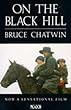
And up the stairs I found in the bookcase to the right of the photo a book I’ve had on my wishlist for a while. It’s On the Black Hill by Bruce Chatwin.

The book begins:

For forty-two years, Lewis and Benjamin Jones slept side by side, in their parents’ bed, at their farm which was known as ‘The Vision’.

The bedstead, an oak four-poster, came from their mother’s home at Bryn-Draenog when she married in 1899. Its faded cretonne hangings, printed with a design of larkspur and roses shut out the mosquitoes of summer, and the draughts in winter. Calloused heels had worn holes in the linen sheets, and parts of the patchwork quilt had frayed. Under the goose-feather mattress, there was a second mattress, of horsehair, and this had sunk into two troughs, leaving a ridge between the sleepers. (page (9)

The Black Hill is not one of the Black Hills of Dakota – known to me only from the song, sung by Doris Day, but it is one of the Black Mountains on the border of England and Wales, although fictionalised in this book. The book was first published in 1982 and won the James Tait Black Memorial Prize that same year. It’s also been made into a film. It looks to be a gentle, richly descriptive book about lonely lives on a farm, largely untouched by the 20th century. A nice change from all the crime fiction I’ve been reading recently.

Book Beginnings on Friday is hosted by Katy, at  A Few More Pages.

The Tinder Box by Minette Walters: Book Review

I really enjoyed this novella by Minette Walters. Being a short mystery it is succinctly written and yet I could still imagine the characters and settings from the descriptions. The Tinder Box is aptly named – about a situation set to burst into flames at any moment.

Description from the book cover:

In the small Hampshire village of Sowerbridge, Irish labourer Patrick O’Riordan has been arrested for the brutal murder of elderly Lavinia Fanshaw and her live-in nurse, Dorothy Jenkins. As shock turns to fury, the village residents form a united front against Patrick’s parents and cousin, who report incidents of vicious threats and violence.

But friend and neighbour Siobhan Lavenham remains convinced that Patrick has fallen victim to a prejudiced investigation and, putting her own position within the bigoted community in serious jeopardy, stands firmly by his family in defence of the O’Riordan name.

Days before the trial, terrible secrets about the O’Riordans’ past are revealed to Siobhan, and the family’s only supporter is forced to question her loyalties. Could Patrick be capable of murder after all? Could his parents’ tales of attacks be devious fabrications? And if so, what other lies lurk beneath the surface of their world?

As the truth rapidly unfurls, it seems that Sowerbridge residents need to be very afraid. For beneath a cunning façade, someone’s chilling ambition is about to ignite . . .

My thoughts:

In some ways this is a theme-heavy book, dwelling as it does on prejudice, incitement to violence and vigilantism as the inhabitants of the village unite in their dislike of the O’Riordan family living in their midst. As the story unfolds it becomes clear that misunderstanding and ignorance are really the problem. I liked the way Minette Walters has structured The Tinder Box using flashbacks,  moving between events that lead up to Patrick’s arrest and the aftermath.

For such a short book it is remarkably complex and layered and the ending with its alternative scenarios is excellent. I think I enjoyed it so much because it is so condensed – it made a refreshing change from the long and detailed books I’ve been reading recently.

  • Hardcover: 128 pages
  • Publisher: Macmillan (14 Jun 2004)
  • Language English
  • ISBN-10: 1405048557
  • ISBN-13: 978-1405048552
  • Source: Library book