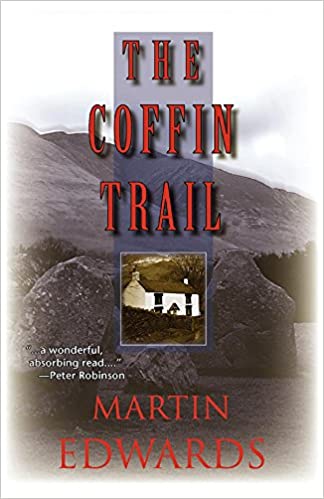
The Coffin Trail by Martin Edwards

A while ago I read The Arsenic Labyrinth by Martin Edwards, the third in his Lake District Mystery series of books, which I wrote about here. Now I’ve read The Coffin Trail,  the first in the series.

Daniel Kind and his partner Miranda have just moved to Tarn Cottage near Brackdale, a beautiful village in the Lakes in a hidden valley. The Cottage used to be the home of Barrie Gilpin, who was suspected of the brutal murder of Gabrielle Anders and Daniel had met Barrie, when as a boy he had spent a fortnight’s holiday at Brackdale. Barrie had died before he could be arrested and Daniel can’t imagine how the Barrie he knew could possibly have murdered anybody. He starts asking the locals questions about it.

So when the police set up a new team to investigate cold cases led by DCI Hannah Scarlett, who had been on the original team investigating the murder of Gabrielle, Daniel’s questions trigger a phone call to the team resulting in the revival of the case.

I was completely involved with the characters and swept along by the mystery. The setting is superb, the Lake District is vividly described, as is Daniel and Miranda’s renovation of the cottage, and the bookshop owned by Marc, Hannah’s partner. I liked all the detail in this book. I could see the coffin trail, the steep stony track that had been used years ago as the route mourners took to bury their dead at the chuch over the fells. It leads to the Sacrifice Stone, an ancient pagan site, where Gabrielle’s body had been found. I could see the bookshop in a section of a converted mill, with its creaking floorboards:

They creaked, just as Daniel believed, all floorboards in secondhand bookshops should creak. It was an essential part of the ambiance, like the giddy sense of claustrophobia that came from squeezing between tottering towers of books and clouds of dust that had to be blown from the ancient volumes lingering in the darkest recesses.

Daniel, an Oxford historian, is used to investgating the past and this leads to his meeting Hannah, partly because he is trying to find out more about his father, Ben who had been Hannah’s boss. Daniel had lost touch with his father after his parents’ divorce. Miranda meanwhile is becoming less enchanted with the idea of living in the cottage away from her job in London and as Daniel and Hannah spend some time together the potential for their relationship arises. I must admit that I took to Hannah rather more than I did to Miranda.

This is a nicely complicated book with complex relationships  and sub-plots. There are plenty of questions to be answered. Can Daniel and Miranda live happily in Tarn Cottage? Did Barrie kill Gabrielle? And if he didn’t who did? Ben Kind and Hannah were never convinced at the time of his guilt and as the cold case team investigate aided by Daniel’s persistence more secrets emerge. I was kept guessing right to the thrilling end of this book.

The Mirror Crack’d From Side to Side

 The Mirror Crack’d From Side To Side by Agatha Christie first published 1962.

 Miss Marple was feeling rather down and a bit weak after an attack of bronchitis. Her doctor prescribes ” a nice juicy murder” for her to unravel and not long after the ideal opportunity arose with the death of Heather Badcock. Heather had gone to a fete at Gossington Hall held by her idol, the glamorous movie star Marina Gregg. She died after drinking a poisoned cocktail, just after meeting Marina. The title is taken from Tennyson’s The Lady of Shalot, a convincing image of Marina’s reaction on meeting Heather – “… ‘the curse has come upon me’, cried the Lady of Shalott.” Heather was the sort of person no-one would want to murder, she was a very kind woman who always did things for other people. Her trouble was that she was sure she knew the best thing to do and she was only really interested in herself. Such people Miss Marple observed “live dangerously – though they don’t know it themselves.” So why was she killed and was Marina really the intended victim?

I remember seeing the TV adaptation of this book with my favourite Miss Marple – Joan Hickson – and although I did remember who had committed the murder I didn’t remember the motive, nor how it had happened. As I read on it all came back to me – just what the curse was.  As usual with Agatha Christie’s books,which are so deceptively easy to read, all is not straight forward and there are many complications and twists before the denoument. 

There was lots to enjoy in this book – not just the puzzle of the murder, but also the setting and the characterisation. The setting is St Mary Mead, once an idyllic English  village, now threatened by the “Development” of rows of new houses which at first didn’t seem real to Miss Marple – it “was like a neat model built with child’s bricks” and the people looked unreal to her. She thought it all looked “terribly depraved”. Then she realised that although everything and everyone looked and sounded different the human beings were the same as they always had been. It’s from her understanding of human nature that she is able to solve the crime.

I also liked the characterisation of Miss Marple, now an old lady thought incapable of looking after herself and the neat way she handles Miss Knight her live-in companion who talks to her as though she is a child. In fact all the characters have that touch of reality that brought them alive.  Their idiosyncracies are what makes them seem real people.

agatha_christie_rc

 For more reviews of Agatha Christie’s books have a look at the Agatha Christie Reading Challenge Carnival.

library-challenge

This is the ninth library book I’ve read this year so I’m well on target to read at least 25 library books by the end of December. Click on the logo for links to other bloggers reviews of  library books.

Sunday Salon – this week’s books

Once more my current reading bears very little resemblance to the Currently Reading Section on the sidebar. This is partly because my reading this week has been rather different from usual as I’ve been reading mainly children’s books – out loud to the grandchildren.

wutheringBut I did manage to squeeze in Emily Bronte’s Wuthering Heights, which I first read many years ago. I was a bit wary about re-reading it in case I was disappointed by it now, but I needn’t have worried as it’s even better than I remembered it. It’s the writing that enthralled me. Parts of it were like reading it for the first time and parts were just so familiar, I think I must have read some sections many times over.  My over-riding memory of the story was of Lockwood spending the night in Catherine Earnshaw’s bedroom and his dream in which he heard a rattle on the window panes. When he opened the window his fingers closed

on the fingers of a little, ice-cold hand! The intense horror of the nightmare came over me: I tried to draw back my arm, but the hand clung to it, and a most melancholy voice sobbed, “Let me in – let me in!” “Who are you?” I asked, struggling, meanwhile to disengage myself.

… Terror made me cruel; and finding it useless to attempt shaking the creature off, I pulled its wrist on the broken pane, and rubbed it to and fro till the blood ran down and soaked the bedclothes: still it wailed, “Let me in!” and maintained its tenacious gripe, almost maddening me with fear.

This still sends shivers down my spine.

I had forgotten that a large part of the book covers the story of Catherine’s daughter, Cathy and Heathcliff’s son, Linton, but I found that just as gripping as the beginning of the book. Linton Heathcliff is the most exasperating, weak character so easily controlled and manipulated by his father’s brutal cruelty. I was impressed by the way Emily Bronte managed to make me feel sorry for such an unsympathetic character as Heathcliff, full of bitterness and driven to gain revenge for Catherine’s betrayal even whilst his love for her never diminished, bordering on insanity. Even though she was so self-centred and rejected him, years after her death he was still obsessed and haunted by her:

I cannot look down to this floor, but her features are shaped in the flags! In every cloud, in every tree- filling the air at night, and caught by glimpses in every object by day – I am surrounded by her image! The most ordinary faces of men and women – my own features – mock me with a resemblance. The entire world is a dreadful collection of memoranda that she did exist, and that I have lost her!

The View From Castle Rock by Alice Munro

view-from-castle-rockI’ve not been writing much on here recently as I’ve been researching my family history and it takes up so much time. I only wish my ancestors had left letters and journals like Alice Munro’s  did. Her book The View from Castle Rock is an excellent mix of fact and fiction. She has taken what she knows of her family history and woven it into an imagined version of the past. She explains in the Foreword that in every generation of her family there was someone who “went in for writing long, outspoken, sometimes outrageous letters, and detailed recollections.” 

The Laidlaws emigrated to Canada from Scotland in 1818 and the first part of the book is about their journey across the Atlantic and their early years as settlers. The title of the book comes from a story about Andrew who when he was ten was taken by his father to see the view from Edinburgh’s Castle Rock. His father, who wanted to emigrate to America, told him that the land they could see in the mist was America;

There is where every man is sitting in the midst of his own properties and even the beggars is riding around in carriages.

Of course it was not America and Andrew knew that. But it was years later before he realised that he’d been looking at Fife!

Story follows story as the years pass spanning several generations of the Laidlaw family moving forward to the present generation – Munro herself. I found the second half of the book even better than the first as she tells of her parents and their hard working lives. Her father bred silver foxes and before she became ill her mother made their pelts into scarves to sell to American tourists. Munro then relates stories based on her own life. These are first person stories based on personal material but as she puts it in an

“austere or rigorously factual way. I put myself at the center and wrote about that self as searchingly as I could. But the figures around this self took on their own life and color and did things they had not done in reality. … In fact, some of these characters have moved so far from their beginnings that I cannot remember who they were to start with.

These are stories.

You could say that such stories pay more attention to the truth of a life than fiction usually does. But not enough to swear on. And the part of this book that might be called family history has expanded into fiction, but always within the outline of a true narrative.

Fact or fiction this is a fascinating book.

library-challengeIt’s also the eighth library book I’ve read this year – for accounts of more library books see J Kaye’s Support Your Library Challenge.

The Falls – Ian Rankin

The Falls (Inspector Rebus, #12)

I loved The Falls by Ian Rankin.  This is set in Edinburgh where a university student Philippa Balfour, known as ‘Flip’ to her friends and family has disappeared.  DI Rebus and his colleagues have just two leads to go on – a carved wooden doll found in a tiny coffin at The Falls, Flip’s home village, and an Internet game involving solving cryptic clues. Rebus concentrates on the tiny coffin and finds a whole series of them have turned up over the years dating back to 1836 when 17 were found on Arthur’s Seat, the extinct volcano within Holyrood Park, east of Edinburgh Castle. DC Siobhan Clarke meanwhile tries to solve the cryptic clues.
There are many things I liked about this book – the the interwoven plots, throwing up several suspects; the historical references to Burke and Hare, the 19th century resurrectionists; the spiky relationship between Rebus and his new boss Gill Templeton; Siobhan Clarke whose liking for doing things independently matches Rebus’s own maverick ways; and above all the setting in and around Edinburgh. All the way through I kept changing my mind about “who did it” and it was only just before the denoument that I worked it out.  This is a very satisfying book and I’m looking forward to reading more Rebus books very soon.

Le Grand Meaulnes – Reading Notes

It’s been a few weeks since I finished reading  Le Grand Meaulnes by Alain-Fournier and my memory of it is fading fast. I prefer to write down my thoughts soon after finishing a book but other books took precedence and as I didn’t take any notes whilst reading it these are just brief notes of my impressions.

le-grand-m001

I thought the first part of this book was better than the rest of it. It begins in France in the 1890s with the arrival of Augustin Meaulnes at Monsieur Seural’s secondary school at Sainte Agathe. He is quickly popular and called ‘Le Grand Meaulnes’ by the other boys.  He and the schoolmaster’s son Francois a shy, younger boy become friends. Augustin on an impluse goes to meet another boy’s parents and gets lost on the way. He stumbles across a chateau where preparations are being made for a celebration of the marriage of a young couple. This has an almost fairy-tale feel to it especially as Augustin falls in love with the beautiful Yvonne, the daughter of the family – a bit like Cinderella in reverse.

The celebrations are broken up with the news that the wedding is not going to happen and everyone departs, including Augustin. He has no idea where to find the estate, the ‘lost domain’ as he is given a lift back to Sainte Agathe. The rest of the book  is about his search to find the chateau and Yvonne, which became increasingly implausible and by the end I had lost interest, although there were parts that I found poetical and richly descriptive.  I didn’t really mind what happened to the characters and was glad when I finished reading the book. But other people enjoyed it more than I did – see the discussion at Cornflower’s Book Group.