The Sixth Wife by Suzannah Dunn

In my last Sunday Salon post I wrote that I was glad I’d got round to reading The Sixth Wife by Suzannah Dunn and was having difficulty  putting it down.  However, on reading further on my enthusiasm for this book waned and then crashed down almost to zero.  I should know better than to write about a book before I’ve finished reading it. But people often say you can tell if you’re going to like a book after about 50 pages and the first part of this book did grab my attention, so it was all very promising.

My problem with it is that the dialogue is too modern, too colloquial. It’s not that I want ‘thees’ and ‘thous’ and ‘prithree’ this and that, but the conversations in this book come from the 21st century, not the 16th. And although I was fore warned from the description on the back cover that Catherine, the Duchess of Suffolk, Katherine Parr’s “best friend” has her own tale to tell I didn’t expect it to be the main part of the book. The Sixth Wife is not really about Katherine Parr, but about Catherine’s relationship with Thomas Seymour – which Dunn explains in the epilogue is from her own imagination.  I don’t expect historical fiction to be a mere recounting of facts,  but I do expect it to have some basis in fact, and not be mainly a story of a woman sleeping with her best friend’s husband. This book is more fiction than history and for me it doesn’t compare with, say Phillippa Gregory’s historical fiction for example.

The plus side, however is that reading this book has spurred me on to read more in the period. This list is taken from Wikipedia:

  • My Lady Suffolk: A Portrait of Catherine Willoughby, Duchess of Suffolk by Evelyn Read (1963) ASIN B000JE85OK
  • Queen Katherine Parr by Anthony Martienssen, McGraw-Hill Book Company, New York 1973
  • Women, Reform and Community in Early Modern England: Katherine Willoughby, Duchess of Suffolk, and Lincolnshire’s Godly Aristocracy, 1519-1580: 19 (Studies in Modern British Religious History) by Melissa Franklin Harkrider
  • Catherine Parr: Henry VII’s Last Love by Susan James (2008). Gloucestershire: The History Press. ISBN o75244591X
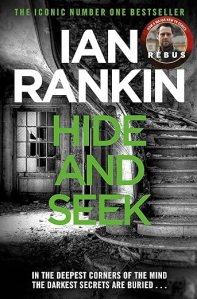
Hide and Seek by Ian Rankin:Book Notes

I finished reading Hide and Seek a few weeks ago and didn’t take any notes whilst reading it. That was  a mistake because now I come to write about it my memory of it is a bit vague. As the main point of my blog is to record what I think about the books I’ve read and to remind me of them, this is not good.

Hide and Seek is Rankin’s second book featuring Rebus. It begins with a junkie in a squat in Pilmuir, Edinburgh shrieking “Hide!” and in fear of his life. Pilmuir is a run-down housing estate, with boarded-up terraced houses, ruptured drainpipes, broken fences and missing gates. “Edinburgh’s army of squatters” had made it their den and it is here that the junkie’s body is found:

Two large candles had burnt down to the shapes of fried eggs against the bare floorboards, and between them lay the body, legs together, arms outstretched. A cross without the nails, naked from the waist up. Near the body stood a glass jar, which had once contained something as innocent as coffee, but now held a selection of disposable syringes. Putting the fix into crucifixion, Rebus thought with a guilty smile. (p196 in the compilation volume Rebus the Early Years)

In Hide and Seek Rankin makes use of word-play, with puns on R L Stevenson’s Dr Jekyll and Mr Hyde and other literary references – the characters of Watson and Holmes for example. Superintendent “Farmer” Watson has assigned Rebus to help with the anti-drugs campaign, which brings him into contact with wealthy businessmen who prove to be just as evil as Mr Hyde. But this is no straight forward contrast between good and evil and Rebus himself is no angel.

It was interesting to see the development of Rebus’s character and the prickly relationship between him and Brian Holmes, a young officer Rebus ropes in to help him. Rebus treats him as a message boy, a dogsbody. Holmes is more than that and is offended when Rebus tells him he is the  “one with the shoeleather”, but it is only by working together that they discover the killer’s identity.

Turbulence by Giles Foden: Book Review

turbulence001

I received an uncorrected proof of Turbulence from the publishers Faber and Faber through LibraryThing’s Early Reviewers Program. I should have found it boring because most of the characters are scientists – meteorologists, to be precise – and a lot of the dialogue is scientific concerning the theory of weather forecasting and mathematical forecasting in particular. Maths is not my strong subject and a lot of this was beyond me. There was just too much detailed information. Yet, strangely this book gripped me and once I’d got through the first chapter, which was very technical and odd, about making a ship out of ice to transport water to Saudia Arabia, it was compelling reading.

The main action takes place during 1944 in the run up to D-Day. The narrator is Henry Meadows a young meteorologist working for the Met Office. He is sent up to Scotland to find out about the “Ryman number”  from Wallace Ryman, a pacifist and former meteorologist who devised the formula that will make forecasting the weather over a longer period more accurate. This is just what the Allies need to know in preparing for the invasion of Normandy. Ryman is based on Lewis Fry Richardson, who devised the Richardson number, which enables the turbulence of different weather systems to be measured (hence the title of the book). I don’t have a clear picture from the novel of what this actually is or how it works, but it was his work in forecasting a  break in the bad weather conditions in the Channel that fixed the date of D-Day as 6 June 1944.

Ryman is the most interesting character in the  book. He is opposed to war, now  pursuing peace studies and is known as a difficult, stubborn character. Henry finds him awkward, uncooperative and reluctant to talk about his work at first. The book began to come to life for me in this section when Henry and Ryman and his wife Gill start to get to know each other, made more interesting by the tensions in the Rymans’ marriage. At this stage Henry’s own fragility becomes obvious from passages where he recalls his childhood in Africa and the death of his parents.

The action moved back to London and began to drag a little, but picked up as Henry became more involved in the disagreements between the meteorologists from different countries, brought together over the phone to pool their resources about methods and interpretation. Henry is assigned to go with the invasion forces as Met liaison between the British and Americans. This provides a dramatic ending to the book as he is injured on landing in France.

Turbulence is a combination of theoretical and scientific information, philosophical musings (which were more meaningful to me), and a portrayal of complex and emotional characters. In the end I thought it was well worth the effort of reading it.

Good Evening, Mrs Craven by Mollie Panter-Downes

good-eveningThere are 21 short stories in Good Evening Mrs Craven: the War-time Stories of Mollie Panter-Downes. These portray the lives of people on the Home Front, getting on with their lives set against the backdrop of war. They’re not stories of action but their subjects are psychological, emotional and social.  They offer a glimpse into what life was like then – the mood, the atmosphere, the tension and the fear, the hopes and the devastation, the loss and the loneliness, the stress and the tragi-comedy of life.

Mollie Panter-Downes’s style is fluent, a touch journalistic, sometimes subtly ironic and most pleasurable to read. There are stories of housewives, evacuees, billeted soldiers and Home Front volunteers, of the ladies in the Red Cross sewing party who met ‘twice a week to stitch pyjamas, drink a dish of tea, and talk about their menfolk’,  the effects of food rationing, of lovers separated by the war and of ‘The Woman Alone’.

Social changes are highlighted in stories such as ‘Cut Down the Trees’. Forty Canadian soldiers are billeted at Mrs Walsingham’s big house by the river. Her maid, Dossie is horrified by the changes. She mourns the passing of the old way of life, blaming the Canadians:

Of course it wasn’t precisely their fault they were there, but it made her sick to hear their big boots clattering up and down the stairs and to see their trucks standing in line along thelime avenue. (page 150)

She looks forward to the end of the war:

When peace came, sane existence would be immediately resumed. Dossie sincerely believed that the big house, quietly chipping and mouldering above its meadows, would be instantly repopulated, as though by a genie’s wand, with faceless figures in housemaid’s print dresses, in dark-blue livery and gardener’s baize aprons. She believed that the lawns would be velvet again, that visiting royalty would once more point a gracious umbrella towards Mrs Walsingham’s Himalayan poppies, that the gentry would know their places and sit over their claret in the dining room, where they belonged.

In contrast, Mrs Walsingham is more realistic and accepts the inevitable change. When the trees are cut down to make space for the soldiers’  ‘paraphernalia’ she thinks it is an improvement, letting in more air and light. She says

It’s altered the view from this side of the house, but what’s a view? Everything else is changing so fast I suppose we shouldn’t bother about trees and water staying the way they were. (page 153)

The Gardens of the Dead by William Brodrick: Book Review

The Gardens Of The Dead

The Gardens of the Dead by William Brodrick is his second novel. Although this book is a page turner I felt it was rather disjointed in parts. I had to backtrack a few times to make sure I was following the plot and the timeline is occasionally confusing. But on the whole I thought the book was pretty good.

Elizabeth Glendenning QC dies of a weak heart at the start of the book. Ten years earlier she had successfully defended a guilty man, Graham Riley. Just before her death she devised a scheme to bring Graham Riley back to court and to implement this scheme she had enlisted the help of Father Anselm, the barrister turned monk and her son Nick. She left a safety deposit box key with Father Anselm along with instructions that he should open it in the event of her death. Once he does this a sequence of events is triggered as Father Anselm and Nick follow the trail laid out by Elizabeth.

Part of me, the cynical part, wondered why she did this – it would have been much simpler to simply leave a written account rather than set what turns out to be a puzzle to be solved. But another part of me enjoyed seeing the mystery unfold. There are several surprising and some not so surprising elements to this story of good and evil, of revenge, family loyalties, justice and morality.

I liked the character of Anselm. He is kind and patient, well versed in analysing information and questioning people from his work at the Bar and also a good listener. My favourite character though is Father Andrew, the Prior, who was fond of a saying from a Desert Father:

Don’t use wise words falsely.

So he didn’t talk much and was always cautious when he spoke, but throughout the book he has several conversations with Anselm which are always perceptive and wise.

I borrowed this book from the library and at the time I thought the author’s name was familiar to me but couldn’t remember reading anything by him or reading any reviews of his books. Later I realised that I have the first novel he wrote The Sixth Lamentation, languishing somewhere in my to-be-read piles. Now I really must dig it out to read more about Anselm.

The Thirteen Problems by Agatha Christie

agatha_christie_rcIn The Thirteen Problems by Agatha Christie a group of friends, including Miss Marple meet on a Tuesday night and tell sinister stories of unsolved mysteries. It was first published in the UK in 1933, collecting together short stories previously published in various magazines. The first story The Tuesday Night Club introduces the character of Miss Marple.

The members of the Tuesday Night Club are Miss Marple, her nephew Raymond West a writer, Joyce Lempriere an artist, Sir Henry Clithering the ex-Commissioner of Scotland Yard, Dr Pender a clergyman and Mr Petherick a solicitor. Raymond wonders what type of person succeeds best at unravelling mysteries and puts forward that the ‘art of writing gives one an insight into human nature’, but Miss Marple questions him thinking that ‘so many people seem to me not to be either bad or good, but simply, you know, very silly.’ Mr Petherick thinks imagination is dangerous and that it needs a legal mind to sift through the evidence looking only at facts to arrive at the truth. Whereas Joyce believes it takes a woman’s intuition, such as hers – an artist who has ‘knocked about among all sorts and conditions of people’. She discounts Miss Marple thinking she cannot possibly know about life only having lived in St Mary Mead.thirteen-problems

So they each tell a tale and are amazed when it is Miss Marple, sitting primly, ‘knitting something white and soft’ who comes up with the right solution each time by using her knowledge of human nature gleaned from observing similar cases in St Mary Mead. She sees similarities and makes connections the others overlook.

The second set of stories are told at Colonel and Mrs Bantry’s house, when the guests tell their after-dinner stories. Sir Henry is visiting them and suggests they invite Miss Marple to make a sixth guest at dinner, along with Jane Helier the beautiful and popular actress, and the elderly Dr Lloyd.  Again Miss Marple correctly solves the mysteries, seeing through the red herrings to discover even the crimes that no one even knew had been committed. As she says

a lot of people are stupid. And stupid people get found out, whatever they do. But there are quite a number of people who aren’t stupid, and one shudders to think of what they might accomplish unless they had very strongly rooted principles.

The Thirteen Problems is an easy read and the short stories are ideal for reading quickly and in isolation. They are not complicated and once Miss Marple starts her explanations the crimes are easily solved.

I particularly liked the first description of Miss Marple, sitting erect in a big grandfather chair she

wore a black brocade dress, very much pinched in round the waist. Mechlin lace was arranged in a cascade down the front of her bodice. She had on black lace mittens, and a black lace cap surmounted the piled up masses of her snowy hair.

Kerrie recently ran a poll asking Who is the Best Miss Marple? My answer was Joan Hickson because I liked her portrayal, and the way she spoke and behaved seemed to me to be Miss Marple. But even though she looked nothing like this description I still prefer to ‘see’ Joan Hickson as Miss Marple. A strange case (for me) of a TV portrayal taking precedence over a book.