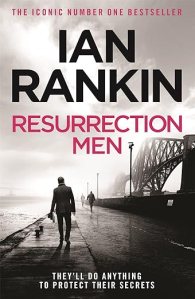
Resurrection Men by Ian Rankin: Book Review

I’m on a roll now with Ian Rankin’s Rebus books. Resurrection Men is excellent, so good that I couldn’t wait to get back to it each time I had to stop reading. And when I finished it I immediately got out the next book in the series A Question of Blood, which promises to be just as good.

Resurrection Men isn’t about body-snatchers (as I wondered it might be), but about the cops who need re-training, including Rebus. They’re at Tullialian, the Scottish Police College and they are a tough bunch indeed, ‘the lowest of the low‘ as one of them, DI Gray tells a witness he is interrogating:

We’re here because we don’t care. We don’t care about you, we don’t care about them. We could kick your teeth down your throat, and when they come to tell us off, we’d be laughing and slapping our thighs. Time was, buggars like you could end up inside one of the support pillars for the Kingston Bridge. See what I’m saying? (page 326)

To help them become team players – fat chance of that I thought – they’ve been given on old, unsolved case to work on. But Rebus was involved in the case at the time and begins to get paranoid about why is on the course. It’s a tough, gritty story and as with other Rebus books, there’s more than one investigation on the go, several, in fact, needing concentration to keep tabs on each one. Siobhan Clarke is now a DS and with Rebus away she is in charge of the case of the murdered art dealer. Siobhan is getting more and more like Rebus and has a much bigger part in this book than in previous books.

Rankin is great on characterisation – they’re all credible, I feel I know the main characters. His dialogue rings true to life and I felt like a fly on the wall throughout, a bit uncomfortable at times as Rebus gets into tricky situations and tries to work out who he can trust. Both he and I were unsure right to the end.
Bad Science by Ben Goldacre:Book Review

Bad Science is mainly about health issues, and how they are reported in the press which surprised me as I expected it to be more wide-ranging. It shouldn’t have been such a surprise as Ben Goldacre is a qualified doctor, working for the NHS. He also exposes the ‘tricks of the £30 billion food supplements industry and the evils of  the £300 billion pharmaceuticals industry’.

It’s a splendid rant against the lack of education and knowledge about health with the inevitable result that we are unable to understand and judge for ourselves the effectiveness of the various treatments on offer. He describes how placebos work,  just what homeopathy is, the misunderstandings about food and nutrition, and above all how to decide what works and what is quackery, scaremongering or downright dangerous. He is scathing about homeopathy, about Gillian McKeith’s lack of scientific knowledge and misleading claims, and dismisses Patrick Holford for the way he cherry-picks the data to suit his case, and makes extraordinary claims without evidence to back them up.

I very rarely read anything scientific but found this easy to understand, apart from the statistics, which cause my eyes to glaze over at the mere sight of a graph, tables or columns of figures. Fortunately there’s not a lot of that in this book.

There are disturbing chapters on such topics as the way some drugs trials are carried out – the distortion of evidence and the way harmful/negative effects are ignored or hidden. His chapters on health scares about MRSA and MMR are particularly interesting. Other topics were not so surprising, as I’ve always been sceptical about the value of taking food supplements and vitamins (even though I’ve taken vitamin C tablets for years).

Overall, even though I thought there was too much repetition and over explanation, I did learn quite a lot and it does provide food for thought.

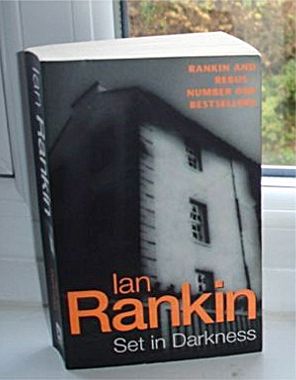
Set in Darkness by Ian Rankin:Book Review

Set in darkness

Set in Darkness was the first Inspector Rebus book I read, nearly three years ago. I’m currently reading all of them in sequence – this is the 11th in the series. I was pleased that I remembered so much about it and it didn’t spoil the tension at all, but then I hadn’t remembered all the details. I think I enjoyed it more the second time round as I knew the main characters and had seen them develop in the previous 10 books.

There are three cases Rebus and his colleagues are investigating. The first is the discovery of a corpse in one of the old fireplaces at Queensberry House, Edinburgh during the works to build the new Scottish Parliament building. The body, nicknamed Skelly by the police, had been bricked up around 1979, twenty years earlier. The second case is the murder of Roddy Grieve, a candidate for the Scottish Parliament, found in a summer house in the grounds of Queensberry House, and the third is the suicide of a tramp who had jumped off North Bridge over the deep gully that housed Waverley Station. The press nicknamed him Supertramp after a building society pass book was found in his belongings that revealed he owned £400,000. At the same time the police are investigating a rapist who is targeting singles clubs.

Rankin’s skill is in interweaving the cases. At no time does this seem contrived or forced, the links seem to unfold naturally as the investigation progresses. Rebus is out of favour with his boss, Farmer Watson, which is why he’d been seconded to the Policing of Parliament Liaison Committee to advise on security for the Scottish Parliament, but also why he was on the spot when Skelly was discovered. DS Siobhan Clarke is working on the rape case and on her way home from the singles club she witnesses Supertramp’s suicide, and is then assigned to his case. Siobhan is becoming more like Rebus, dedicated and obsessed cops, who like working on their own. The cop instinct defines them – always on the lookout, their lives not their own, but made up of other people’s lives (page 223 paraphrased).

This is a dark book; there is darkness within Rebus himself, as well as in the crimes he investigates. He doesn’t sleep at night, aand as one of the other characters says to him

‘We all come from the darkness, you have to remember that, and we sleep during the night to escape the fact. I’ll bet you have trouble sleeping at night, don’t you?’  He didn’t say anything. Her face grew less animated. ‘We’ll all return to darkness one day, when the sun burns out.’ (page 157)

He is a troubled soul, with ghosts in his life – past family and past friends who come to him as he sit sin darkness on long nights when he’s alone. He can see his career crumbling around him and ends up beaten and bloodied. He only survives with help from Big Ger Caffety, released from prison and still Edinburgh’s crime boss.

I loved this book.

The Right Attitude to Rain by Alexander McCall Smith

The Right Attitude to Rain is the third in the series of Isabel Dalhousie novels, set in Edinburgh and the Scottish Borders. It’s a pleasure to read but difficult to write about. Not a lot happens and reading it is like being inside Isabel’s head. She takes a great interest in the affairs of others and likes watching people. Some people might call this nosiness.

Some things do happen – Isabel is buying a flat for her housekeeper, Grace. Cat, her niece has a new boyfriend, Patrick, but Isabel doubts his possessive mother is happy about that. Meanwhile she is wondering if her love for Jamie, 14 years her junior and Cat’s ex-boyfriend, could ever be reciprocated:

There is no point in my loving this young man, she told herself, because it can never go anywhere. And yet did it matter if love was not reciprocated? Was it not possible to love somebody hopelessly, from a distance even, and for that love to be satisfying, even if never reciprocated, even if the object of one’s affections never even knew? (page 33)

A large part of the book is taken up with their developing relationship and the tensions it arouses. Then there is the American couple Isabel watches in the Scottish Gallery who turn out to be friends of her cousin Mimi, who is staying with her for a few weeks. This gives Isabel the opportunity to meet the couple and become involved in their lives. Mimi also has a revelation concerning Isabel’s ‘sainted American mother’, which causes Isabel some distress.

It’s a study of relationships, communication and misunderstandings as Isabel mulls over philosophical and moral dilemmas, and conducts internal debates instead of simply making a decision and acting upon it. Grace sums her up admirably:

Isabel’s life was a good one; she was a kind woman, and she felt for people, which was more than one could say about a lot of people in her position, Grace thought. But there were certainly areas of Isabel’s life where what was required was a little less thought and a bit more action. (page 125)

What about the rain? Well, it all depends on your attitude – any hint of warm weather and you’re optimistic about being outside:

… but resigned to being driven back in by rain, or mist, or other features of the Scottish summer. (page 10)

I’d add that it’s not only Scotland where it rains …

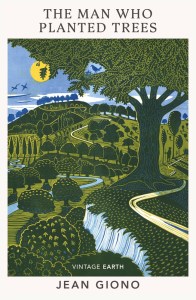
The Man Who Planted Trees by Jean Giono

I have always liked trees, particularly in spring when you can see the branches through the leaves and in autumn when the leaves change colour and fall to the ground. There are many trees in our garden and when we moved here last December the trees were bare and I couldn’t recognise many of them, having forgotten how to identify them by their shape and structure. As they began to grow leaves and blossom I still couldn’t identify all of  them (except the sycamores, silver birch and weeping willow) and so as usual turned to books and the internet for information. The best book I found is The Reader’s Digest Field Guide to the Trees and Shrubs of Britain. This has illustrations and photos of different ways to identify trees – by their bark, buds, flowers, leaves, twigs and shape. Some of the trees here are well established, predating the house and others are quite young – the history of the garden is probably more interesting than the history of the house.

Given my interest in trees Simon’s review of The Man Who Planted Trees by Jean Giono intrigued me. Then I discovered that the local library actually had a copy. It’s very short book (a short story really), just over 50 pages, with illustrations – wood engravings by Michaell McCurdy, about a shepherd who transformed the land by planting trees. Not just a few trees, thousands of them over the years. Where once the earth was dry and barren the trees brought water back into the dry stream beds, seeds germinated, meadows blossomed and new villages appeared. Contrasted against a background of the destruction caused by war, the lonely shepherd, Elzeard Bouffier shows the power of nature to regenerate the land, planting oaks, birches and beech trees:

Creation seemed to come about in a sort of chain reaction. He did not worry about it; he was determinedly pursuing his task with all simplicity; but as we went back to the village I saw water in brooks that had been dry since the memory of man. This was the most impressive result of chain action that I’d seen. (page 25)

The wind too scattered seeds. As the water reappeared, so there appeared willows, rushes, meadows, gardens, flowers, and a certain purpose in being alive. (page 26)

In an Afterword by Norma L Goodrich, she recounts how she met Jean Giono in 1970 shortly before his death. His book was first published in Vogue in 1954 under the title The Man Who Planted Hope and Grew Happiness. His purpose in writing this story was to

… make people love the tree, or more precisely, to make them love planting trees. (page 45)

It’s a simple story, simply told of the harmony possible between man and nature.

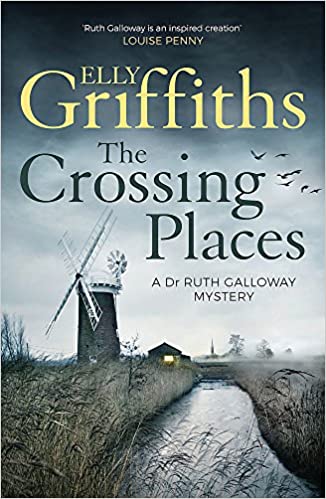
The Crossing Places by Elly Griffiths: Book Review

When I started reading The Crossing Places by Elly Griffiths I nearly didn’t bother carrying on because it’s written in the present tense, but I’m glad I did because I did enjoy it and at times didn’t even notice the tense. This is a debut crime fiction novel, even though it’s not the author’s first book.

Set in Norfolk it’s an interesting mix of investigations into a cold case – the disappearance of Lucy, a five year old girl ten years earlier and a current case of another missing four year old girl. Are they connected and just how does the discovery of a child’s bones from the Iron Age fit in? The police ask Dr Ruth Galloway, who lectures in archaeology at the local university and lives near the finds in a remote cottage at Saltmarsh overlooking the North Sea, to date the bones. She becomes more involved when DI Harry Nelson asks her to look at the anonymous letters the police have received ever since Lucy disappeared – strange letters full of archaeological, biblical and literary references, taunting the police about Lucy’s whereabouts and details of ritual sacrifice.

There’s a satisfying amount of information about Ruth’s earlier life and just enough about the archaeological digs to whet my appetite, plus some whacky characters like Cathbad who lives in a decrepit caravan on the beach. I liked Harry Nelson, a gruff northerner obsessed by Lucy’s disappearance and I became very fond of Ruth, an overweight woman nearing forty who lives on her own with two cats. I found the setting in Norfolk  in winter with its immense skies was very atmospheric – its remoteness, treacherous mud flats, marshlands and driving rain made feel as though I was there. In fact there were parts of the story involving quicksand that reminded me of Wilkie Collins’s The Moonstone, in which Rosanna Spearman drowns in quicksand on the marshes and there is a remarkable similarity between the names of Sergeant Cuff (in The Moonstone) and Sergeant Clough (in The Crossing Places).

The mystery isn’t too difficult to solve and I’d guessed the culprit quite early on in the book, so the ending wasn’t a surprise. I thought there were maybe just one too many coincidences in the connections between the characters, but none of this spoilt the book for me and I’m adding the next Ruth Galloway book, The Janus Stone to my list of books to look out for.