Blood Safari by Deon Meyer: Book Review

Blood Safari by Deon Meyer, originally written in Afrikaans, translated by K L Seegers is set in South Africa. It’s a tense thriller/detective story.

Lemmer was demolishing a wall between the kitchen and bathroom on Christmas Day when the phone rang. It was his boss at Body Armour, a company specialising in personal security. Lemmer is a professional bodyguard and is hired by Emma Le Roux after she was attacked in her home by three men wearing balaclavas. Her brother, Jacobus had disappeared twenty years previously, but she thinks she saw him on the news, suspected of killing four poachers near the Kruger National Park and she is convinced by an anonymous phone call,  that the attack is connected to her brother.

Desperate to know whether Jacobus de Villiers is in fact her brother, Emma and Lemmer travel to the Lowveld to find out. This leads them into all sorts of dangers and Lemmer, who has a short fuse, doesn’t know who can be trusted, including Emma herself. Lemmer, an ex-con is the strong silent type. His First Law is: Don’t get involved and his second is Trust nobody. Despite that when someone tries to murder both him and Emma he has no choice.

This isn’t just crime fiction, however. It’s also a novel about South Africa, the countryside and its people. I found that just as fascinating, although at times the environmental issues came over as lectures and maybe would have been better if they were shorter – I now know quite a bit about African vultures amongst other things. But that is just a minor criticism as the book as a whole is totally engaging, with a satisfying plot, convincing characters and a colourful and well-drawn setting.

The Mystery of Edwin Drood by Charles Dickens

Edwin Drood 001It’s been a few weeks now since I finished reading The Mystery of Edwin Drood by Charles Dickens, his last and unfinished book. I was surprised that it took so long before the mystery actually began to emerge and that it’s more the story of Edwin Drood’s uncle, John Jasper, than it is of Drood himself.   I was also surprised that much of it is written in the present tense, a style that I’m not too keen on. I haven’t read a Dickens novel for a few years and found the difference in style between this and modern mystery novels interesting. The build up to the mystery is so much more leisurely and descriptive than in modern novels, and I had to tone down my impatience for something mysterious to happen. Once I’d passed these hurdles I enjoyed the book immensely, even though I knew that the mystery is left open.

It begins dramatically with a scene in an opium den where Jasper lies under the influence of several pipes of opium, trembling and almost incoherent from the visions that came to him. According to the introduction to the book, Dickens took great care to make the scenes in the opium den authentic and had visited one in the east end of London, under police guidance. The mystery only becomes apparent when Drood has disappeared and cannot be found.

He had been engaged to Rosa Bud from their childhood days and both had realised that they didn’t want to get married. Before that Neville Landless and Edwin had come to blows over Rosa, but made up their differences just before Edwin disappears, but Jasper spreads suspicion that Neville may have killed him.

The novel abounds with wonderful characters – Canon Crisparkle, Neville’s mentor; Durdles a stonemason and his assistant, Deputy, whose tasks include making sure the drunken Durdles gets home safely, by the unlikely means of throwing rocks at him; and my favourite character, Mr Grewgious, a lawyer and Rosa’s guardian. Over and above these characters is the setting of Cloisterham (Rochester), with its Cathedral and sinister and dark background, ideal for secrecy and crime:

… a certain awful hush pervades the ancient pile, the cloisters, and the churchyard, after dark, which not many people care to encounter.

The inhabitants of Cloisterham feel

the innate shrinking of dust with the breath of life in it, from dust out of which the breath of life has passed. (page 105)

The mystery remains unsolved. What did happen to Edwin Drood? Was he killed and if so was it by John Jasper, his uncle, obsessed with his passion for Rosa? Who is Datchery, a stranger who arrives in Cloisterham six months after Edwin’s disappearance and what is his part in the story? And what is ‘Er Royal Highness the Princess Puffer’, the opium den woman’s connection with Jasper? I suppose it’s up to each reader to decide, although there is an account given by Forster, Dickens’s friend, in which he wrote that Dickens had intended it to be a story of the murder of a nephew by his uncle, but we’ll never know if that was so.

Also reviewed by A Library of My Own.

Sunday Salon – Current Books

I finished reading The Fall by Simon Mawer yesterday. It is the story of Rob Dewar and Jamie Matthewson from their childhood up to Jamie’s death 40 years later. But it’s also the story of their parents and how their lives are interlinked. I found it enthralling, one of those books that make me want to look at the ending to see how it all turns out. I managed to stop myself, however, and read impatiently to the end anxious to know what actually happened between them all.

It moves between the two generations beginning in the present day, when Rob hears on the news that Jamie, a renowned mountaineer has fallen to his death in Snowdonia. No one is sure whether it was an accident or suicide. Then it moves  back 40 years to the time when the two boys met, both fatherless – Jamie’s dad, Guy went missing when climbing Kangchenjunga and Rob’s parents are divorced, and back yet further again to 1940 when Guy Matthewson met the boys’ mothers – Meg (later calling herself Caroline) and Diana. And so  the drama unfolds in the mountains of Wales and the Alps, culminating on the North Face of the Eiger.

The Fall is not just a gripping account of the dangers of rock climbing and mountaineering, but it’s also a love story, with the intricacies of relationships, and love, loss and betrayal at its core. The love stories and the climbing scenes are both shown through the imagery of falling with all its ambiguities – actual falls, falling in love, falling pregnant and falling from grace. It’s beautifully written, capturing not only the mountain landscape but also London during the Blitz. This is the second excellent book by Mawer that I’ve read, even though it has a rather predictable ending.

I’m still reading Agatha Christie’s  An Autobiography and will be for some time as it is long and detailed – 550 pages printed in a very small font, which makes it impossible for me to read it in bed. But it is fascinating. It’s not just an account of her life but is full of her thoughts and questions about the nature of life and memory:

I am today the same person as that solemn little girl with pale flaxen sausage-curls. the house in which the spirit dwells, grows, develops instincts and tastes and emotions and intellectual capacities, but I myself, the true Agatha, am the same. I do not know the whole Agatha. The whole Agatha, so I believe, is known only to God.

So there we are, all of us, little Agatha Miller, and big Agatha Miller, and Agatha Christie and Agatha Mallowan proceeding on our way – where? That one doesn’t know – which of course makes life exciting. I have always thought life exciting and I still do. (page 11)

I’ll be writing more about Agatha Christie on Wednesday for my contribution to the Agatha Christie Blog Tour.

The Naming of the Dead by Ian Rankin: Book Review

As the police prepare for the G8 Conference at Gleneagles in July 2005, DI Rebus is apparently surplus to requirements, not much more than a year away from retirement. No-one would blame him for coasting, but that’s not his way. The Naming of the Dead begins with a funeral, that of Michael, Rebus’s brother which fills him with remorse and nostalgia. But true to form he puts work before family when DS Siobhan Clarke phones to tell him of progress in the search for Cyril Colliar’s killer.
Colliar had been killed six weeks earlier and his death was the first in a series of killings of convicted rapists who had recently been released from prison. Items of clothing were found at the Clootie Well, leading forensics to identify the victims. The police had not gone overboard in trying to find the killers, but Colliar was one of Big Ger Cafferty’s men, and the gangleader wants his killer found. He leads Rebus and Siobhan to BeastWatch , a website giving details of rapists and their release dates.

Matters are complicated by the death of Ben Webster, a Labour MP at the conference. He fell from the ramparts of Edinburgh Castle. It’s not clear whether his death was an accident, suicide, or murder. Rebus’s investigation is hampered by Steelforth from Special Branch. Siobhan’s attention is diverted when her parents arrive in Edinburgh to take part in the protests and her mother is injured. Siobhan is determined to find the culprit, particularly if it’s one of the police. Then there is the local councillor Gareth Tench, who gets involved and is then killed.

As with all of Ian Rankin’s Rebus books this has a convoluted plot, with several sub-plots and many characters. Rebus as ever, is dogged and determined, cynical and weary, fighting against the odds and wishing for and fearing his retirement – what would he do? Cafferty and Rebus have their usual sparring matches and Siobhan seems to be drawn into Cafferty’s web.

There is an emphasis on family relationships and loyalties, and reflections on power and the effects of the loss of power as both Rebus and Cafferty are feeling their age:

It struck Rebus that what Cafferty feared was a loss of power. Tyrants and politicians alike feared the self-same thing, whether they belonged to the underworld or the overworld. The day would come when no one listened to them any more, their orders ignored, reputation diminished. New challenges, new rivals and predators. Cafferty probably had millions stashed away, but a whole fleet of luxury cars was no substitute for status and respect. (page 257)

For me there is too much in this book about the G8 conference and the political scene and I got restless in the middle of the book because of that. But overall I enjoyed this last but one book before Rebus finally retires.The title comes from the ritual of reading out the names of a thousand victims of warfare in Iraq. Siobhan reflects that this summed up her whole working life.

She named the dead. She recorded their last details, and tried to find who they’d been, why they’d died. She gave voice to the forgotten and the missing. A world filled with victims, waiting for her and other detectives like her. Detectives like Rebus too, who gnawed away at every case, or let it gnaw at them. Never letting go, because that would have been the final insult to those names. (page 135)

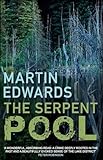
The Serpent Pool by Martin Edwards: Book Review

I’d been eagerly looking forward to reading Martin Edwards’s latest Lake District Mystery, The Serpent Pool and it didn’t disappoint. It’s a  terrific book. It has everything, a great sense of location, believable, complex characters, a crime to solve, full of tension and well paced to keep you wanting to know more, and so atmospheric. I loved all the literary connections, the secondhand bookshop, the book collectors and historian, Daniel Kind’s research into the 19th century writer, Thomas de Quincey and his history of murder.

The earlier books in the series are The Coffin Trail, The Cipher Garden, and The Arsenic Labyrinth, featuring DCI Hannah Scarlet, in charge of the Cumbria’s Cold Case Team, her partner Marc Amos, a rare book dealer and Daniel Kind, a historian and the son of Hannah’s former boss, Ben Kind. See Martin’s website for more information.

The Serpent Pool begins with the death of George Saffell, one of Marc’s customers, stabbed and then burnt to death amidst his collection of rare and valuable books.The motive for his killing, the subsequent death of another of Marc’s customers, Stuart Wagg, and the connection with the cold case Hannah is investigating gradually become clear.

Hannah is investigating the apparent suicide of Bethany Friend who had drowned 6 years earlier in the Serpent Pool, a lonely, isolated place below the Serpent Tower, a folly high on a ridge. Her mother refused to accept she had killed herself, she had no suicidal tendencies and no known history of depression. She had drowned in just eighteen inches of water and was found with her hands loosely tied behind her back and her ankles tied together. Hannah and Greg Wharf, her new detective sergeant set about re-interviewing all the witnesses.

When Hannah discovers that Marc knew Bethany she wonders what he is hiding and why he had never mentioned it to her. Their relationship is not going well and to make matters worse she is still attracted to Daniel. Marc, in turn, seems dangerously attracted to Cassie Weston, a new employee.

The complex plot kept me guessing to the end of this gripping murder mystery.

Thirteen Hours by Deon Meyer: Book Review

Thirteen Hours by Deon Meyer (translated from Afrikaans by K L Seegers) is a great book. I was engrossed in it right from the start. It’s tense, taut and utterly enthralling. Moving at a fast pace the book follows the events during the thirteen hours from 05:36 when Rachel, a young American girl is running for her life up the steep slope of Lion’s Head in Capetown.  The body of another American girl is found outside the Lutheran church in Long Street. Her throat slit had been slit. An hour or so later Alexandra Barnard, a former singing star and an alcoholic, wakes from a drunken stupor to find the dead body of her husband, a record producer, lying on the floor opposite her and his pistol lying next to her.

It’s not just the story that makes this book such a gripping read, but the characters are so well-drawn too. DI Benny Griessel is mentoring two inexperienced detectives who are investigating these crimes. I grew very fond of Benny, who is also an alcoholic and struggling to keep his marriage together. He deals with mentoring his charges very well, with patience and expertise, but also gets emotionally involved when Rachel’s father entreats him to save his daughter. There are many other memorable characters, such as Inspector Mbali Kaleni, a Zulu woman with a powerful personality who commands people’s attention, and the elderly Piet van der Lingen, who helped Rachel, looking like an ‘aged monk with his thinning grey hair around the bald spot that shone in the flourescent light.’

The two cases move along parallel to each other, keeping me desperate to know what happened next in both. The book also reflects the racial tension in the ‘new South Africa’ with its mix of white, coloured and black South Africans. There is a strong sense of location, not just from the cultural aspect but also geographical because although I know nothing about Capetown I had no difficulty in visualising the scenes from Meyer’s descriptions.

Without doubt this has to be one of the best books I’ve read this year, one that had me eager to get back to it each time I had to stop reading.