Crime Fiction Alphabet – Letter J

I was undecided what to write about for the letter J in Kerrie’s Crime Fiction Alphabet series. I could have chosen P D James’s book The Private Patient, or Peter James’s Not Dead Enough or Jed Rubenfeld’s The Interpretation of Murder, all of which are in my to-be-read piles. But these, inviting though they are, are longish books and I haven’t started any of them yet.

Instead I picked one of the books I’ve borrowed recently from the library by Janie BolithoBetrayed in Cornwall, a quick, easy read. Janie Bolitho was born in Falmouth, Cornwall and her books have a very strong sense of place. She became a full-time writer after being employed as a bookmaker’s clerk, a debt collector, a tour operator’s assistant and a psychiatric nurse. She died of breast cancer in 2002. The first book of hers I read was Snapped in Cornwall, which is the first book in her series of mysteries featuring Rose Trevelyan (see  my review). I think Betrayed In Cornwall (the fourth in the series) is a better book.

Rose is an artist and is holding her first solo exhibition in oil paintings. When her friend Etta Chynoweth doesn’t turn up at the pre-opening private viewing she is concerned and then shocked to discover that Joe, Etta’s son had been found dead at the bottom of a cliff, a packet of heroin near his body. The police think he was involved in drug dealing but Rose and Joe’s family can’t believe that. Rose is convinced that Joe was murdered and that he was set up. Then Joe’s sister, Sarah goes missing. She’d seen Joe with two men on the night he died, near where he died. Did she know too much? Etta has been having an affair with a married man – is he involved and how? Rose has her own ideas and sets about investigating on her own, then everything goes wrong. Add into this mix Rose’s relationship with DI Jack Pearce, a relationship she had broken after a year. Everyone except Rose can see how he still feels about her but she just cannot admit what she feels about him.

I enjoyed this book for what it is, a murder mystery with a ‘cosy’ feel. The characters are quickly drawn, but I still felt they were believable, the writing is fluent, and the Cornish location is superb.
Crime Fiction Alphabet – Letter I

Rebus’s Scotland: A Personal Journey by Ian Rankin is my choice to illustrate the letter I in Kerrie’s Crime Fiction Alphabet.

If you like the Rebus books, like me, then you’ll also like this book. It is fascinating to read, with insights into Ian Rankin’s own life and that of the character he has invented, along with his thoughts on Scotland and the Scottish character. It’s partly autobiographical, blending his own life with Rebus’s biography. It also describes many of the real life locations of the books, in particular Edinburgh, Rebus’s own territory.

I particularly enjoyed Ian Rankin’s views on writing – how writers mine their own experiences, reshaping their memories to create fiction and the similarities between novelists and detectives:

Both seek the truth, through creating a narrative from apparently chaotic or unconnected events. Both are interested in human nature and motivation. Both are voyeurs. (The Edinburgh-born Muriel Spark says that she and her fellow novelists ‘loiter with intent’ – playing on the idea of a criminal activity.) I certainly enjoy dipping into other people’s lives, giving fresh texture and tone to them, while Rebus has his own reasons for prying into everyone else’s secrets. (page 31)

He went on to quote from The Hanging Garden and then The Falls giving Rebus’s reasons – which were ‘to stop him examining his own frailties and failings.’

I’ve read all the Rebus books – links to my posts are in the Author Index (the tab at the top of the blog). Some of these are brief and last year I decided to make a page on each one to flesh them out a bit more. So far, that just remains an intention, although the parent page has a list of all the books. In preparing to write Rebus’s Scotland Ian Rankin re-read all his Rebus books. Here is his own analysis:

Authors seldom read their own work: by the time a book has been published, we’re busy with our next project. When a story is done, it’s done – reading it through would only make most authors want to tinker with it. Having said that, I enjoyed the majority of the Rebus novels. Knots & Crosses I thought wildly overwritten – definitely a young man’s book. Dead Souls possesses too many characters and story-lines: at points it confused even its author! But several books which had seemed real chores to write surprised me with their deftness – Set in Darkness and Let it Bleed especially. (I think they probably seemed chores because of the amount of political detail they had to embrace – it’s never easy to make politics seem exciting to the layman.) (page 125)

Throughout this book Ian Rankin quotes liberally from his books to illustrate the points he makes. He begins with a chapter on the place where he was born and grew up, which was in the same cul-de-sac as John Rebus – even in the same house. But really, of course, Rebus was not born there. He was created in a bed-sit in Edinburgh where Rankin was living and writing. He deals with Rebus’s ‘prodigious intake of alcohol‘, the Oxford Bar, his taste in music, the city of Edinburgh (Rebus’s territory) and Fife, where Rebus and Rankin have shared memories. I like the way he writes about Rebus as though he were a real person, sometimes admitting that he’s not sure what Rebus will do, but at the same time acknowledging that he is his creation.

An excellent book. My only criticism is that I would have loved it to have an index – maybe I’ll do one for myself

  • Paperback: 224 pages
  • Publisher: Orion; New Ed edition (1 Jun 2006)
  • Language English
  • ISBN-10: 0752877712
  • ISBN-13: 978-0752877716
  • Source: my own copy

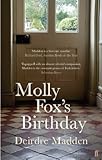
Molly Fox’s Birthday by Deirdre Madden: Book Review

I loved Molly Fox’s Birthday by Irish author, Deirdre Madden.

It takes place in one day, that day being Molly Fox’s birthday. Her friend, the unnamed narrator is staying in Molly’s house in Dublin whilst Molly is away and she reminisces about their friendship, wondering why Molly doesn’t like to celebrate her birthday. Molly is an actress and her friend a playwright, who has written plays in which Molly acted. Their friendship goes back a long way and during this one day she contemplates their past, how their relationship evolved and the relationships with their friends and families.

She thinks about their mutual friend Andrew, an art historian, Fergus, Molly’s disturbed brother, Tom, her own brother who is a priest and during the day both Andrew and Fergus turn up an announced on Molly’s doorstep. It’s written at a gentle pace, with vivid descriptions of the setting – the house and garden in Dublin

The big clock at the head of the stairs bonged softly for nine-thirty. I carried the mug out of the kitchen, into the hall and through to the sitting room. It looked this morning like some kind of jewelled casket, like a box of treasures. sunlight caught on copper and brass, was reflected in polished wood and mirrors. All this glitter and brightness was offset by the rich dark colours of the kilims on the floor. (page 44)

It’s a novel about identity as well as family and friendship, about how we see other people and how they see us. For example she had never really got to know Fergus but had heard of his problems from Molly. During her conversation on this day she realised that the Fergus she knew through Molly ‘timid, weak, a failure in life‘ had disappeared and the man she now knew for herself was a ‘man of wisdom and acute moral knowledge‘. It’s a novel about character and about the parts we play as well as the people we are, what we hide from others and what we reveal  to others. It’s the sort of book I could happily re-read and still find plenty to think about.

My first book towards the Ireland Reading Challenge.

Crime Fiction Alphabet: Letter H

Letter HThis week it’s time for the letter H in Kerrie’s Crime Fiction Alphabet and I’ve chosen Reginald Hill’s Exit Lines, which is a Dalziel and Pascoe crime novel.

I first knew of Dalziel (pronounced Dee-ell) and Pascoe from the BBC television series starring Warren Clarke and Colin Buchanan, without realising that the stories were based on Reginald Hill’s books. I’ve since read a few of the books and not in the order Hill wrote them, although I have read the first one that introduced Chief Superintendent Andy Dalziel and DS Peter Pascoe – A Clubbable Woman, first published in 1970. There are now 24 in the Dalziel and Pascoe series.

Reginald Hill grew up in Cumbria and is a former resident of Yorkshire, which is the setting for his police procedural novels. After serving in the army he went to Oxford University and then became a teacher, before giving that career up in 1980 to be a full-time writer. He has won numerous awards, including the Crime Writers’ Association Cartier Diamond Dagger for his lifetime contribution to the genre. He has also written another mystery series featuring Joe Sixsmith and numerous other books, including some under the pseudonyms Patrick Ruell, Dick Morland and Charles Underhill.

Exit Lines, first published in 1984 is the eighth book in the series and Pascoe is now a Detective Inspector. He and Ellie, his wife are celebrating their daughter’s first birthday on a cold and storm-racked November night when he is called out to investigate the death of an old man found in his bath bruised and bleeding. This is just the first of three deaths that night. All three victims were elderly and died violently and a drunken Dalziel is a suspect in one as it seems he was driving the car that hit an elderly cyclist. The third victim was found dying, having fallen whilst crossing the recreation ground.

Each chapter is headed with famous last words – exit lines from literary and historical people, such as George V – ‘Bugger Bogner’ and Oscar Wilde – ‘Either this wallpaper goes or I do’.  The emphasis is on death and dying, and the ageing process is alarmingly illustrated not only through the lives of the victims but also by the sad portrayal of Ellie’s father as his senile dementia develops.

The plot is intricate, each separate case being linked in one way or another. There is some comic relief in the character of Constable Tony Hector, nicknamed ‘Maggie’s Moron’:

PC Hector had been the first officer on the scene and was therefore a potential source of illuminating insights. Unfortunately he was to Pascoe the last person he would have wished first. His principal qualification for the police force seemed to be his height. He was fully six feet six inches upright, though at some stage in his growth he had reached a level of embarrassment which provoked him to shave off the six inches by curving his spine forward like a bent bow and sinking his head so far between his shoulders that he gave the impression that he was wearing a coat-hanger beneath his tunic.

Although Dalziel  denies he was driving the car that hit the cyclist his actions are extremely suspect and he is sidelined, Pascoe leading the investigations. Just what Dalziel was up to doesn’t become clear until the end of the book. Exit Linesis an excellent crime fiction novel which kept me guessing until the end, and although I did have an inkling about Dalziel’s actions, the causes of the three deaths were a surprise to me.

The Small Hand: A Ghost Story by Susan Hill

Susan Hill’s The Small Hand: A Ghost Story is a novella, quickly and easily read, but it is not a scary ghost story. I think it could have worked better if it had been reduced to a short story – I felt even though it’s short that it had a certain amount of extra padding that reduced the tension and atmosphere. It felt rather limp and I was more interested in the main character’s book searches than in his search for the ghostly owner of the small hand that creeps into his.

It begins well. Adam Snow, a dealer in antiquarian books and manuscripts gets lost on his way home from visiting a client when he comes across a derelict Edwardian house. Wandering around the garden he feels compelled to know more about it, to see more, to find out what had happened and why the house had been abandoned. It was there in the garden that he had a strange experience:

And as I stood I felt a small hand creep into my right one, as if a child had come up beside me in the dimness and taken hold of it. It felt cool and its fingers curled themselves trustingly into my palm and rested there, and the small thumb and forefinger tucked my own thumb between them. As a reflex, I bent it over and we stood for a time which was out of time, my own man’s hand and the very small hand held as closely together as the hand of a father and his child. But I am not a father and the small child was invisible. (page 7)

But as I read, despite the pleasure of reading Susan Hill’s descriptive writing, I began to lose interest in the plot. At the end I thought it was more of a sad, mournful tale than a ghost story.

True Grit by Charles Portis: Book Review

True Grit is a change of genre for me and I would not have chosen to read it myself – it’s my face-to-face book group book for this month. We met last night – the overall opinion was that it was OK, but rather disappointing, not living up to the quotes on the back of the book, or to the Introduction by Donna Tartt, who explained how much she and her family loved the book.

I used to like watching Westerns, but I don’t think I’ve read any since I was a child. My library had quite a lot of what I thought of as ‘cowboy’ books and after I’d read all the fairy tale books I moved on to those. I’ve watched the John Wayne film True Grit many years ago and remembered very little about it, other than an old and overweight Wayne wearing an eye patch helping a girl to trace her father’s murderer. And that is really the plot in a nutshell.

Mattie Ross, the girl in question, is a determined 14 year-old who in the 1870s leaves her mother and younger brother at home whilst she sets out after Tom Chaney, who had worked for her father and had killed him. Chaney had joined a band of outlaws – the Lucky Ned Pepper gang and gone into hiding in the Indian territory , which was under the jurisdiction of the US marshals. The sheriff tells her that one of the marshals, Rooster Cogburn is the ‘meanest’, a ‘pitiless man, double-tough, and fear don’t enter into his thinking. He loves to pull a cork.’ She hires him to get Tom Chaney.

In the book Cogburn is not quite like the John Wayne portrayal. He’s younger, in his late forties, but he is fat, one-eyed with walrus moustaches, unwashed and drunk most of the time. Most of our group had difficulty accepting that a 14 year old girl would behave as Mattie does or that Cogburn and LaBoeuf (a Texas Ranger who is also looking for Chaney) would take her along with them.

I liked the format of the story told from Mattie’s point of view as an adult remembering what had happened and the straight forward style. She is a very down-to-earth character who sees things as either right or wrong and backs up her opinions with Bible texts. The other characters are a bit like cardboard cutouts though and not too convincing. It’s a quick easy read but not one to stay in my mind for long – I finished it over a week ago and my memory of the detail is fading already. However, it has made me interested in watching John Wayne’s True Grit (it was on TV last week and we recorded it) and in seeing the new film, starring Jeff Bridges, Matt Damon,  Josh Brolin and Hailee Steinfield as Mattie.