October Prompt: A Classics Challenge

This month’s prompt in Katherine’s Classics Challenge 2012 is:

Chapter Musings
Jot down some notes about the chapter you’ve just read or one that struck you the most. It can be as simple as a few words you learned, some quotes, a summary, or your thoughts and impressions.

I’ve just started to read The French Lieutenant’s Woman by John Fowles. (I have read this book years ago and seen the film.) The first chapter is very short and sets the scene in a few paragraphs. The narrator is looking back to March 1867, presumably from the twentieth century. Three characters are present, none named in this first chapter, a man and a woman walking along the Cobb, ‘ a long claw of old grey wall that flexes itself against the sea’, and a solitary figure, standing at the end of the Cobb:

It stood right at the seawardmost end, apparently leaning against an old cannon-barrel upended as a bollard. Its clothes were black. The wind moved them, but the figure stood motionless, staring, staring out to sea, more like a living memorial to the drowned, a figure from myth, than any proper fragment of the petty provincial day.

The narrator is authoritative, contrasting the Victorian Lyme of a hundred or so years earlier with that of the present day and contrasting the style of dress and manners. There are literary and historical allusions, including the verse (quoted at the beginning of the chapter) from Thomas Hardy’s poem ‘The Riddle‘, and the vocabulary is also formal and academic. There are some unfamiliar words – just what I wondered are ‘dundrearies’ that the gentleman (for that is what is implied) was wearing:

… the taller man, impeccably in a light grey, with his top hat held in his free hand, had severely reduced his dundrearies, which the arbiters of the best English fashion had declared a shade vulgar – that is, risible to the foreigner – a year or two previously.

I had to look up this word – ‘dundrearies’ were long sideburns worn with a clean-shaven chin (a bit like Bradley Wiggins, who won this year’s Tour de France, maybe?).  There is also a hint that there is more to this story than a love story, for there is also a ‘local spy’.

This first chapter promises an intriguing novel.
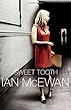
Sweet Tooth by Ian McEwan: my view

I finished reading Sweet Tooth feeling disappointed. To my mind it falls well short of Atonement, but is better than Solar.

It began so well and Ian McEwan’s writing is smooth, eloquent and richly descriptive. I couldn’t fail to visualize the scenes and for the most part the characters were distinct and believable, but I really couldn’t warm to any of them – purely a personal reaction, and one that shouldn’t detract from the novel.

Set mainly in the 1970s, it’s written in the first person as Selena Frome, looks back from forty years later. The first paragraph reveals that she was sent on a secret mission by the British Security Services; the mission failed, she was sacked and her lover was ruined. From then on the novel expands on this plot. But this is not primarily a spy story, nor even a love story, although there is a lot about that and about the politics of the 70s (which dragged a bit), it’s about deception, about writers and writing and readers and reading, with multiple stories within stories. I should have enjoyed that, but it all fell a bit flat and contrived. And I really disliked the ‘unexpected twist in the tale’ at the end.

KevinfromCanada has written a more detailed analysis of Sweet Tooth, which expresses just what I felt about it. And for more positive reviews there are those in The Observer and The Telegraph, and for a slightly more reserved look at the book there is this article in The Independent.

  • Hardcover: 336 pages
  • Publisher: Jonathan Cape (21 Aug 2012)
  • ISBN-10: 0224097377
  • ISBN-13: 978-0224097376
  • Source: my own copy
  • My Rating: 3/5 (because I liked the writing)

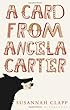
A Card From Angela Carter by Susannah Clapp: Book Notes

I liked the look of A Card from Angela Carter when I saw it in the library. It’s a small book that slots easily into a pocket or handbag and is very short – just 103 pages. I thought it would be a nice change after some of the very long books I’ve been reading recently.

I also liked the concept – a study of Angela Carter using the postcards she had sent to Susannah Clapp, who is the literary executor of Angela Carter as well as being a publisher’s reader, editor and critic. She and Angela had been friends for a number of years.

Now, Angela Carter is one of those writers whose books I’ve been meaning to read and have never got round to them, so I thought this book, which forms a sort of biography would give me at least an elementary picture  of her life and work. And that’s just what it did. Now I really do want to read some of her books – Angela Carter’s Book of Fairy Tales and Nights at the Circus, for example. I really find it hard to realise that it is twenty years ago now since she died at the age of 51 from lung cancer.  The fact that she had never made the shortlists of the Booker Prize led to the foundation of the Orange Prize, but this book, slight as it is, is the only biographical work to have been published.

Susannah Clapp uses the postcards Angela had sent to her ‘form a paper trail through her life.’ Sent from various places around the world some have a full message, some only a few words, which Susannah uses to paint a picture of what Angela was like, a ‘great curser’, capable of the sharpest of remarks, clever, unpredictable, quirky, and funny. She laughed and talked a lot. Using the postcards as a trigger, the book is mainly Susannah’s recollections of Angela, full of stories of her family life, her political views and what the critics made of her work. There’s also a considerable amount, considering the length of the book, about her physical appearance.

As for the postcards, I was disappointed at the black and white reproductions. I was also disappointed that as she was a cat lover, Angela had not sent her any cards featuring felines, although she did send them to her friend and publisher Carmen Callil. Angela herself loved cats and her first book written at the age of six was called ‘Tom Cat Goes to Market’, which her mother eventually threw away!

Susannah Clapp, whilst allowing that Angela’s fiction and prose did not go unacknowledged while she was alive, considers that her work did not receive the acclamation it deserved because:

She was ten years too old and entirely too female to be mentioned routinely alongside Martin Amis,  Julian Barnes and Ian McEwan as being a young pillar of British fiction. She was twenty years too young to belong to what she considered the ‘alternate pantheon’ of Iris Murdoch, Doris Lessing and Muriel Spark in the forties, when ‘in a curious way, women formed the ascendancy.’ (page 3)

This is an entertaining and vivid account in miniature which left me wanting to know more and to read Angela Carter’s books for myself.

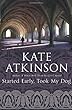
Started Early, Took My Dog by Kate Atkinson: Book Notes

Started Early, Took My Dog by Kate Atkinson is the fourth book featuring Jackson Brodie and one in which he doesn’t have a major role. It’s a complex book with several plots and sub-plots. The narrative moves between the past and the present day – sometimes not too clearly and is told from various characters’ perspective.

Jackson Brodie is working for Hope McMaster, who was adopted as a very young child in the 1970s and wants to find out about her birth family. Tracy Waterhouse, an ex-police officer is working as a security post in a shopping centre and can’t forget about a particular murder that had happened when she was a young detective. Detective Superintendent Barry Crawford,Tracy’s ex-colleague, with now just two weeks to go before retirement is also haunted by past events. Tilly is an elderly actress, suffering from the early stages of dementia. Add in to this mix a small child, Courtney and a little dog, called The Ambassador.

The book begins slowly and gradually builds to a tremendous pace. Brodie’s past keeps surfacing as he travels around in his search for Hope’s family roots, staying at Travel Lodges at Premier Inns, and in Bed and Breakfasts. He’s tired:

And truth be told he was tired of his vagrant life. He wanted a home. He would like a woman in that home. Not all the time, he had grown too used to his own company. (page 103)

There’s a lot in this novel about grief and loss, parenthood and responsibility and it paints a grim picture. The characters are well-drawn – the ex-copTracy, the child Courtney and the actress Tilly stand out in my mind as memorable characters, not forgetting The Ambassador, a small scruffy dog, who is ‘big inside‘.

It’s very much a book about consequences, full of regrets and lost opportunities as it moves, seemingly without reason from one character to another and from the past to the present. It’s a book you have to read with thought and concentration. I think It would benefit from re-reading, but my copy is a library book, due back today. Maybe I’ll re-read it one day.

  • Paperback: 496 pages
  • Publisher: Black Swan (17 Feb 2011)
  • Language: English
  • ISBN-10: 0552772461
  • ISBN-13: 978-0552772464
  • Source:  library book
  • My Rating: 4/5

Guilty Consciences: a Crime Writers’ Association Anthology

I’ve taken my time reading this collection of short stories Guilty Consciences: a Crime Writers’ Association Anthology, edited by Martin Edwards, who has also contributed one of the stories. I read them one or two at a time, which for me is the best way.

The contributors are Robert Barnard, Ann Cleeves, Bernie Crosthwaite, Judith Cutler, Carol Anne Davis, Martin Edwards, Jane Finnis, Peter James, Alanna Knight, Susan Moody, Sarah Rayne, Claire Seeber, L.C.Tyler, Dan Waddell and Yvonne Walus, and there is an introduction from the current Chair of the CWA, Peter James.

I haven’t been too keen on short stories in the past but I enjoyed this collection and think it’s one of the best I’ve read. As Peter James writes in his introduction:

I believe the short story is long overdue for a renaissance, and the ideal literary form for our increasingly busy, time-poor modern lives. What better for a quick read between tube station stops, or using your e-reader to turn a tedious airport security queue into fifteen minutes of surprises and delight?

Or as I found the ideal length to read at breakfast.

As the title suggests the stories all reveal various aspects of a guilty conscience. I find it hard to write about short stories without giving away the plot, so here are just a few notes on some. There are many I could pick out but these particularly stand out in my memory, now that I’ve read the book:

  • Hector’s Other Woman by Ann Cleeves – an intriguing insight into Vera Stanhope’s past and her motivation for joining the police, as Vera recollects her visit to Holy Island with her father whilst she was in the middle of her A-level year.
  • Squeaky by Martin Edwards – about a couple who both have something to hide and how their marriage began to fall apart when Squeaky came into their lives.
  • Deck the Hall with Poison Ivy by Susan Moody – a cautionary story about Christmas and a family’s arrangements.
  • The Train by Dan Waddell – as a husband anxiously waits for the return of his estranged wife he remembers their lives together and vows it will be different this time.

All the contributions were written specially for this collection with the exception of The Visitor by H R F Keating, who died in 2011, a story that had previously been included in a Penguin India collection, featuring Inspector Ghote. Ghote’s visitor is consumed with guilt about something that he had done in the past – but had he?

An excellent collection.

May’s Reading & Crime Fiction Pick of the Month

I read a lot in May – well I read and listened, because three of the books were audiobooks, which was quite a novelty for me. In total I ‘read’ 11 books and 9 of them were crime fiction. So far I’ve only reviewed 4 of them.

This is what I read –  the links are to my posts on the books and * indicates crime fiction:

  1. Wycliffe and the Cycle of Death by W J Burley* 4/5
  2. The End of the Affair by Graham Greene 3/5
  3. Murder in Mesopotamia by Agatha Christie* 3.5/5
  4. The Redeemed by M R Hall* 4.5/5
  5. Blue Lightning by Ann Cleeves* 4/5
  6. The Hanging in the Hotel by Simon Brett * (library audiobook) 2/5
  7. Fatherland by Robert Harris* 5/5
  8. Bring Up the Bodies by Hilary Mantel 4/5
  9. The Sign of Four by Arthur Conan Doyle* 3/5 (library audiobook)
  10. The Coroner by M R Hall* (library book) 4/5
  11. Dandy Gilver and an Unsuitable Day for a Murder by Catriona McPherson* 3/5 (advanced reading copy)

I’m aiming to review the rest of the books, but for now here are notes on them.

Wycliffe and the Cycle of Death by W J Burley is set in Penzance in Cornwall. Matthew Glynn, a bookseller,is found bludgeoned and strangled, which sets Chief Superintendent Wycliffe a difficult mystery to solve. The answer lies in the past and in the Glynn family’s background. I enjoyed this book, which I read quickly, eager to know the outcome, but the ending was a let down.

Murder in Mesopotamia by Agatha Christie. I always like Agatha Christie’s books and although I don’t think this is one her better books, it was a satisfying read. It’s a closed room type mystery. Who killed Louise, the wife of the celebrated archaeologist leading the Hassanieh dig? Only the people at the dig could have done it, but which one – they’re all under suspicion? Poirot doesn’t appear until quite late on in the book, but, of course, works it all out.

The Hanging in the Hotel by Simon Brett (audiobook). This is the fifth of the Fethering Mysteries, in which Jude and her friend Carole investigate the death of one of the guests at the local country house hotel, following the dinner attended by the all-male members of the Pillars of Sussex the night before. It looks like suicide but Jude thinks it can’t be. I got rather tired listening to this book as Jude and Carole endlessly (or so it seemed) went over and over the events and questioned the suspects.

Bring Up the Bodies by Hilary Mantel is the sequel to Wolf Hall. This book certainly deserves a post of its own. Here I’ll just comment that this chronicles the fall of Anne Boleyn, Henry VIII’s second wife and Cromwell’s part in satisfying Henry’s wishes. I don’t think it’s quite as captivating as Wolf Hall, but it does show just how devious Cromwell could be.

My Crime Fiction Book of the Month is a close call between  Fatherland by Robert Harris  and The Redeemed by MR Hall, both of which had me engrossed.

Fatherland is a fast paced thriller, set in a fictional Germany in 1964, a Germany that had been victorious in the Second World War. It begins with the discovery of the body of one of the former leading members of the Nazi party, who had been instrumental in devising ‘the final solution’. It’s a complex book and leads police detective Xavier March into a very dangerous situation as he discovers the truth.

The Redeemed by MR Hall is by contrast not about a police investigation but is the third book in which Jenny Cooper, a coroner investigates the death of a man discovered in a church yard, the sign of the cross carved into his abdomen. At first it looks like a horrific suicide, but as Jenny delves deeper during her inquest she finds links to yet more deaths. This is the third book in M R Hall’s Jenny Cooper series and I enjoyed it so much that I immediately borrowed the first book, The Coroner, from the library. They do stand well on their own but I think it helps to read them in sequence. In The Coroner Jenny begins her career, having been a solicitor for fifteen years. She obviously has devastating events in her personal life that she has to deal with.

May’s reading has been exclusively fiction, so I’m looking forward to reading some nonfiction in June. I’m feeling like reading a biography or two.

See the round-up post at Mysteries in Paradise for other bloggers’ choices of book of the month for May ‘“ and add your favourite May read to the collection.