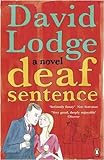
Deaf Sentence by David Lodge

I have mixed feelings about Deaf Sentence, but overall, I liked it.
Synopsis from the back cover:

Retired professor of linguistics Desmond Bates is going deaf. Not suddenly, but gradually and – for him and everyone nearby – confusingly. It’s a bother for his wife, Winifred, who has an enviably successful new career and is too busy to be endlessly repeating herself. Roles are reversed when he visits his hearing-impaired father, who won’t seek help and resents his son’s intrusions. And finally there is Alex. Alex is the student Desmond agrees to help after a typical misunderstanding. But her increasingly bizarre and disconcerting requests cannot – unfortunately – be blamed on defective hearing. So much for growing old disgracefully …

After an amusing start, the book almost slowed down to a stop for me with too much detail. It was only towards the middle of the book and the final third that it really came alive for me. It’s a mixture of reflections on deafness, life, death, ageing and bereavement.

It switches between the first person and the third person, which does give it a slightly disjointed effect but highlights Desmond’s unease with his situation. Not only is he having to come to terms with his increasing deafness but also with his retirement from the academic world. He still hankers after his position as a Professor of Linguistics. He’s having to deal with academic rivalry, and his feelings of isolation and inadequacies in his relationship with his wife and family.

I liked the word-play, the misunderstood conversations and the comedy surrounding deafness and the references to authors, poets and artists who had also suffered. But overall I thought this was a melancholy book about the problems of ageing, not just deafness:

Deafness is a kind of pre-death, a drawn-out introduction to the long silence into which we will all eventually lapse. (page 21)

I did enjoy the picture of Gladeworld that Lodge painted – if you’ve been to Center Parcs it’s instantly recognisable! Desmond likens it to ‘a benevolent concentration camp. A benign prison’, with the Tropical Waterworld a modern version of Dante’s Inferno, with

… half naked crowds tossed in the turbulent waves, or hurtling down the spirally semi-transparent tubes at terrifying velocity, or tumbled arse over elbow through the rapids, choked with water, blinded by spume, spun round in whirlpools, dragged backwards by undertow, entangled with each other’s limbs, bruised and battered by impact with the fibre glass walls, to be tipped at last into a boiling pit at the bottom … (page 225)

I know this from my own experience!

But contrast this with Desmond’s visit to Auschwitz – a real hell on earth. As Desmond reflects there are no words adequate to describe the horror of what happened there and no adequate emotional response:

In the end perhaps the best you can do is to humble yourself in the face of what happened here, and be forever grateful that you weren’t around to be drawn into its vortex of evil, in either suffering or complicity. (page 269)

Lodge acknowledges that Desmond’s deafness and his Dad have their sources in his own experience and for me this is the heart of the book, the parts that captured real life with depth of feeling, emotion and empathy. For these reasons I did like this book.

  • Paperback: 320 pages
  • Publisher: Penguin (4 Jun 2009)
  • Language: English
  • ISBN-10: 0141035706
  • ISBN-13: 978-0141035703
  • Source: I bought the book

Silent Voices by Ann Cleeves

Ann Cleeves has become one of my favourite writers this year and Silent Voices is one of the best crime fiction books I’ve read recently. Although it’s the fourth in her Vera Stanhope series it’s the first that I’ve read. I did watch some of the TV versions of Vera earlier this year but I missed this one, so the plot was completely new to me.

Synopsis (taken from the back cover):

When DI Vera Stanhope finds the body of a woman in the sauna room of her local gym, she wonders briefly if, for once in her life, it’s a death from natural causes. But closer inspection reveals ligature marks around the victim’s throat…

Doing what she does best, Vera pulls her team together and sets them interviewing staff and those connected to the victim, while she and colleague Sergeant Joe Ashworth work to find a motive. While Joe struggles to reconcile his home life with the demands of the job, Vera revels being back in charge of an investigation. Death has never made her feel so alive.

And when they discover that the victim had worked in social services – and was involved in a shocking case involving a young child – it seems the two are somehow connected.

But things are rarely as they seem . . .

My view:

When I began reading I could visualise and hear Brenda Blethyn as Vera, but gradually that impression faded away and the character of Vera began to take shape in my mind from the words in this book alone. Vera is a truly eccentric individual, intelligent, single minded and dedicated to her job, single and with no family responsibilities. She finds it difficult to delegate and is exhilarated by her job. In the following extract she has phoned Joe late at night:

Her voice was loud. She’d never really got the hang of mobiles, yelled into them. She sounded as if she’d just woken up after a good night’s sleep. Murders took her that way, invigorated her as much as they excited the pensioners he’d spent all afternoon interviewing. Once, after too many glasses of Famous Grouse, she’d said that was what she’d been put on the Earth for. (page 67)

The other characters are equally as well- defined. As well as creating memorable and individual characters Ann Cleeves conveys a strong sense of place bringing the Northumbrian countryside, towns and villages to life as I read. The plot is nicely complicated and although I had an inkling about the killer I was wrong, but looking back I could see where I’d been misled. Silent Voices is an excellent book, one that kept me turning the pages and exercising my brain.

  • Paperback: 400 pages
  • Publisher: Pan (16 Sep 2011)
  • Language: English
  • ISBN-10: 0330512692
  • ISBN-13: 978-0330512695
  • Source: Library book
  • My Rating: 5/5

Full Tilt by Dervla Murphy

Dervla Murphy was born in County Waterford, Ireland. In a Book Beginnings post I wrote about how when she was ten she decided she wanted to cycle to India. And that is what she did 21 years later.

Full Tilt: Dunkirk to Delhi on a Bicycle, first published in 1965  is an account of her journey in 1963, which took her through Europe, Persia (Iran), Afghanistan, over the Himalayas to Pakistan and into India. She travelled on her own, with a revolver in her saddle bag. I’m full of admiration for her courage and determination.

Reading this book made me wonder about the countries she cycled through and how they’ve changed since the early 1960s. It would certainly be a different experience if anyone tried to do the same these days! T

Here are a few quotes to give a taste of the book:

The border between Persia and Afghanistan

The only indication of the Persian-Afghan frontier is a seven-foot stone pillar, conspicuous from far across the desert, which lucidly announces ‘Afghanistan’.  Here I stopped to photograph Roz [her bicycle]. Three miles further on a long branch served as Customs barrier and beside it lay a very young soldier in a very ragged uniform, sound asleep with one hand on his rifle. I quietly raised the barrier for myself and continued towards the Customs and Passport Office two hundred yards ahead.

There, no one took the slightest notice of either my kit or my passport, no uniformed officials appeared and no series of dingy, uncomfortable offices had to be visited. (page 47)

The concept of time:

… people here have no concept of time as we understand it. The majority wear watches as ornaments and I was diverted to discover that they can’t read the time and don’t see why they should learn! Yesterday is over, today is something to be enjoyed without fuss, and tomorrow – well, it’s sinful to plan anything for the future because that’s Allah’s department and humans have no business to meddle with it. (page 58)

Dervla Murphy loved the Afghan way of life and deplored the modernisation of countries:

The more I see of life in these ‘undeveloped countries’ and of the methods adopted to ‘improve’ them, the more depressed I become. It seems criminal that the backwardness of a country like Afghanistan should be used as an excuse for America and Russia to have a tug-of-war for possession. (page 69)

Her thoughts on the attitude of Westerners:

… what an artificial life is led by the foreign colonies in these Asian cities! The sense of their isolation from the world around them is quite stifling. At a dinner party tonight I met a European couple who have been in Kabul for eighteen months without once entering the home of an ordinary Afghan – and they are not exceptions. The attitude is that the ‘natives’ are people to be observed from  a discreet distance and photographed as often as possible, but not lived among. The result is boredom and an obsessional longing for home leave, (page 101)

This was not her attitude as she stayed with local people wherever she could, accepting their food and lodgings which was given freely – they would not let her pay for anything and would have been offended if she had insisted.

Her essentials for a five-month trip – she needed less than I would want!

… the further you travel the less you find you need and I see no sense in frolicking around the Himalayas with a load of inessentials. So, I’m down to two pens, writing paper, Blake’s poems, map, passport, compass, comb, toothbrush, one spare pare of nylon pants and nylon shirt – and there’s plenty of room left over for food as required from day to day. It’s a good life that teaches you how little you need to be healthy and happy, if not particularly clean! (page 105)

Her views on ‘Progress’:

The more I see of unmechanized places and people the more convinced  I become that machines have done incalculable damage by unbalancing the relationship between Man and Nature.

people now use less than half their potential forces because ‘Progress’ has deprived them of the incentive to live fully. (page 149)

… I don’t know what the end result of all this ‘progress’ will be – something pretty dire, I should think. We remain part of Nature, however startling our scientific advances, and the more successfully we forget or ignore this fact, the less we can be proud of being men. (pages 149 – 150)

I enjoyed Full Tilt, as much for her descriptions of the places she visited as for her thoughts along the way. I’m not sure that I would find her easy company though!

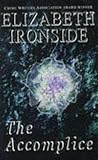
The Accomplice by Elizabeth Ironside: Book Notes

I first came across Elizabeth Ironside on Bev’s blog My Reader’s Block during the Crime Fiction Alphabet meme. I liked the sound of her books, so when I saw The Accomplice in my local library I immediately borrowed it.

Elizabeth Ironside is the pseudonym of Lady Catherine Manning, wife of Sir David Manning the former British Ambassador to the United States (from 2003-2007). Her first novel A Very Private Enterprise won the Crime Writers’ Association (CWA) John Creasey Award for Best First Mystery of 1985, and Death in the Garden was shortlisted for the CWA Gold Dagger for Best Mystery of 1995. The Accomplice is her third novel, published in 1996.

This is one of the most fascinating mysteries I’ve read for a while. It’s historical crime fiction, moving back in time to Latvia before and during the Second World War and present day Russia and Britain.

Summary (from the back cover):

‘Zita Dauncey’s tragic past and difficult present seem firmly under control. Until a child’s skeleton is dug up in her friend Jean’s rose bed, and (Xenia) a mysterious young woman arrives from Russia.

Jean’s English ordinariness hides her original identity as Yevgenia Chornoroukya: a woman whose history includes two lovers, two exiles and all the desperate compromises she makes to escape the horrors of eastern Europe in 1945. And quite possibly, the murder of a child.’

My view:

I liked the way Ironside wove together the past and the present, although at first I thought there was too much about Jean’s background, but it grew on me as I became fascinated with her history and life in Russia during the war years.

This is a complex book, with plenty of interesting characters, all of whom are well-rounded characters who came to life as I read, some with their annoying ways, like Xenia and others, like Zita, who I came to like a lot – for example, Zita’s son, Tom has cerebral palsy and Xenia’s view is that “physical disability shows moral distortion“, quoting Stalin’s withered arm, Richard III, Attila the Hun (club foot) “And Hitler, you only have to look at him to see he was unsafe and insane.“(pages 99 – 100)

Xenia is a scheming, manipulative character. She claimed to be related to Jean but actually she had no idea whether they were or not.  Jean’s reaction to her seemed to indicate she had something to hide or fear – and just what that was gradually surfaces.

Along with that strand of the book there are the questions about the identity of the child’s skeleton found buried in the rose garden, how long ago it was buried and the implications for Jean who claimed to know nothing about it.

This is a well paced book building gradually to a climax, a book that I wanted to finish but was sad when it came to the end, leaving me with some questions still unanswered. I enjoyed it very much and I hope to read more of Elizabeth Ironside’s books.

A Very Private EnterpriseDeath in the GardenThe AccompliceThe Art of Deception
A Good Death
 List and images from Fantastic Fiction.

Crime Fiction Alphabet: Letter Z

We have reached the final letter in Kerrie’s Crime Fiction Alphabet and to illustrate the letter Z I’m focusing on:

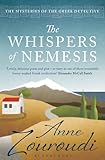
The Whispers of Nemesis by Anne ZouroudiThis book is the fifth in Zouroudi’s series about Hermes Diaktoros of Athens, the Greek Detective.

Summary (from Anne Zouroudi’s website):

It is winter in the mountains of northern Greece and as the snow falls in the tiny village of Vrisi a coffin is unearthed and broken open. But to the astonishment of the mourners at the graveside, the remains inside the coffin have been transformed, and as news of the bizarre discovery spreads through the village like forest fire it sets tongues wagging and heads shaking.

Then, in the shadow of the shrine of St Fanourios (patron saint of lost things), a body is found, buried under the fallen snow – a body whose identity only deepens the mystery around the exhumed remains. There’s talk of witchcraft, and the devil’s work – but it seems the truth, behind both the body and the coffin, may be far stranger than the villagers’ wildest imaginings. Hermes Diaktoros, drawn to the mountains by a wish to see an old and dear friend, finds himself embroiled in the mysteries of Vrisi, as well as the enigmatic last will and testament of Greece’s most admired modern poet.

The Whispers of Nemesis is a story of desperate measures and long-kept secrets, of murder and immortality and of pride coming before the steepest of falls.

My view:

Hermes is a detective with a difference. Just who he is and who he works for is never explained. He’s most definitely not a policeman and when asked he says he works for a ‘higher power’ than the police. He is described as ‘the fat man’. He wears a cashmere overcoat of midnight blue, a grey suit with a subtle stripe and a waistcoat, and white tennis shoes. He has owlish glasses and thick curly greying hair. His name is his

… ‘father’s idea of humour. He’s something of a classical scholar.  And in the spirit of my namesake, I call these’ – he indicated his white tennis shoes – ‘my winged sandals.’  (page 94)

It is this element of the novels that appeal to me – that and the quirky mysteries. And this book certainly is about a strange mystery about the life and death of the poet Santos Volakis. A local man, he had died some four years earlier choking on an olive stone. In his will he had stipulated that his bequests would only be available when his bones ‘finally see daylight’. So the rite of exhumation, which is customary in rural Greece four years after a death was important to his family and friends, but no one was prepared for the shock that it delivered when the bones were revealed.

I found it a little difficult at first following the sequence of events and identifying who was who, but I soon worked it out. I also had worked out what the mystery was well before the the end, which actually added to my enjoyment of reading the book. The setting is superb, placing you so completely in Greece in winter amongst believably real people.

Each of the books in the Hermes Diaktoros series features one of the Seven Deadly Sins ‘“ in this one it is the sin of pride. Nemesis is the bringer of retribution.

  • Paperback: 304 pages
  • Publisher: Bloomsbury Paperbacks (7 Jun 2012)
  • Language: English
  • ISBN-10: 1408821915
  • ISBN-13: 978-1408821916
  • Source: I bought the book
  • My Rating: 3.5/5

1. The Messenger of Athens (2007)
2. The Taint of Midas (2008)
3. The Doctor of Thessaly (2009)
4. The Lady of Sorrows (2010)
5. The Whispers of Nemesis (2011)
6. The Bull of Mithros (2012)

Thanks to Kerrie for organising the Crime Fiction Alphabet. I’ve listed the books I’ve read in a page (see Index tab at the top of the blog) and soon I’ll do a summing up post about the highlights.

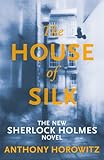
The House of Silk by Anthony Horowitz

*I enjoyed reading Anthony Horowitz’s book, The House of Silk. It’s pacy, full of atmosphere and mystery, and above all it captures the essence of Sherlock Holmes and Dr Watson. Horowitz’s plot is cunning, full of twists and turns, with allusions to Conan Doyle’s stories.

Synopsis from the book cover:

It is November 1890 and London is gripped by a merciless winter. Sherlock Holmes and Dr Watson are enjoying tea by the fire when an agitated gentleman arrives unannounced at 221b Baker Street. He begs Holmes for help, telling the unnerving story of a scar-faced man with piercing eyes who has stalked him in recent weeks. Intrigued, Holmes and Watson find themselves swiftly drawn into a series of puzzling and sinister events, stretching from the gas-lit streets of London to the teeming criminal underworld of Boston and the mysterious ‘House of Silk’ . . .

My view:

The book is narrated by Watson as he looks back on two of the most puzzling and sinister cases he and Homes had to solve November 1890 – that of The Man in the Flat Cap and The House of Silk. The first involves an art dealer, Mr Carstairs who is being threatened by a member of the American Flat Cap Gang, whereas the second concerns the murder of Ross, a new member of the Baker Street Irregulars, the scruffy, ragged gang of street urchins Sherlock Holmes uses to help him track down criminals. For a while I couldn’t see how these cases connected, or indeed if they did, as Horowitz effortlessly spun the wool over my eyes .

I haven’t read anything by Anthony Horowitz before, although when I read that he is a TV screenwriter, including Midsomer Murders, Foyles War and Poirot to his name I realised that I’ve certainly enjoyed his work before. He’s also written bestselling children’s books, including the Alex Rider series.

I’m not often keen on pastiches,  prequels or sequels written by a different author from the original but this one is the exception. The House of Silk is vastly entertaining, a page-turner, full of detail and great characterisation, with Holmes at the peak of his powers, even though it nearly costs him his life. I do hope there will be a second book.

*Edited after first publishing – see comments*.