Normal service has been resumed – thankfully!! – I’m back to writing on this blog thanks to my son.
It seems quite a while since I finished reading Ariana Franklin’s The Death Maze (published as The Serpent’s Tale in the US), so these are just a few thoughts about the book.
Back in 2007 I’d really enjoyed her first book, Mistress of the Art of Death (which I wrote about here) and I was eager to read the next book about Adelia Aguilar, the 12th century anatomist employed by Henry II. But I was a bit put off by reports that The Death Maze was not as good, and other books grabbed my attention. Time passed, the third book came out – Relics of the Dead – and curiosity got the better of me so I bought both books, and eventually I got round to reading them – one after the other.
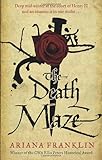 Yes, The Death Maze does not live up to the first book for me, but it’s still enjoyable. Rosamund Clifford, Henry II’s mistress has been poisoned, allegedly by Eleanor of Aquitane, Henry’s wife. Adelia is summoned to investigate her death. So, she sets off to Oxford, accompanied by her baby daughter, Allie, her servant Gyltha and the Saracen, Mansur, who has to pose as the doctor whilst Adelia pretends to be his assistant. Adelia was a graduate of the School of Medicine in Salerno, which, unlike England, allowed women to train as physicians; in England her forensic skills would have been considered witchcraft.
Rosamund had lived in a strange and sinister tower surrounded by a maze, constructed of walls of granite with blackthorn planted against them. So, the first problem Adelia had to solve was to find the way through the maze. She was then faced with the gruesome discovery of Rosamund’s dead body. The main thrust of the book centres on Eleanor’s moves to overthrow Henry II, and after Eleanor and her supporters capture Adelia, they take her to the nunnery at Godstow, where they wait snowbound for the right moment to launch their rebellion.
I think the book works well as historical fiction, even though as Ariana Franklin wrote in her Author’s Notes that there is only a brief reference to Rosamund Clifford in the historical records and so this is a fictional portrayal based on legend. And she inserted a fictional rebellion in England in a gap in the medieval records. It has whetted my appetite to know more about the period. But as crime fiction, I was rather disappointed because although I found the details of Rosamund’s death interesting, there was actually very little about Adelia’s investigation, very little for her to exercise her forsenic skills, which was one of the elements I’d enjoyed in Mistress of the Art of Death.
This is my second book for Carl’s R.I.P.VII challenge and it also slots into the Historical Fiction Challenge and the Mount TBR Challenge 2013.


 Grey
Grey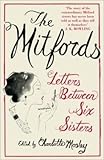 letters between the Mitford sisters – Nancy, Pamela, Diana, Unity, Jessica and Deborah. I’ve had this book for 5 years! I think two of the reasons I’ve not read it before now is that it is so long – over 800 pages and it’s in a very small font.
 November. I down loaded it on my Kindle because it’s a free book and I thought maybe I should try another book by Edith Wharton, having failed to finish The House of Mirth. At the time
  it’s about three years. I’m not sure I’ll like it as I wasn’t keen on
 The Drowning

 ‘Deep in Siberia lies the oldest lake on earth, lake Baikal. When a small boy arrives on its banks, he is amazed by the beauty of the lake and surrounding mountains. As this astonishment yields to inquisitiveness, he begins to explore the fairytale of the area. We’ve published a beautiful new edition of this magnificent title, which the New York Times called €˜a work of art so seamless and so natural one can only imagine it took ages and ages of hard dreaming to construct’. (Blurb from Quartet Books)
 The Man in the Wooden Hat (blurb from the book jacket)
 Last Friends (blurb from the book jacket):
 Greenshaw’s Folly was first published in the Daily Mail 3 – 7 December 1956 and is included in
  BooksPlease