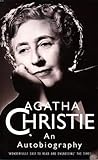
Agatha Christie on Individuality

This morning I was reading more of Agatha Christie’s Autobiography. It feels as though I’m listening to her as she recalls her life and in this morning’s chapter she was talking about individuality and writing. She said that even though you admire certain writers and may wish to write like them, you know you can’t:

If I could write like Elizabeth Bowen, Muriel Spark or Graham Greene, I should jump to high heaven with delight, but I know that I can’t, and it would never occur to me to attempt to copy them. I have learnt that I am me, that I can do the things, that as one might put it, me can do, but I cannot do the things that me would like to do. As the Bible says, ‘Who by taking thought can add one cubit to his stature?’ (page 422)

So it’s no good me wanting  to write like she did!

She went on to list the things she couldn’t do:

  • she was never good at games
  • she was not a conversationalist
  • she couldn’t draw or paint
  • she couldn’t model or do any kind of sculpture
  • she couldn’t hurry without getting rattled
  • she couldn’t say what she meant easily – she could write it better

and then the things she could do:

  • she could write
  • she could be a reasonable musician, but not a professional one
  • she could improvise when in difficulties

and things she didn’t like:

  • crowds
  • being jammed up against people
  • loud voices
  • noise
  • protracted talking
  • parties, especially cocktail parties
  • cigarette smoke and smoking generally
  • any kind of drink except in cooking
  • marmalade
  • oysters
  • lukewarm food
  • grey skies
  • the feet of birds, or the feel of birds altogether
  • and most of all – the taste and smell of hot milk

finally, things she did like:

  • sunshine
  • apples
  • almost any kind of music
  • railway trains
  • numerical puzzles and anything to do with numbers
  • going to the sea
  • bathing and swimming
  • silence
  • sleeping
  • dreaming
  • eating
  • the smell of coffee
  • lilies of the valley
  • most dogs
  • going to the theatre

Apart from a few exceptions we like and dislike most of the same things – I do like a glass of wine for example, I’m useless at numerical puzzles, can’t do sudoku (I bet she’d have liked that), I’m not fond of swimming, and I like cats as well as dogs.

Weekly Geeks – The books you’ve waited too long to read

This weekend, Weekly Geeks host EH asks about books we have waited too long to read.

Is there a book that has been hanging around your reading pile for far too long before you got to it. A book that probably got packed away until you accidentally got to it or a book that you read a few pages in and never got back to.

There are quite a few books over the last few years that I have started to read and not finished. I don’t mean the ones that I don’t intend to finish. Rather these are books I would like to read all the way through but have not so far got round to it. They are mainly non-fiction and the reason I’ve not finished them is usually that they take more time to read than fiction and so I slot other books in between reading sessions and sometimes just don’t get back to the non-fiction.

These are some of them – all books I do intend to finish:

  1. Thomas Hardy: The Time-Torn Man by Claire Tomalin – I stopped reading this partway in as I decided I needed to read more of Hardy’s own books before going further. I’ve read a few more of his books, but have never got back to this biography.
  2. A Long Walk to Freedom: The Autobiography of Nelson Mandela – I must have read about half of this book before I stopped. It was so long ago that I can’t remember why I didn’t finish it.
  3. A Dead Language by Peter Rushforth – this one is fiction. I loved Pinkerton’s Sister by Rushforth. I found A Dead Language hard-going, but I will get back to it one day. The downside is that I’ll have to start it again as I’ve forgotten who all the characters are.
  4. 1599: a Year in the Life of William Shakespeare by James Shapiro – I can’t remember any specific reason I haven’t finished this book.
  5. Body Parts: Essays on Life Writing by Hermione Lee. I’ve thoroughly enjoyed each essay that I’ve read so far. As the essays are self-contained there is no problem in reading it in instalments.

Sunday Salon – Book Connections

The Sunday Salon is the place to meet and blog about the books we’re reading.

This morning I read some more from Agatha Christie’s book An Autobiography. It’s now 1917 and Agatha is working in a hospital dispensary in Torquay and also studying to take her Apothecaries Hall examination so she could dispense for a medical officer or a chemist. As part of her training she had instruction from a proper commercial chemist – a Mr P, one of the principal pharmacists in Torquay. She described him as

… a rather funny-looking little man, very roundabout and robin redbreast looking, with a nice pink face. There was a general air of childish satisfaction about him. (page 261)

He once showed her a piece of deadly curare that he carried around with him in his pocket. Curare once it has entered the bloodstream paralyses and kills you. He said he carried it in his pocket because it made him feel powerful. Agatha often wondered about him afterwards. In spite of his cherubic appearance she thought he was possibly a dangerous man and years later used her memory in writing The Pale Horse.

I then picked up H R F Keating’s book A Detective at Death’s Door and started reading it, whilst drinking a cup of coffee. I had intended reading one of my own books but this library book was closer to hand than any of my own books. In this book Superintendent Harriet Martens is just recovering from a nearly fatal dose of aconitine. Her husband, John recognised the symptoms from reading their description in an imaginary Agatha Christie book, Twisted Wolfsbane – aconitine is also known as wolfsbane.  Then a few pages later I came across this coincidence – Harriet quoted the passage in Agatha Christie’s An Autobiography about the chemist carrying round a piece of curare – the same passage I’d read half an hour or so earlier.

Agatha Christie on …

I’ve been reading Agatha Christie’s Autobiography for a while now – just a chapter or so each day. Instead of writing about the details of her life I thought I’d do a few posts now and then on things she drops into the narrative. Ideas she had, thoughts on various things, books she liked and so on.

Today, I’ve chosen to focus on her joy in being alive and happiness.

She’s writing about the time in her life when she was thirteen or fourteen:

Always when I woke up, I had the feeling which I am sure must be natural to all of us, a joy in being alive. I don’t say you feel it consciously – you don’t – but there you are, you are alive, and you open your eyes, and here is another day; another step as it were, on your journey to an unknown place. That very exciting journey which is your life. Not that it is necessarily going to be exciting as a life, but it will be exciting to you because it is your life. That is one of the great secrets of existence, enjoying the gift of life that has been given to you.(page 133)

She goes on to say that not every day will be enjoyable, for example if you remember you’re going to the dentist. However, she thinks it does depend upon your temperament – whether you’re a happy person or melancholic:

Naturally happy people can be unhappy and melancholic people enjoy themselves. But if I were taking a gift to a child at a christening that is what I would choose: a naturally happy frame of mind. (page 133)

I like that.

Dame Agatha Christie: An A-Z

This is my contribution to The Agatha Christie blog tour to celebrate the 120th anniversary of Agatha Christie’s birth in September, in which each participant focuses on some aspect of Agatha Christie’s life and work. As I’m reading her books and writing about them already I thought I’d concentrate more on her life. I’ve listed the books I’ve read on my Agatha Christie Reading Challenge page.

This is a mixture of quotations and Agatha’s thoughts and observations that I noted whilst reading her book An Autobiography (I’m reading the paperback version). First of all a quotation which I think sums up her attitude so well:

I like living. I have sometimes been wildly, despairingly, acutely miserable, racked with sorrow, but through it all I still know quite certainly that just to be alive is a grand thing. (An Autobiography, page 11)

Here is an A-Z of miscellaneous information relating to Agatha Christie, all found in An Autobiography, except for the letters G, X and Z. For many letters I could have chosen many different subjects, so this is really just a sketchy look at Agatha’s life. I have tried not to use the titles of her books or the characters, but there are one or two:

A is for An Autobiography. She started to write this in April 1950 when she was 60 and stopped writing it 15 years later. She didn’t include everything and there is no mention of her disappearance in 1926.  In the Epilogue she wrote:

I have remembered, I suppose, what I wanted to remember; many ridiculous things for no reason that makes sense. That is the way humans are made. (page 548)

B is for Baghdad. When Agatha first met her second husband, Max Mallowan he took her on a tour of Baghdad. She accompanied Max on many of his archaeological expeditions, staying in different places. Agatha’s house in Baghdad was an old Turkish house on the west bank of the Tigris. It was cool, with a courtyard and palm-trees coming up to the balcony rail, in front of palm-gardens and a tiny squatter’s house made out of petrol tins. (page 546-7)

C is for Crime and Criminals. Agatha was interested in reading books by people who had been in contact with criminals, especially those who had tried to help them, or ‘reform’ them. (page 452)

D is for Divorce. She wrote:

I had been brought up, of course, like everyone in my day to have a horror of divorce, and I still have it. (page 365)

E is for Earliest Memory. Agatha had  a happy childhood. Her first memory is of her 3rd birthday and having tea in the garden at Ashfield. There was  a birthday cake with sugar icing and candles and what was exciting to her was a tiny red spider that ran across the white tablecoth, which her mother told her was ‘a lucky spider, Agatha, a lucky spider for  your birthday’. (page 19)

F is for her First short story written when she was a child:

It was in the nature of a melodrama, very short, since both writing and spelling were a pain to me. It concerned the noble Lady Madge (good) and the bloody Lady Agatha (bad) and a plot that involved the inheritance of a castle. (page 55)

G is for Grave. Agatha died on 12 January 1976 at Winterbrook, her home in Wallingford. Her grave is in St Mary’s Parish Church in Cholsey, a village near Wallingford. I wrote about it last September (including photos).

H is for Houses. Agatha’s love of houses stemmed from her childhood dolls’ house. She enjoyed buying all the things to put in it – not just furniture, but all the household implements such as brushes and dustpans, and food, cutlery and glasses. She also liked playing at moving house, using a cardboard box as a furniture van.

I can see quite plainly now that I have continued to play houses ever since. I have gone over innumerable houses, bought houses, exchanged them for other houses, furnished houses, decorated houses, made structural alterations to houses. Houses! God bless houses! (page 62)

I is for Imagination and Ideas. Sometimes Agatha’s ideas just came into her head, and she jotted them down in her notebooks, which she invariably then lost. Sometimes she devised plots that teased her mind and she liked to think about and play with them before fixing the details. (pages 451-2) She liked the light-hearted thriller and the intricate detective story with an involved plot, which required a great deal of work, but was always rewarding.(page 453)

J is for Jane Marple. When Miss Marple first appeared she was about 65 -70 years old. Agatha envisaged her as ‘the sort of old lady who would have been rather like some of my grandmother’s Ealing cronies’. But she was not like Agatha’s grandmother at all – being ‘far more fussy and spinsterish‘. People suggested that Miss Marple and Poirot should meet, but Agatha dismissed that idea because she didn’t think they would enjoy it at all and wouldn’t be at home in each other’s world. In one way Miss Marple was like her grandmother – in her powers of prophecy and kindness. (pages 447 -50)

K is for Nancy Kon. Nancy and Agatha met when Madge, her sister, married James Watts, Nancy’s brother. They were friends from then on. They both liked to drink cream by the half-pint.

L is for Life. She wrote that life seemed to fall into three parts: the present, absorbing and rushing by, the future, dim and uncertain, and the past ‘the memories and realities that are the bedrock of one’s present   life…’ (page 10)

M is for Memories. She thought that:

one’s memories represent those moments, which insignificant as they may seem, nevertheless represent the inner self and oneself as most really oneself.  (page 11)

N is for Nimrud where Agatha was living when she started writing her autobiography, on an expedition with her second husband, Max Mallowan, who was leading the British School of Archaeology in Iraq team’s excavations of the ancient city. They lived in the Expedition House, built of mud-brick. She wrote in a room added to the House, a room measuring about three metres square, with rush mats and rugs. Through the window she looked out east towards the snow-topped mountains of Kurdistan. (page 9)

O is for Orient Express. It was Agatha’s ambition to travel on the Orient Express, which she achieved in 1928. She went on her own on a journey on the Simpleton-Orient Express from Calais to Stamboul, and from there to Damascus. Her account of her journey is in pages 374 – 9. After a three-day stay in Damascus she travelled to Baghdad across the desert, a forty-eight-hour trip in a bus operated by two Australian brothers Gerry and Norman Nairn.

P is for Poetry. As well as her fiction works Agatha also wrote poetry and in her teens won several prizes in The Poetry Review. A collection of her poems was published in 1924 – The Road of Dreams and a later collection entitled Poems in 1973.

Q is for Quin. Mr Quin was one of Agatha’s favourite characters;

Mr Quin was a figure who just entered into a story – a catalyst, no more – his mere presence affected human beings. There would be some little fact, some apparently irrelevant phrase, to point him out for what he was: a man shown in a harlequin-coloured light that fell on him through a glass window; a sudden appearance or disappearance. Always he stood for the same thing: he was a friend of lovers, and connected with death. (page 447)

R is for Rosalind. Agatha’s daughter was born in 1919. When she was born Agatha thought that ‘she seemed from an early age both gay and determined.’ (page 274) Later in their lives AgathA wrote that Rosalind had ‘had the valuable role in life of eternally trying to discourage me without success.’ (page 489)

S is for Siblings. As a child Agatha remembered little of her older brother and sister, Monty and Madge, as they were away at school. Madge also wrote stories, many of which were accepted for Vanity Fair, a literary achievement (page 128). Agatha thought she wrote very well. Monty was a source of family trouble and worry. He was intensely musical, very charming and always had someone who would lend him money and do things for him (page 83).

T is for Travel. Agatha loved travelling and longed to see the world, which she did with her first husband, Archie Christie (pages 298 – 317). Later she travelled extensively with her second husband, Max.

U is for Ur. Agatha also visited the archaeological dig at Ur for the first time after her trip on the Orient Express. She went as a guest of the Woolleys (Sir Charles was the leader of the expedition). She was given VIP treament because Sir Charles’s wife, Katherine had just read and enjoyed Agatha’s book, The Murder of Roger Ackroyd. (page 386-9)

V is for VAD. Agatha was a Voluntary Aid Detachment nurse. She had taken First Aid and Home Nursing classes before the outbreak of war in 1914. She like nursing:

From the beginning I enjoyed nursing. I took to it easily, and found it, and have always found it, one of the most rewarding professions that anyone could follow. I think if I had not married, that after the war I should have trained as a real nurse. (page 236)

W is for Writing. Throughout her autobiography Agatha writes about writing, how she wrote, where she wrote and so on. Just one quote:

… I knew that writing was my steady, solid profession. I could go on inventing my plots and writing my books until I went gaga.

There is always, of course, that terrible three weeks, or a month, which you have to get through when you are trying to get started on a book. There is no agony like it. You sit in a room, biting pencils, looking at a typewriter, walking about, or casting yourself on a sofa, feeling you want to cry your head off. (page 490)

X is an interesting letter. As Dr Thompson thinking about the murderer in The ABC Murders, said:

Interesting to know how he’d have dealt with the letter X.

Y is for Yugoslavia. Agatha and Max went to Dubrovnik and Split for their honeymoon, where they ‘had enormous fun with the menus‘; written in Yugoslavian they didn’t know what they were ordering and none of the restaurants ever wished them to pay the bill.

Z is for Zero Hour. I haven’t come across anything in the autobiography for Z. Towards Zero is both a play and a novel in which Agatha asserts that destiny manipulates us, moving us towards a decisive zero hour. (The Life and Crimes of Agatha Christie by Charles Osborne, page 172)

Sunday Salon – Current Books

I finished reading The Fall by Simon Mawer yesterday. It is the story of Rob Dewar and Jamie Matthewson from their childhood up to Jamie’s death 40 years later. But it’s also the story of their parents and how their lives are interlinked. I found it enthralling, one of those books that make me want to look at the ending to see how it all turns out. I managed to stop myself, however, and read impatiently to the end anxious to know what actually happened between them all.

It moves between the two generations beginning in the present day, when Rob hears on the news that Jamie, a renowned mountaineer has fallen to his death in Snowdonia. No one is sure whether it was an accident or suicide. Then it moves  back 40 years to the time when the two boys met, both fatherless – Jamie’s dad, Guy went missing when climbing Kangchenjunga and Rob’s parents are divorced, and back yet further again to 1940 when Guy Matthewson met the boys’ mothers – Meg (later calling herself Caroline) and Diana. And so  the drama unfolds in the mountains of Wales and the Alps, culminating on the North Face of the Eiger.

The Fall is not just a gripping account of the dangers of rock climbing and mountaineering, but it’s also a love story, with the intricacies of relationships, and love, loss and betrayal at its core. The love stories and the climbing scenes are both shown through the imagery of falling with all its ambiguities – actual falls, falling in love, falling pregnant and falling from grace. It’s beautifully written, capturing not only the mountain landscape but also London during the Blitz. This is the second excellent book by Mawer that I’ve read, even though it has a rather predictable ending.

I’m still reading Agatha Christie’s  An Autobiography and will be for some time as it is long and detailed – 550 pages printed in a very small font, which makes it impossible for me to read it in bed. But it is fascinating. It’s not just an account of her life but is full of her thoughts and questions about the nature of life and memory:

I am today the same person as that solemn little girl with pale flaxen sausage-curls. the house in which the spirit dwells, grows, develops instincts and tastes and emotions and intellectual capacities, but I myself, the true Agatha, am the same. I do not know the whole Agatha. The whole Agatha, so I believe, is known only to God.

So there we are, all of us, little Agatha Miller, and big Agatha Miller, and Agatha Christie and Agatha Mallowan proceeding on our way – where? That one doesn’t know – which of course makes life exciting. I have always thought life exciting and I still do. (page 11)

I’ll be writing more about Agatha Christie on Wednesday for my contribution to the Agatha Christie Blog Tour.