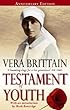
Testament of Youth by Vera Brittain

Testament of Youth by Vera Brittain is based on her diaries, telling of her life up to 1925, concentrating on the World War One years.

It is an absolutely fascinating account of the war and all its horror and sufferings, and very moving. Vera was a VAD (Voluntary Aid Detachment) during the war, nursing casualties both in Britain and France. The conditions were appalling.

During the war her fiance, Roland Leighton, her brother, Edward, and two friends, Geoffrey Thurlow and Victor Richardson, were all killed. Roland was killed the day before he was due home on leave at Christmas 1915 and Edward was killed just a few months before the Armistice – all heart-breaking. Vera’s life was irrevocably changed – as were those of so many others.

For me, her account of the war years is the most outstanding in this book, the most personal and vivid. The preceding years are about her childhood and youth and bring to life the social conditions and her struggles for education. By the outbreak of war she was an undergraduate at Somerville College, Oxford. But I found the final section after the war to be more detached. It’s about her work as a speaker on the League of Nations and International Relations, about the development of the peace ideal. The language in this section is more formal and so does not come across as fresh and immediate as in those on her childhood and war years.

 I read this book as a result of reading Climbing the Bookshelves by Shirley Williams, Vera’s daughter. It slots nicely into the War through the Generations Challenge – World War One.

  • Paperback: 640 pages
  • Publisher: Virago; New Edition with new cover edition (2004)
  • Language English
  • ISBN-10: 0860680355
  • ISBN-13: 978-0860680352
  • Source: borrowed from a friend – I’ve now bought the e-book version
  • My rating 4/5 (it would have been 5/5 apart from the change in writing in the last section)

Teaser Tuesday – Testament of Youth

I’m currently reading Testament of Youth by Vera Brittain. She was born in 1896 and this book is an Autobiographical Study of the Years 1900 – 1925. 

I’ve read up to the beginning of 1915, just after the outbreak of the First World War. It’s fascinating and there are so many passages I could highlight, but for now I’m quoting these that I read this morning. Vera Brittain wrote this book in 1933 and she pointed out the change from 1915 to 1933. Just think  of the vast difference between life now and then, nearly 100 years ago.

Sophisticated present-day girls, free immediately after leaving school to come and go as they wish, or living, as independent professional women, in their own rooms or flats, have no conception of the difficulties under which courtships were contracted by provincial young ladies in 1915. There was no privacy for a boy and girl whose mutual feelings had reached their most delicate and bewildering stage; the whole series of complicated relationships leading from acquaintance to engagement had to be conducted in public or not at all. (page 120)

Everything in a young woman’s life was supervised and discussed in the family circle, letters were observed and commented upon. Vera had never been anywhere by herself until she left home to go to Oxford University, on train journeys her ticket was bought for her and she had to send a telegram home immediately she arrived.

In 1915 (aged 19) she was deeply in love with a young man, Roland Leighton, her brother’s friend, but had never been alone with him or without constant observation and the possibility of interruption. She wrote:

Consequently, by the middle of that January, our desire to see one another alone had passed beyond the bounds of toleration. (page 121)

For more Teaser Tuesdays go to Should Be Reading.

War Through the Generations Challenge – World War One

I’ve been thinking about Reading Challenges for next year. At first I thought I would only do one or two, because I start out full of enthusiasm and then find that by listing the books I want to read often ends up with me forgetting about them and reading something completely different. I’m very much a ‘mood’ reader. This made me feel a bit pressured when I remembered that I haven’t read the books/finished a particular challenge.

But then I realised that the pressure is purely of my own making, and as I really enjoy making lists and seeing which books I already own would fit into a challenge, I’ve decided to go ahead, make my lists and if I do complete the challenge, so much the better. This of course, means that I’m not treating it as a ‘challenge’, but then I don’t consider reading is or should be a ‘challenge’.  I  think I’ll call it ‘themed reading‘.

My books fit so well into this theme, so I’m signing up for The War Through the Generations:World War 1 Challenge.

Here are the details:

The challenge will run from January 1, 2012, through December 31, 2012.

The books, whether fiction or non-fiction must have WWI as the primary or secondary theme and occur before, during, or after the war, so long as the conflicts that led to the war or the war itself are important to the story. Books from other challenges count so long as they meet the above criteria.

  • Dip: Read 1-3 books in any genre with WWI as a primary or secondary theme.
  • Wade: Read 4-10 books in any genre with WWI as a primary or secondary theme.
  • Swim: Read 11 or more books in any genre with WWI as a primary or secondary theme.

And these are my books:

  • All Quiet on the Western Front by Erich Maria Remarque – a book I mean to read each year. I started it a couple of years ago and never finished it. I’ll have to start again.
  • The Ghost Road by Pat Barker – set in 1918 as the War came to an end. This is the third in the trilogy. I haven’t got the first two, so hope this stands well on its own.
  • Testament of Youth by Vera Brittain. This is Vera Brittain’s autobiography. She was 21 in 1914.
  • Chronicle of Youth by Vera Brittain. This is her war diary 1913 – 1917 on which she based Testament of Youth.

Book Notes

I’ve recently finished reading two books:

It’s taken me several weeks to read Eden’s Outcasts and at one point I nearly abandoned it because I thought it was too much about Louisa May Alcott’s father. I’m glad I persevered because the second half of the book  concentrates much more on Louisa and I realised that the title does convey the subject matter very well as it reveals the relationship between them. Bronson Alcott was a complicated person who appeared to have mellowed as he grew older. Louisa, well known and loved for her children’s books never achieved her ambition to write serious books for mature readers, enduring debilitating illness in her later years.

I learnt a lot from this book about their lives and their relationships with other writers such as Emerson, Thoreau and Hawthorne. It’s a very detailed book and there is no way I can summarise their lives in a few words and a double biography is even more difficult to deal with. In the final  paragraph Matteson sums this up very well:

To the extent that a written page permits knowledge of a different time and departed souls, this book has tried to reveal them. However, as Bronson Alcott learned to his amusement, the life written is never the same as the life lived. Journals and letters tell much. Biographers can sift the sands as they think wisest. But the bonds that two persons share consist also of encouraging words, a reassuring hand on a tired shoulder, fleeting smiles, and soon-forgotten quarrels. These contracts, so indispensable to existence, leave no durable trace. As writers, as reformers, and as inspirations, Bronson and Louisa still exist for us. Yet this existence, on whatever terms we may experience it, is no more than a shadow when measured against the way they existed for each other. (page 428)

Turning to Climbing the Bookshelves by Shirley Williams,  I thought an autobiography would maybe include more personal recollections and descriptions of events. It starts off very well with her descriptions of her early childhood – her earliest memory from 1933 when she was three and fell on her head from a swing at the Chelsea Babies’ playground. I was very impressed by her memories of the time she spent in America as a young girl during the Second World War and her self-reliance and independence.

However, much of the book consists of her accounts of her political life, making it very much a political history of Britain, rather than a personal account of her life. There are some personal memories and I particularly liked her descriptions of her fellow politicians – Harold Wilson, Jim Callaghan, Roy Jenkins and so one – very little about Margaret Thatcher and a few pertinent comments about Tony Blair. Having said that she comes over as a very honest, genuine person who cares deeply about being a good politician. And maybe it is more personal than I originally thought because in the last chapter she writes these words:

Being an MP is like being a member of an extended family. You learn to love your family with all its knobbliness, perversity, courage and complexity. You learn respect and build up trust. …

To be a good politician in a democracy you have to care for people and be fascinated by what makes them tick. … The politician whose eyes shift constantly to his watch, or to the apparently most important person in the room, feeds the distrust felt by the electorate. It is a distrust born of being manipulated, conned, even decieved and it is fed by a relentlessly cynical national press. (page 389)

A side effect of reading this book is that I’m going to read her mother’s book, a best seller published in 1933 – Testament of Youth by Vera Brittain. Shirley describes it as

… an autobiography of her wartime experience as a nurse and her personal agony in losing all the young men she most loved … (page 13)

In the preface to Testimony of Youth she wrote:

Testimony of Youth is, I think, the only book about the First World War written by a woman, and indeed a woman whose childhood had been a very sheltered one. It is an autobiography and also an elegy for a generation. For many men and women, it described movingly how they themselves felt.

This looks like a much more personal autobiography.
Read, Reading, To Read – Sunday Salon

I’ve just finished reading Exit Lines by Reginald Hill, a Dalziel and Pascoe novel – my post to follow. I’m almost up-to-date with reviews of books I’ve read recently, just Exit Lines and Molly Fox’s Birthday by Deirdre Madden to do.

As usual when I’ve finished one book I’m not sure what to read next. I’m still reading Eden’s Outcasts: the story of  Louisa May Alcott and Her Father and have yet to get going again on The Matchmaker of Kenmare by Frank Delaney, but I fancy reading something different.

I go to a face-to-face book group and the next book we’ll be discussing is Climbing the Bookshelves by Shirley Williams. I think I’ll start reading it soon. I know very little about her, other than the bare facts that she was a member of the Labour party for years before becoming one of the founders of the Social Democratic Party, one of the ‘Gang of Four’. I particularly like the title of this autobiography, which came about as she and her brother liked challenges; one challenge being her

parents’ bookcases which ran from floor to ceiling like climbing-frames, with the added zest of forbidden books on the top shelf. Soon after I could read, I sneaked Havelock Ellis and Marie Stopes from that top shelf. I had learned from my brother that these were naughty books. They turned out to be very boring, but I was amazed by one illustration, a blurred spot underneath which was written: ‘This photograph of a human egg is several times life-size’. (page 3)

Although we’re not meeting until the last week in April I think I’d better start reading this soon as autobiographies/biographies take me longer to read than novels.

But I’d like to fit in something else as well. I have now built up quite a lot of books and samples on my Kindle and having watched some of the My Life in Books programmes last week I’m quite keen to read some of the books mentioned – such as Black Beauty, Crime and Punishment, The Moonstone, Treasure Island and Nicholas Nickleby, all of which I have at my fingertips. As usual, my wishes run away with me – so many books and not enough time to read all of them. And my reading time has been reduced recently as I have started to go to an art group. Painting, even though I’m terrible at it or maybe because I’m so inexperienced and lacking in talent, is just as time-consuming as reading – but it is so very enjoyable.

Crime Fiction Alphabet – A is for …

… Agatha Christie

For the first of this year’s Crime Fiction Alphabet hosted by Kerrie I’ve chosen a double A – Agatha Christie – An Autobiography.

I finished reading it at the end of December. I can’t remember exactly when I began reading it. I think it was the end of May because in a Sunday Salon post then I wrote that I was thinking about starting it. I read short sections of it most days since I started it and felt quite sad when I came to the end. It was like having a daily chat with Agatha.


It took her fifteen years to write it. She stopped in 1965 when she was 75 because she thought that it was the ‘right moment to stop’. It seems right that a book that took her so long to write should take me a long time to read. As well as being a record of her life as she remembered it and wanted to relate it, it’s also full of  her thoughts on life and writing. I’ve written about her Autobiography in a few posts as I was reading it:

It struck me as I was reading her Autobiography that  it’s not very easy to work out the dates of many of the events she described. It follows on chronologically but is so interspersed with her thoughts and reflections that I forgot the date, or she hadn’t mentioned it. She wrote about her childhood, teenage years, friends and family, and her marriage to Archibald Christie; but although she wrote about their divorce she didn’t write about her disappearance in 1926. She wrote about her travels around the world, the two world wars, her interest and involvement with archaeology and her marriage to Max Mallowan.

Towards the end of the book she wrote that she had decided not to tidy up her Autobiography too much:

Nothing is more wearying than going over things you have written and trying to arrange them in proper sequence or turn them the other way around. I am perhaps talking to myself – a thing one is apt to do when one is a writer. (page 455)

What she remembered most were things that were most vivid and it was places that remained most clearly in her memory. She never had a good memory for people, apart from her own dear friends:

A sudden thrill of pleasure comes into my mind – a tree, a hill, a white house tucked away somewhere by a canal, the shape of a hill. Sometimes I have to think for a moment to remember where and when. Then the picture comes clearly, and I know. (page 416)

She wrote quite a lot about her writing methods, writing criticism, hearing your own voice, economy in wording, writing detective stories, adapting plays and writing them herself, the right length for a detective story (50,000 words), writing two novels at once, writing books set in historical periods and the joy of creation. The one book that satisfied her completely is not one of her detective books but one she wrote under the name of Mary Westmacott – Absent in Spring – and she wrote it in three days flat (pages 516 -7).

She ended the book with these words:

A child says ‘Thank God for my good dinner’.

What can I say at seventy-five? ‘Thank God for my good life, and for all the love that has been given to me.’ (page 551)